Wr*ting Advice: A Slight Return

I’ve written before about writing advice. I’ve even created a somewhat cheeky sub-title for certain articles (Wr*ting Advice) about writing advice.

Let’s review the stuff I hate:

    • writing advice ends up being vague because when you write writing advice for a general audience you’re either speaking to someone more advanced (and leaving beginners out) or speaking to someone about basics (and leaving the more advanced out).
    • same as above, but with respect to what type of writing we are talking about; in general, when I’m writing about writing advice I’m writing about writing fiction (though I’m sure there are applications well beyond), but even then, what kind of fiction? Highbrow literary fiction? Genre (romance/horror/SFF)? Something in-between?
    • perhaps most hated of all is the pervasiveness of writing advice, which seems to have become its own cottage industry (not, I wish to clarify, writing workshops, which can be worth their weight in gold). When I see interviews with animators are they asked what advice they have for other animators? No. When I see interviews with performing artists (dancers, singers) are they asked what advice they have for other performing artists? No. Now, I’m not thick, I get it: writing is easier to access (all you need at bare minimum of cost is a pencil and a piece of paper) and so there are always going to be people trying it out, which is cool. It’s the disparate mess those seeking direction have to wade through that I feel bad about.

This all said, I’d like to mention a book that I found very helpful at a time when I decided to begin taking writing — the labour of, as well as the business of — seriously. I’m not sure whether I would qualify it as a “self-help” book, however it’s likely to be categorized as such. It’s called Art & Fear: Observations on the Perils (and Rewards) of Artmaking, written by David Bayles and Ted Orland. The book was inspired by what its authors saw around them as they entered their 30s, namely that their artist peers were dropping out. The book is, in a sense, an examination of why that was, and delves into matters both practical and psychological without being overly technical in either area.

To this day, I use some of the book’s observations about perfectionism and artistic process in my work with clients (artmakers or not). If there’s one thing I walked away with personally (and I’m happy to say I walked away with several observations), it’s the importance of not getting hung up on any one project to the detriment of others (present or future). When you’re a beginner it’s easy to want cling to any proof that you’re good; this especially holds true for those without the means/opportunities to attend a writing workshop or join a writer’s group. The problem with this — especially with more ambitious (in scope and/or length) projects — is that one might be tempted to continue working on a particular project for a very, very long time (or submitting it in vain to every. single. publisher) and leaving other ideas by the wayside in the process. It’s not about whether that original idea is good/not-good, it’s about how much of your creative life (which, for those of us who need to pay rent for a living doing other things, is finite) you’re expending on one single thing as opposed to moving on to the next idea and, along the way, seeing progress of a different kind; going from “this is good” to “this is different/more advanced.”

It was first published in 1985. I read it in 2005, and I’m sure it’s just as useful for someone in 2021. If you decide to buy this book (or any), please consider purchasing from a retailer who isn’t Amazon, thank you.

One thing I will also say, specifically about any sort of guide or self-help book, is that its inspirational value is typically a combination of its contents and where you are. It can be a bit like match-making: someone you meet when you’re 23 might not be a good fit, however they might be a perfect fit when you’re 31. This brings me back to what I was saying in the beginning: when seeking writing advice, having an understanding of where you are is just as important as whatever ballyhoo’d resource people are recommending.

Share

Writing Adv*ce: Revising

Revising is one of the most important aspects of writing. It’s also the most unsexy, and the hardest to explain (and by explain I mean “gain sympathy”).

You have your first draft done. Could be your second. Could be your fifth. Every project is different, every format is different, every writer is different. No one’s judging here. The thing is, you know it’s missing stuff, or, the stuff that’s there that isn’t missing is maybe not as well communicated as could be. Or it’s out of order. Or confusing.

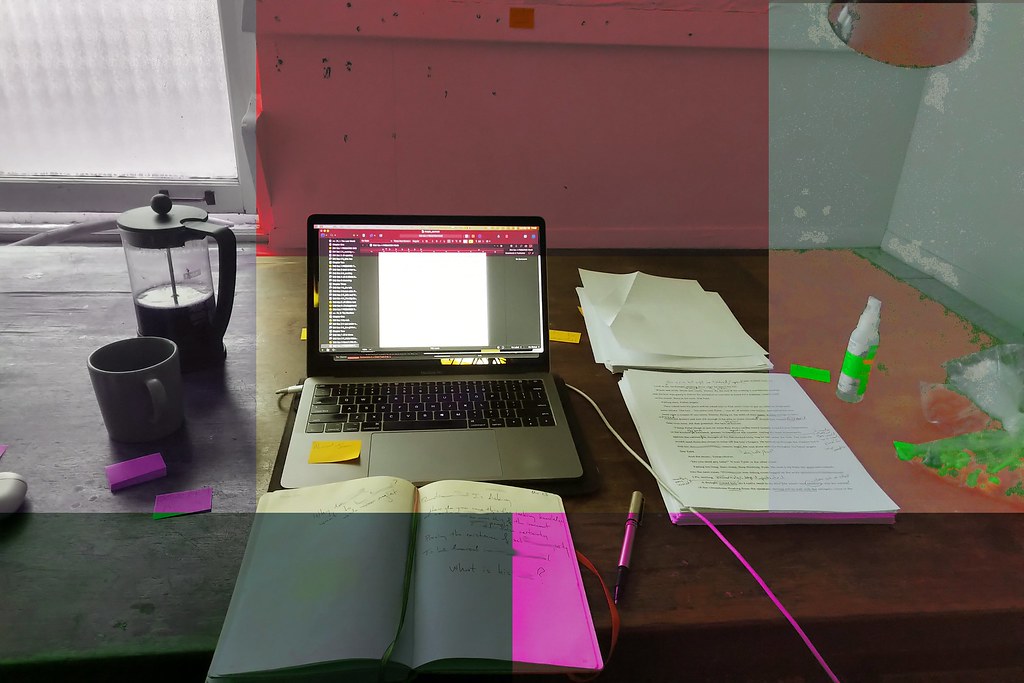
So, you hit ⌘-P and print that bastard out (preferably on recycled paper, if possible). You grab a pen and go through line by line and find all the guilty suspects — the lazy punctuation, the nebulous internalized dialogue, the parts that should sing but don’t — and you mark it up, complete with thoughts/notes/feelings for future reference.A stylistic photograph of a writing desk, with laptop, notebook, and print outs

The next step is sitting down and implementing those revision notes into the current draft on your computer. Some people might just use the marked up print out as their Bible. I go one step further and re-read from scratch, making changes on my laptop as I go *and then* check the printed copy to see if I’ve missed anything. It’s tedious as fuck (especially on on a novel FML) but it tends to balance, for lack of a better way of putting it, the zealotry that can come with revising on paper. It’s easy to sit with a print out and a pen and go revisit this and skip that. The truth is that sometimes our sentiment during that process can be impatient and ill-judged, which is why I like to re-read and see whether I decide to leave things in that have a way of justifying their existence on second glance.

When you’re revising you’re having a dialogue with yourself. It’s a little different than the dialogue you have when writing new stuff. New stuff is new. It’s sexy and glows and makes us feel good, and we’re happy when we’re able to empty it onto the page, so volume — even if it’s garbled — always feels like striking a gold mine. When we’re revising we step back and attempt to look at what we’ve written within the context of the whole project. The hardest part of revising, for me, is the trifocal quality of how we are reading the text — approaching it as the ideal reader, approaching it as the editor, approaching it as a total stranger. Does it hold our attention? Does the paragraph work within the chapter or am I just trying to shoehorn a smart-sounding insight that simply isn’t meant for this particular project.

Sometimes we don’t know. Sometimes it’s something we’ve been working on for years and we feel like we’ve lost perspective. Does it rock? Does it suck? Does it read like I’ve shoved my head up my ass? It can be difficult to tell when we’re too close. Add some insecurity to that and revising can feel interminable. This is when you take a break (I’m talking days if not weeks).

But here’s the thing: revising is where your piece finds both its soul and its feet on the ground. Greatness is made in the revision process. First drafts are necessary evils. If you are starting out and feel that your first draft is perfect, you’re likely going to need to adjust your perspective. And it’s hard, right, because it’s so easy to construe the weaknesses that an editor or reader might find in our work with the insecurities we might have with ourselves.

If writing was just that — literally just writing new material — then things would be much different. They would be worse. We wouldn’t learn what our bad habits are, we wouldn’t have that opportunity, when we feel we’ve hit a wall during revisions on a particularly hard chapter, to realize how we might alter things so that it finally works the way we originally wanted it to.

Revising is learning. And again, it is a dialogue with yourself. Be supportive. Don’t forget to mark up the stuff you like! Don’t forget to tell yourself what’s funny, or what’s particularly poignant. In many ways, revising mirrors the relationship we have with ourselves, so watch the trash talk. Accept that you are fallible. Everyone’s first draft looks like dog food. Be patient.

Just some thoughts.

(And kindly note a couple of things: I’m speaking specifically about fiction and creative non-fiction; other formats might require other approaches or appreciate different philosophies. And a golden rule: what works best for you is what’s most important.)

Share

Man Alone (Can’t Stop The Fadin’), by Tindersticks

I’m in heavy novel revision mode at the moment. In fact, as I write this I’m at Artscape Gibraltar Point. It’s day 2 for me. Only a handful of artists here, given the lockdown conditions, which, as a writer, I don’t mind at all. I’m here to work. And eat like a 12yr old.

I’m very happy to have happened onto Tindersticks awhile back. This is from their newest:

Share

Patience

In a previous post I wrote about how guitar lessons have been a gateway for me to work with patience, and I thought I would devote a little more space to that (side note: sometimes I’ll look back on blog posts and see how cramped/dense the ideas are, which reminds me a bit of how my first drafts look like when I’m sketching fiction — except it’s not exactly in the nature of blog posts to go back and revise, so I apologize if sometimes what I end up writing here is a little nebulous).

Anyways, guitar and patience. I didn’t go into guitar thinking I would be doing anything great or fancy. Not starting a band or anything. I just wanted to build a relationship with this instrument — something I couldn’t do when I played drums (due to their cumbersomeness and noise, especially if you are living with someone). Thing is, drumming came naturally to me, even though I never really sought them out. I took piano when I was a kid, and when I signed up for concert band (because why wouldn’t you find any way possible to avoid staring at a blackboard) my keyboard skills weren’t quite at the level to easily follow the sheet music that accompanied the band. And so I was thrown into percussion. I took to it quite well because I’ve always had a keen sense of rhythm. Going into high school, the percussion section expanded and there was usually drum kit available to practice on. And so I helped myself and eventually joined a rock band. We lasted about 5 years and there are, as they say, no regrets. But, as I mentioned, it wasn’t so much my dream to be a drummer, as much as it allowed me to stay close to music. My relationship with drums is arms-length let’s say.

With guitar the first thing you realize is that, unlike drums where the pressure is keeping the beat, if your calloused fingertips are off by only a couple of millimetres you are probably going to play the wrong note. In other words, the feedback loop of wrong/right is much more immediate and sensitive, reminiscent of piano (even more so, I would say, especially if you trying playing guitar with an overdrive pedal). As a highly sensitive person (not diagnosing myself but being honest nonetheless) this feedback loop can be very intense, and, if I’m in an off mood, the “wrong” feedback can get on my nerves fairly quickly, leading me to melt down a bit. And this is where patience comes in. I’ve had many instances where, either because I’m developing a new skill (say, a pull-off using my fourth, or “pinky”, finger) or increasing my speed with an advanced piece, I’ll end up having a bad day. In the beginning of learning guitar, those bad days were stormy for me; I got frustrated with myself, frustrated with my lack of finger coordination — all the things. I learned a couple of things over time (which is easier to do when you’re playing a song you like): bad days are part of learning and not an indictment of any innate ability you have to do something; and taking time off (be it an hour, a day, even a week) — although it might seem counterintuitive to those of us who read about performers spending several hours each day practicing — allows you to come back to your instrument with a fresh mind and, in my experience at least, if not better technique then easier comfort with the instrument. As a result of allowing myself to take it easy, on myself and my expectations, I’ve gotten better at being able to picture myself overcoming the inevitable short-term stumbles and seeing the bigger picture where the mistakes I’m making today are not carved in stone forever, as they sometimes feel in the moment.

I’ve been cognizant of this because when I’ve been revising my writing in the past — my fiction in particular — sometimes my notes can be brutal. In a fit of frustration I’ll write things in full caps (“DOESN’T MAKE SENSE?!”) which, while maybe capturing how I’m reacting to something that’s a rough draft, doesn’t exactly make for pleasant reading when I come back to implement the revisions to the story or book. It’s like taking on the tone of a quasi-abusive teacher or parent. It can be oppressive and can make the process of revision (which is where the magic truly happens) tedious and soul-melting whereas I know it’s supposed to be where I develop a closer relationship with the work. Note the word relationship.

If you will excuse the generalization, there are two types of people who pick up a guitar: the person who wants to learn [insert cool song], and the person who is curious about developing a relationship with the instrument. Sometimes the former turns into the latter, but rarely does it go the other way if your intent is honest. Likewise with learning to write (which, in the end, is largely learning to revise) I’ve taken some of the lessons I’ve learned with guitar and patience and applied them to how I “speak” to myself in my revision notes. Do I need a stern lecture? No, I don’t. Do I need shouty language? No, I don’t. And, now that I’m up to my knees in revisions to Radioland, I’m implementing this approach. The full-caps are gone. Instead of “CHANGE THIS” or “NO” I try to write something akin to an editor’s voice — an editor who wants the intended end-result to rise to the surface of the current draft — with something like “This is working but could use clarity.” Imagine coming to that while you’re making changes? Doesn’t that sound more reasonable (let alone approachable) than something like “WHAT ARE YOU TRYING TO SAY HERE??”

I suppose I’m putting this out there to show that there are many ways to grow as an artist — at any stage– and one of those ways is indirectly applying the lessons of one form to another. I still have bad guitar days and will continue to experience them as long as I endeavour to play, but the important thing is that I can look past those days. And because of that, I’m better able to see (and believe) that I can, as a novelist and short story author, work through the rough patches in my writing.

(P.S. Big shout-out to Michael @ Red House Music Academy)

Share

Growing Pains

So, as you might have read, my 2nd novel, RADIOLAND has been picked up by a publisher, and I’m very happy and excited about this. A lot of work went into it over a number of years and…

…and it’s a week later, and I’m reading over the manuscript (actually, “reading over” is not quite accurate, I’m squinting at it) and I’m experiencing a darkly familiar feeling as I had with the last book. With THE SOCIETY OF EXPERIENCE I was initially ecstatic to realize that it was going to be published. And then something inside tapped me on the shoulder, and I turned around to hear it say: “You realize you wrote this years ago and that it doesn’t reflect you or your interests as a writer currently?”

And as I’m squinting over the current draft of RADIOLAND and going over the editor’s notes (five pages), I am finding part of myself wishing in the same familiar way that, if time, patience and energy were no object, whether I could just rewrite it from scratch.

Now, of course I’m not going to do that. I need to honour the work that I started. However: why the hell am I thinking this in the first place?

It’s complicated, but I’m going to try and break it down anyways. First, part of it is the sheer amount of work I set up for myself, having written a fairly ambitious piece of fiction that is trying to blend a number of genres and comment on a number of things, all while attempting to maintain a sense of rhythm while keeping the reader interested in the characters and where they are going. With any level of ambition comes the requirement to follow-through with what it is you’ve promised the reader or else you may not deliver the goods and the reader might feel ripped off. We can call this the weight of expectation. Second, and perhaps something only writers or other artists might identify with is that, while it’s healthy to have time away from your work for sake of perspective, there’s a part of me screaming out but I’m not the same person/writer now as I was when I wrote this, and so, as I squint at the manuscript with an eye to revision, I’m needing to find a way to re-approach the work so that I’m respecting what it was I was not only going for as a novel, but what I was going through and ruminating on at the time that I wrote it. I honestly don’t know if other novelists experience this, but I certainly do. Third is easy to explain but hard to do. It’s called: letting go.

In any case, I look at these as growing pains, and I’m privileged to be in a situation where these are my problems.

Share

Radioland Update!

Hello all! I am extremely pleased to announce that RADIOLAND will be published in Fall 2022, with Wolsak & Wynn. It’s been a long haul with this one, and while I still have a fair amount of work ahead of me, it’s gratifying to know that not only will this book have a home, but that it will be with the same great team, including editor Paul Vermeersch, as THE SOCIETY OF EXPERIENCE.

(This wouldn’t have been possible without my agent, Kelvin Kong at K2 Literary.)

Here’s a summary of RADIOLAND (from my author site):

— RADIOLAND —

Kris is an alt-rock musician who abruptly drops out of his popular band to rake over an unprocessed trauma from his childhood; Jill is an outcast who operates in the shadows of the city, cursed with a dangerous type of magic that draws mysterious strangers to her. By chance, they start a correspondence with each other and a strange relationship begins – one that coils around their lives like a macabre spell. As they share their stories with one another, they each approach the source of their misery and risk losing themselves, even their lives, in a darkness that seems destined for them.

    Everything Jill senses tells an intense story, so she numbs herself with alcohol to keep her head clear, hoping she’ll meet someone who can tell her how she came to be the way she is. Kris struggles to maintain his grip on reality as he pulls apart the threads that make up his identity. Working through fallen mentors, splintered identities, and substance dependency, the two of them try to help each other make sense of their lives, though it may ultimately reveal one of them as a serial murderer.

Radioland explores the absurdity of fame, the toxicity of trauma, and the morbid dangers unearthed as we seek a greater understanding of ourselves.

Radioland is Matt Cahill’s second novel, and steps further into the metaphysical social realism he has employed in his short fiction as well as in his debut novel, The Society of Experience, which Harper’s Bazaar magazine picked as one of the best of fall 2015.

Share

Ambient Album Picks 2020

Here are a few ambient/experimental albums last year that I really liked:

Share