Kensington Market Essay in BlogTO

For those who don’t live in Toronto, there’s been a lot of discussion about my neighbourhood, Kensington Market, in the news. Much of it is about preservation vs development. I offered to write an op/ed for BlogTO and they published it today. I’m quite pleased that they kept the essay intact (you never know what an editor’s going to do sometimes). You can read it here.

It feels good to work on my non-fiction chops, and even better when something gets published.

Share

About Blame, Shame, and the Sacred Altar of Individual Responsibility

[This originally started out as a post on my psychotherapy blog, but became so lengthy and opinion-laced that I figured I’d put it here.]

One comment I hear, particularly in op-ed sections of newspapers, is that as a society we are becoming “soft” (ostensibly because we are beginning to encourage children to discuss their emotions throughout public school life, and not just when they get in trouble or are victimized). Within this same argument is the contention that, thanks to people like me (mental health professionals), everything that is perceived to be wrong with the individual is to be blamed on other people or institutions. Thus, the contention is that individual responsibility is somehow being sapped of its strength.

I see no need to blame anyone for anything. If a client’s parents were too strict when they were growing up, it’s enough to explore it (and its effects) until such a time as the context of those events have a present-day meaning which will allow the client to lead a healthy, durable life and move on. My interest is with the client: their health, their well-being. I have no use for encouraging, casting, or redirecting blame. That is not within the philosophy of the modality of psychotherapy that I am trained in. It is certainly not within my personal philosophy. There’s not much to be gained from vilifying people and things.

Something to note is that many forms of victimization carry with it, primarily, shame (though other feelings may follow closely, like anger). The shame of not being able to avoid the caretaker who struck you. The shame of not being able to speak out about the racial discrimination you experienced in school. The shame of being sexually preyed upon by a coworker. Shame is a very deep hole to climb out of. Just talking about shameful experiences can retraumatize some clients – that is, put them right back in the original emotional context which first scarred them.

Survivors of abuse often feel responsible for their victimization, regardless of how little agency they had at the time they were victimized. In other words, if we are to talk about blame then we should talk about victims of abuse walking around blaming themselves. One of the tasks of therapy is to move the finger of blame away and to look at what has happened to a client with clarity, without an agenda. Then and only then can the process begin of assisting the client out of that deep hole I previously mentioned; assisting by paying close attention, sharing, talking. The client does the heavy work and I’m there to help in every way I can.

I cannot think of something which better defines individual responsibility than someone recognizing that something deep down within them needs to change, and undertaking the time and effort (and pain, and, yes, in the case of working with a therapist, money) to rework their understanding of themselves, to lift themselves to a higher point of view – and all that this entails both in the therapeutic space and in the outside world.

If by “soft” critics mean weak, then the individual who helps herself is not “soft” – she is not weak. She does not blame herself as she once did. She has taken control of herself and has worked hard to build awareness, and through awareness resiliency.

Share

The Pause Button

I don’t believe our identities ever settle, to become static. This isn’t to say that they fly willy-nilly like laundry in a windstorm. There are two great wheels: the one inside of us and the one outside. Both move forward regardless of our individual philosophies.

The outside wheel is time. It is the inevitable movement of progress, the passing-on of events, linking like the teeth of a sprocket on a bicycle chain. Whether we stand still or keep moving, this wheel keeps turning.

The inside wheel is our own development: our learning, the expansion of our comprehension of things, as well as our personal growth. It also keeps moving, again, whether we stand still or move.

Development is growth, and growth is sometimes painful, especially when we suspect we have been travelling on a path which does not intuitively serve our needs any longer. The temptation can be strong to “hit the pause button”; to stop looking at how the outer wheel affects the inner wheel, the learnings contained within their interplay. I’m not sure if it would be fair to call this wilful ignorance, but some would.

I’ve known people, particularly those from school, who seem to have “hit the pause button” at some point in their late teens or early twenties: they dress the same, they obsess about the same music, they ask the same questions they asked at that age – it can seem as if they are exist in a still photo of a past universe. I speculate that they see the larger wheel, the world, turning (one cannot wilfully blind oneself from seeing this), but don’t wish to acknowledge that the inner wheel, identity/personality, still turns and evolves also.

It makes me sad, and yes I realize that is a judgement. I don’t wish to categorize people since we live in a society which already puts such an emphasis on a divisive winners/losers binary. It makes me sad because I have a relational tether to those who are in this way: I know what it’s like. It’s also quite common.

I could speculate all day about whether this is fear-induced, shame-induced, whether (from a psychoanalytically informed perspective) there is a concern about narcissistic rupture at play in this. All I know is that it exists, and that the temptation for some to “keep things the way they are”, regardless that this is kind of impossible, has a strong lure.


Share

Residue

In the end, all you have are memories.

I say this as someone who has lived in Toronto since 1995. I’ve seen many changes: the mainlining of Queen West into a retail stripmall, the slow existential irreverence of Church Street/Boystown, the awkward moral reclamation of Yonge Street by the city, the evolution (and perverse deflation) of Ossington Avenue, the current “yuppy tension” in Kensington Market. To name just a few.

One thing you learn in Toronto (and perhaps most large urban centres) is that it was always cooler before you got there. It was always more fun. There was more leniency. Less rules. This is bullshit, of course, but it makes the people who were around back then feel important.

You live somewhere long enough and, whether you expect to be in this role or not, you end up being the person who points out what used to be at certain addresses: clothing stores, book stores, record shops, dance clubs, their lovely fucked-up people, long gone (and missed).

We go through life somewhat arrogantly or narcissistically thinking it’s all being recorded – it is the modern age, after all. But it’s not. The only thing recording it is your head. Your eyes. Your nose, your brain. When it’s all been taken-over, torn-down, or burnt to the ground by corrupt real estate developers, you – yes, you and your memories – are the only record of that thing having existed.

If there is something we share, I suppose it is that we all become storytellers after a while.


Share

Moronity

One sometimes discovers that a word like “moronity” exists, not because your gifted intuition plucked it from the ether and nimbly inserted it into a witty essay, but rather because you felt compelled to use it, whether or not it existed, to describe your actions within the context of a bloody stupid mistake you made.


Share

Connectedness, Social Media, and Syntheticism

If there’s something to be said about going on a vacation – whether that means renting a car and driving two hours away from your town, or buying a plane ticket and flying six hours away from your country – it’s that it provides something crucial: distance. Physical (and, one should hope, subsequently mental) distance.

When I go away I take that idea of “distance” seriously. I don’t check Facebook, I don’t check Twitter. I don’t even check voicemail (unless it looks important). My only transgression is occasionally checking newspaper headlines to make sure that the world isn’t on the brink of collapse (which it often seems to be).

Upon returning, I find myself staring at my computer (or, more often, my BlackBerry) and wondering: what’s the point? Sure, I’ll go back to checking email, scheduling things, occasionally making sure the world isn’t on the brink of collapse, but re-entering the world of social media is another question. A daunting one, to be honest. I respect social media, yet, against its purpose, I often find it paradoxically alienating.

It started with Facebook, which began as a unique way to stay in touch with friends without relying upon email – a communal sandbox with multimedia extensions. With time (and popularity) came the inevitable mediocrity of a lot of people (along with the watering-down of “friend”-ship) without a lot of ideas posting a lot of crap that I found myself more often than not skipping. Continue reading “Connectedness, Social Media, and Syntheticism”

Share

Health & Illness

There has been a lot of work done over the last few years to bring to the foreground how mental health and well-being affects everyone, from every quadrant of society, regardless of their geography, culture, race, or class. And I say, as both an emerging mental health professional and citizen: bravo.

There is, however, something which bothers me in the midst of this accelerated (but otherwise welcome) media awareness campaign. It is the habitually casual use of the term “mental illness”, rather than “mental health”. There is more than a semantic difference between the two.

“Illness” is a medicalized notion. It correlates to somatic cause and effect: the patient’s body is sick, so the patient must take x to get better. When you have an illness, you take drugs to get better. Illness implies sickness, which implies the prescription of medicine. “Health” is a generalized notion, which may incorporate the taking of medication but certainly also encompasses needs which do not strictly apply to treatment via medication.

When we lump such disparate problems as schizophrenia, post-traumatic stress disorder, cigarette addiction, and behavioural/emotional anxiety under a catch-all phrase, that term should not imply that everything which falls under its domain be medicalized or seen as a medical problem.

If you fear that you may have a problem which is affecting the quality of your life, slapping the word “illness” on it is needlessly stigmatizing. Illness = something is wrong. And when “illness” comes after “mental”, it can then seem to someone that they are wrong or somehow broken. In other words, the constant use of “mental illness” as a generalized term for discussion actually perpetuates a needless (and ironic) branding upon those who are affected.

Quite frankly, to use “mental health” is to say that someone who feels that something is affecting the quality of their life is not ill. They may not feel well, but they still have agency. It’s well-documented that what may appear to some as “symptoms” of behavioural or emotional disorders are in actuality subconscious attempts by the person affected to become healthy. We can facilitate this quite easily by not stigmatizing the language around mental health with terms that needlessly cast an onerous light on the problem.

Share

Ask The Zombies in July, or, How Are The Dutch Going To Do at Euro 2012?

In less than two weeks, various qualifying teams from throughout Europe are going to get together in Poland and Ukraine for Euro 2012. It’s like the World Cup, but without most of the World. Still, some of soccer’s (which I will call football going forward) greatest stars will be competing for glory.

Now, about the Dutch. Yes, the country is called (provoking visions of clouds and grey veils) the Netherlands or, more quaintly (insert visions of tulips and blonde farm wives in wooden shoes), Holland. But, whether you are a fan or an opponent, they are often referred to as “the Dutch”.


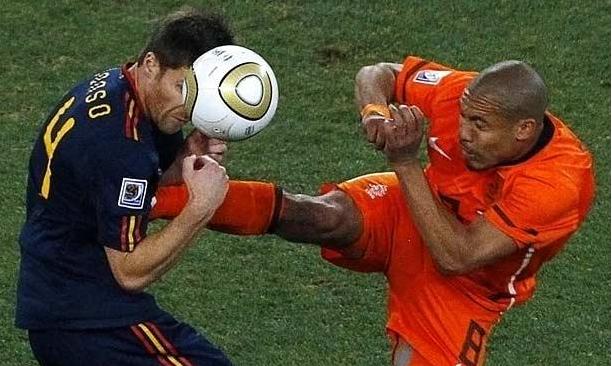
The Dutch met Spain in the World Cup finals in 2010. It should have been the seminal moment of my football-loving/Dutch-cheering life, but (see here for more) I was turned-off by their strategy, which – with the exception of some honest-to-God deserved victories against mortal foes such as Brazil – seemed kind of cynical.

There’s winning and then there’s winning. The Dutch, since the early 70s, have always emphasized beautiful football: flowing, sexy, unpredictable, and effective. Unfortunately, since World Cup 98, that effectiveness came into question as a combination of generational talent turnover (Ruud van Nistelrooy was not exactly Dennis Bergkamp) and some daft coaching decisions (chief in my mind, Louis van Gaal’s decision to squander a two-goal lead against Portugal in the WC 2002 qualifiers) created an existential crisis. Beautiful football wasn’t getting results.

Continue reading “Ask The Zombies in July, or, How Are The Dutch Going To Do at Euro 2012?”

Share

Narratives & Messages

We live in an atmosphere concentrated with media: we are drenched so deep that we don’t often realize how integral it has become in our lives. In my fiction, which can be speculative and sometimes nodding to “the future”, I don’t mention this much. I was wondering if, by not speaking to this (awesome/scary) fact of life, I was missing out on saying something substantial about our lives; then again, a writer with the intent to say “something substantial about our lives” is often asking for more than they can deliver to begin with. Perhaps I intentionally avoid the subject. Perhaps I want, fictionally, to portray a world where the reader can escape our media fishbowl, not content to stare into our monitors and smartphones – into any one of the many shining screens around us. *

 (*This is not to say that, as someone who writes stories to be read, I am exempt from any of what I go on to describe.)

As Madge the manicurist in the Palmolive commercials used to say: “You’re soaking in it.” And we are.

My concern, as far as this post goes, is not the number of screens surrounding us, nor is it the gross subsidization of our environment by advertising (vis à vis self-interested parties). Content is king, after all. And, unlike ads and the proliferation of screens, I feel we don’t look at content very closely.

We are essentially surrounded by narratives.

Continue reading “Narratives & Messages”

Share

On Self-Censorship As A Canadian Preoccupation

There are always going to be thin-skinned readers, but writers who self-censor for fear of offending said readers suck more. #canada

This was going to be a missive sent over Twitter. Then I thought, what if someone replies to me, calling me out? What if someone says:

@m_cahill Care to name names, or are you AFRAID OF OFFENDING SOMEONE? #jerk

Allow me to elaborate (and do it in an environment I can totally control without distorting my message due to a 140-character limit).

Two articles in the last week were sources of outrage among certain parts of the online world, particularly on Twitter, where it’s particularly easy to express outrage*. The first was Ian Brown’s essay on men gazing at women in the Globe & Mail. It elicited a lot of criticism, from feminists who were offended by the objectification of women to people who simply construed Brown’s perspective as creepy in a Lolita sorta way.

My partner and I began talking about some of the anger we saw in our respective Internet social circles. I felt a lot of it was overblown. Predictable, actually (sadly). And yet I agreed with Ingrid, who reminded me that there is something to be said about “the gaze” which women historically have been on the other end of. In other words, it was a complex issue. All said, something I found admirable in Brown’s piece (and his writing in general**) was his forthrightness. Unlike so many writers there was no effort made to allay the concerns of the entire reading public that he wasn’t trying to offend anyone.

Continue reading “On Self-Censorship As A Canadian Preoccupation”

Share