Residue

In the end, all you have are memories.

I say this as someone who has lived in Toronto since 1995. I’ve seen many changes: the mainlining of Queen West into a retail stripmall, the slow existential irreverence of Church Street/Boystown, the awkward moral reclamation of Yonge Street by the city, the evolution (and perverse deflation) of Ossington Avenue, the current “yuppy tension” in Kensington Market. To name just a few.

One thing you learn in Toronto (and perhaps most large urban centres) is that it was always cooler before you got there. It was always more fun. There was more leniency. Less rules. This is bullshit, of course, but it makes the people who were around back then feel important.

You live somewhere long enough and, whether you expect to be in this role or not, you end up being the person who points out what used to be at certain addresses: clothing stores, book stores, record shops, dance clubs, their lovely fucked-up people, long gone (and missed).

We go through life somewhat arrogantly or narcissistically thinking it’s all being recorded – it is the modern age, after all. But it’s not. The only thing recording it is your head. Your eyes. Your nose, your brain. When it’s all been taken-over, torn-down, or burnt to the ground by corrupt real estate developers, you – yes, you and your memories – are the only record of that thing having existed.

If there is something we share, I suppose it is that we all become storytellers after a while.


Share

Connectedness, Social Media, and Syntheticism

If there’s something to be said about going on a vacation – whether that means renting a car and driving two hours away from your town, or buying a plane ticket and flying six hours away from your country – it’s that it provides something crucial: distance. Physical (and, one should hope, subsequently mental) distance.

When I go away I take that idea of “distance” seriously. I don’t check Facebook, I don’t check Twitter. I don’t even check voicemail (unless it looks important). My only transgression is occasionally checking newspaper headlines to make sure that the world isn’t on the brink of collapse (which it often seems to be).

Upon returning, I find myself staring at my computer (or, more often, my BlackBerry) and wondering: what’s the point? Sure, I’ll go back to checking email, scheduling things, occasionally making sure the world isn’t on the brink of collapse, but re-entering the world of social media is another question. A daunting one, to be honest. I respect social media, yet, against its purpose, I often find it paradoxically alienating.

It started with Facebook, which began as a unique way to stay in touch with friends without relying upon email – a communal sandbox with multimedia extensions. With time (and popularity) came the inevitable mediocrity of a lot of people (along with the watering-down of “friend”-ship) without a lot of ideas posting a lot of crap that I found myself more often than not skipping. Continue reading “Connectedness, Social Media, and Syntheticism”

Share

Narratives & Messages

We live in an atmosphere concentrated with media: we are drenched so deep that we don’t often realize how integral it has become in our lives. In my fiction, which can be speculative and sometimes nodding to “the future”, I don’t mention this much. I was wondering if, by not speaking to this (awesome/scary) fact of life, I was missing out on saying something substantial about our lives; then again, a writer with the intent to say “something substantial about our lives” is often asking for more than they can deliver to begin with. Perhaps I intentionally avoid the subject. Perhaps I want, fictionally, to portray a world where the reader can escape our media fishbowl, not content to stare into our monitors and smartphones – into any one of the many shining screens around us. *

 (*This is not to say that, as someone who writes stories to be read, I am exempt from any of what I go on to describe.)

As Madge the manicurist in the Palmolive commercials used to say: “You’re soaking in it.” And we are.

My concern, as far as this post goes, is not the number of screens surrounding us, nor is it the gross subsidization of our environment by advertising (vis à vis self-interested parties). Content is king, after all. And, unlike ads and the proliferation of screens, I feel we don’t look at content very closely.

We are essentially surrounded by narratives.

Continue reading “Narratives & Messages”

Share

On Self-Censorship As A Canadian Preoccupation

There are always going to be thin-skinned readers, but writers who self-censor for fear of offending said readers suck more. #canada

This was going to be a missive sent over Twitter. Then I thought, what if someone replies to me, calling me out? What if someone says:

@m_cahill Care to name names, or are you AFRAID OF OFFENDING SOMEONE? #jerk

Allow me to elaborate (and do it in an environment I can totally control without distorting my message due to a 140-character limit).

Two articles in the last week were sources of outrage among certain parts of the online world, particularly on Twitter, where it’s particularly easy to express outrage*. The first was Ian Brown’s essay on men gazing at women in the Globe & Mail. It elicited a lot of criticism, from feminists who were offended by the objectification of women to people who simply construed Brown’s perspective as creepy in a Lolita sorta way.

My partner and I began talking about some of the anger we saw in our respective Internet social circles. I felt a lot of it was overblown. Predictable, actually (sadly). And yet I agreed with Ingrid, who reminded me that there is something to be said about “the gaze” which women historically have been on the other end of. In other words, it was a complex issue. All said, something I found admirable in Brown’s piece (and his writing in general**) was his forthrightness. Unlike so many writers there was no effort made to allay the concerns of the entire reading public that he wasn’t trying to offend anyone.

Continue reading “On Self-Censorship As A Canadian Preoccupation”

Share

The Dread of Zombies

Everyone is waiting for the zombie genre (in books, television, and particularly film) to whither away like a desiccated corpse. I argue that it’s here to stay – that, in fact, it has stronger legs (ugh) than most other genres of the macabre.

The dread of zombies imagined – the tiredness some of us feel with each iteration (Pride and Prejudice and Zombies, The Walking Dead, Zombieland) – is understandable. Less understandable than with vampires, but understandable still. There are too many zombie and zombie-like (for the record, 28 Weeks Later is not, strictly-speaking, a zombie film, yet it more or less qualifies itself by virtue of many shared) themes in books, shows, and movies these days. But I would argue that it’s because – due to our increased connectedness to each other via the Internet and social media – we are exposed to real life zombies. Thematic zombies. Metaphorical zombies. And the exposure stands to increase.

A shitload of people voted for a complete ass to be the mayor of Toronto. A shit. Load. Mind you, not many who lived downtown did. Still, it was a rout. People like me – people who prize intelligent discourse over pot shots, people who would prefer to be ruled by someone with an informed conscience rather than a bullet-list of to-dos – were incredulous. It didn’t even matter what quadrant of the political spectrum Rob Ford occupied: he was the last person any reasonably well-informed person would have wanted. And yet he won in spades.

Thematic zombies. Metaphorical zombies. The dread of zombies.

Who voted for him? Who can say that they “understand” him? Are they too not also zombies by virtue of his succession to the throne of city council? Faceless, nameless, godless, conscience-less hordes hefted Mr. Ford to office, and we stand here still – a year later – asking ourselves just what the hell happened, watching the circus of political buffoonery before our eyes.

Lest this become a solely personal treatise, isn’t this the same for everyone? Aren’t we witnessing “zombie activity” in other guises: large groups of seemingly nameless, faceless, godless, conscience-less hordes blindly enabling things we fundamentally disagree with but are powerless to dispell? For me it’s the rise of Rob Ford, for others it could be the Occupy movement. For others still, it could be the revolution in Tahrir Square. The massive, faceless but powerful other. The faceless, godless, conscience-less hordes…with agency.

Thematic zombies. Metaphorical zombies. The dread of zombies.

No, it is not going away. Make popcorn.
Share

Brief Reviews: Incendies

For someone like myself, who makes his living working in film, it would seem perilous to declare a “favourite” Canadian filmmaker. However, it’s a no-brainer that one of them is Denis Villeneuve. Ever since I saw his Genie award-winning Maelstrom, I knew I was watching someone who was not burdened by the shackles of mediocrity so commonly on display in the end-product of so many emerging or established Canadian filmmakers.
Incendies, nominated for Best Foreign Language Film at the 2011 Academy Awards, is devastatingly good. It tells the story of fraternal twins who, while coping with the death of their mother, are handed two envelopes by the estate lawyer. One is to give to their father, whom they presume is either dead or estranged. The other is to give to their brother, whom they’ve never known existed. Neither know what any of this means and what follows is a side-winding story that is equal parts tragic and breath-taking.

Based on a play by Wajdi Mouawad, the film spends most of its time in a Middle Eastern country that is never identified for the audience. It’s a curious technique which may frustrate some, and yet it was refreshing for a film to sidestep our cultural preconceptions or prejudicial baggage by focusing strictly on the unfolding of its complex tale and its toll on the characters, past and present. At the core of Incendies is the devastating journey of the twins’ mother, played by Lubna Azabal, told in flashbacks.

There are moments of heightened violence in this film. Moments where you say to yourself: no, no, no – please don’t show us what I think you are about to show us. And yet, to Villeneuve’s credit – something I noticed in Maelstrom – he is one of a short list of directors capable of portraying material which may be extremely unsettling in ways which are neither insensitive to the audience nor disrespectful to the spirit of the story. Yet, the weight of what is ultimately revealed in the circuitous route of the twins will certainly haunt the audience long after the film is done.

Share

Brief Reviews: Certified Copy

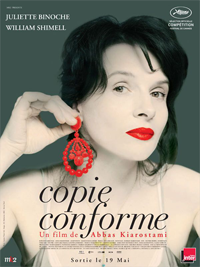
Certified Copy is certainly in the running for one of the best films I have seen in 2011. You would not guess this by looking at the poster or the anonymity of its title. Two things do stand out to me immediately: actor Juliette Binoche and director Abbas Kiarostami. Binoche is one of the greatest of her generation, able to transform herself at will. Kiarostami is not a household name but is nonetheless a master of intimate cinematic storytelling (A Taste of Cherry). Certified Copy is about an English writer (William Shimell) and a French art dealer (Binoche) who spend the day in Tuscany together. He is there on a book tour, and she is there ostensibly as his handler.

What transpires requires some delicacy in explaining. While having coffee in a small village, a presumption is made about them by a local: that they are a married couple. The presumption and all that follows lies at the heart of what is a masterful piece of work by Kiarostami. Cutting is kept to a minimum, but that’s fine because often the actors are staring right at us (rather than each other), and what actors: Binoche displays such a range of emotion and depth of feeling in her role as the conflicted half of the presumed couple, and Shimell – an opera singer in real life (believe it or not, this is his first film) – is hypnotic as the edgily self-consumed, emotionally opaque other half.

I am tempted to compare this film in some respects, stylistically at least, to Michael Haneke (Funny Games, Caché), with whom Binoche has collaborated many times. And yet, Certified Copy lacks the brutality, the near-misanthropy of Haneke. Which is not to say that you won’t be kept on the edge of your seat wondering just what is going on between the two leads, and within them. A must-see for anyone looking for depth in their drama.

Share

Chaos Cinema

I posted this for my Humber College students on their blog. I posted this on Facebook and Twitter. As such, I should probably post it here.

If you are a film lover who feels increasingly unable to understand or orientate yourself watching action movies made in the last decade, I implore you to watch this video essay about what the author calls chaos cinema.

Bad Boys 2It describes quite succinctly what has frustrated me as a film viewer: action sequences (or entire films) are becoming little more than jagged-edged stimulation devices and not the shared experiences that they should be (see: chase scene in Batman: The Dark Knight)

Essential viewing.

Share