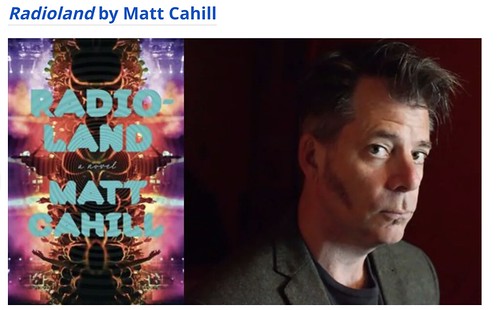
September Update

Regular visitors have probably been frustrated with the lack of updates here. So have I. The truth is that I’ve been swamped with doing the finishing touches on Radioland…and taking care of an ailing parent. I cannot express how exhausting the last while has been, on so many personal levels.

The good news is that, as of Friday, I signed-off on the last of the changes to the manuscript. It is, for all intents and purposes, out of my hands…which is both satisfying and frightening.

I finally have had time to update my website as well as post an update here (and add Radioland to the sidebar links). My next task is to gird myself for publicity, which I’m both excited for…and intimidated af. If there’s one thing I need to work on it’s getting out of my Writer Head and speaking about the book so that someone who isn’t in my head can understand what it’s actually about, which would be easier if I hadn’t written a fairly complex novel. There are worse problems.

Also…

(CBC Books 2022 fall fiction picks)

I should mention that Radioland was picked as one of CBC Books fall fiction titles!

Anyhoo, I hope to be here more regularly.

Share

Radioland: Cover Reveal and Pre-Order!

Hello all,

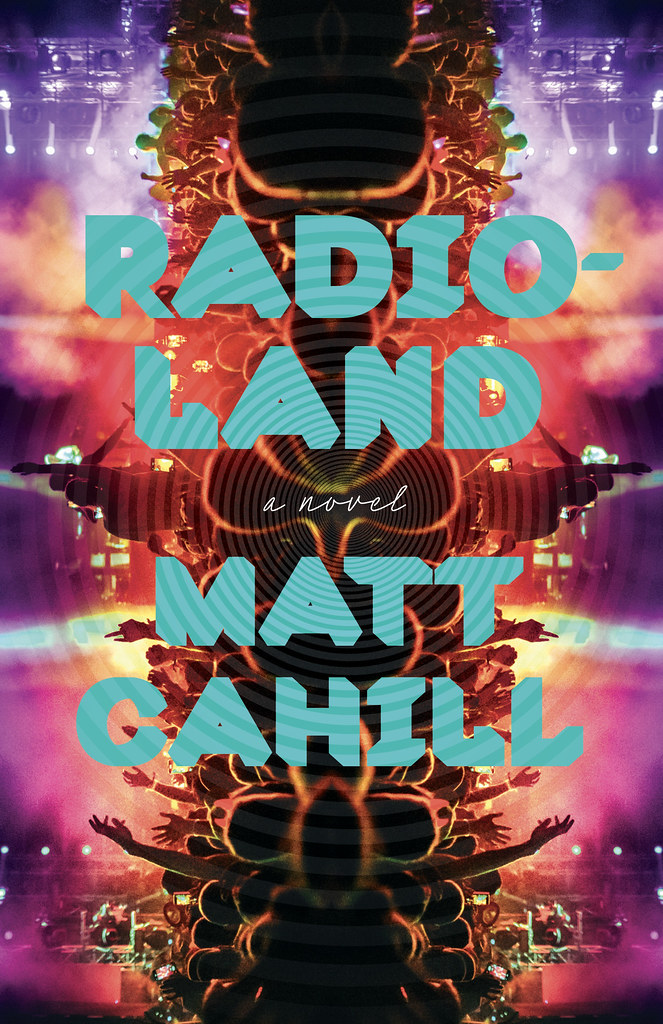
It’s been a time-and-a-half to get to this point, so it’s with a mixture of relief and exhaustion that I’m able to share the cover for my next novel, Radioland.

book cover for Radioland, my next novel

Nice, eh? The cover is by designer extraordinaire Ingrid Paulson.

This book has taken a lot work, and I can’t wait for you all to read it. Here’s another thing: it’s now available for pre-order, which means that you can order it now, and when it’s released (currently looking like October) it will get shipped to you ASAP then. Presales are also cool b/c they can build interest from stores, retailers, etc, so there’s that too. I trust you to do the right thing.

You can read more about Radioland on the publisher’s site (where you can also pre-order it): Wolsak & Wynn

You can also bug your local independent bookstore or local library to order it for you.

You can also pre-order it from these folks, too:

Amazon

Chapters/Indigo

Barnes & Noble

Share

Something to read (February 2022 edition)

I’ve been thinking a lot about this piece by Mitch Therieau for the Chicago Review, called “Getting Personal”. It’s essentially a state-of-the-nation on the personal-critical essay, surveying where we’ve come since the latter part of the 20th century (starting with New Journalism) and bringing the reader to what might be termed “personal criticism”. Therieau’s piece defies easy summation (as you will see below), which is sort of the point, in a meta (though not conceited) way. Is there a crisis in the personal-critical essay? Yes, but it has less to do with the dominant style, which is ultimately downstream from the demands of the marketplace.

Along the way, Therieau makes use of indirect references to psychoanalysis, Marxism (neither of those in an overbearing way), feminist theory, as well as an overarching attempt to define where we’re at, which, to clumsily summarize, seems to be (here we go…) a pyretic hammering away with personal anecdote as a mimetic tool that risks exploiting the writer even though we know full-well that personal experience can only truly be secondary (and thus filtered) but what the hell let’s go out with a blaze of glory.

Anyways, it’s very good.

Share

Writing Life Update, Late-November Edition

I’ve been putting some of the final touches on Radioland, and while I’m still convinced it’s going to be one of those books that is ultimately ripped out of my hands by my publisher, I’m happy with how this second round of revisions is coming along. Part of me just wants to walk away from it. It’s been five years, and that is a long time to work on something that is as dark and introspective as Radioland is. I’m confident that I’ve pulled it off, but there’s another part of me that wants to make sure that every. single. section. works. Ugh.

Book Three is looking to be sent out to publishers in early 2022, and at that point I will publicly reveal the title, and spill a little bit about what it’s about. Keeping the title and details secret is just a bit of prudence on my part; I think it’s natural for any writer to want to protect their works-in-progress from the possibility of someone else riffing on their material before it’s released, and I realize that this is probably a little bit of paranoia on my part.

And there’s a Book Four, folks. Yes. I’ve barely sketched it out, but I can tell you that it has good bones. I look forward to falling into its hole come December.

Share

Writing Adv*ce: Constraints

Someone who is new-ish to writing is liable to want to have every option open to them when it comes to writing — this applies equally to fiction, creative non-fiction, and poetry. Get out of my way, this writer says to themselves as they roll up their sleeves, and just let me get to it. And there’s nothing inherently wrong with this ethos (most writing advice tbh is Janus-faced, in that the opposite could equally be true depending upon the context of the individual in question); writing can be (and often is) liberating.

But here’s the thing (because why else would I be writing this in my spare time if there wasn’t a point): sometimes having all the options open to you will have the opposite effect of liberty — it can incongruously create its own roadblock by virtue of being, well, too open-ended. If there are no boundaries it can often feel as if we are tasked with filling an abyss which might lead to a sense of paralysis. Do I write about this? Wait…what about that? The question of what you write about (or the angle you choose to write about it from) can be intimidating if there are no rules, no guardrails, no ceiling and no floor.

When I took part in a week-long writing intensive many years ago, which incorporated fiction and poetry writing, the end goal was for each of us to write a sestina. What’s that? It’s a form of poetry that carries with it very specific rules for how it is to be constructed and it is a massive. pain. in the. ass. Without exception, every person in my group — poet, non-poet, or (like me) something in-between — saw each day that approached the assignment deadline with a sense of dread. The sentiment could be summed as: this is bullshit. As in, this is bullshit, I should be free to write whatever and however I want. What is more freeing than Art, after all!? And yet, when I sat my ass down and began to work out how I would construct my sestina, which I admit was painful, I was also struck by how the constraint of the sestina form forced me to be very specific and focused on what it was that I was doing. Lo and behold, I ended up writing something I never thought I would’ve pulled off — and managed to impress the instructor in the process. It was an inspirational step forward to me, not just as an artist but as someone who reflects on the hows and whys of human behaviour.

A few weeks ago, a documentary was released on the band The Velvet Underground. Its director, Todd Haynes, an artist in his own right, set his own constraints on the project. Rather than having a bunch of present-day intellectuals and music nobility reflecting on the influence of the Velvets (ie how many music documentaries are constructed) he insisted on maintaining temporal and situational context in his choice of subject by only presenting people who were there at the time and place that the events unfold. For example, when the Velvets set out on an ill-fated tour of California he doesn’t interview anyone who was not part of that tour. No Warhol. No Jonathan Richman. Just whatever archival footage was available and/or surviving members of the band and entourage to speak to their experience. It makes for a fascinating and immediate way of telling the story without it being a nostalgic love-in or overly biased hagiography. You should see it.

What are other ways in which we might use constraints to help us focus? How about a police procedural with no police? A mystery told from the sole vantage point of a security camera? A poem expressing your current feelings but using excerpts/fragments from your teenage journals?

Constraints can guide and inform an artist’s work. Note I say can. Sometimes it’s good to go-for-broke and blow the doors off whatever it is you want to get off your chest without care for form. But whatever you do don’t forget that form itself can allow you, if counter-intuitively, to transcend your inner biases and intellectual confines.

Share

Writing Adv*ce: Changing Things Up

Well over two months without a writing project to put my mind to, and I’m still alive and functioning, if sometimes feeling purposeless. I find myself asking what “normal” is after all. Last year, with all my writing haunts closed because of lockdowns, I was stuck writing from home, a 750 square ft shared condo w/ a terrace. I slapped on a pair of over-the-ear headphones, put my head down and pushed myself to lay at least 1,000 words down per weekend, which, given I had nowhere to go, ended up being a successful, if arbitrarily chosen, formula (prior to this, my formula was a little more haphazard: go out, sit somewhere and fucking write for a least two hours — no emphasis on word count or quantitative stuff. I have thoughts on this I’ll share later). By November of 2020 I had the the first draft of Book Three. It felt like I’d gone to a Writer’s Gym, if such a thing existed, and getting so much done in such a comparatively short period of time had a lot of implications on how I saw and approached my craft. In short, it became less magical / alchemical and more about persistence / stamina. I should qualify “magic / alchemical” as to be a figurative way of saying “having the elements and inspiration of your project more or less come to you through a more slacker-friendly means; organic but not undisciplined.”

In 2020 I found that less (choice in where I wrote) begat more (output, inspiration-by-diktat), and I’m happy to have some time to reflect on this now. When I’m lucky enough to be able to afford a week at a writing retreat it’s different — those times are purpose-built, so of course I’m going to be productive (and also I tend to use retreats for revising rather than creating raw material, though that inevitably happens in the process). The question is going to be how I approach writing now that my old haunts are opening up again, or at least the ones that haven’t shut down.

I’m careful to note that epiphanies generated under extraordinary circumstances sometimes only make sense under extraordinary circumstances. I know I can deliver the goods — quantitatively and qualitatively — in a single sitting whereas before I would’ve felt chuffed if I’d been able to do both. Speaking of being careful, I also want to remind myself that I didn’t have a life for over a year, on top of a full-time day job that became exacerbated by my own anxiety and the collective anxiety of clients and everyone around me. I’m not, in other words, championing or abandoning any particular approach, only noting what is possible under certain circumstances, some of which may be more doable and/or replicable than others. Let’s not forget there are also half-ways and acceptable compromises in any art form. I’m happy with what I was able to accomplish with Book Three, but I fear a top-down, capitalist you-should-obviously-write-a-book-a-year bullshit coming into my life. I’m not privately wealthy. I’m not a trust fund kid. I got bills. I need to think about what my life is going to look like in a decade, given that I have no pension, that I’m self-employed, and that any notion of being a Full-Time Author is more than a little naive.

I’m lucky and grateful for the opportunities I’ve been able to take advantage of, but making writing its own career is a bit of a pipe dream when you’re 50. That’s reality.

Share

Story: Wesley Evonshire

Today I have a new short story in the world, which I’m very happy to announce is now available in Fusion Fragment issue #7 (a seriously well-done anthology). This leans more heavily toward speculative fiction (in this case, horror and sci-fi), Wesley Evonshire was one of four stories I began working on a few years ago when I was taking a break from revisions to my upcoming novel, Radioland. They each share a link involving something that fell to earth which has a deleterious effect on those who come across its remnants.

I’m grateful to have any works published, but I’m distinctly happy with this one, not only because I’m proud of it, but that it was also used as inspiration for the cover art of the issue. It is available both as a digital download and hardcopy (my contributor’s copy is pictured below). Other contributors include Tiffany Morris, C.J. Lavigne, and Calgary’s own Heather Clitheroe.

Your patronage is much appreciated (also, the digital version is basically free, so now you have no excuse).

Share

Gap

I handed off the first substantive pass of Radioland a few weeks back to my editor and, lo and behold, two weekends ago found myself without a novel to work on, which was the first time (I’m not counting vacations, etc, obviously) I’ve not had a novel to work on in years. It was and is such a weird feeling.

I’ve been working on Radioland since about 2016, and last year, when it was being circulated to publishers, I was working on Book Three, which is currently simmering in a figurative pot as I wait to see if I can get any C/O/T Arts Council grants to be able to afford an editor for a substantive reading of it. I’ve never gotten a grant in my life, which is not to say that my previous applications have been sterling or anything — it’s just that I’m not hopeful. Windfalls are for other people, or so I tell myself. And yet it’s silly if I don’t try.

I’m not going to get notes from the editor on Radioland until August, and I’m trying not to reflexively fill in the intervening time with — surprise! — another writing project (though I wouldn’t put it past me). I’d like to give myself time to reflect.

I don’t like the literary world. I don’t feel I fit in, which is saying something considering writers are interloping creatures to begin with. There’s a lot of smarm, a lot of performative politics, a lot of preciousness, a lot of passive aggressive bullshit, and a lot of public ass-kissing. I don’t want to get caught up in any of it. I don’t want its insecure “loving” hypocrites, or its logrolling. All of this obscures the highlights: the truly deserving people (writers, publishers, editors, publicists, agents, reviewers, and readers) whose passion and support for others are unwavering.

I just want to write and find (let alone build) an audience. And I worry the day will come when I have to choose between belonging to the literary community (and potentially worsening my eyesight because of constant eye-rolling) or just walking away. Or I can just get off Twitter — ha.

I also want to think hard about the future projects I need to get off my chest, versus the ones that are “nice to have”. I’m over 50, and while my ability to churn out work is better than ever, I can see how it’s possible to have resentment build for projects I commit to that end up eating my weekends and spare moments. I suppose to some extent I don’t know what I want the next 50 years to look like. I know what I don’t want it to look like, let’s put it that way. Among other things, I don’t want to feel (or be made to feel) like I’m competing with people in their 20s, like in some fucked up Logan’s Run reboot, nor do I wish to see the landscape scooped by a literary version of Spotify, where we are asked to write faster for our rewards.

It’s been a long year.

Share

Writing Adv*ce: Revising

Revising is one of the most important aspects of writing. It’s also the most unsexy, and the hardest to explain (and by explain I mean “gain sympathy”).

You have your first draft done. Could be your second. Could be your fifth. Every project is different, every format is different, every writer is different. No one’s judging here. The thing is, you know it’s missing stuff, or, the stuff that’s there that isn’t missing is maybe not as well communicated as could be. Or it’s out of order. Or confusing.

So, you hit ⌘-P and print that bastard out (preferably on recycled paper, if possible). You grab a pen and go through line by line and find all the guilty suspects — the lazy punctuation, the nebulous internalized dialogue, the parts that should sing but don’t — and you mark it up, complete with thoughts/notes/feelings for future reference.A stylistic photograph of a writing desk, with laptop, notebook, and print outs

The next step is sitting down and implementing those revision notes into the current draft on your computer. Some people might just use the marked up print out as their Bible. I go one step further and re-read from scratch, making changes on my laptop as I go *and then* check the printed copy to see if I’ve missed anything. It’s tedious as fuck (especially on on a novel FML) but it tends to balance, for lack of a better way of putting it, the zealotry that can come with revising on paper. It’s easy to sit with a print out and a pen and go revisit this and skip that. The truth is that sometimes our sentiment during that process can be impatient and ill-judged, which is why I like to re-read and see whether I decide to leave things in that have a way of justifying their existence on second glance.

When you’re revising you’re having a dialogue with yourself. It’s a little different than the dialogue you have when writing new stuff. New stuff is new. It’s sexy and glows and makes us feel good, and we’re happy when we’re able to empty it onto the page, so volume — even if it’s garbled — always feels like striking a gold mine. When we’re revising we step back and attempt to look at what we’ve written within the context of the whole project. The hardest part of revising, for me, is the trifocal quality of how we are reading the text — approaching it as the ideal reader, approaching it as the editor, approaching it as a total stranger. Does it hold our attention? Does the paragraph work within the chapter or am I just trying to shoehorn a smart-sounding insight that simply isn’t meant for this particular project.

Sometimes we don’t know. Sometimes it’s something we’ve been working on for years and we feel like we’ve lost perspective. Does it rock? Does it suck? Does it read like I’ve shoved my head up my ass? It can be difficult to tell when we’re too close. Add some insecurity to that and revising can feel interminable. This is when you take a break (I’m talking days if not weeks).

But here’s the thing: revising is where your piece finds both its soul and its feet on the ground. Greatness is made in the revision process. First drafts are necessary evils. If you are starting out and feel that your first draft is perfect, you’re likely going to need to adjust your perspective. And it’s hard, right, because it’s so easy to construe the weaknesses that an editor or reader might find in our work with the insecurities we might have with ourselves.

If writing was just that — literally just writing new material — then things would be much different. They would be worse. We wouldn’t learn what our bad habits are, we wouldn’t have that opportunity, when we feel we’ve hit a wall during revisions on a particularly hard chapter, to realize how we might alter things so that it finally works the way we originally wanted it to.

Revising is learning. And again, it is a dialogue with yourself. Be supportive. Don’t forget to mark up the stuff you like! Don’t forget to tell yourself what’s funny, or what’s particularly poignant. In many ways, revising mirrors the relationship we have with ourselves, so watch the trash talk. Accept that you are fallible. Everyone’s first draft looks like dog food. Be patient.

Just some thoughts.

(And kindly note a couple of things: I’m speaking specifically about fiction and creative non-fiction; other formats might require other approaches or appreciate different philosophies. And a golden rule: what works best for you is what’s most important.)

Share