September

September is a strange month. As a therapist, I associate it with a predictable increase in new and former clients reaching out for support. Why is that? A bunch of things, depending upon the situation of the individual, but to name just a few reasons: end of summer, beginning of school, vacation(s) in the rearview mirror, THE END OF THE YEAR IS COMING (if I were the months of October and November I would file a complaint), shorter days (and, subsequently, daylight). What’s that, your pulse is racing just reading this? I’m not surprised.

I find September to be a significant time for reflection, whether or not I’m looking for it, and this year is no different for yours truly.

As an author, it’s hard not to think about the progress on Book Three. I’ve just received some substantial feedback and I find myself wanting to balance between (putting on overalls) OKAY LET’S GET TO WORK!… and taking a little bit of time to stand further back from the book (if possible), so that I’m not simply following through on what I’ve already created, but asking myself essential questions about structure, story, themes.

Writing a book (or short story), one can sometimes fixate a little too much on what the original idea was — that thing which struck your passion and allowed you to sit your ass down and start the project in the first place — and in doing so run the risk of missing how the larger form might change to convenience the parts which require changing within it. It’s like getting the inspiration for a mansion on a hill only to discover, the more you think about what it is you’re aiming for that, actually, a bungalow near a pond is actually a closer realization of your original idea. This can especially happen if you’ve put in a shitload of work already. Your insecurities begin to howl, and suddenly the idea of changing direction is giving you heart palpitations. No! No! I have to finish it soon, I want to move on to the next project! I don’t want to work on this forever! As with psychotherapy, there are no easy answers in this profession, and much of the time it boils down to “it depends.”

Welcome to September.

Share

Radioland, a Nine-Month Retrospective

As of August 2nd, it will have been nine months since the official launch of my second novel, Radioland. I wanted to reflect, if non-linearly, on how things have gone. And yeah, I get that “nine months” is a fairly loaded measurement of time. Fact is, I could’ve written this months ago, but time is my enemy.

a copy of Radioland on my home work desk
  1. I will always (and I mean that literally) be thankful for the opportunity to have my work published, especially in novel form. The format takes a lot of time and energy. Time from my life. Energy from my life. Not only am I thankful that those sacrifices were not in vain, but that my publisher (and acquiring editor) took this particular book on. Call it what you will or want — psychological thriller (a descriptor my publisher chose that I’m sometimes uncomfortable with), weird fiction, urban fantasy, or simply “literary fiction” — this isn’t an airport book (ie easy to read, not exactly challenging or demanding on the reader).

2. Unlike my experiences with the publication of The Society of Experience, which went so smoothly that I stand in awe of it, with Radioland every step of the way was difficult. Not only was I tasked with promoting a complex, multi-threaded tale in the sort of limelight I didn’t have for The Society of Experience, the more I tried to summarize it into an elevator pitch for radio and podcast interviews, the less I believed it (or felt I was doing the book justice). From an investment standpoint, my publisher choosing psychological thriller makes sense in that it at least gives the potential reader a rough idea of what’s inside. It’s certainly better than literary fiction which can mean anything to those who don’t discern or care whether they’re reading Jo Nesbø or Eudora Welty. As thankful as I was for the opportunities, it still felt as if I was peddling some vague literary fiction, especially given that the vast majority of those I spoke with didn’t have time to read the fucking book (this, I understand, is par for the course), leaving me to build a scaffolding of sense about it while they prod me with the same goddamn questions gleaned from our PR person’s one sheet (“So, this is a psychological thriller. Could you tell us about that?” “What’s it like writing about Toronto?”). I would’ve killed for someone to have asked about its darkness, its weirdness, its splitting the world into the real and unreal and how both of those worlds are in internal conflict. At least my chat with Jamie Tennant included realtalk about music, given that a) he actually read the book, and b) he’s a musician. The strange, flattening, surreal experience of trying to get word out about a novel in ways much more wide and far-reaching than The Society of Experience and yet walking away not knowing whether anyone listening had any better a clue about what it was that was being presented.

3. The pants-down ridiculousness of University of Toronto Press Distribution not anticipating that lower / less consistent orders from independent publishers and bookstores (this coming after the lockdowns of the pandemic) would cause their internal algorithm to go ¯\_(ツ)_/¯ just as publishing’s fall season was unrolling in anticipation of the Christmas buying season. This meant that my book wasn’t in stores when people expected it to be. I was marathon-publicizing a book (see #2) that no one was able to buy in the city of Toronto. Oh, but they could buy it in Ancaster. I was interviewed about it here, but there’s a paywall (that said, Steven’s site is worth the $5/month). Here’s an excerpt:

One affected author is Matt Cahill, whose second novel, Radioland, published on October 18. His book is still not in stores in his home town of Toronto, and some stores are not even sure when they will receive supply of the title. “As an author I bust my ass to revise and make deadlines; the editorial and layout staff are busting their asses; the publisher has paid an advance to me and is overseeing the printing schedule; bookstores are preparing to stock their shelves for the upcoming season; readers are creating their Christmas lists; preorders have been prepaid,” Cahill says. “And all of this comes to a crashing halt for reasons that don’t sound unforeseeable.”

4. Oh, and then there were the book reviews. I’m not going to go into thoughts about Goodreads (note: please feel free to leave a review there if you wish), but rather reviews written by people whose role is to actually review books. Now, I know that reviews aren’t aimed at the author (and their ego) but rather intended to help readers sort through new releases, etc, and it’s always good to come back to this. But there are so few outlets left in this country (forget about getting a review in another country for a there-unknown Canadian author) that each one seems to have more gravitas than before. Add to this that a review of one’s work can be just a little stressful in the first place. Add to this that a review posted online anywhere is 100% better than nothing nowhere. Radioland received a couple of glowing reviews from the Ampersand Review and The Minerva Reader which I deeply appreciate. It also got a couple of mixed reviews elsewhere, which I find issues with, but it would feel neurotic/insecure to post my feelings here. I should note that The Society of Experience had no reviews. Nix. And there’s something about this that illustrates the deal you make as a published author: you want exposure? Ok — oh, but you don’t get much say in how it happens. It is, as they say, what it is.

5. I’m gladdened by the unwavering support I’ve experienced from loved ones, friends, family and complete strangers. Despite my own anxiety, despite the fuck-ups with the distribution, despite it not being an airport book, despite the ebook coming out months after the paperback’s publication, many people indulged themselves in my work, which is very gratifying (<- understatement). It’s good to remind myself of this, especially as the seasons cycle and the latest “hot book” takes up all the oxygen, and the opportunities for me to publicly promote Radioland become less and less. It’s also good to remind myself of all the people who helped get Radioland into Toronto Public Library, most of whom I don’t know.

6. What is success as a literary writer? I can tell you that I don’t want to be famous. I don’t want people to recognize me on the street (though this *sometimes* happens, especially in Kensington Market where I used to live). If “Matt Cahill” is just a name people associate with my writing but not me as a person I’m ok with that. Would I love it if my book sold thousands of copies (thus supporting bookstores, my publisher and me)? Sure thing! But that’s not very realistic in the smaller market of literary fiction. So, success… I think success is reaching a broad spectrum of readers. Art doesn’t exist without an audience. I don’t know how much Radioland has sold — and, like external reviews, maybe it’s best I don’t inquire too much — and I won’t know until year’s end. I still don’t know how my weird tale of two people trying to find connection in a city almost designed to thwart them is going to land with readers. That said, the arrow has left the bow. I’ve done all I can on this one.

The one person who has been through all this with me is my partner, Ingrid. Without her support, her ear and her perspective, I’d likely set fire to all this years ago. I’d also like to thank you, dear reader, for giving me time to open up a little here, warts and all.

Share

Hello, it’s summer

A

I’d like to enjoy myself this summer.

The city is alive, certainly this year more than last. I get the sense that this is the year people chose to figure out what “normal” was going to be. With the recent municipal election results, though I will admit I didn’t vote for Chow, it feels as if I can relax a little; at least one form of government has hope of improving things, depending chiefly upon Chow’s relationship with city council. I’m pragmatic. I’m not looking for magic wands, or accepting magic beans.

I’ve been working steadily on Book Three. It’s in a really good place, and if I’ve made progress over the last six months, a good part is thanks to feedback from a couple of early readers. This afternoon, I finished making revision notes based upon my reading of the latest draft, and I’m hoping — if stars align — I might have it completed for the autumnwinter. Feeling very good about it. It’s propulsive, well-plotted and, most of all, I gave myself license to write something that incorporated more satire. I wrote the first draft in the first eight months of the pandemic, and I needed an excuse to allow people to be amused. Being able to make people laugh is something I would love to do because laughter allows us to be so vulnerable. And because there were so many terrible things going on in the world, I wanted to spin a tale that, somewhere between the encroaching darkness of a movie like Brazil and the fantastical energy of a book like The Hitchhiker’s Guide to the Galaxy, catches the reader off-guard with an certain amount satirical flair. It’s been a joy to work on (though I’d like to get it off my plate) and I appreciate the support from friends and loved ones as I keep at it.

Share

Houston

I had the opportunity to finally visit family in Texas last April. This would be my first time seeing my father in about seven years, and my half-siblings (and extendeds) in an even longer period.

It was a bit of a whirlwind tour, but I was happy to have done it, despite the stress of driving on Texas highways and their many overlaps and cutoffs, despite spending most of the time in suburban enclaves, which are not my thing.

My father’s getting older. He’s over 80 now. One of the reasons I chose to go this year is that I realized that his ability to travel is increasingly getting harder, and it would be presumptuous to expect him to make an appearance in Canada any time soon. His hearing is going, and he’s beginning to walk with a shuffle. Getting older is a thing. A real thing. One of the first things I did when I got back to Toronto was text my brother and urge him to make travel plans in the next couple of years.

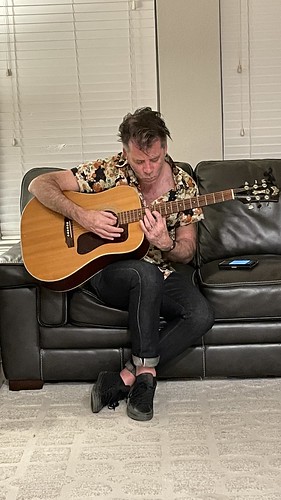
There was some unfinished business that I wanted to take care of on this trip, and that was finally putting my hands on my late uncle’s Guild D40 (if you haven’t read about this, you can start here). I realized, when I had the opportunity to handle it that I’ve never held, let along played, an acoustic guitar in my life. I started taking guitar lessons in 2019 but it’s been strictly electric. It was so light and airy compared to either of my guitars. The neck was shorter so I had to adjust where on the fretboard I was choosing to play lest I run out of real estate. Most of all, the resounding dynamics of an acoustic guitar. It was magical, and I was relieved that I had the opportunity to have access to something of my family’s past.

photo of my playing my uncle's guitar

I’ve been working on a piece about my relationship with my father, his past (which I inherited), and my uncle’s murder in Austin in 1979. It will probably be the hardest project I ever undertake.

Share

Essay: Making Art is Hard

I wrote this essay last year, anticipating that my choice of having a Black protagonist in my novel Radioland might be met with curiosity (or criticism) about the nature of that choice. What actually followed was complete silence on this topic, save for when I eventually spoke with Steven Beattie for his That Shakespearean Rag site (subscriber only). I wish I’d been better able at that time to communicate some of what I wrote here, but I was battling exhaustion at the time and that’s just the way it goes with interviews. I’ve made some mild revisions to this, but otherwise it’s what I wanted to say.

The title comes from a fortuitous moment where I happened upon visual artist Shary Boyle, leading a presentation of her latest works at the Gardiner Museum to a group of U of T students last year. “Making art is hard,” she said, and followed it by imploring those paying attention to not rely on curators or critics to summarize their work; that it was important for artists themselves to put something out there — a statement, an explanation, a proposition — for the record, before other people do that for you.

####

Making Art is Hard

Making art is hard. It doesn’t always need to be, but if you’re trying to get a handle on the complexities of our world – let alone articulate them – I feel there’s no room for those who don’t have a personal stake.

When I set out to write Radioland, I did so as I’ve done before, with a focus on moving beyond only telling a story, or rather, to tell a story of people with an eye to those who inhabit the place I live. That place, as much a character as any other, is Toronto, where I’ve made my home since 1995. This city is a lot of things, with a distinct history of its own. Like other major cities in North America, it shares a deep and often troubling history of disrupting the lives of its citizens, mostly working class.

I wrote my first novel, The Society of Experience, as someone making sense of a bustling but dark, often cold city where power was seemingly held by a tiny coterie who may as well have been in a secret society; a blend of the Family Compact and The Theosophical Society, if you will.

Downtown Toronto in the 90s, to borrow a phrase from my editor, was as white as cream cheese. The news was written by white people from a middle to upper-middle-class white perspective (which it largely still is). The people who wrote my paycheques were white. I started in TV commercials which were uniformly white. And white inherited wealth ruled the roost (which it still does). Hell, in the 90s you could get by as exotic if your parents were from Eastern Europe. That white. I worked my first TV post-production jobs downtown, and it was rare to see individuals from Black or South Asian communities in those spaces. The politics of racial identity wasn’t in the foreground for me because I was a white guy surrounded by a largely white crowd.

Becoming aware of my white-guy blinders and the default whiteness of our media perspective has happened gradually. I began to notice how public conversations about multiculturalism (its brokering of what gets acceptance in a predominantly white society) were often conducted by panels of white people with a token racialized academic on hand to lend credibility; how it seemed that the same over-educated white people talked about Toronto — its rich tapestry of ethnic identities! — as if commenting on a really good food court they discovered in Markham. As I shifted from film/TV, training to eventually operate in private practice as a psychotherapist, I learned from my program and especially via the lived experiences shared through client work, how the idea of multiculturalism that I grew up with felt more like a form of gatekeeping, essentially regulating whomever was allowed in to respect the established values and hierarchies of white society.

Radioland is, among other things, a novel about the scars of trauma, told within a macabre world that is somewhat stranger and more speculative than our own. It concerns Kris, a white musician having a nervous breakdown as he comes to terms with his experience of sexual abuse as a kid, and Jill, a Black woman who harnesses a strange and ominous form of magic within her, whose power sometimes leaves a trail of destruction. There’s also a serial killer, but let’s not go there.

A significant factor, though not the only, in deciding to change how I approached Radioland came indirectly from none other than J.K. Rowling, author of the vastly popular Harry Potter series, whose public blessing of main character Hermione Granger being Black (reacting to the casting of Noma Dumezweni for a 2015 theatre adaptation) seemed not only a rather oblique after-the-fact bestowment of white acceptance, but, as has been pointed out, rather than taking on the work of making any of her main characters explicitly racialized in her books, readers were left to, very optionally, in the words of the late Doug Henning, use their imaginations. To do the work for her, in other words. There’s a double-standard around a white author suggesting the reader change the landscape of representation, not the author. Reading this exchange, its discourse about power, I also saw my own faults – as someone who grew up in white rural and suburban enclaves — or should I call them defaults. Ultimately, I thought, fuck billionaire JKR, where were my blindspots?

When I started Radioland in 2016 I wanted to describe, and have the novel reflect, the changing Toronto I saw around me. I wanted this complexity and diversity to be reflected in my characters. I wanted it to be about music, magic, and madness; highly sensitive people roaming through and seeking connection in a randomly insensitive world. Alarmed by rapid neighbourhood gentrification and wage inequity worsening around me, I didn’t want to write a novel about people who, for some reason, never seem to worry about rent or bills, let alone debt or uncertain comfort. I didn’t want to put into the world another lie about a rock band “making it” (whatever the hell that means). I wasn’t interested in magic saving someone from the realities of an unfair world; what would it be like, in fact, if magic made it worse?

I wrote this essay because it’s not 2016. It’s 2023, and there is a lot of scrutiny out there; an understandably greater burden on white authors, whether or not they are established, to take more responsibility for what they’re working with when they choose to include characters of colour in their work; readers and authors increasingly want to see diverse, relatable experiences reflected in their media, otherwise it frankly risks irrelevancy. As a white author who chose to make one of his book’s protagonists Black, this required a lot of things. Mostly humility, and knowing I was going to need to do a lot research, as well as meditating on what it means for a white author to choose a Black character (especially a protagonist), what the privilege of that freedom of choice means, and the responsibilities that come with this. And within the portrayal of the character, Jill, not wanting to have a Black protagonist who’s made to speak for all Black people but rather a woman who is her own person, yet doing so without erasing her Black identity, or obscuring the racism she has internalized. Balancing the very real lives of Black people with care not to veer into a monolithic, monocultural depiction, or reducing the depiction into a convenient political tract, perhaps what Naben Ruthnum may have meant by social-betterment fiction.

Specifically in terms of writing from the viewpoint of racialized characters, I came upon some influential works that were helpful. One of them is a piece Jen Sookfong Lee wrote for Open Book focusing on the question: how do I write about race when it’s not my race? Writing advice can be Janus-faced — the opposite is sometimes just as true as the rule sometimes — but her well-considered guidance made me feel, at the very least, that I wasn’t indulging in a disaster. Written for an academic audience (though immediately approachable) there is also Linda Alcoff’s excellent paper, The Problem of Speaking For Others, and the author’s thorough consideration of the many perspectives involved in writing from a racialized perspective. Most recently, Jay Caspian Kang tackled this in response to the release of the film Turning Red.

I didn’t want to be Anne Tyler, who recently underscored how frustrating this is: “I’m astonished by the appropriation issue […] It would be very foolish for me to write, let’s say, a novel from the viewpoint of a black man, but I think I should be allowed to do it.” The big problem is in her use of allow. No one is stopping white authors like Tyler from writing from the viewpoint of a Black man, but, perhaps for the first time, they are feeling liable around liberties previously tolerated; the freedom, yes, but not as trustworthy without some sense of self-reflection on the implicit privileges those of us producing art may bring. As someone put it in simple terms, this is more about consequence culture than cancel culture. And what we’re seeing are white people being asked to take responsibility. To make matters worse this is being manipulated in right-leaning quarters as a form of existential annihilation.

A sensitivity reader was ultimately hired, and I’m humbly thankful for their insights. I had considered hiring a sensitivity reader during an earlier revision cycle, but stalled on the idea as there had been stories of authors hiring SRs only to throw them under the bus, owing to not taking into account the advice they were given and treating their hiring as a sort of de facto sanctification against criticism. There’s a lot of misplaced and defensive rhetoric that has come out with the rise of the sensitivity reader; a cursory search will unfortunately direct you to articles that don’t so much compare but literally call the hiring of SRs a form of censorship. The very notion of people of colour suddenly being in a position to gatekeep (which SRs don’t actually do) scaring the living hell out of white people is revealing enough. But let’s get back to this allegation of censorship. It’s not. Not only is it about continuity and accuracy, but authors and publishers being open to taking more responsibility for what we create. In the notes I got back from the SR, there were no “thou shalts”. I was pointed to some technical things in my manuscript that I simply hadn’t considered — and it was flagged because the reader thought it didn’t make sense, or needed more clarity. Good catch, I thought. In their preface, the words of the SR who read my manuscript are important, too: “[…] that being said, I am only one Black [person] with a specific experience growing up in Toronto.” They were there to be an informed eye. This was not some NYT op-ed’s notion of woke-ism run amok. Should we then be surprised when sensitivity readers, such as the person who read my manuscript, decline to be publicly identified or acknowledged by name?

All of this is not to say that I don’t exclude the possibility I’ll have to take responsibility for what I might not have thought through well enough. Oppositely, it’s not like I’m expecting some sort of special singling out for not setting the default depiction to white. Making art, as I mentioned earlier, is hard. I don’t think art-making is well-served if we’re seeking to float safely above that which we are thoroughly immersed in.

Share

Author Discussion

I’m not going to claim authorship (*ping*) for the idea — I was inspired by both the original intention of Wolsak & Wynn‘s fall launch, which was an author Q&A, as well as seeing how smaller publishers could combine their authors into a shared launch — but seeing an opportunity, last month I proposed the following idea to my publisher: what if we (myself and A.G. Pasquella, author of Welcome to the Weird America) were to have an author event that wasn’t about readings but rather a conversation with other authors; this allowed me to invite Freehand Books author Emily Saso (her latest book Nine Dash Line is wonderful — I know because I blurbed it) and for A.G. to invite ECW author Terri Favro (whose latest book is The Sisters Sputnik). The idea was for there to be a more relaxed discussion that could be interesting for both readers and writers.

The event went very well — I wish it had actually gone longer to include audience Q&A, but it was getting late, and I should always remind myself that the folks behind the scenes putting this together are working outside of their normal hours and aren’t getting paid for any of this. I think it was a successful experiment and I hope to see more of it in the future.

Please enjoy:

Share

Greetings from somewhere cloudy

Hi all — I’m slowly getting back into the swing of providing regular updates here, but I should be honest with you that I’ve been battling exhaustion and burnout over the past couple of months. It’s not pretty: in-between forgetting a lot of things, tackling overdue quotidian tasks comes with frustration and resentment. My energy and focus have been more or less on my day job, with good reason. I was also somewhat ironically prolific over the Xmas break, having done a complete read-through of Book Three for revision notes, as well as putting together a very personal essay which ties the story together of my murdered uncle’s stolen guitar.

So yes, “productive”, but I’m paying for it currently, along with the dividends of the not-so-good things from 2022 (ie my mother was hospitalized for several months).

I’m going to leave you with a wonderful song from Jenny Hval that I have been trying not to mainline every moment I can, owing to the fact that the piece has a strong emotional impact on me. Perhaps it’s the reflective and speculative nature of the (gorgeous) lyrics. In any case, I hope to see you soon.

Share

The Big December Update

It’s been a year…however, I’m going to save the reflection for when I have the time to do so (!).

I’m so happy that RADIOLAND was recently chosen as a top music pick from CBC Books, especially to see myself listed with my friend (and well-respected music journalist) Michael Barclay and his thorough history of Canadian music from 2000-2005, HEARTS ON FIRE. Talk about good company.

I should also let you know that my publisher is celebrating their 40th anniversary and is offering a 40% discount on their complete catalogue until the end of December. Yes, that includes RADIOLAND and my debut novel THE SOCIETY OF EXPERIENCE — however, I’d like to also add that it also includes works from friends/authors Andrew Wilmot, A.G. Pasquella, Dani Couture, Daniel Scott Tyson, Sofi Papamarko, James Lindsay and D.D. Miller. Seeing as this is holiday-adjacent, this 40% discount is well-timed.

As I’ve mentioned, it’s been a year. I want to thank everyone who has supported my writing. Your support has been felt.

Share

The Big November Update

Holy cow, what a month. I’m sitting here at a sports bar (using their wifi) half-exhausted from everything that’s transpired since my last post here.

me at the launch

The launch for RADIOLAND went great and was well attended!

You can stream my interview with CBC Toronto’s Gill Deacon to assess whether I made any sense (I think I did, though I was very nervous being on live radio).

Speaking of radio interviews, I just completed a wonderful interview with Jamie Tennant for CFMU’s Get Lit. It’s not going to be available until mid-December, but I’ll let y’all know when that happens!

Last but not least…I have a giveaway of sorts. For my launch I decided to do something special and had custom guitar picks made, which I distributed to those who purchased my book. Guess what? I have some left over! So, while quantities last (I’ve never typed that before and it feels weird), if you get in touch and provide a photo of your copy of RADIOLAND (or proof of purchase) I will mail you one of these! Seriously! You can either DM via Twitter (@heymattcahill) or you can email me (matt at mattcahill dot ca).

I’m planning on taking a little time off to regroup (and catch up on my reading!) but I’m planning on getting back into Book Three in December and hopefully deliver the goods in 2023. Take care, and thanks for popping by!

Share