One of my favourite tracks currently.

Ambient Album Picks 2020
Sault, track “Monsters”
II by Nathan Moody
Tira Sapato by Dimba Diangola
Harbor Darkness by PINKCOURTESYPHONE
Michael Cahill, Coda
Let me begin by saying that this is the short version…
For those who haven’t been following my blog, my uncle, Michael Cahill, was shot and killed in 1979, in Austin Texas. This happened as he came upon someone burglarizing his apartment, who fled on foot with my uncle’s prized possession — a Guild D40 acoustic guitar. As I covered in 2006, this sad episode in my family’s life was resurfaced by journalist Denise Gamino of the Austin American-Statesman (Gamino is now a former staffer and her very excellent article is no longer on their site, however I’m linking to a copy of it here). Fortuitously, a producer from America’s Most Wanted came across it and reached out to my aunt for permission to spotlight this cold case on one of their episodes. And so, in 2007 I got to see the story of my uncle’s murder not only re-explained and re-contextualized, but also recreated with actors on broadcast TV.
And then…nothing happened. I wrote about it here and here and that generated interest. People reached out to share their theories, sometimes the odd story about Michael. Over time — especially given the cancellation of America’s Most Wanted (and the erasure of its online presence which wiped out all of the stories they covered, a crime in itself for families whose only hope for justice was the information that site provided) I grew ambivalent to any suggestion that I should be hopeful my uncle’s murder would find any sort of resolution.
On February 7th of this year, I got on a plane to Tulum, Mexico, for a vacation. When the jet landed on the tarmac of Cancún International Airport, I saw that I’d received a voicemail. I ignored it, assuming it was work-related, or maybe just spam — it was from an area code I didn’t recognize — until I returned to my office on the 18th. It was a Tuesday.
The message was from Randy Crafton the owner of Kaleidoscope Sound, a recording studio in New Jersey. While doing an inventory of their music equipment, they looked up the serial number of one of their studio guitars. Unlikely as it may seem, even as I write this, that serial number was the same as the one my uncle died chasing in 1979. It had likely changed hands many times; at some point I’m sure someone will investigate this.
This past Friday — Good Friday — the guitar was delivered by UPS to my father in Houston, just in time for the 41st anniversary of my uncle’s death. My family down there is, to say the least, ecstatic, and I am still gobsmacked at how this all came to be. Let’s face it, the probability is beyond calculation. I’m grateful, which feels like a tremendous understatement. Grateful to the people at the studio in New Jersey. Grateful to everyone who has shared Michael’s story (including that serial number!) on the web. I will most likely write something more comprehensive about this, because there are so many moving parts — names, places, people — and the story is much larger than what I’m able to encapsulate here. But I’ll get to that when the dust has settled.

The One I Feed
If I’ve learned anything this year it’s the command, perhaps even the primacy, that music holds over my creative life, which is strange(ish) for someone who isn’t a full- or even part-time musician. Let me qualify “someone who isn’t a full- or even part-time musician”: I can play drums decently well, I’m barely adequate on keyboards, and I’m beginning to develop confidence on electric guitar. But there are no stakes for me: I’m not in a band, I’m not hoping to become a recording artist. So, as an established/emerging writer, what’s the deal?
The deal is that music presents as part of a triumvirate of full-blooded influences on me: music, film, and writing. I am incomplete as an artist without one of these. Don’t get me wrong, I love other forms of art — dance, painting, sculpture, etc (to infinity) — it’s just that my DNA is activated by music, film, and writing.
But the predominancy of music in my life sometimes has me worried.
Let’s start with writing. Music twists around my work almost symbiotically. The Society of Experience involves a character whose day job is a music supervisor for film and TV productions, and thus the narrative is punctuated with songs from the very beginning; the main character is sometimes haunted by the sound of a jukebox in the bar beneath his apartment. And yes, of course I created a soundtrack for the book’s launch (which features music mentioned within as well as inspired by the themes and subject matter). My next novel, Radioland, involves a “successful” musician having a nervous breakdown. The novel I’m working on right now, [untitled matt cahill project], involves the power of a DJ on a young boy in the country. If I could afford the rights I would quote song lyrics to introduce book sections.
Even when it comes to film, music has been immensely influential. From the quirky soundtrack of Brazil to the Wagnerian flourishes of Excalibur, I have not only fed deeply on music scores and soundtracks but have followed a countless number of rabbit holes. If it hadn’t been for watching Underground, I wouldn’t have spent a year chasing down recordings of Serbian brass band music. In film school, one of the best things I ever did was a one-take b&w short I shot on a wind-up Bolex that I played back w/ The Jesus and Mary Chain’s Reverence blasting in the background.
I care deeply about music to the extent that, on a social occasion where we were taking turns playing songs on a nearby jukebox based on a chosen theme, I was asked to choose 3 songs I hated. I said I wouldn’t. And I wouldn’t because a) it meant sitting through 3 songs I hated, and b) life is too short to listen to songs you don’t like. It made for an awkward moment and I felt somewhat precious, but that’s how it goes when you take a principled stand about most things.
So, my worries, however ephemeral, are whether I’m suffering from a blindspot in how I prioritize music. Is it a blinder? Is my appreciation for it distorting my perspective insofar as my writing (in particular) might suffer? I don’t know. I don’t have a lot of artist friends, and the ones I do have probably wouldn’t deem this to be something worth much concern. That said, sometimes I wonder: am I using one art form to inform and/or expand another, or am I misusing either/both? Should I be concerned when things become sacrosanct?
These are not really questions that require answers, but as an artist who wishes to be reasonably self-aware, they are good to ask nonetheless.
State of Music
At some point early this year I found myself sitting at one of my writing spots in Little Portugal and hearing a really good post-punk band, Ought (note: the album to hear is 2015’s Sun Coming Down). It was everything I liked, reminding me very much of one of my favourite post-punk bands, The Fall.
And I was sick of it.
I’d had enough. I’d heard too much. And so I’ve spent the year focusing intently on other types of music: ambient (which I’ve written about here), classical, Afro-funk, R&B, soul, you name it. Especially coming back from Memphis I rediscovered blues in all its forms (gospel, rockabilly, etc). What I like about blues — and there are many derivations of it so bear with me for the purposes of a blog post; let’s assume I’m talking 1950s John Lee Hooker — is its lack of pretence, its sparseness. There’s nothing wrong with pretence, don’t get me wrong, but what I’m realizing is that part of me has seen the need to get back to basics; a compelling repetitive motif communicated succinctly with next to no frills. I suppose I’d spent my life listening to so many artists inspired by early blues, gospel, soul, funk, and R&B that I needed to (re-)acquaint myself with the original source material.
There is something about the sound of John Lee Hooker pulling and snapping an E-string on a hollow-body guitar that brings music to its essence. That sound is the equivalent of Pete Townshend doing windmills, Karen O screaming with a microphone clasped between her teeth. Simple, primal, pure.
There are so many incredible developments in music production (listen to Kaytranada‘s 99.9%) and yet it’s easy to get lost in all the plug-ins and digital magic. Under no circumstances, unlike a certain Toronto jazz radio station’s tag line, am I suggesting that the lack of analog instruments denotes a lack of soul or legitimacy. As far as I’m concerned, an instrument is an instrument is an instrument. What I’m saying is that at some point I lost sight of the primacy of musical performance.
And lately I’ve realized (ironically while listening to an awesome track by the band Dry Cleaning, reminiscent of Broadcast) that post-punk is, well, dead. For now, at least. It’s spirit will always be alive but all of its chess moves have been laid bare, its finiteness made plain. This is subjective, of course. Anyone who hasn’t heard a lot of post-punk will enjoy years (if not decades) of fulfillment. But I feel that my time is up. And I’m not sure where I’m going next because I know my recent rediscovery of blues in particular can only go so long and so far.
Blues travels well as an art form, but, similar to theatre, it can be stifled in certain environments. Its strength is its fragility, but you can’t inorganically manufacture fragility, which is why most blues recordings don’t do anything for me. Like jazz, hearing blues live is best, but that’s assuming the trio or solo artist you’re seeing is in command of their art (or, say, isn’t just there for a quick paycheque). I guess what I’m saying is that I can see the end of this journey on the horizon (not that I’m not going to enjoy every highlight I can find; I’m currently learning Freddie King’s Hide Away on guitar, which is a great introduction to Texas blues).
I suppose the worst case scenario is that my playlists become even more disparately populated by genre than they currently are. To be fair, if I’ve done any mourning for my relationship with post-punk, I’ve expressed it within my next novel, Radioland, which I’m hoping will find a publisher in 2020. Sometimes writing a novel is a way to process change, and sometimes the novel itself sets me off on a fact- (or feeling-)finding mission to explore that change. Welcome to the artist’s life.
The Memphis Effect
As mentioned in my last post, going to Memphis had an effect on me. One thing that it affected that I didn’t have the space to mention was how I was influenced musically.
First, let me tell you about American museums (or at least museums in Memphis): unlike here in Toronto (I’m thinking of the ROM) where you are basically in an Ikea and are able to roam about and find the exits freely, the museums I went to in Memphis (namely the National Civil Rights Museum and the Stax Museum of American Soul Music) subscribed to a similar script. First, thou shalt sit and watch an obligatory documentary for at least 12 minutes before entering said museum. Second, after said documentary has been screened, thou shalt exit through appointed theatre exits and continue through a prescribed path until the gift shop approacheth, not unlike a mouse in a maze.
Thing is, during the Stax documentary (which was very well done, as was the NCRM doc), I witnessed the apparition of Sister Rosetta Tharpe. Now, if you have a decent knowledge of rock-and-roll, you might have heard Sister Tharpe’s name as an early influence on the genre. This is similar to how some of us might hear the name Kepler attributed to astronomy or Cruyff as pertains soccer. I sat there on that Saturday afternoon (I was amongst a cohort of three people) and watched an excerpt of her performing the gospel standard Down By The Riverside with a choir behind her, ripping into her white Gibson SG for a ridiculously soulful guitar solo.
That did it.
Leaving Stax, I proceeded to watch everything I could on Tharpe, with particular attention to her electric guitar performances. This was not someone playing rhythm guitar while she sang, strumming chords. Just as her voice had a beautiful, soaring quality with a lot of power behind it, so did her guitar work. Technically and tonally she was (and is) extremely expressive, demonstrating a vocabulary of electric guitar playing that predated rock-and-roll as we know it, combining both religious and secular gospel with R&B. There are a number of good places to read more about her — here’s one. And another. It’s no surprise that when she was finally (belatedly) inducted into the Rock and Roll Hall of Fame, it was Alabama Shakes’ Brittany Howard who introduced her.
But I wanted more. I was inspired to the degree that I wanted to explore what I saw beyond listenership. And so I did my research, and after a couple of weeks, I located a guitar teacher. And after a lesson or two, I ended up locating a semi-hollowbody guitar — an Epiphone Riviera Custom P-93 (pictured) that someone was selling because they weren’t finding use for it.
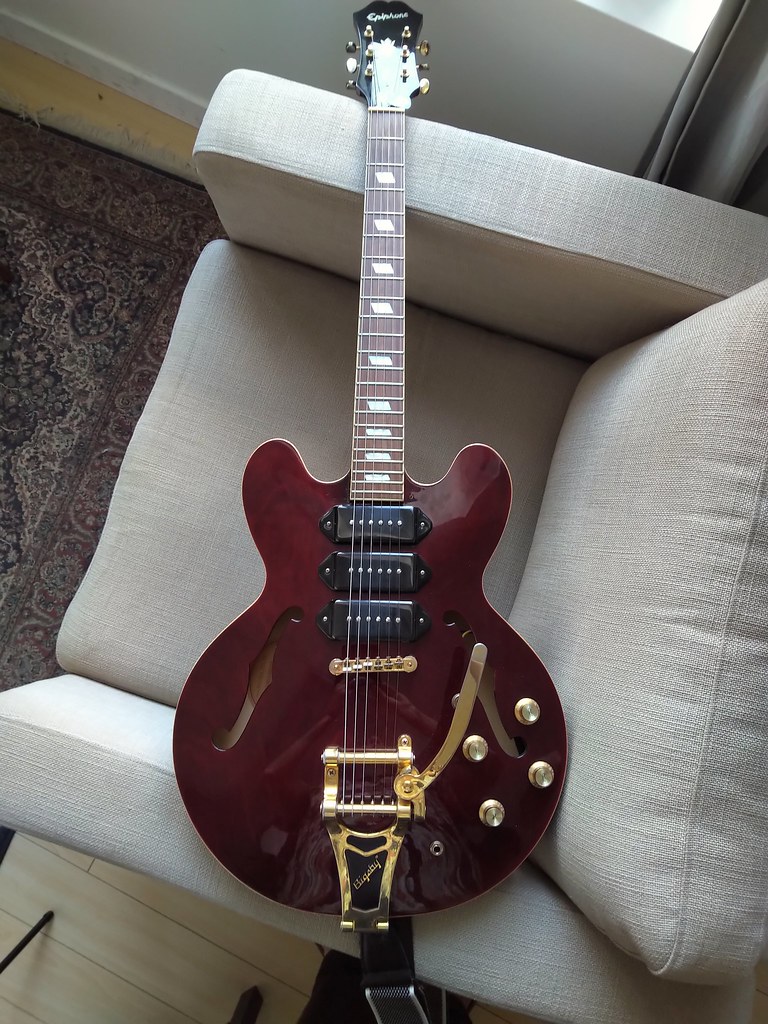
I play drums and can do adequate keyboards, but I’ve never (ever) wanted to learn to play guitar (just magically “play” it? Sure, but not actually learn the thing), despite the fact that some of the greatest influences on me are from guitar-driven music. Learning guitar is a strange yet rewarding process of teaching the increasingly calloused finger tips of my left hand to traverse the frets and coordinate themselves, touching the strings at first hesitantly, then, with practice, confidently. Oh, and then there are the pickups, the tuning, the tremolo bar. I’m not doing this because I want to start a band or play on stage, but rather because I’m drawn to this process, and a relationship that I am building with the instrument.
What am I learning? Mostly surf and rockabilly, for the time being.
Here’s more SRT: