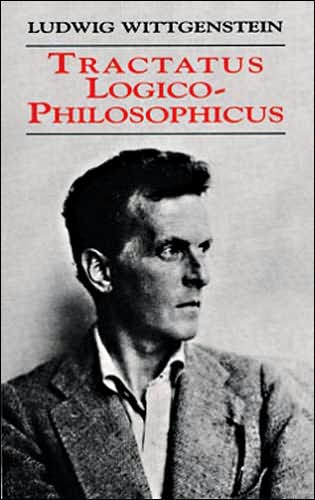
Book Review: Tractatus Logico Philosophicus, by Ludwig Wittgenstein

4.003    Most propositions and questions, that have been written about philosophical matters, are not false, but senseless. We cannot, therefore, answer questions of this kind at all, but only state their senselessness. Most questions and propositions of the philosophers result from the fact that we do not understand the logic of our language.
(They are of the same kind as the question whether the Good is more or less identical than the Beautiful.)
And so it is not to be wondered at that the deepest problems are really no problems.


I’ve been promising this review for some time. The problem has been – since this is a book not of philosophy but about philosophy – I’ve needed time for it to sink in. Furthermore, as much as I hate prefacing my opinion (or anyone else doing the same), due to the nature of this book I feel it fair to say a few words: I’m not an academic who specializes in philosophy. I do not have the names and concepts of all the world’s great thinkers at my fingertips. As such, I tackled this book as a reasonably intelligent layman. What I have to say about it should be seen through this particular lens. This is not a dissertation and most certainly this is not an academic exercise. So there.

Wittgenstein’s Tractatus Logico Philosophicus though only clocking-in at a svelte 108 pages, is a monster of a book. It is a perception-altering, densely laid treatise that attempts to clarify not a particular theory per se, but rather, pulls its focus back to comment upon the very scaffolding of philosophical understanding itself.

The way Wittgenstein sees it, there are too many fundamental errors and/or assumptions that sabotage philosophical propositions before they’re even written down on paper. The key is to first lay down exactly what a sound proposition is and to understand it in its elemental form. Technically, linguistically, even mathematically Wittgenstein has taken his understanding of what makes a philosophical proposition sound and distilled into a dense uber-logical lexicon.

It’s a fascinating (if insufferably semantic) approach: each point and sub-point are laid down like a revolutionary manifesto:


4.023    The proposition determines reality to this extent, that one only needs to say “Yes” or “No” to it to make it agree with reality.
Reality must therefore be completely described by the proposition.
A proposition is the description of a fact.
As the description of an object describes it by its external properties so propositions describe reality by its internal properties.
The proposition constructs a world with the help of a logical scaffolding, and therefore one can actually see in the proposition all the logical features possessed by reality if it is true. One can draw conclusions from a false proposition


Wittgenstein is intent on defining the way in which we attempt to interpret the world rather than the specifics of content. Wittgenstein’s reverence for the power and importance of how language is utilized in articulating the world is infectious. His approach, however, requires careful reading. I will be honest in saying that it’s difficult to review such a book without having spent a number of weeks re-reading it, making notes, checking out other people’s feelings about it, etc.. I have not had the time to do this, and have only managed to read Tractatus twice – however, I will say that while the first reading was a slog in the mud, during the second reading things became suddenly more clear and fascinating.

Who should read this book? Anyone interested in expanding their practical and theoretical understanding of language and logic. While Tractatus is dense and unsparing to the casual reader, those who give Wittgenstein’s treatise the time and effort it deserves will undoubtedly walk away richer for the experience (if not wiser). If Aristotle wrote the book on metaphysics, then Wittgenstein has written the book on metaphilosophy.

Tractatus Logico Philosophicus (ISBN 0-486-40445-5) is available at a fine independent bookstore near you. Also available online at various merchants. Note: this review is based upon the 1999 Dover republication (using the translation by C.K. Ogden, which is thought to be the definitive text).

Share

Wheel of Fire

We live in a society which thinks fortune is synonymous with providence.

Fortune is just fate, marketed well. Fate is a spinning wheel, capriciously objective and favouring no one.

Look at those lottery winners who find themselves bankrupt because they pissed away their winnings on stupid things: flying their friends to Vegas, buying cars for family members. If that’s fortune, then I’m happy it doesn’t visit me often.

As for providence – providence is for those who treat fate with respect, like fire.

Share

Thoughts on Truth & Medium

I’ve been reading Wittgenstein’s Tractatus Logico-Philosophicus. Intimidating little book. Seems to be written in its own language: cold fucking logic. Still, there are some fascinating ideas relating to how we choose to define the world around us. It’s easy to see how revolutionary this book may have been for some people, as concepts of truth and falsity take a back-seat to the greater question of a proper logical confine for the philosophy itself – in doing so, Wittgenstein is saying that the structure of a philosophy is greater than the veracity of its content.

Gleaning from this, I couldn’t help but be reminded of Marshall McLuhan’s 1 observation, “the medium is the message” (which was also the name of the resulting book he published 2), which seems resonant of Wittgenstein’s approach (if not somewhat parallel).

From Tractatus:

3.332 No proposition can say anything about itself, because the propositional sign cannot be contained in itself (that is the “whole theory of types”).

3.333 A function cannot be its own argument, because the functional sign already contains the prototype of its own argument and it cannot contain itself.

It would be rather trite to pit Wittgenstein against McLuhan based upon a couple of sentences (foundational though they may be). However, from this discourse I’m curious to take a closer look at what McLuhan was trying to say – I suppose I carry a vain hope of tripping over a Unified Theory.

You know you’re part-geek when things like this really interest you. However, I swear, I’m also part-superhero 3.

1. I always get this guy’s name mixed up with the guy who created the Sex Pistols (Malcolm McLaren)…if only they were the same person.

2. Although, technically speaking, due to a copy-edit error, the book was first published as The Medium is the Massage. I shit you not.

3. …as opposed to the Nietzschean concept of the Superman (*chortle*)

Share

Oh, right – the world

If I’ve relented from espousing opinions on the world lately, it’s because of two things (primarily):

    1. The world is nuts.


  • Too many people are trying to make sense of #1


Let me qualify this…well, actually no. No, I don’t think it’s necessary to qualify either of these. This isn’t a formal academic essay.

Ludwig Wittgenstein, whose work I’ve found myself inexplicably drawn to lately, believed that the role of philosophy wasn’t to change the world, but rather to articulate it 1. I’ve played with this aphorism for quite a while, objectively and personally; while not conclusive, I suspect it applies to more than just philosophy.

Music, calculus, meditation…essentially, the Big Three 2 : Art, Science, and Religion.

I suppose what I’m getting at (as I type this on borrowed time, with little sleep, on an old laptop, knowing that at any minute someone’s going to drop the proverbial Anvil of Stress on my head) is that rather than having a Romantic notion that the world needs to be changed, perhaps we should focus primarily on expressing what exactly it is first, unwieldy though it may be. We can’t even start to explain what the world is (and thus, life) without starting from the beginning: how we individually see it, how we individually live our lives, and the extent to which our individual morals and ethics weigh our actions. Let’s face it, if we can’t articulate these foundational (and certainly more practical) questions then the world, try as we might to change it, will most likely turn and laugh in our face…or just walk by, carrying shopping bags, without looking (in Toronto, anyway).

Instead of trying to ram our passions down the throats of others 3 in the (rather selfish) hope that everyone’s life will change as a result of our unbottled wisdom, what if we changed our approach? What if, instead of proselytizing, we simply worked on articulating ourselves as well as possible (as if that wasn’t formidable enough)? I would argue that a well-conceived, original articulation of an individual point of view would have a much better chance of affecting our environment in the long term than all the thunder and plunder of what essentially boils down to a Crusade To Make The World Understand The Way [place name here] Sees It.

It’s funny that, when the emphasis of our philosophical passions are changed from “tell it like it is” to “tell your story well”, you wind up with less fire and brimstone (ie outrage) and a greater sense of awareness.


1. Michael Dummet, “Vagueness: A Reader”, Edited by Rosanna Keefe and Peter Smith, (essay: Wang’s paradox, pg.100), MIT Press 2002

2. (articulated previously here)

3. (boy, could this sentence be misconstrued)

Share

Forging on (he says)

It’s difficult to maintain a positive perspective when it seems you are book-ended by sirens of madness on one side and the encroachment of useless bullshit on the other. It makes one consider the benefits of a solitary agrarian lifestyle; unfortunately, that’s not in the cards for me. Firstly, most solitary agrarians are often too invested in their solitude (and their agrarianism) to even stop and contemplate their identity – after all, occupational lifestyles such as “solitary agrarian” tend to come naturally to people. I admit I may have missed that boat. Secondly, I simply wouldn’t trust anyone who identified him/herself as a solitary agrarian (“Take the chip off your shoulder, hippy.” my inner pub-crawling bully yells out – let’s call him Sully. Truth be known, he yells a lot).

It’s hard being an artist 1 when you’re surrounded by a stream of people who also call themselves artists, not necessarily because they are or that what they do is particularly outstanding, but rather because it doesn’t make your situation any easier. When you were a kid, an Artist was some sort of hallowed currency – you imagined they were raised on Easter Island by alpacas and shipped to the New World via hovercraft.2 Well, they’re not. I suppose it’s good that they’re not, as I’m sure someone would’ve raped and pillaged them long, long ago, Viking-like. To that end, I’m thankful the world doesn’t have to contend with a breed of sullen warrior sub-artists from Easter Island.

In the inner universe of the artist, “I” is the loneliest word. But let’s come back to this.

On the extreme opposite of the universe, far, far away from the tiny satellite of “I” is “you”.3 You, as in, not-the-artist. Sure, you could be “an artist” also, but it really doesn’t matter. For all you know, they’re nothing like you…or I, sorry. Bloody pronouns.

Right, let’s come back to “I”. Lonely word blah blah blah. Rudolf Steiner saw no difference between Art, Religion, and Science. In his eyes, they all dealt with the same conflict 4: bridging the chasm of understanding between the I and the not-I. Let’s face it – everything around us is not us, and yet it is, and yet it’s not. I have no relationship to the CBC Visitor sticker that I have stuck to the wall in front of me – it is, after all, a piece of sticky paper. Yet, it’s an encapsulation of one of various meetings/sessions I’ve had at the broadcaster, which is tied to what I do for a living, which is somehow (sometimes depressingly) tied to who I am. There is a constant conflict between the inner and outer world and it is the job of the Artist, the Philosopher, and the Scientist to ask fundamental questions in order to better define this relationship. I suppose I could’ve picked a better example than a sticker, yes (Sully laughs in the background, a pint of Guinness in his hand, leaning back on his barstool, smoking a cigarette as only fictitious inner pub-crawling bullies can do in light of Toronto’s recent smoking by-laws).

Every artist has to realise that they are, ultimately, alone. You can be part of a collective, you can have a gaggle of supporters, you can own an over-priced bar named Camera, but in the end it’s your inner voice that expresses itself and not the sum of your distractions, be they good or bad. The environment – the “not I” – can inspire art, but it doesn’t create art in and of itself. At best, in the Artist’s World, the “not I” is a muse that we toy with, fight against, woo, or plunder jealously for material. But in the end, you’re on your own.

I’m an unpublished writer (when I withdraw various insubstantial exploits: a College Street community newspaper that never got past Issue #1/Volume #1, a poem I wrote in high school that was somehow allowed in the Burlington Post, and various letters to the Globe and Mail), yet despite that, I’m not unaccomplished. This is the fine line: knowing the difference between a lack of commercial success and a lack of personal accomplishment. We tend to equate the two as synonymous, yet one is inherently more substantial than the other. I look back at the last five or six years and I say to myself (“Self…”) that I’ve accomplished a lot (a novel, numerous short stories, countless poetry) – it’s only been in the last year that I’ve begun to seriously aim for commercial success. I would rather be in this situation now than have peaked early (when I knew less about myself as a person and a writer) and withered, as most early-peakers do. Success is not a race, or at least that’s what I tell myself when I feel I’m going nowhere.

The key is to forge on, and whether that requires optimism, humour, or even distilled anger is up to the individual. The common-sensical answer would be: whatever it takes.5

As for me today, I might just join Sully for a pint.

Footnotes:

1. I use the term “artist” in its general context. I do not specifically mean visual artists, although they are obviously part of the category. I just can’t speak for them.

2. Hovercrafts. What kind of brilliant magic was that? Weren’t they the coolest things ever made by mankind when you were a kid? Christ, give me a place with hovercrafts and moving sidewalks and I’m buying real estate.

3. This is assuming a finite universe which could contain opposite sides (which obviously wouldn’t be possible if there was no end or beginning).

4. Conflict is, in retrospect, a slightly dramatic term – but I’m a slightly dramatic person.

5. The artistic process is just as important as the artistic product; it would be dangerous to focus on one to the exclusion of the other – you’d either be left with a industrious stream of mediocrity or constipated with directionless obsession. And you thought artists had it easy.

Share

Book Review: The Unconscious Civilization, by John Ralston Saul

As mentioned previously, House of Anansi recently re-released their acclaimed CBC Massey Lectures series. This news is a significant boon to the reader who values provocative, intelligent discussion which often straddles the fine line between social anthropology and philosophy. Having been pleasantly surprised with Doris Lessing’s Prisons We Choose to Live Inside (reviewed previously here), I picked-up John Ralston Saul’s The Unconscious Civilization with hesitant interestI say hesitant because I’m already well-acquainted with his work.

I was first introduced to Ralston Saul many years ago with his book Voltaire’s Bastards (ISBN 9780140153736). I was impressed with his bold and thoroughly-referenced perspective on what he contends is the growing paralysis of Western civilisation throughout history. However, in retrospect, this was probably the wrong book to start with; for one thing, it’s about 656 (trade paperback) pages which, considering his dense style and cogent analysis, makes for a bit of a brain slog. Nonetheless, I followed this with the successive releases of Confessions of a Siamese Twin (ISBN 9780140259889), his treatise on Canadian social/political identity, and On Equilibrium (ISBN 9780140288032), his elaboration on six foundational aspects of civilization.

I wish now that I had first read The Unconscious Civilization.

Clocking-in at a comparably svelte 205 pages, Unconscious Civilization finds Ralston Saul boiling down the magnum opus that was Voltaire’s Bastards into something much more approachable for the average reader without filing down its fangs. The thesis is partially revealed in the Preface, written for the 10th anniversary re-release:


When I wrote these Massey Lectures, I was convinced they would cause a shock. After all, I was describing the state of the West in a manner quite off the radar screen. I was saying there had been a persistent growth of corporatism in spite of the outcome of the last world war. And that this growth continued. Why would this be shocking? Because corporatism was part of the anti-democratic underpinnings of Fascist Italy in particular, but also of Nazi Germany. Beneath the uniforms and the military ambitions and the dictatorial leadership and the racism lay corporatism. It was the intellectual foundation of fascism. And it was supposed to have been destroyed along with both regimes in 1945.


So, it’s not exactly light reading. Throughout history though, concepts and arguments that heed us to re-evaluate our surroundings (whether or not we end up holding fast to them) are often dissonant to our day-to-day perspective on life – in other words, controversy often ensues difference. Ralston Saul is unafraid to call a spade a spade.

The Unconscious Civilization lays out in dense, history-shifting references, the problems and origins of corporatism and how it has become an increasingly acceptable means to run modern societies, in spite of its history of stifling democracy and rewarding conformism.

One of the key points made is how one can propose to adjudicate the underlying strength of any given society – that is, asking: where does its legitimacy lie? He proposes that this legitimacy lies in one of four areas: God, a king, groups, or civilian individuals working as a whole. While the history of Western society has largely been influenced by the former two, Ralston Saul feels that we are most certainly in the hands of groups: think-tanks, specialists, and managers.

The corporatist model, he argues, in the tradition of the Catholic Church, is obsessed with God and Destiny – albeit transposed onto contemporary concerns such as the trade markets and privatisation of public interests. Corporatist language is thus cloaked in a similar sense of inevitability and sycophantic awe that the Church used to instill fear and hold power over the populace.

Although the density of Ralston Saul’s arguments is impressive (in particular, his contention that Jung and Freud allowed the posterity of their work to fall victim to an inarticulated obsession with mythology) , I feel it’s this same quality that weighs down the over-arching themes of the book. At points, particularly with his repeated references to Athens in the days of Socrates, I longed for the simple first-person perspective that gave Doris Lessing’s Prisons We Choose To Live Inside its sprightliness and pactical immediacy. At times, Unconscious Civilization buckles under the considerable thickness of its content, which makes me wonder what the average reader will take away from it (without re-reading).

However, this doesn’t change the fact that this is powerful stuff. Not content to only point out what’s wrong with society, his last chapter is dedicated to thinking towards solutions. In particular, I found great interest in his contention that the public school system is out of step with the lifestyle changes over the last 20 years – as people are set to retire later and later, would it not make sense for children to enter into school later and then be required to receive a more complete education than the current system which is only concerned about cranking out specialists for the marketplace? Ralston Saul also delves into his equilibrium theory, to which he devoted a book in 2002, in which he postulates that individuals and society alike must work to remain balanced rather than hyper-focused on any one quality, in particular rationality, which has been used to justify abuses throughout history.

I would not hesitate to suggest this book to anyone interested in challenging views of society in general, and Ralston Saul’s ideas in particular. For the latter, The Unconscious Civilization is the ultimate primer. For the former, you will undoubtably find yourself spending a great deal of time wrestling with its well-researched and sometimes scathing message.

The Unconscious Civilization is available for sale at a fine independent bookstore near you and online at House of Anansi Press, as well as…Powell’s, Amazon, Chapters. Published by House of Anansi Press (ISBN: 0-88784-586X)

Share

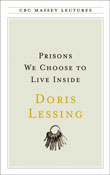
Book Review: Prisons We Choose To Live Inside, by Doris Lessing

House of Anansi Press has re-released their excellent CBC Massey Lectures Series. These are expansive, thought-provoking works which aim to push our understanding of society and the individual in the late-20th (now early-21st) century. The series includes works from many different points of view: A Short History of Progress by Richard Wright, The Unconscious Civilization by John Ralston Saul, and Beyond Fate by Margaret Visser are only a fragment of this extremely revealing and influential volume.

Prisons We Choose To Live Inside, a collection of five lectures author/novelist Doris Lessing gave in Canada in 1986, is a fine introduction to this astutely-observed collection. Clocking in at a mere 76 pages, Lessing lays down a sobering, eye-opening conception of the place of the individual in modern-day society. Her points are clear: history (the study of which she advocates with Cassandra-like insistence) clearly warns us against the perils of becoming embroiled in “mass emotion” and the inherent fascism of group-think. Repeatedly, she advocates the need for cool, objective distance from events and society – even at the peril of seeming an elitist.

With succinct skill and a preference to reference personal experience over statistics, she lays down her points consistently throughout:


I think when people look back at our time, they will be amazed at one thing more than any other. It is this – that we do know more about ourselves now than people did in the past. But that very little of it has been put into effect.


She makes it clear that there is little excuse, living in an age where social sciences (psychology, sociology, social behaviourism) have flourished, for society to not be equipped with an understanding of the basic underpinnings of society and human behaviour. Yet we don’t; the information never trickles down from academia in a way that can be instilled easily in our public schools, perhaps because the message is largely: group-thinking and mass emotions are our undoing – at risk of ostracism, it’s best that you question everything.


One of the many examples she lists is how Stalin, at the time when the Nazis invaded the Soviet Union, was referred to in Allied propaganda as ‘Uncle Joe’ and how the Russians’ defiant struggle was our struggle…only to turn on a dime after the fall of Hitler and turn against ‘Uncle Joe’, decrying every aspect of the Soviet Union not only as backward – but evil. This last word is very important within the context of Lessing’s lectures because historically it tends to come up every time a group wishes to strengthen their moral stance – and eliminate dissent. It isn’t enough to politely disagree – you must denigrate and vilify. Lessing speculates the reason behind this lies with our animal instincts: the instinct to separate into good/bad, black/white etc..

One of her more chilling statements, which she uses when talking about her childhood in war-torn Southern Rhodesia (now Zimbabwe), is that we have to accept that there are people in all parts of the world – in every society – who quite simply enjoy barbarism. They enjoy it, and, when society is on the verge of a conflict, these same people will move to the forefront to push things towards violence.

Again, sobering – and pertinent – stuff. Lessing’s tone is unapologetic, yet she does pepper her lectures with humour (albeit darkly at times). One thing to be aware of is that the original lecture was given in 1986; her examples refer to the British mining strike of ’84, the Falklands War, and then-Communist Russia. Obviously, for those not born early enough to remember these conflicts, it may be good to have Wikipedia nearby for a little context. However, her analogies and references are universal and certainly applicable to the debacles we face today. Her speculations are haunting in their honesty and relevance, and I am reminded of someone’s reference to John Ralston Saul’s Voltaire’s Bastards as “a hand grenade disguised as a book”.

Quite true, and we are all the better for reading books such as these.

Prisons We Choose To Live Inside is available for sale at a fine independent bookstore near you, as well as…Powell’s, Amazon, Chapters.

Published by House of Anansi Press (ISBN: 0-88784-5215)

Share

The Vagaries of Vagueness

I would hazard to say, standing in my media-saturated 21st century Western society, that being ‘vague’ is worse than being ‘wrong’. Today, you can be concisely misleading yet never be taken to task by your peers, whereas if you are perceived (even falsely) of ‘waffling’, it is presumed that you are a lower life form and a drag on the sail of civilisation.

Ask John Kerry, the gentleman who ran against the incumbent president of the United States in 2004. Although a confident public speaker, arguably his great shortcoming was an inability to distill his ideas (and, as the campaign wound-down, his reactions) in a precise way. Although he performed well in the presidential debates, off-stage he was generally unable to articulate a clear message at crucial junctures to a large population, many of whom were shopping for a new president. It didn’t help of course that his competitor’s well-funded propaganda machine (abetted by a democratically impotent news media) raised as many distracting peripheral issues as they could. Arguably, by the time Kerry could get back to the task of getting elected, he’d wasted much of his steam as well as the hopes and patience of the US public.

On the other side, the incumbent succeeded in spite of the fact that his administration was clearly contemptuous of journalists, artists, and anyone else who dared to posit difficult questions (being hallmarks of democracy the last time we checked). In other words, in spite of the fact that the administration treated the very people whose job it is to articulate the world around them like rubes, they won. They won a majority. But damn was he clear. Unlike his rival, George W. Bush was firm: cut-and-run, bait-and-switch, flip-flopper. These hyphenated accusations clearly, if inaccurately, conveyed moral and ethical failures within his opponent’s character and ideals. Whether or not his policies were realistic, they were precisely worded: we will not abandon our cause. If you asked what the cause was – easy: democracy.

What I’m saying is that we increasingly reward firmly-stated obfuscations over less impermeable truths.

I often wonder why there is so little true debate in our society, outside of academia. I’ve found that it’s because truth is neither precise, nor is it unyielding. Knowledge is inherently vague – and by knowledge, I don’t mean the concept of knowledge, but rather its practical application in society. Truth is messy; it’s neither red, nor blue, nor grey. Truth is moderated by the lack of absolute answers. The problem of course is that this doesn’t make for nicely-packaged media clips, so what we end up with are endless volleys of increasingly intolerant hyperbole.

When foisted truths are painted in the absolute (some would say fascist) colours of rhetoric the middle-ground of debate is sufficiently suffocated; the public is the loser. And when society’s moderators, the media, are complicit, debate is a moot point altogether. Even a cursory glance at the major news networks (in particular Fox and MSNBC) reveals this partisan implication. Not only is there a lack of interest in debate, but I would dare say that debate is increasingly synonymous with treason. For the last few years, treason has been the word often levelled at anyone questioning America’s involvement in Iraq. Recently, in Canada, the Prime Minister’s office has refused Parliamentary debate of our involvement in Afghanistan, citing ‘security reasons’. We are given the Bush administration’s long-standing argument: we will not cut-and-run. However, I can’t recall anyone initially stating: “Hey, let’s cut and run.”.

There are people, however, who indeed ask necessary questions: the whys, the hows, the whats, etc.. Contrary to the muffling rhetoric from government spokespeople, these necessary questions are not preludes to surrender, nor are they indicative of moral ‘waffling’. They are hallmarks of the very democracy our soldiers are trying (and dying) to instill. When questions that would necessarily draw out a less-than precise response are posited, they are either ignored or condemned. In doing so, our society continues to favour the impermanent solidity of rhetoric. The less solid but more applicable truths wait to be acknowledged, and I fear they will only be addressed in retrospect.

Share