Just giving everyone a heads up that I will be having a short story included in the late-October / early-November issue of The Quarantine Review (more about them here). I’m very happy to have another piece available to the world, and once I get a confirmation of the publication date (it will be e-pub only, fyi) I will post here and on my author site. Cheers.

September 3rd
There is a buzz outside. Labourers work on condo construction but also nearby household renovations. Patios everywhere, sidewalks filling with people. The sun is out and it’s the peak of our sociability for this year, is it not? We all quietly know it’s only going to get colder from here, which means less people to seat on those patios, meaning eventually no patios, which means potentially no way for those businesses to stay in business.
That buzz is the sound of people whistling past the graveyard, wondering what’s going to happen when the kids go back to school. Wondering what the autumn will bring from the south.
That buzz is the necessary distractions we create for ourselves so that we don’t begin to feel like the world is caving in.
Radioland and Book #3 Update
I’ve written about Radioland (aka Book #2) before. It’s being submitted to publishers now that the industry has adjusted to the lockdown. Fingers are crossed. As tempting as it is to divert myself with this, I’m trying not to think about it. And yet…it’s The Second Book, the sophomore effort, etc etc. It’s a giant unnecessary burden — as well as a cliché! — to feel that somehow, of all things, this is the book that determines my future and not the last one (or the next). And so, yes, I’ve been a little concerned sometimes about this being some sort of reckoning of me as a writer, which is kind of silly. Whereas my mind is like Is the book good? Yes? Then that’s all you should really care about. And yet…
In other news, prior to the lockdown I started a third book, which I wrote about here. I didn’t expect to start another novel so soon — in fact, it’s the last thing I wanted — but something had been building up within me during the latter part of working on Radioland. It’s very different (and yet, the more I work on it, I can see how it falls into place with both The Society of Experience and Radioland’s themes). Don’t worry it has a name…buuut I’m not sharing it with anyone until it’s done. Let’s call it Book #3. What makes it different? Unlike the first two, it’s mostly a satire. Now, I can do humour, no problem. It comes second nature to me. And yet, devoting an entire book to it is something altogether different and a major challenge. I also have to say that I’ve not written anything so quickly before (I don’t share my word/page counts publicly, sorry, just like I don’t share my 10K race times). It’s the sort of book that wants everything out of me, and now. The good news is that I think it rocks. I don’t know where the hell it’s necessarily going (which perhaps also answers anyone’s question about how strictly I outline things), but I’m enjoying the trip.
Some Fiction (Not Mine)
I read this just now and thought it was very appropriate for our times (even though “very appropriate for our times” sounds unbearable). Then again, it seems to be about the unbearable. Please enjoy:
Too Much of a Good Thing, by Steve Himmer (from 3:AM Magazine)
Writing Adv*ce: Tools
Welcome to another piece of writing adv*ce (here are some earlier entries), which eschews advice itself and instead asks questions or demonstrates different (not necessarily better but hopefully not worse) approaches.
I want to say, off the top, that however you end up writing your story, poem, book, essay is good so long as you get the work done. I’m against being too precious about my tools, even though, as I show, it can happen easily. Like any art form, writing can be self-absorbing. The trick is to give ourselves enough time, space, care and attention so that we capture the best of it in our work, without losing touch with day-to-day realities (interpersonal interaction, paying bills). So, yes, sometimes we don’t want to write in just any ol’ journal, but something that’s well-made and maybe looks cool at the same time.
I love fountain pens. I love their aesthetic, love the different inks and nibs. And for a while it’s what I used to do my writing. Now, I should make it clear: with few exceptions I go everywhere with a notebook and a pen. It helps me capture things, purge ideas. The problem I eventually found with fountain pens was that, depending upon the paper, the ink might smudge (I’ll come back to this). Or, I ran out of ink in the middle of a writing session. Or, maybe the nib had an annoying scratchy part that dragged against the paper. Ultimately, I was far too distracted by what my fountain pen brought to the endeavour of writing, or, rather, what it interrupted: work. The work is everything, and, though this need not be an either/if, if need be it takes precedence over the more procedural aspects of writing. Performance artists notwithstanding.
My fountain pens sit dejectedly in a coffee cup on my office desk. They are rarely touched. Some day perhaps, but not now. I’ve been using the same brand of rollerball pen (uni-ball deluxe fine) ever since. It just works, and I don’t have to think about it. It serves my purposes as a tool of my trade. As well as the same pen, I use the same type of notebook. Finding a decent brand and staying with it is another way I try to stay focused on the work without being tempted to switch my tools. That said, someone might easily consider this precious (lest I be accused of modelling my habit after Einstein, who owned multiple copies of the same grey suit). Speaking of notebooks, an interesting thing: a couple of years ago I switched brands for the first time in…let’s say, well over 10 years. My former notebook of choice was Moleskine. They’re perfectly fine, except I hold them partially responsible for my falling out of love with fountain pens. You see, Moleskines, despite appearing in a classic style, are a modern product based on the design of a French notebook from the early 20th century; while you and I would think, because of its pedigree, the quality of the paper Moleskine used would be perfectly suitable to fountain pens, they are, as I ruefully learned a couple of years ago, not. I have since switched to Leuchtturm and have no regrets. (I have to admit, this feels like writing about an ex-girlfriend.)
Writer, if you want to use an old fashioned typewriter, go for it. If you want to write diagonally across the page of your journal, go for it. I might suggest along the way you keep an eye on how your tools serve your task, and be open to asking whether simplifying the way you write would allow you to better focus on the work. Try not to get hung up on your tools. I write less and less in my notebook these days, and more and more I send texts to myself w/ my smartphone. All my smartphone is doing, because it’s practically attached to my hip, is making it easier to do what I achieve with the notebook, albeit with less character. Maybe this is my own preciousness coming out, as I do prefer the act of handwriting. But sometimes it’s just not practical.
Normal
When I’m working with clients at my day job as a therapist, a lot of questions get asked. These can as often be prompted at the client’s request than from my own professional curiosity. However, at some point in the course of our work, one question will almost always be arrived at, regardless that finding its answer in a general or objective sense would seem intimidating: what’s normal supposed to be?
This question is provoked by the arrival of two large, often incompatible and almost always incongruent masses: our-normal — the nuanced consideration of the innate (though not necessarily immutable) principles and conditionings that define who we are as individuals — and normal-normal — the broader idea of how we should be both as individuals and with others, and our expectations for how society works. In our unprecedented present situation, given widespread self-isolation, a death count that isn’t stopping soon, and worldwide unemployment, to name just a few items, normal-normal seems less normal than it did previously.
I’ll start by saying that I’m pretty sure our-normal, who we are as individuals, isn’t going to change as much as some might fear. Individual change happens slowly, even when its intentional. That said, over the course of our current crisis we may feel different due to a host of serious inconveniences, which — depending upon socio-economic factors — might wreak havoc on our lives, even traumatize; this isn’t even to mention the ever-present tension and the fact most of us don’t know what the the future looks like beyond the next week. This is not a safe time, for anyone, and these sorts of situations don’t happen often on a worldwide scale. In light of this, if we find ourselves suffering anxiety or depression during this unsafe time, even if we haven’t experienced those things before, I don’t generally consider that to be a sign of our-normal changing; I would contend it’s a sign of our-normal reacting within an allowable range, given the present context. If anything we may end up seeing more of ourselves (the good and the meh).
For me, the prime question boils to: when this is all done, what’s normal-normal going to be? What will normal be like with respect to unemployment support and health care services? What’s normal like for travel and public gatherings? When we don’t even know the next time we’ll be allowed to sit in a pub or café — let alone our favourites because they might’ve gone out of business? When we don’t know when we’ll be seeing our next paycheque, what’s normal supposed to look like?
I’m tempted to look at normal like the passage of time from the standpoint of physics. Time doesn’t really pass, it just is. There isn’t really a 2pm — that’s just society trying to sort itself out so that we know when to sleep and when to feed the chickens. Given the unpredictable timeline ahead of us, I think we will need to look at normal-normal similarly. Most of us would readily acknowledge that words such as “normal” are open to subjective bias, even if at the same time we are using them to define objective standards because we have to, because humans. I think we may be less comfortable acknowledging that normal can be something as subject to change as it is to definition.
What’s happening, I feel, is not the suspension of normal-normal, or normal-normal being reprogrammed. Like being part of an engrossing movie only to catch a piece of fake scenery, we are jolted out of the way we have accepted our places in, and the construct of, pre-pandemic society. I see this as an opportunity to question to what degree normal-normal, beyond semantics, truly exists, and who benefits.
I feel it’s important not to get too hung up on restoring whatever our collective version of normal-normal was, like the last backup of a computer. Among other things, there’s a lot of inequality there. When our community, municipal, provincial, and federal representatives inevitably talk about moving forward I would prefer that we not reflexively reach for previous notions without first considering what can be addressed so that there is less inequality. I want to pay attention to the laws and precedents being laid down presently — like taking over a hotel in order to house the homeless, an initiative that was ignored by city council in the past — so that we are able not only to take care of ourselves and our communities today, but to think about the evolving normal-normal we want from this point forward.
As I might venture to share with a client, in answer to that inevitable question I opened with, whatever normal can be, whatever normal can include, we get to have a say.
Comedy
The next book is going to different.
I’ve given up on “the next book isn’t going to be an ambitious book” because inevitably I churn out something that ends up doing so, or at least attempting. That said, I would like to write something funny, which is hard — at least if you’re aiming for something that is consistently funny. Then there’s the type of funny. Not all funny is funny to all, and that’s the main problem with writing something comedic: it has to have a consistency that you wouldn’t necessarily expect from other genres (as long as a thriller contains a handful of thrills then it earns the merit badge of its title), and not just in terms of how populated it is with humour; there’s consistency in terms of the volume of material but there’s also consistency in terms of texture — is this a satire that a smaller number of people with more rarefied knowledge will appreciate (think of the film The Square, a wry satire of the upper echelons of the art world), or a broader, more bombastic, plot-driven variety (see Hitchhiker’s Guide)?
It’s intimidating and I may abandon the whole thing, but Radioland, my second book (hello, publishers at this year’s London and Frankfurt Book Fairs — my agent will be looking for you!), took a lot out of me and I’m looking to try something stylistically different.
Wish me luck!
Book Review: Mind Fixers: Psychiatry’s Troubled Search for the Biology of Mental Illness, by Anne Harrington
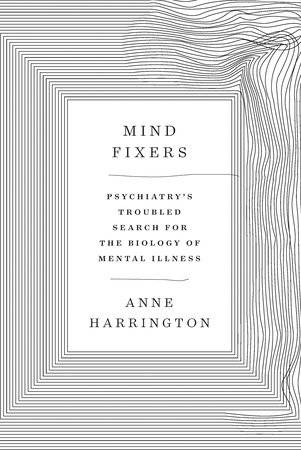
For the longest time I’ve been looking for an impossible book: an historic exploration of psychiatry and psychology over the last 150+ years that lays the groundwork of how we got to where we are (with the infighting, the arrogant spectacles, the tentacles of private interests), that also isn’t painfully academic or with too little (or too much) of the author’s own perspective of such a unwieldy topic. Well, as I said, it doesn’t exist, but Anne Harrington’s Mind Fixers comes very close.
As the subtitle states, Harrington (a science historian and the Franklin L. Ford Professor of the History of Science at Harvard University) has her lens steadied on the search for the (real, perceived, and ultimately elusive) biological underpinnings of mental health conditions. This is a terribly important topic and if this book has not ignited the debate it might have, it’s no reflection on the scholarship or insights gleaned from Mind Fixers, but perhaps a victim of timing and not being the loudest possible controversy to be found on Twitter. Even then, if you follow psychologists, psychiatrists, and those who specialize in related research on Twitter you’ll soon find yourself inundated with accusations of anti-psychiatry levelled at those who criticize prevailing notions of mental illness being caused by chemical imbalances in the brain, while the replication crisis undermines many of the foundations of Psychology 101.
If there’s a story here, it’s one of shifting hegemonies: from those who were concerned of their patient’s physical wellbeing, to those concerned with their brains, from those concerned about subconscious maternal conflict to those convinced the answer was in our brains, but only chemically. And with each shift in search of a possible answer to mental suffering there are reciprocal shifts in public investment and, eventually, interest from pharmaceutical companies. And at the end of the day what shifts the most are some of the most vulnerable people in our society: from sanitariums to hospitals; from wartime battlefields to community centres…only to be dumped onto the streets. It’s all here in Mind Fixers, and it’s a timely read considering the vested interests currently luring large investments in brain science, or in such promised but potentially dangerous remedies as ketamine, or those convinced of a genetic pathology. And if it sounds as if this book is strictly for history/psychiatry wonks you are dead-wrong.
What Harrington does very well is take reams of historical information and distill it into a narrative that ultimately maps out how those with what is generally called (though I hold some hesitations at times) mental illness were treated and what those in their charge felt was at play inside their bodies. Along the way we see ethical lapses in the form of wholesale human experimentation (i.e. injecting unknowing patients with blood infected with malaria), as well as the overreaching ideal of Freudian psychoanalysis as a Rosetta stone. Along the way we are introduced to ideas and theories which seemed to make sense at the time — narcosynthesis, insulin coma therapy — along with travesties such as deinstitutionalization, basically the dumping of people with mental health issues on the streets as a result of overambitious government policy that was out of sync with the realities of state coffers. Mind Fixers is also blunt about the influence of pharmaceutical companies, who increasingly figure in the narrative; the last quarter of the book is an admonishment of the profiteering that took place from the mid-1980s to the mid-00s as companies such as Eli Lilly were able to advertise directly to Americans and, with the help of an increasingly subjective DSM that allowed two people with completely different symptoms to be diagnosed with the same disease, exponentially increase their profits through prescriptions.
There are some issues. Repeatedly, Harrington refers to the “neo-Freudians” who, in their day (mid-20th century), held the reins of power with respect to diagnosis and how psychiatric trends were approved. There is a lot of confusion (just look at the definition provided on this U of C Berkeley page) about what a neo-Freudian is: those who studied but ultimately disagreed with Freud (however kept his strictly psychodynamic approach) or those who held Freudian views but refused to downgrade the role of biological processes? It may sound semantic, but in lieu of a definition the term’s repeated use without context begs for clarity. In the process it also makes it sound as if all psychoanalysts were in some way Freudian adherents. What about Melanie Klein and the rest of the object-relations movement? How did they differ? Indeed, the role of plain ol’ talk therapy — explicitly Freudian or not — is given short shrift, which might sound understandable in a book looking at biological underpinnings, but as a tool in the arsenal against so-called mental illness its absence feels odd, especially in light of the author’s emphasis on the misdirections of neo-Freudians. I get that Harrington could easily have written a book three times its size on her chosen topic. But if you’re going to talk about the influence of Freud and psychoanalysis in general then I feel you have to unpack and contextualize a bit more than what is on display here.
For the most part, however, Harrington is surprisingly fair-minded, not only unveiling the naked greed (and capricious biological arguments) of psychopharmaceutical manufacturers, but highlighting the testimony of those patients who were — placebo effect or not — helped by their medications, even if it came at a cost of other aspects of their health. She is by no means on a mission to dispel the notion of a biological source of mental illness, as I’m sure some vested interests might think looking at her book from a distance, but rather to show how partisanism, arrogance, and greed have wasted decades of valuable mental health research as we swing from trend to trend.
Mind Fixers: Psychiatry’s Troubled Search for the Biology of Mental Illness, is available at an independent bookseller near you, or online.
The One I Feed
If I’ve learned anything this year it’s the command, perhaps even the primacy, that music holds over my creative life, which is strange(ish) for someone who isn’t a full- or even part-time musician. Let me qualify “someone who isn’t a full- or even part-time musician”: I can play drums decently well, I’m barely adequate on keyboards, and I’m beginning to develop confidence on electric guitar. But there are no stakes for me: I’m not in a band, I’m not hoping to become a recording artist. So, as an established/emerging writer, what’s the deal?
The deal is that music presents as part of a triumvirate of full-blooded influences on me: music, film, and writing. I am incomplete as an artist without one of these. Don’t get me wrong, I love other forms of art — dance, painting, sculpture, etc (to infinity) — it’s just that my DNA is activated by music, film, and writing.
But the predominancy of music in my life sometimes has me worried.
Let’s start with writing. Music twists around my work almost symbiotically. The Society of Experience involves a character whose day job is a music supervisor for film and TV productions, and thus the narrative is punctuated with songs from the very beginning; the main character is sometimes haunted by the sound of a jukebox in the bar beneath his apartment. And yes, of course I created a soundtrack for the book’s launch (which features music mentioned within as well as inspired by the themes and subject matter). My next novel, Radioland, involves a “successful” musician having a nervous breakdown. The novel I’m working on right now, [untitled matt cahill project], involves the power of a DJ on a young boy in the country. If I could afford the rights I would quote song lyrics to introduce book sections.
Even when it comes to film, music has been immensely influential. From the quirky soundtrack of Brazil to the Wagnerian flourishes of Excalibur, I have not only fed deeply on music scores and soundtracks but have followed a countless number of rabbit holes. If it hadn’t been for watching Underground, I wouldn’t have spent a year chasing down recordings of Serbian brass band music. In film school, one of the best things I ever did was a one-take b&w short I shot on a wind-up Bolex that I played back w/ The Jesus and Mary Chain’s Reverence blasting in the background.
I care deeply about music to the extent that, on a social occasion where we were taking turns playing songs on a nearby jukebox based on a chosen theme, I was asked to choose 3 songs I hated. I said I wouldn’t. And I wouldn’t because a) it meant sitting through 3 songs I hated, and b) life is too short to listen to songs you don’t like. It made for an awkward moment and I felt somewhat precious, but that’s how it goes when you take a principled stand about most things.
So, my worries, however ephemeral, are whether I’m suffering from a blindspot in how I prioritize music. Is it a blinder? Is my appreciation for it distorting my perspective insofar as my writing (in particular) might suffer? I don’t know. I don’t have a lot of artist friends, and the ones I do have probably wouldn’t deem this to be something worth much concern. That said, sometimes I wonder: am I using one art form to inform and/or expand another, or am I misusing either/both? Should I be concerned when things become sacrosanct?
These are not really questions that require answers, but as an artist who wishes to be reasonably self-aware, they are good to ask nonetheless.
The Memphis Effect
As mentioned in my last post, going to Memphis had an effect on me. One thing that it affected that I didn’t have the space to mention was how I was influenced musically.
First, let me tell you about American museums (or at least museums in Memphis): unlike here in Toronto (I’m thinking of the ROM) where you are basically in an Ikea and are able to roam about and find the exits freely, the museums I went to in Memphis (namely the National Civil Rights Museum and the Stax Museum of American Soul Music) subscribed to a similar script. First, thou shalt sit and watch an obligatory documentary for at least 12 minutes before entering said museum. Second, after said documentary has been screened, thou shalt exit through appointed theatre exits and continue through a prescribed path until the gift shop approacheth, not unlike a mouse in a maze.
Thing is, during the Stax documentary (which was very well done, as was the NCRM doc), I witnessed the apparition of Sister Rosetta Tharpe. Now, if you have a decent knowledge of rock-and-roll, you might have heard Sister Tharpe’s name as an early influence on the genre. This is similar to how some of us might hear the name Kepler attributed to astronomy or Cruyff as pertains soccer. I sat there on that Saturday afternoon (I was amongst a cohort of three people) and watched an excerpt of her performing the gospel standard Down By The Riverside with a choir behind her, ripping into her white Gibson SG for a ridiculously soulful guitar solo.
That did it.
Leaving Stax, I proceeded to watch everything I could on Tharpe, with particular attention to her electric guitar performances. This was not someone playing rhythm guitar while she sang, strumming chords. Just as her voice had a beautiful, soaring quality with a lot of power behind it, so did her guitar work. Technically and tonally she was (and is) extremely expressive, demonstrating a vocabulary of electric guitar playing that predated rock-and-roll as we know it, combining both religious and secular gospel with R&B. There are a number of good places to read more about her — here’s one. And another. It’s no surprise that when she was finally (belatedly) inducted into the Rock and Roll Hall of Fame, it was Alabama Shakes’ Brittany Howard who introduced her.
But I wanted more. I was inspired to the degree that I wanted to explore what I saw beyond listenership. And so I did my research, and after a couple of weeks, I located a guitar teacher. And after a lesson or two, I ended up locating a semi-hollowbody guitar — an Epiphone Riviera Custom P-93 (pictured) that someone was selling because they weren’t finding use for it.
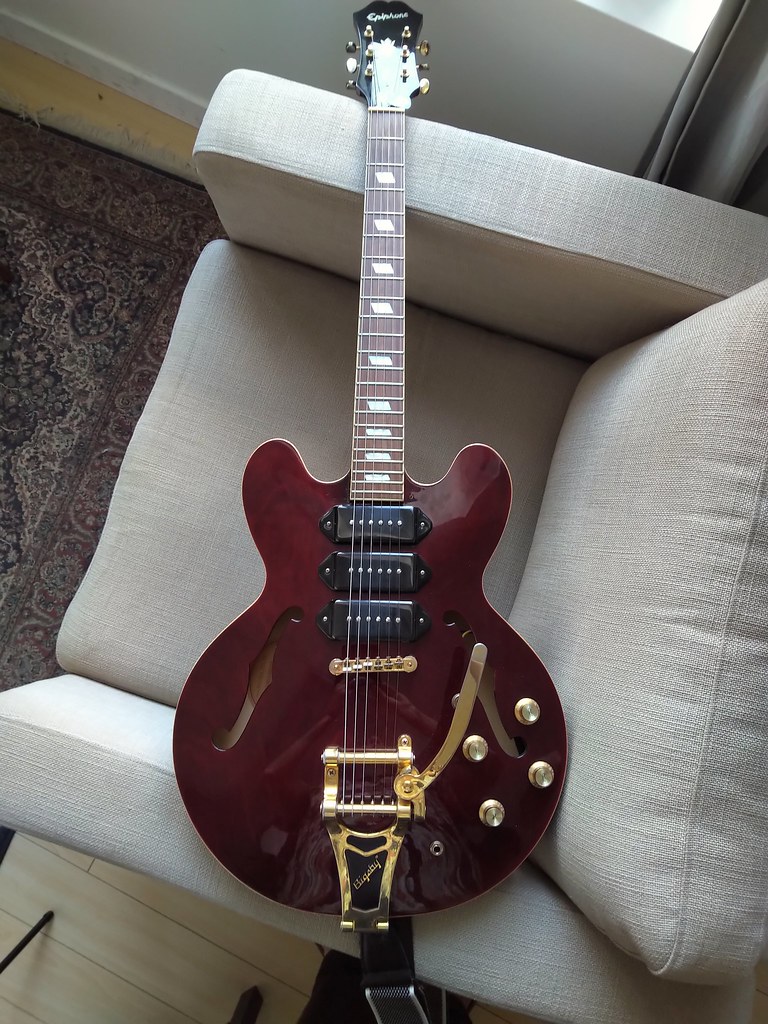
I play drums and can do adequate keyboards, but I’ve never (ever) wanted to learn to play guitar (just magically “play” it? Sure, but not actually learn the thing), despite the fact that some of the greatest influences on me are from guitar-driven music. Learning guitar is a strange yet rewarding process of teaching the increasingly calloused finger tips of my left hand to traverse the frets and coordinate themselves, touching the strings at first hesitantly, then, with practice, confidently. Oh, and then there are the pickups, the tuning, the tremolo bar. I’m not doing this because I want to start a band or play on stage, but rather because I’m drawn to this process, and a relationship that I am building with the instrument.
What am I learning? Mostly surf and rockabilly, for the time being.
Here’s more SRT: