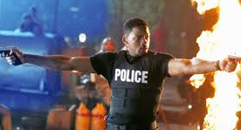
 When I saw that David Hyde Pierce was going to be in a movie where he got to play a villainous dinner host, I thought it had everything going for it. When, later, I saw the trailer for the film, I found myself very much interested in seeing it.
And then nothing happened. I never saw it released in theatres. It didn’t even make the local rounds as a limited or art house theatrical release.
Then, one day, I’m walking through Queen Video and I see it on the shelf. Hot damn, thinks I. I take the tag to the counter and the cool video girl says I really want to see this. I then comment on the fact that I never saw it released in theatres, that this is typically – certainly not in this movie’s case – the mark of Cain. I think we both looked at each other for a moment, then I settled up and took the DVD home.
The Perfect Host has a great premise: a bank robber (Clayne Crawford, eerily reminiscent of Ray Liotta), fleeing capture, takes shelter under false pretenses as a guest of Warwick Wilson (Pierce), a rather elegant, if odd-mannered home owner who is about to throw a party for friends. However, the thief discovers that his host is more than he seems – that he is in fact a sadistic bully who wants to have fun with his prey.
The problem, and this becomes apparent quite soon, is that Warwick’s impending dinner party is all in his head. His guests are imaginary. That’s right: HE’S INSANE. This wouldn’t be so bad if it wasn’t for the fact that the trailer didn’t really make this apparent, and suddenly what promises to be a suspenseful nail-biter (a thief hiding in a crowd of strangers sizzles on the page, after all) turns into a ho-hum, sometimes awkward two-hander. While David Hyde Pierce (who many will know as Niles Crane, from TV’s Frasier) is certainly up to the job in the role of Wilson, the script hits an early dead-end after the initial setup, leaving him and Crawford to play in a lame version of Sleuth as directed by Quentin Tarantino.
What’s worse is that, despite the low-budget compromises and lack of other real characters to impact upon the action (after all, who gives a shit about what imaginary house guests think), The Perfect Host shows promises of becoming a better film via flashbacks of the thief’s backstory, but by the last act (and certainly the ending) the logic is stretched beyond respect for the intelligence of the viewer, with far too many plot holes. Considering the talent wasted, this is sort of tragic.


 For someone like myself, who makes his living working in film, it would seem perilous to declare a “favourite” Canadian filmmaker. However, it’s a no-brainer that one of them is Denis Villeneuve. Ever since I saw his Genie award-winning
 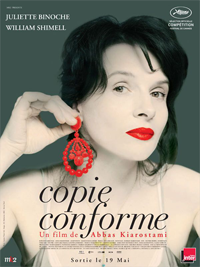 Certified Copy is certainly in the running for one of the best films I have seen in 2011. You would not guess this by looking at the poster or the anonymity of its title. Two things do stand out to me immediately: actor Juliette Binoche and director Abbas Kiarostami. Binoche is one of the greatest of her generation, able to transform herself at will. Kiarostami is not a household name but is nonetheless a master of intimate cinematic storytelling (A Taste of Cherry). Certified Copy is about an English writer (William Shimell) and a French art dealer (Binoche) who spend the day in Tuscany together. He is there on a book tour, and she is there ostensibly as his handler.