
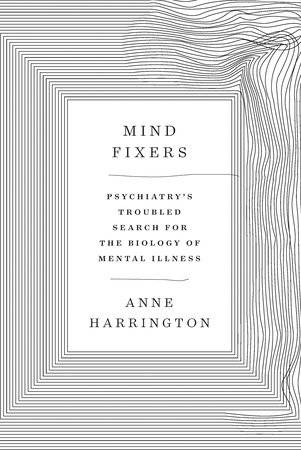
Book Review: Mind Fixers: Psychiatry’s Troubled Search for the Biology of Mental Illness, by Anne Harrington

image of

For the longest time I’ve been looking for an impossible book: an historic exploration of psychiatry and psychology over the last 150+ years that lays the groundwork of how we got to where we are (with the infighting, the arrogant spectacles, the tentacles of private interests), that also isn’t painfully academic or with too little (or too much) of the author’s own perspective of such a unwieldy topic. Well, as I said, it doesn’t exist, but Anne Harrington’s Mind Fixers comes very close.

As the subtitle states, Harrington (a science historian and the Franklin L. Ford Professor of the History of Science at Harvard University) has her lens steadied on the search for the (real, perceived, and ultimately elusive) biological underpinnings of mental health conditions. This is a terribly important topic and if this book has not ignited the debate it might have, it’s no reflection on the scholarship or insights gleaned from Mind Fixers, but perhaps a victim of timing and not being the loudest possible controversy to be found on Twitter. Even then, if you follow psychologists, psychiatrists, and those who specialize in related research on Twitter you’ll soon find yourself inundated with accusations of anti-psychiatry levelled at those who criticize prevailing notions of mental illness being caused by chemical imbalances in the brain, while the replication crisis undermines many of the foundations of Psychology 101.

If there’s a story here, it’s one of shifting hegemonies: from those who were concerned of their patient’s physical wellbeing, to those concerned with their brains, from those concerned about subconscious maternal conflict to those convinced the answer was in our brains, but only chemically. And with each shift in search of a possible answer to mental suffering there are reciprocal shifts in public investment and, eventually, interest from pharmaceutical companies. And at the end of the day what shifts the most are some of the most vulnerable people in our society: from sanitariums to hospitals; from wartime battlefields to community centres…only to be dumped onto the streets. It’s all here in Mind Fixers, and it’s a timely read considering the vested interests currently luring large investments in brain science, or in such promised but potentially dangerous remedies as ketamine, or those convinced of a genetic pathology. And if it sounds as if this book is strictly for history/psychiatry wonks you are dead-wrong.

What Harrington does very well is take reams of historical information and distill it into a narrative that ultimately maps out how those with what is generally called (though I hold some hesitations at times) mental illness were treated and what those in their charge felt was at play inside their bodies. Along the way we see ethical lapses in the form of wholesale human experimentation (i.e. injecting unknowing patients with blood infected with malaria), as well as the overreaching ideal of Freudian psychoanalysis as a Rosetta stone. Along the way we are introduced to ideas and theories which seemed to make sense at the time — narcosynthesis, insulin coma therapy — along with travesties such as deinstitutionalization, basically the dumping of people with mental health issues on the streets as a result of overambitious government policy that was out of sync with the realities of state coffers. Mind Fixers is also blunt about the influence of pharmaceutical companies, who increasingly figure in the narrative; the last quarter of the book is an admonishment of the profiteering that took place from the mid-1980s to the mid-00s as companies such as Eli Lilly were able to advertise directly to Americans and, with the help of an increasingly subjective DSM that allowed two people with completely different symptoms to be diagnosed with the same disease, exponentially increase their profits through prescriptions.

There are some issues. Repeatedly, Harrington refers to the “neo-Freudians” who, in their day (mid-20th century), held the reins of power with respect to diagnosis and how psychiatric trends were approved. There is a lot of confusion (just look at the definition provided on this U of C Berkeley page) about what a neo-Freudian is: those who studied but ultimately disagreed with Freud (however kept his strictly psychodynamic approach) or those who held Freudian views but refused to downgrade the role of biological processes? It may sound semantic, but in lieu of a definition the term’s repeated use without context begs for clarity. In the process it also makes it sound as if all psychoanalysts were in some way Freudian adherents. What about Melanie Klein and the rest of the object-relations movement? How did they differ? Indeed, the role of plain ol’ talk therapy — explicitly Freudian or not — is given short shrift, which might sound understandable in a book looking at biological underpinnings, but as a tool in the arsenal against so-called mental illness its absence feels odd, especially in light of the author’s emphasis on the misdirections of neo-Freudians. I get that Harrington could easily have written a book three times its size on her chosen topic. But if you’re going to talk about the influence of Freud and psychoanalysis in general then I feel you have to unpack and contextualize a bit more than what is on display here.

For the most part, however, Harrington is surprisingly fair-minded, not only unveiling the naked greed (and capricious biological arguments) of psychopharmaceutical manufacturers, but highlighting the testimony of those patients who were — placebo effect or not — helped by their medications, even if it came at a cost of other aspects of their health. She is by no means on a mission to dispel the notion of a biological source of mental illness, as I’m sure some vested interests might think looking at her book from a distance, but rather to show how partisanism, arrogance, and greed have wasted decades of valuable mental health research as we swing from trend to trend.

Mind Fixers: Psychiatry’s Troubled Search for the Biology of Mental Illness, is available at an independent bookseller near you, or online.

Share

Book Review: Casting Light on the Dark Side of Brain Imaging

Whenever a mental health authority is interviewed in the media it’s nearly inevitable that this person is a medical doctor, usually a psychiatrist. This individual typically isn’t a practicing therapist; they may only be able to speak of clinical diagnoses and/or the prescription of psychopharmaceuticals. I mention this because when this authoritative psychiatrist is interviewed in the media I end up listening to a depiction of the massively complex human interrelational landscape I see around me every day, as both a writer and psychotherapist, reduced to a chemical imbalance in someone’s brain. It’s like ascribing a boxer’s loss of a title match solely to the width of their biceps.

book coverThe gold standard for looking at mental health is through what’s called a biopsychosocial lens, a flexible model that allows professionals to consider the biomedical (for example, thyroid issues, dementia), the psychological (traumatic experiences, abusive relationships), and socio-economic factors (unemployment, impoverished environment) that might be at play in the mental health profile of any given individual, even if it ends up a combination of one or more parts. In North America there is unfortunately a sacred primacy around the biomedical approach to mental health, with the psychological and socio-economic as (at best) secondary considerations at the table of funding and education. At this moment there are medical doctors losing sleep wondering how to beat the shame of knowing there is a patient in their care whose condition might be psychogenic (meaning, whose pathology is not, strictly speaking, a biomedical end product). Continue reading “Book Review: Casting Light on the Dark Side of Brain Imaging”

Share

Pain, pt. 3

So, according to the chiropractor I was referred to, I have an irritated disc [“subacute grade III mechanical low back (irritation of the L5/S1 disc, affecting the L5 nerve root on the left”)]. It’s nice having an answer. It’s also nice to hear that, contrary to what my impatience tells me, I’m doing very well (though I’d leave out the “…for your age” part, ahem). Basically, she said to keep doing what I’m doing and give it time.

The pulled Achilles is slowly healing. Ironically, though it didn’t stop me from running that 8K race, it does prevent me from doing my baguazhang forms due to the crouching stance required.

In the meantime, the weather is warming up, my winter coat is spending most of its time unused.

Again: give it time.

Share

Pain, pt. 2

The short version: it turns out that what I have isn’t piriformis syndrome.

The long version is that if it were piriformis syndrome it would be gone by now. The pain has been alleviated greatly, but there is an odd pattern to the soreness, and overall it’s overstaying its welcome. I’m inclined to believe my TCM clinician when he suggests it’s a herniated lumbar disc. This would explain the prolonged condition, as well as how the pain is activated by any unhealthy sitting that messes with my spine’s alignment.

So, I need to be patient. This is new territory for me.

The good news is that I was able to take part in the Spring Run-Off 8K in High Park — something I’d signed up for a couple of months ago. I was prepared to sit it out (albeit miserably), however I felt good enough to take part, so long as I kept my target limited to crossing the finish line vs achieving any particular run time. In the end I crushed my expectations and pulled off a solid performance for someone who hasn’t run in weeks (and didn’t injure anything in the process).

The bad news is that, the day before the race, I was stepping off a sidewalk to cross the street at a light when I pulled/tore something in the heel of my right foot. This would be the Achilles tendon. Luckily, as running goes, I’m not a heel-striker, so it didn’t bother me on race day (now that would have been a cruel reason to cancel). That said, I have yet another part of me to rehab.

Share

Pain

I have this weird, recurring thing. It starts with a dull soreness in my left glute, kinda like someone kicked it the day before and it feels bruised. Then, in a day or so, an odd stiffness and soreness stretching from the glute all the way down the back of my left leg, going down to my ankle. Within a day or so it reaches the zenith of its pathology: pain.

Two weeks ago yesterday I tried getting out of bed. I swung my legs over to the side of the mattress, and between that everyday action and my feet touching the floor I became a crumbled mess, bent over in agony. I was in so much pain I was crying. I was unable to stand. I was unable to sit. I was unable to do anything without experiencing the sort of intense, unrelenting pain that makes you realize in seconds why anyone would unhesitatingly reach for opiates.

What I have goes by two names: pseudo sciatica, or piriformis syndrome. The sciatic nerve travels from the spine and down the leg where it provides sensation to the skin of the foot and the lower leg. Unlike classic sciatica which involves irritation of the nerve from the spine via a disc, what I got is caused by the irritation via the piriformis muscle — something you’ve likely never hear of, but it’s a band of muscle in the core of your glutes. If the piriformis is aggravated it can bother the sciatic nerve in a similar way to classic sciatica. [Update: please see the follow-up post]

I’ve described the pain to people as like having your hamstring replaced with razor wire. It’s actually worse, because of how the pain “glows” all through the leg. At its worst, the pain cuts through your thoughts, your feelings. It takes priority over everything. It doesn’t care if you are happy or if you had plans to go somewhere that day. I’m always humbled by how quickly physical pain cuts through everything, taking priority, and how it terrorizes me with its power. I end up impatient with others, downright angry 24/7. I catastrophize: this is never going to end, I’m going to be like this forever.

I can afford physiotherapy, which makes me lucky. I don’t have health benefits because I’m self-employed, so anything not covered by provincial health care comes out of my wallet. I immediately checked myself into a physio clinic and I remember being furious: this again. This being physio. Physiotherapy (and related physical therapies) is something I have a good deal of experience with and I never hesitate to recommend it to people; the irony is that when I find myself being forced to return to physio it feels as if I’ve failed at something. Something tells me I’ve been irresponsible, which is silly.

Piriformis syndrome can happen to people who sit a lot. While I’m one of the most physically active people I know (I walk to work every day, I go to the gym, I run, I practice baguazhang) my job as a psychotherapist means I’m sitting for an hour at a time. Piriformis syndrome also prefers distance runners, which makes me a prime candidate.

For the last two weeks I’ve been doing physio exercises three times a day, combined with visits to a clinic, combined with acupuncture and Chinese medicine. Progress was very, very slow. The last time I had this it lasted all of a week or so, and I was able to work it out on my own with stretching and massage. This time it’s been remarkably more painful and long-lasting.

Yesterday, on the two week anniversary of not being able to stand out of bed, it felt like something had subtly changed. My mobility felt more easy, I didn’t have the feeling like I couldn’t extend my lower leg when I was walking on the sidewalk doing errands. I stayed outside, pushing myself a little, forcing myself to stay active. Today, for the first time in many weeks (partly because of the terrible weather we’ve had) I was able to practice ba gua outside on our terrace. I nearly cried.

My relationship with physical exercise is a personal one. It allows me to connect with my body. It is embodied movement, whether it’s running a 10K circuit or doing ape offers fruit. I’ve gone two weeks without any chance of significant exercise, and so the things that gave me internal relief — running, baguazhang, gym — were off-limits, which in turn made me miserable, feeling imprisoned.

I suppose I’m sharing this because it’s important to take a moment to reflect on the relationship between body and mental health. How it directly affects my spirit. The pain is slowly receding, I have my mobility, and I know that soon I’m going to be able to run outside and feel better. But my experience pales beside anyone with chronic pain, and I am humbled when I consider anyone who has to go through life under such conditions, be they due to injury or living conditions. Not to mention the fact that, when this has passed, I will have spent hundreds of dollars on physical therapies that many cannot access.

Share