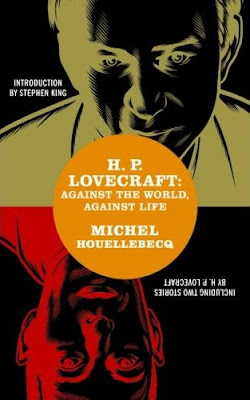
When I first noticed a series of novels in a local bookstore by a writer I’d never heard of, with a strange last name (reminiscent of Benelux origins rather than French), I proceeded to do some research – as I often do when faced with a writer I’ve discovered – to find which book I should read first. This writer was Michel Houellebecq.
I ended up picking The Elementary Particles, which I reviewed earlier this year. However, during my search I discovered – to my astonishment – that he had written a biography of H.P. Lovecraft (!)…complete with an introduction by Stephen King (!!?!). I will tell you that, even if I ended up throwing Elementary Particles across the apartment in disgust, I would still have purchased the biography. How do I put it… It’s as if Vincent Price wrote a biography of Boris Karloff, or if David Lynch wrote a biography (inevitably it would be a Faber edition, you know this) on Andrei Tarkovsky. Irresistible to this mere mortal.
In the end, though tempted on a few occasions to throw said novel across said apartment (and/or unsaid streetcar), I liked Elementary Particles. It’s a tough novel; not “tough” in a muscular, masculine sense, but rather “tough” in a mentally-I’m-squinting-because-he’s-pouring-acid-on-humanity-in-the-way-only-a-French-intellectual-can sorta way.
Back to the book at-hand. When I was a kid I read a lot of horror/mystery books, and yes, Stephen King was among them. I also recall reading H.P. Lovecraft, whose style I found to be as instantly recognizable as, say, a painting by Mondrian or Kandinsky. One only needs to read the first paragraph (or sentence) and you know it’s Lovecraft. The same instant familiarity cannot be said of many writers, whether they be pigeon-holed in lit or genre fiction. The thing is, I never really got around to reading much of Lovecraft’s work, seeing as the time at which I discovered him was a sort of indeterminate period in my teenhood, from which I have few fond memories; as often happens when you step away from darkness, you also step away from everything else that was appended to the darkness, good or bad.
Lovecraft has always been at the back of my head as a writer I wanted to read more of, so this biography served a dual purpose; not only does it have the introduction by King, but it also contains two of HPL’s “great texts” (as Houellebecq refers to them, rightly so), The Call of Cthulhu and The Whisperer in Darkness.
Indeed, King’s introduction is as predictably King-like as one familiar with his work would expect: engaging, funny, poignantly personable. And yet, when you stand back, you realise he probably just read the first twenty pages of the biography and, as they say, phoned it in. The thing is, I’ll take an introduction that’s phoned-in as long as it is two things: short and good. An introduction to a book, after all, is a like an opening-act at a rock concert; as long as their instruments are tuned and they keep an eye on the clock, I’ll clap.
The biography itself is not a traditional (read: dry, linear, boring, historicist) one. One must first understand, as I had an inkling of going in, that H.P. Lovecraft wasn’t a happy man. Nor was he likely to win a Humanitas Award for his insights into the enriching possibilities of mankind’s potential. And so, with his biography being written by Houellebecq – arguably a misanthropist’s misanthropist – the reader will have a unique opportunity: to see darkness filtered through another, somewhat sympathetic darkness.
Houellebecq does a very good job of tapping the man who was Lovecraft – his deep prejudices, his emotional and intellectual isolation from society – as well as postulating how the events of his life influenced the outcome of his work without the current populist habit of divining what isn’t known for sake of milking controversy. Lovecraft was a man who based much of what he wrote on dreams, whose one and only relationship with a woman ended with financial destitution and heartbreak. His racism leaked into the grim depths of his “weird tales” in the form of the onlooking “savages” and “half-bloods” who – particularly in The Call of Cthulhu – seemed to aid and abet the ancient evil lurking among us. Not a pretty picture in retrospect. There is also some interest in how Houellebecq calls to attention HPL’s habit of never mentioning two things in all his work: sex and finances.
And yet, while we may not wish to embrace Lovecraft the man, one cannot dismiss Lovecraft the writer. In reading The Whisperer in Darkness, arguably his masterpiece, one beholds a very seminal kind of horror; a slow, creeping alien night descending upon a remote Vermont farmhouse, revealed mostly through correspondence with the narrator, a professor of literature in Massachusetts. There is a poetry in Lovecraft’s prose, and by that I mean the ability to articulate flourished description with condensed, exacting verbiage. It is for this reason that HPL was (and is) such a seminal literary influence, not just in so-called genre circles.
I would not say Against the World, Against Life is essential reading. In fact, if you were to just read The Whisperer in Darkness or any of his other “great texts” you would be well served. However, there’s something alluring about having the life of such a tortured soul (remember that Lovecraft never lived to know his fame and fortune) rendered by someone so well-placed to plumb his depths. I suppose the question I would ask is: to what end? In this, I would say the book is not a great success, but there are nuggets of great interest for those drawn to both H.P. Lovecraft and Houellebecq alike.
H.P. Lovecraft: Against The World, Against Life, by Michel Houellebecq (ISBN:1932416188) is available at an independent bookstore near you, or online at any number of vendors.