Book Review: Deep Blues, by Robert Palmer

At the risk of coming across like a cliché–namely, a middle-aged white dude who’s really into the blues–I might as well lean into it, as I put this on my Xmas list for 2025.cover of book, Deep Blues

Sometimes I’m looking for The One Book That Will Explain The Thing I Want to Learn. This is often folly, especially when it comes to things relating to science, philosophy, psychology (and more!), but what I wanted was a way to piece together the myriad of the names I kept coming across in my listening and discovery of blues musicians; to put it into some sort of historical (and, ideally, geographical) context.

Robert Palmer’s Deep Blues does a pretty good job on all counts. It’s unique in that, published in the early 80s, it was written during a period when it was still possible to speak to many of the sources while they were among us, and it benefits from this perspective in ways that a similar book written today could not.

Palmer (no, not that Robert Palmer) begins with Muddy Waters cooling his heels at his home and reflecting on his success. It then goes back to the beginning, to the roots of how the Delta blues was formed. The author does a good job of providing not just a stateside perspective, but also draws parallels in how the fife and drum, and the holler-and-response style of music from the cotton fields of the Delta originated in West African song and instrumentation, such as the instrument that eventually became ubiquitous in the south, the banjo.

If there was an ur-Delta blues musician–someone who tied things together in an original way that hadn’t been done before–it was Charley Patton. I’m struck by the initial reaction to the first blues songs. I’m not talking from white folks, but from established Black performers such as Ma Rainey. The word most commonly used is weird. This is the value of good historical writing: informed perspective.

Because of the sweeping scope of the book inevitably there are parts that contain a roll-call of names that are almost impossible to register in a single reading, but if you have to start somewhere this is definitely it. Towards the end, deservedly given the rigor of Palmer’s journalism, there are touching moments such as the last days of harmonica player Sonny Boy Williamson (with added perspective from none other than The Band’s Robbie Robertson).

If there are any criticisms, there are two: the lack of women (hello, Sister Rosetta Tharpe) profiled, and most oddly the lack of perspective on race. The latter is a head-shaker. Palmer’s matter-of-fact prose seems to make it feel as if Black musicians just decided uniformly to move from the South to the North for economic reasons. Yes, he recounts the injustices Black people faced, but there’s no mention of Jim Crow and no mention of the Great Migration–these are not “woke” concepts but very real and pertinent things that a journalist at the time could have easily made room for a couple of paragraphs to include. Yes, there’s no such thing as The One Book That Will Explain The Thing I Want to Learn…but the lack of perspective on these two points do not help this age well.

Share

Me & Genre

What do I like in a book?

I like to feel immersed, whether it be in an environment, or character, or perhaps only a sustained tone; mix of any of the above is even better. I like books that make the everyday somewhat strange, or alternately making the strange seem ubiquitous. As a writer, I think this is what makes so-called genre books (typically sci-fi, fantasy, horror, western, etc) that much more challenging to pull off satisfyingly. I mean, sure, a lot of writers can pull of a few paragraphs or even pages of a genre story, but to do so in a sustained way, with a determined consistency…that’s hard. It takes a lot of work to do it well. Yes, yes, the literary small town book with the domestic intrigue also requires much of the above, but go ahead, you add menacing tentacles and see how far you can go.

I have a complicated relationship with the genre universe. I work in genre but I’m not wedded to it in as totalizing a way as many writers so firmly are. To the far end of what annoys me about genre works are tired tropes (laser guns! robots!) left unexamined, and to the far end of what what annoys me about what we call literary fiction, is the sense of an author proceeding to insert their head up their ass. I actually expressed this at a author talk in Winnipeg and I don’t think it went over well, but I reserve the fact that the other author I was supposed to appear with got his calendar mixed up, leaving me, the organizers, and the local audience (more than half expecting the author who didn’t make it) high and dry. In retrospect I wished I’d engaged more with the host–a much more committed author of genre than I–so that it was less about solo author me and my book, and opened up the discussion so that it was more a conversation and less what ended up being a short Q&A. That handful of author talks I did while publicizing The Society of Experience across the country (okay, Ontario and the prairies) were a learning curve for me, mostly in terms of learning to take more consideration of what an audience wants to hear, versus whatever thoughts are occurring to me while I’m in the spotlight. First rodeo, etc.

When you write a book like The Society of Experience, which riffs on a couple of genres–namely sci-fi, but also western (Derek’s The Lonely Cowboy stories)–but remains steadfastly literary, it can be easy to find oneself unsure upon which patch of the ice floe to stand on. I certainly felt more at home in literary circles because it’s largely what I read the most, and the novel was firmly that, however in the handful of more genre-forward appearances I made–conventions, reading series’–I found myself more often not seeing myself in the audience. They tended to be more capital-G genre readers, and I felt a bit like an imposter. I mean, there are worse problems to have in life, but being an artist is about connecting, and when you don’t see yourself in the room it can be weird, as if you’re doing something wrong.

With my novels, I’d like to think I’m doing something different. I’m kinda saying hey literary folks, you don’t have to make it so kitchen sink realistic, like The Diviners or Of Mice and Men, although those are excellent works (and knowing how to render a realistic environment is a huge skill). And at the same time I’m also saying hey genre folks, you can have three dimensional characters wrestling with things that aren’t literal tentacles. I have a suspicion Stanislaw Lem liked detective stories because so many of my favourite short stories by him involve the solving of a crucial riddle, often involving a terrifying event. And while he wrote almost exclusively in genre (sci-fi) his curiosity and want to mix these influences with his scientific  preoccupations make for fascinating reading. One story I would use as an example of this would be Ananke from the collection More Tales of Prix the Pilot; its use of a line from an Edgar Allan Poe story as a clue to an unravelling investigation on Mars is Lem firing on all cylinders. I swear it’s like taking a drug reading something like that; you just want to savour the rush for as long as you can.

A book is a book. A story is a story. It doesn’t need to correlate to any categorical expectation, other than it be worth the reader’s time and intelligence. And yet publishing–like any creative practice which survives on scant government funding and word-of-mouth– can get caught up in pettiness sometimes, which I find frustrating, and I don’t doubt, especially doing something different, that I’ve been the recipient of some sniping. I know I’m not a provocateur or some self-styled controversialist aiming to upset norms; I’m not trying to upset anything other than to demonstrate a hybrid style that is sometimes weird and different. Like most arts you need a thick skin for this, and I’m not just talking pub rejections.

Share

Retreat

I had the pleasure of spending a week as a guest (and sort of alumni) of The Pouch Cove Foundation, an artists’ retreat located in Pouch Cove, Newfoundland. While only about twenty minutes outside of St. John’s, it might as well be in the middle of nowhere, in the best possible way.

I went there to work on final changes to Book Three, and it was very productive. So much so that I’m hoping to hand off the book to my agent at the end of the month (fingers crossed). I was also happy to be sharing the retreat with a handful of visual artists who were preparing for a showing of their water-themed paintings in-progress. Writers and painters are different kinds of artists, insofar as painters come across as regular people when they’re not painting and writers tend to remain mumbly introverts when they’re not writing, not that we weren’t able to get together for the occasional beer and a chat in the evening. The good news is that we were all there to work and the setting was ideal for our tasks. And when we weren’t working, it was easy to step away and go on a hike along the East Coast Trail (in the course of one hike I spotted a pod of whales nearby and found myself tracked by a fox), or simply go down to the shore and admire the many gorgeous views.

Pouch Cove is one of the most beautiful places I’ve had the pleasure of visiting, and this marks a return for me after 20 years. Back then I was still working in film/TV but trying to get my act together as a budding author. A work colleague suggested I check out the retreat at Pouch Cove which, it turned out, her father operated. I was only able to get away for a long weekend at the time (because broke), but it was my first introduction to an artists’ retreat and I was able to develop some of the ideas that made it into my first novel, The Society of Experience.

James Baird, who runs the Pouch Cove Foundation, has been a tireless supporter of the arts community in Newfoundland for decades and is an extremely generous host to artists from all corners of the world. I’m very appreciative of his support and enthusiasm, and grateful to have had the opportunity to return.

It was hard to leave.

Share

Grants

It took someone on social media posting a reminder of an upcoming deadline for me to realize that I haven’t applied for a writer’s grant in the better part of three years. For anyone outside of publishing reading this, while there’s no obligation to do this (unless of course you’re depending upon writing for a living, in which case it pretty much would be an obligation), it can make life a lot less burdensome for those who want to be able to take time off work so that we might devote ourselves more thoroughly to our writing projects. Most of us secretly bend time and space to be able to spend a few hours here and there each week.

This strikes me whenever I’m researching residencies for writers. A lot of the ones I’ve been interested in have a time stipulation of something grand, like “at least three weeks”, and that’s a deal-breaker for me. I pay for residencies out of my own pocket, and typically 5-7 days is the max I can allot. This is where grants come in. The big ones, from the Ontario Arts Council and Canada Arts Council, have the capacity to provide wide financial support (in other words, scalable to the needs of the applicant, depending upon their professional and personal circumstances). The catch is that you have to go through the application process, which necessitates answering a lot of very detailed questions, not only about your project but about things like your budget (which in itself requires a breakdown of living expenses, etc). You have to essentially provide a compelling argument for the arts council awarding your project, as well as providing a reasonably accurate idea that you (the artist) understand what it is that you’re talking about from a financial perspective.

One of the reasons I’m writing this post is that I think it might be easy for outsiders to think that Arts Council grants are easily awarded, as if it were a question of simply hacking an algorithm. Let me assure you: they are not. If such were the case, there wouldn’t be professional grant writers marketing themselves (and paying their bills assumedly with something other than magic beans). Most artists might be able to summarize their projected finances, or describe their motivation for being an artist, or provide a captivating enticement for their current work-in-progress. Not many can do all three. And, just to add a dose of reality, even if you manage to ace all three, you’re still at the mercy of whomever is reading your application and whatever inevitable cognitive biases and preferences they have.

I’ve never received a big grant, though I’ve certainly applied. I supposed I stopped applying for the same reason I begin walking when I realize the streetcar isn’t coming any time soon; I’d rather try to achieve something on my own than be let down by something out of my control. That said, I run a small business. If I take time off, I don’t have any income. So yes, when I see a TWO MONTH MINIMUM on a writer’s retreat, I can get punchy. Truth is, there’s something strangely out-of-date about a framework whose parameters so clearly prohibit those who don’t have careers which allow such long absences.

The grant I mentioned at the beginning of this post is the Recommender Grants for Writers (via the Ontario Arts Council). It’s not nearly as big (or as arduous to complete) as others. I was lucky enough to have been awarded once before, which helped me book a flight out west to the Banff Centre for the Arts for a self-directed residency, so I pushed myself to submit a sample of Book Three to one of the indie publishers who are participating in the program this year, hopefully before their internal deadline (with this grant in particular, which runs from September to January, the deadline for submissions is set internally by the publishers).

One of the benefits of grant writing, and a reason for my writing this post, is that it can motivate (aka force) you to polish/revise/clarify your work for an actual (aka real) audience, even if you never see them or know exactly what they liked or didn’t. It can be a good prod to work on your bio (which a lot of writers freak out about), or the synopsis of your piece. I’d like to think there’s no downside, other than going through a bit of stress.

Share

Radioland: Cover Reveal and Pre-Order!

Hello all,

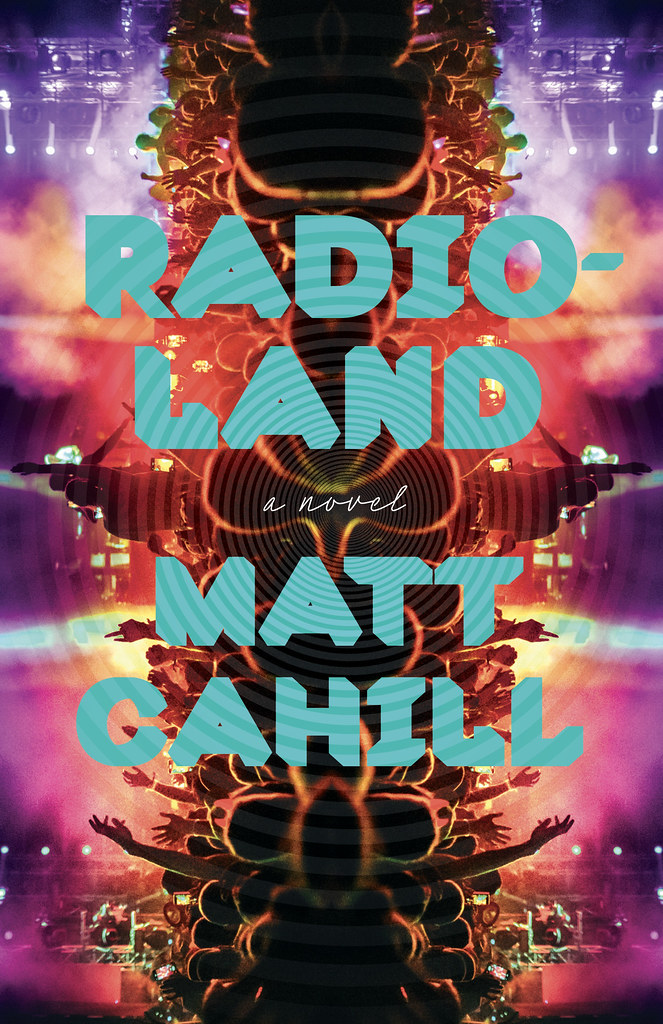
It’s been a time-and-a-half to get to this point, so it’s with a mixture of relief and exhaustion that I’m able to share the cover for my next novel, Radioland.

book cover for Radioland, my next novel

Nice, eh? The cover is by designer extraordinaire Ingrid Paulson.

This book has taken a lot work, and I can’t wait for you all to read it. Here’s another thing: it’s now available for pre-order, which means that you can order it now, and when it’s released (currently looking like October) it will get shipped to you ASAP then. Presales are also cool b/c they can build interest from stores, retailers, etc, so there’s that too. I trust you to do the right thing.

You can read more about Radioland on the publisher’s site (where you can also pre-order it): Wolsak & Wynn

You can also bug your local independent bookstore or local library to order it for you.

You can also pre-order it from these folks, too:

Amazon

Chapters/Indigo

Barnes & Noble

Share

Glenn Branca

I just discovered Glenn Branca. I don’t actually remember how this came about, but it was late last week that I tripped over him, perhaps as part of a randomized Spotify playlist or some post-rock/Minimalist rabbit hole I was chasing. [edit: what’s odd is that I couldn’t have discovered him on Spotify because what I’d first heard was a track from his tremendous early album The Ascension which doesn’t exist on Spotify; a bit of a mystery, I admit.]

It’s like both barrels of a shotgun going off. The first barrel fires and I’m like Whoa — what’s this? And all I want to do is dig further and research and figure out what the deal is with his music. The second barrel fires, and rather than reactive it’s reflective and I suddenly realize that what I’m hearing here, recorded many years earlier, was the essence of the calamitous and shambolic guitar orchestrations I was eagerly intrigued with from the generation of Montreal bands (usually on the Constellation label) I discovered in my 30s, namely Godspeed You Black Emperor, Silver Mt. Zion, and (to a lesser degree) Arcade Fire.

I found myself both thankful to have discovered his music and regretful that I didn’t discover him back in my late teens where for a while I was specifically searching for someone who might elevate the guitar to the heights of symphonic performance. Needless to say I’m mainlining pretty much everything I can listen to.

There’s a very thorough and well-reflected piece on Branca here, and I’m thankful that there are people out there sharing reflections like this.

Enjoy.

Share

Doing Research

A while back, I read a lovely piece about David Sylvian, vocalist with 80s new wave band Japan and an accomplished solo artist, and was struck by an observation he made, reflecting upon hearing a track by ambient artist Christian Fennesz:

‘What I liked about his work is that there’s a melodicism to it. It wasn’t all sample manipulation. lt really had a heart to it somewhere. I was talking to Ryuichi [Sakamoto] about two years ago and he said, “Do you still listen to music?” I said, “Well, I still tend to buy a lot of music and I listen to a fair amount of it. But I’m not touched by it. I’m not moved by it.” He said, “Yeah, that’s right. It’s just a process of education. It’s a means of finding out what is now possible with this or that technology. You’re no longer listening to music. You’re doing research.” And what I liked about Christian’s work is that there it all was: modern technology, but in the service of the heart. I always come back to the heart.

There are two things that stood out to me in this passage. The first was Sylvian speaking about how his relationship with music had changed. So, first, I suppose it needs to be contextualized that when someone is working in a creative field they should (unsurprisingly) not only be affected by but also actively familiarizing themselves with other artist’s works. The problem is that, after a number of years/decades, it can feel as if everything has been done. Note Ryuichi Sakamoto‘s question; it’s not Have you heard anything good lately. His question is distressing: Do you still listen to music? It raises the spectre of a rupture between an artist and their craft. Sylvian’s answer and Sakamoto’s response, while relieving also point to a sense of being lost. “Yeah,” says Sakamoto, referring to his listening habits, “that’s right. It’s just a process of education. It’s a means of finding out what is now possible with this or that technology. You’re no longer listening to music. You’re doing research.” In other words, the naive curiosity which can be so important for any artist has become dormant. Yes, you are still listening to music, but it’s become reference material; a question of keeping up; who’s doing what with which device.

I have not become anesthetized to music, and the reason for this is most likely because I am not a professional in that industry, and I’m thankful for this. I do relate to this situation with respect to TV and film however. Having gone to school and eked out a career in televised programming followed by long-form motion pictures, it became second nature to watch (and deconstruct) a wide variety of works. And having worked in the sausage factory for 20 years I must admit to feeling a resonant frequency with regards to moving pictures at least, reading Sylvian’s conversation with Sakamoto. Yes, I’m still watching shows and movies, but am I affected by them or am I simply filling in time with reference material? Let’s just say that I am not easily affected these days.

Which brings me to the second thing about this passage: deliverance. In coming across the track from Christian Fennesz, Sylvian seems to rediscover something. Cliché though it may sound, there is the sense of having faith restored. And who could not be struck by something that, while technically accomplished, is “in the service of the heart”? In other words, there is honesty in this work, and depth. Something that is ultimately restorative and worthy of kick-starting another artist’s relationship with their work once more.

I share this because it’s good to share stories of inspiration, and good to admit that sometimes inspiration can be hard to find.

Share

Writing Adv*ce: Constraints

Someone who is new-ish to writing is liable to want to have every option open to them when it comes to writing — this applies equally to fiction, creative non-fiction, and poetry. Get out of my way, this writer says to themselves as they roll up their sleeves, and just let me get to it. And there’s nothing inherently wrong with this ethos (most writing advice tbh is Janus-faced, in that the opposite could equally be true depending upon the context of the individual in question); writing can be (and often is) liberating.

But here’s the thing (because why else would I be writing this in my spare time if there wasn’t a point): sometimes having all the options open to you will have the opposite effect of liberty — it can incongruously create its own roadblock by virtue of being, well, too open-ended. If there are no boundaries it can often feel as if we are tasked with filling an abyss which might lead to a sense of paralysis. Do I write about this? Wait…what about that? The question of what you write about (or the angle you choose to write about it from) can be intimidating if there are no rules, no guardrails, no ceiling and no floor.

When I took part in a week-long writing intensive many years ago, which incorporated fiction and poetry writing, the end goal was for each of us to write a sestina. What’s that? It’s a form of poetry that carries with it very specific rules for how it is to be constructed and it is a massive. pain. in the. ass. Without exception, every person in my group — poet, non-poet, or (like me) something in-between — saw each day that approached the assignment deadline with a sense of dread. The sentiment could be summed as: this is bullshit. As in, this is bullshit, I should be free to write whatever and however I want. What is more freeing than Art, after all!? And yet, when I sat my ass down and began to work out how I would construct my sestina, which I admit was painful, I was also struck by how the constraint of the sestina form forced me to be very specific and focused on what it was that I was doing. Lo and behold, I ended up writing something I never thought I would’ve pulled off — and managed to impress the instructor in the process. It was an inspirational step forward to me, not just as an artist but as someone who reflects on the hows and whys of human behaviour.

A few weeks ago, a documentary was released on the band The Velvet Underground. Its director, Todd Haynes, an artist in his own right, set his own constraints on the project. Rather than having a bunch of present-day intellectuals and music nobility reflecting on the influence of the Velvets (ie how many music documentaries are constructed) he insisted on maintaining temporal and situational context in his choice of subject by only presenting people who were there at the time and place that the events unfold. For example, when the Velvets set out on an ill-fated tour of California he doesn’t interview anyone who was not part of that tour. No Warhol. No Jonathan Richman. Just whatever archival footage was available and/or surviving members of the band and entourage to speak to their experience. It makes for a fascinating and immediate way of telling the story without it being a nostalgic love-in or overly biased hagiography. You should see it.

What are other ways in which we might use constraints to help us focus? How about a police procedural with no police? A mystery told from the sole vantage point of a security camera? A poem expressing your current feelings but using excerpts/fragments from your teenage journals?

Constraints can guide and inform an artist’s work. Note I say can. Sometimes it’s good to go-for-broke and blow the doors off whatever it is you want to get off your chest without care for form. But whatever you do don’t forget that form itself can allow you, if counter-intuitively, to transcend your inner biases and intellectual confines.

Share

A note from Richard Chartier

I’m a fan of experimental composer Richard Chartier, whose solo projects (particularly under his Pinkcourtesyphone imprint) and collaborations (like this quiet monster w/ France Jobin) have received regular rotation in my eardrums.

I came across a newer composition last year which is sublime, however, of all things, it’s his artist statement at the bottom which caught my attention. I’m pasting it in its entirety:

A note from Richard Chartier
I find myself at the collision of an inflection point and more over a reflection point. 50 years on this planet. I still find it difficult to write about my work. This is not because I cannot, but because I want the listener to approach my compositions of sound as such. Focus on the sensorial nature rather than an explicit narrative or reasoning.

I do not see my work as abstraction but rather purely abstract.

I chose sound as my medium after many years as a painter. I slowly came to conclusion that I no longer understood how to communicate sensation via a pigmented surface. The visual language I was using had become foreign to me.

Sound allowed me a language that was wordless, open, moving, shapeless yet full of forms, connections, and progressions. It raised questions though and these are still part of what I struggle with in the ways I chose to create and then speak of my work

why these sounds?
what is the attraction to these sounds?
how did I arrive at these compositions and their placements?

The pieces exist then as less of a statement, more of a question, but a question that will be different for each listener. For me, listening to them over and over, they will take another form as time passes. They evolve. For now though, they are in limbo on a piece of plastic or a series of lines of data

Often i am puzzled by how other artists create their work, how they come to decide arrangements, sequences of sounds or just the sounds themselves.

That is the magic of music.

The reason I find myself coming back to this is its vulnerability, something I’ve heard in his music but have not been exposed to in terms of how Chartier himself– or any artist of his ilk — has chosen to represent themselves textually. Most artist statements are, to be perfectly honest, easily ignorable; they boil down to: “Here. Signed, x”. And that’s ok. I would prefer this to a ham-fisted statement which did the music (or the listener’s expectations) no favours.

Instead Chartier makes himself prone and speaks to the to-be listener not as an underling but an equal. Turning 50 recently myself, I can’t help but wonder what was going on in his life, his head, when he wrote this. There’s little ego evident, no unnecessary flourish of cliché (“So, me and the boys recorded this in a shack outside Fayetteville…”). Instead he lays himself bare and presents himself plainly, and emphatically. He allows us into his philosophical process, his inspiration, and his limits. He dares to express a certain innocence. This is not the Wizard of Oz, attempting to razzle and dazzle (and intimidate). Instead, Chartier allows the to-be listener to engage with him, and I think this approach is magical.

Share