Book Review: Cathedral, by Raymond Carver

I recently made the acquaintance of someone who works as a literary agent for TV and films. I didn’t know this when we’d been first introduced, just as she was unaware that I wrote fiction. In these sorts of situations I tend to play it cool, because the last thing I want to do is come across as a “desperate unpublished writer” (insert images from Dawn of the Dead) and thus endanger the non-professional relationship. Still, she nonetheless asked if I’d be interested in sending her some work to read. I obliged and, happily, she liked it very much.

We got to talking about writers and influences, and she asked whether I’d ever read Raymond Carver. I hadn’t (insert sound of audience hissing), though I’d heard of him. [It occurred to me later that I’d seen Robert Altman’s Short Cuts – which (very loosely) strung together several of Carver’s short stories into one long, dark ensemble piece.] It was when she mentioned that one of my stories reminded her of Carver that I figured I might as well find out for myself.

So, I picked up Cathedral, a collection of short stories at Babel Books & Music, a local second-hand bookstore and immediately proceeded to satisfy my curiosity.

Firstly, I was thankful. Yes, there was a similarity, but I found that the “world” Carver inhabited as a writer (I use the past tense because he passed away in 1988) differs from mine. This may sound selfish, but I still sometimes suffer from an irrational fear that everything I’m writing has been done by someone else, and that it’s only a question of time before I find out, like some sick Twilight Zone episode. But I digress…

And what, pray tell, is Carver’s world? It’s a sparsely urban, godless place, inhabited with people who find ways to ignore the mounting problems facing them. This doesn’t speak for all the stories, but it certainly summarizes the atmosphere. He paints as a writer what Edward Hopper writes as a painter (though I would argue that Carver’s characters probably aren’t as well-dressed, and if you’re wondering why I’ve switched from past-tense to present-tense, it’s that I’m trying to wittily suggest that the product of an artist can survive its creator’s demise). And yet, this world isn’t one that has gone to hell. There is love, though it is often tempered by the cool water of circumstance. There is even a sense of magic lurking in the shadows, albeit a neutral magic; one that can spell enlightenment or tragedy at the slightest moment.

Since this is a collection of short stories, providing a synopsis for each (or any) would probably spoil the pleasure of reading them – and despite the picture I paint of Carver’s literary universe (or at least that contained in Cathedral), it is a unique pleasure to read them. Carver is a model of tight writing – he takes the “why say in 30 words what you can say in 10?” mantra and says it in five. Most recently, an article in the New York Times highlights an ongoing controversy about the editorial authority of some of Carver’s published work, with speculation that some of this tightness may have been the work of an over-zealous editor.

In short, I clearly understand why Raymond Carver is praised as one of the great American writers: his vision is clear, even when the lives of his characters are muddied, and his writing style is immediate and bracing.

Cathedral, by Raymond Carver (ISBN: 978-0679723691) is available at an independent bookstore near you, new or second-hand. You can also purchase it at any number of online vendors.

Share

Book Review: Siddhartha, by Hermann Hesse

This is the second book I’ve read (and reviewed) from Hesse. Admittedly, after first reading Steppenwolf early this year, I was in no rush to go further just yet – that book was enough for my mind to deal with and left an indelible impression. However, hey, Siddhartha is only 122 pages…how much of a hassle could that be?

Thankfully, this svelte novella bares little resemblance to Steppenwolf‘s hallucinogenic soul-churning. It’s a simple, spiritual tale, reminiscent in style of works I read in my late-teens and early twenties (in particular: Khalil Gibran and Jiddu Krishnamurti).

The book begins with Siddhartha, the handsome and talented son of a Brahmin family, bidding farewell to his people and homeland. Driven to plumb the depths of spiritual knowledge, he and his best friend, Govinda, decide to join a group of Samanas – ascetic nomads who drift through towns and desert alike, denouncing all possessions. At first, Siddhartha takes to the group and spends a long time mastering their philosophy until he eventually finds himself dissatisfied and conflicted by the limits of their teaching.

Breaking away with Govinda in tow, Siddhartha journeys to find a group of monks attending an open lecture by the Gotama Buddha, their spiritual leader. Hearing Gotama speak, Siddhartha begins to finally understand his path. Given an opportunity to speak privately with him, Siddhartha extols the virtue of what Gotama has stated, but tells him that the path he sees for himself cannot be found following Gotama. The Buddha is surprised and asks him to explain, to which Siddhartha reveals his revelation: that the Gotama learned everything not by following others, but by making his own path, and if need be his own mistakes.

It is at this point that he and his friend break from one another – Siddhartha decides to go into a nearby town to find his way, and Govinda, equally taken by the words of Gotama, decides to follow him as one of his faithful monks. When he reaches the town, Siddhartha finds himself indulging in the flesh and physical manifestations of the world: he falls in love with a beautiful courtesan and finds a job with a wealthy trader. Years pass, and while Siddhartha accumulates fortunes and lavish tastes, his soul begins to buckle, his demeanour sours, as he longs for the path he thought he’d found. He eventually breaks away from the town and finds himself at the doorstep of a poor ferryman – it is there that he forms his understanding of the spirit, nourished with the help of the ferryman and the voice of the river.

In the end, Siddhartha’s path is one of profound simplicity – a result of his spiritual maturity aided by the fateful intervention of those in his past. In circumstances both tragic and sublime, he attains the peacefulness he was searching for, though in ways he was unable to perceive beyond his youthful revolt.

This book is oft-described as one of the more compelling European perspectives on Indian spirituality. I found myself, for the first quarter of the book, feeling as if I was going over familiar territory – concisely written, but hardly ground-breaking stuff. It was only at the point of Siddhartha’s revelation in the face of Gotama, that the Buddha himself never followed the teachings of others save for the lessons of personal experience – thus, why should Siddhartha be a follower? – that the book grabbed me. There is something Nietzschian in this; superimposing the perceptive defiance of an individual onto a “meeting by the river” of two minds, one old and wise, the other young and daring. To see what happens to Siddhartha, in many ways symbolic of those precious few who attempt to live by their learned convictions, is what drives the reader to finish the book. I don’t think anyone will be disappointed in Siddhartha, though to what extent they are inspired is another question – one which truly depends on the mind and soul of the reader.

Siddhartha, by Hermann Hesse (ISBN: 978-0811200684) is available at a friendly independent bookstore near you. Or online at any number of vendors.

Share

Book Review: Slouching Towards Kalamazoo, by Peter De Vries

There’s nothing sadder than to have contributed your soul to the world, and as a writer this contribution is more like a communion of flesh, only to find that, at the end of your life, everyone has forgotten about you.

Considered one of the greatest American humourists of his day, on par with the likes of James Thurber and Mark Twain, Peter De Vries was a prolific novelist who wrote over 20 books over the span of his life, most notably Tunnel of Love, The Blood of the Lamb, and Slouching Towards Kalamazoo. There is a fascinating, heartbreaking story about American society’s collective memory loss as it regards De Vries’ work here.

Humourist. The word feels like an anachronism. It conjures the image of an old man in suspenders, sitting on some honeysuckle scented Midwestern porch spinning tales of the County Fair of ’36 when Old Man Smucker’s pig got loose and… but this is all presumption. In other words, we’ve equated “humourist” with “rustic”. It’s wrong. We need humourists, whether they be satirists, parodists, or even the most groan-inducing vaudevillian showmen. We need to laugh – not just with grotesque cruelty, which is our current fixation, but thoughtfully.

Slouching Towards Kalamazoo is classic American humour: an extremely well written (De Vries was an accomplished linguist as well as an editor) portrait of a boy’s disoriented steps toward adulthood and independence in small-town society. It’s also terribly funny in places. His narrative style is never creaky or mannered; he tells the story, adds some window dressing, but always gets back to the point. The point: Anthony Thrasher, an intelligent yet under-achieving Grade 8 student falls for his teacher and winds up getting her pregnant. Compounding this is the fact that, due to his age and immaturity in the realm of the hands-on world, he doesn’t even fully understand the implications of what’s happened, having only the mythology of a boy’s speculation to cope with the problem. Meanwhile, his father, a devout church minister with a passion for reading literary classics aloud at the dinner table, is driving Anthony’s mother toward infidelity…with an equally devout atheist.

Combining a witty parallel retort to The Scarlet Letter – required reading in Anthony’s Grade 8 class – with a prescient view of the theist/atheist debates currently raging around us, De Vries manages to portray vivid characters that, aside from being given satirical names such as Bubbles Breedlove (a friend whom Anthony becomes smitten with later in the book), are touchingly real.

Profundity…? Perhaps. I’m not sure that would be the chief reason for reading Slouching Towards Kalamazoo. It’s delightful, character-driven storytelling with some killer dialogue. What more do you need?

Of all De Vries books, only two are currently in print – out-of-print editions are available via eBay and AbeBooks. Other than Slouching, there is his “dark book” as it’s been referred to, The Blood of the Lamb. I encourage people to give preference to independently-owned bookstores, but in this regard, given the scarcity of De Vries work, I’ll simply say that you owe it to yourself to check him out.

But don’t forget him.

Share

Book Review: The Master and Margarita, by Mikhail Bulgakov

Readers of this blog (both of you!) may have caught my previous mention of the strange road I took in finding Mikhail Bulgakov’s The Master and Margarita – not only the book itself but also this particular translation (self-published by Michael Karpelson – more on this later). Without exaggerating, it was well-worth the effort.
How does one describe this book? Well, considering all the fuss over Harry Potter as of late (or perennially, as it would seem), The Master and Margarita would seem a perfect literary tonic for anyone looking for speculative adult fiction. Hailed as one of the best pieces of Russian literature (not just speculative) of the 20th century, such praises can also be intimidating; visions of a depressing, Dostoevskian St. Petersburg, and the obligatory poverty and mental illness which filter to a bleak (if well-rendered) conclusion. This is not that kind of book.

One day, two members of the reigning literary elite meet in a park to discuss problems with the subject matter of one of their poems – it’s not atheistic enough, says the elder, and thus not worthy of publishing (this being Soviet Russia, under Stalin’s rule). No sooner is the question (and denial) of the devil raised, than the two are greeting by a tall, dark stranger who appears out of the blue and proceeds to describe how one of them will die. And, albeit under fantastic circumstances, it comes true.

Pretty soon, the stranger and his motley troupe – a clownish bloke with a broken pince-nez, a fang-toothed redheaded goul, and a large, talking black cat who walks on his hind legs – occupy a townhouse in the centre of Moscow from which they direct a chaotic spell over the city. Anyone it seems who gets in their way – usually members of the cultural privileged classes – either vanishes, winds up in the sanatorium, or is vanquished to another part of the country.

Who are they? What are they doing? All of this is unravelled (and exploded) the further into the book one reads. We meet the eponymous Master, a discouraged writer whose seminal work on Pontius Pilate is lain to waste by the bureaucratic tendrils of the sycophantic literary scene, and his faithful lover, Margarita – a married woman who would do anything to be free of her chains and reunited with him.

The Master and Margarita is a wild, throw-the-rulebook-out-the-door tale which manages to weave outrageous satire with eloquent speculation on morality. Bulgakov’s novel confidently navigates between deft, fantastic comedy and touching, emotional drama – without one disregarding the power of the other. Written under the tyrannical reign of Stalin from 1929 until Bulgakov’s death in 1940, it is both a response to the madness of that period and a triumphant individual statement.

I wouldn’t hesitate to recommend this book to anyone who is looking for something fantastic and unpredictable to consume them. It is truly a book that can be read and re-read numerous times, with each pass being as fulfilling as the next.

The Master and Margarita, by Mikhail Bulgakov (ISBN: 978-1411683051) is available at a friendly independent bookstore near you. Or online at any number of vendors.

A note about this translation: The translation I refer to above is the latest, by Michael Karpelson. While listed on Amazon, he is currently making small revisions to this edition which, combined with other projects in the works (another book by Bulgakov as well!), means it will not be available for the next while. If you like, I’ve received permission from Michael to post his email address – if you contact him, he can arrange for a copy of the existing edition to be shipped to you, as he did with me. His email address is: mkarpelson (at) gmail (dot) com. {psst – support independent publications}

Another note (June 24, 2010): I recently read another translation of M&M, by the prodigious team of Richard Pevear and Larissa Volokhonsky. I’m a little surprised, because it seems as if it’s longer than the Karpelson version (ie. it has slightly more content in places). Maybe that’s just me. It’s certainly the easier of the two to purchase, so I put this out there for you to contemplate.

Share

Book Review: Crime and Punishment, by Fyodor Dostoevsky

Rodion Raskolnikov, an impoverished ex-student living in St. Petersburg, methodically sets out to kill a money-lender. As if that isn’t bad enough, the cold-blooded murder goes terribly wrong, and – being a man of principle – he endures a multitude of agonies associated with his crime. Erstwhile, his mother and sister are moving to the city in preparation for his sister’s just-announced engagement to an ambitious cad.

All in all, it’s not a good time to be Rodya Raskolnikov, or for that matter, to live in St. Petersburg during the late 1800’s.

Crime and Punishment, completed in 1866, is a brooder of a book. It looks unsparingly at the lives of the desperate and destitute – comprising most of its central characters – and sends them in circles around a very lonely and philosophically distraught young man who makes a terrible decision: murder. It isn’t made in haste, but meticulously planned and carried out until the act itself is within his grasp, at which point it explodes in his face. Rather than empowerment, to be “a man and not a louse” in Raskolnikov’s words, he comes face to face with reality: his less-empowered and certainly more human inadequacies.

The problem, however, is that the police aren’t after him…or are they? He tries several times early in the novel to expose his crime, but barely arouses suspicion – if anything, people around him grow more and more concerned for his health. The irony is that it’s after Raskolnikov’s crime when everyone around him starts paying him visits and taking care of him – even though half the time he’s flirting with madness and fever. It is during this purgatorial reprieve from justice – with the police as close as his friends – that he is drawn into the lives of those around him and takes pains to emancipate the weak from their burdens.

Characters sad and corrupt walk into his life, often literally, and draw him into their own. Vacillating between pity, outrage, and spiritual agony, Raskolnikov takes great pains to make amends with those around him, sensing that the payment for his earlier crime is hanging inevitably in front of him, whatever turn he takes. After all, if the noose is in the mind, there are no lands you can escape to.

Crime and Punishment has many strengths, chief among them some of the best dialogue in literature. Surprisingly, there are great swaths of humour too, most notably Raskolnikov’s friend, Razumikhin – who becomes smitten with Rodya’s sister, the ravishing Avdotya. Dostoevsky, who spent four years as a political prisoner prior to writing C&P, writes honestly about the souls of those who are defeated by the circumstances of life. The city to which the book is seemingly dedicated – albeit in a poison pen fashion – St. Petersburg, comes across as a Gothic cesspool of poverty and corruption.

If there are drawbacks to Crime and Punishment it is the bleak hues in which the story is rendered. Although it is ultimately a book about the greatest aspect of humanity – fiery perseverance – there a number of parts that move at a snail’s pace. In particular, I found the fourth chapter (of six) to be burdensome. I say this in case anyone would take me for a masochist.

Still, I recommend Crime and Punishment to those wanting to pick up the classics, particularly written from Eastern Europe. In Rodion Raskolnikov, Dostoevsky has created a template of the tortured idealist that stands as tall now as it did in 1866.

Crime and Punishment, by Fyodor Dostoevsky (ISBN: 019 281549 0) is available at a friendly independent bookstore near you. Or online at any number of vendors

Share

Book Review: The Magus, by John Fowles

They don’t write books like this anymore.

The Magus was published in 1965, after the success of John Fowle’s The Collector. However, The Magus was written first. As a writer – especially as a novelist who has placed his first novel on a shelf so that he can focus on new work – I can empathize. The Magus is big, ambitious, and in many ways (especially for its time) controversial – this in spite of the fact that it largely takes place on a Greek island and features only a handful of characters.

Meet Nicholas Urfe, an English Oxford-educated drifter whose parents died when he was young. It’s 1953, and with nothing holding him to the ground (neither a sense of mortality nor morality), he spends his time hooking up with women and moving without direction. Needing a job, he happens upon a teacher’s position on an obscure Greek island, called Phraxos. He takes to it as any man in his mid-20’s would: with abandon and a sense of escape from duty. But there’s something to take care of first – the girl he just met, Alison. Despite feeling closer to her than anyone previous, he tells her he’s off and thus ends a relationship whose occasional torridness masked a begrudging love.

In Phraxos, Nicholas learns quickly – due to the desolate environment, the stale classroom, and the lack of female comfort on the island – that he’s made a huge mistake and feels he’s reached a virtual and philosophical cul de sac. It’s at this point when he happens upon Maurice Conchis, a shadowy European millionaire who lives on the far side of the island. What at first begins as a budding acquaintance based on Nicholas’ curiosity of the old man’s life, slowly turns into a devilish (and dangerous) game.

Enter Lily – a mysterious young guest of Conchis who at first appears to Nicholas like an erotic Siren projected from his host’s nostalgia. He becomes obsessed with her, first sexually and then emotionally, and begins to spend his free weekends with Conchis as the old man relates, bit by bit, the fascinating and sometimes horrific story of his life. Conchis soon reveals an elaborate live theatre which he has put on for Nicholas’ benefit. All is comfortable (in the most guiltily voyeuristic way) until he discovers that the theatre doesn’t end on the weekends, and every calculated move he makes to thwart Conchis’ control over his life on the island and his attraction to Lily, he finds himself pulled deeper into an intellectual and emotional labyrinth.

The Magus deals very specifically with the raw rebellion of youth – in this case, a generation of post-war well-educated British men – and those who disingenuously eschew the seeming hangman’s noose of middle-class responsibility in favour of an existential aloofness. The book is beautifully written, blackly funny in the right places, and – considering it exceeds 650 pages – makes for the one of the fastest and most voracious reads I’ve had. There is so much going for this book: a story that slowly wraps around you, characters you can clearly visualize, a sumptuous eroticism, and plot twists which don’t feel tacked-on or pretentious. Sprinkle with a dash of the occult for good measure.

The Magus, by John Fowles (ISBN-13: 978-0316296199) is available at a friendly independent bookstore near you. Or online at any number of vendors

One last note: this review concerns the 1977 revised version. Yes, it was first printed in 1965, but the author wanted to clear up a number of elements that he felt were either ambiguous or, well, messy. First novels, eh?

Share

Book Review: Steppenwolf, by Hermann Hesse

We often lack depth when looking backward, particularly as it regards cultural history. For example, if I were to ask you “Name some book titles or authors whose style you would describe as hallucinogenic?”, you’d probably name the likes of William S. Burroughs and such books as Brave New World. And if I asked “What period would you pin the advent of this style to?”, you’d probably say, and without much pause, the 60’s. Because, you would reason, everything before then was formal and disciplined; rational if enlightened.

The problem is that this is entirely wrong. It is an assumption which benefits too much the artists of the mid-50’s to late-60’s 1 and by ignorance does disservice to those who came before and made such efforts feasible in the first place. Most people wouldn’t know that one of the most commonly-associated hallucinogenic novels, Brave New World, was not a product of the 50’s-60’s. It was written in 1932, nearly 50 years before Burroughs’ Junkie (1953).

Another of these books is Steppenwolf, by Hermann Hesse. Written in 1927, it is a cracker of a novel, injected with a dream-like existential narrative, intermingled with undercurrents of Eastern mysticism and Western philosophy.

The novel opens with a brief (although I would’ve preferred a briefer) forward by the son of a rooming house matron who describes his relationship with a mysterious boarder who had inexplicably left without notice one night. The tenant, a temperamental stranger in his early 50’s, named Harry Haller, left a manuscript behind which the son hopes will some day shine some light on the capricious personality of the tenant who disappeared. The manuscript which follows is a revelatory and harrowing first-person account of Haller’s self-discovery.

Harry Haller is a man out of place and out of step with his time and his country (in this context, post-WWI Germany). He has grown accustomed to referring to himself as the Steppenwolf: a wolf who has come down from the Steppes to live among men, and as such can neither fully be at ease with an increasingly bourgeois society nor, as a man, the divisively lonesome and eternally longing animal within.

Arriving at a nameless town, he finds himself trying to fit-in as best as possible, but always restless and battling with his duality and the thirst for an end to his seemingly infinite inner conflict. He can’t seem to relate to others and increasingly begins to loathe the life he has led. Just as he begins to obsess over the thought of suicide, he meets a mysterious and vibrant young woman, Hermine. Harry discovers that, unlike anyone around, she is able to understand him and, in a way that is once playful and scolding, is able to direct him away from self-destruction.

Hermine introduces Harry to a colourful and sensual existence with the help of her friends, yet this experience comes at a price. There is a tragedy beneath Hermine’s hedonistic demeanour, and Harry realises that the path she offers him is one not only of liberation, but necessary destruction. As the story proceeds, Harry is enveloped into a seductive world of physical pleasure which unleashes within him a mystical inspiration which serves to alleviate his natural displeasure with the world and his place in it.

However, Harry Haller is Harry Haller. He can’t help but feel as if he has stepped into a world that is not his, inspirational though it may be. As before, just as he feels freed from the shackles of his own prison, the Steppenwolf beckons; the conflict between righteousness and desire, formality and inspiration. He cannot help but grip his traditional way of thinking, torn as he is by the transcendent pleasure Hermine unfolds for him.

The story comes to an end, a hallucinatory multi-layered climax, as Hermine introduces Harry to the Magic Theatre, which becomes an existential funhouse mirror through which Harry comes face to face with his predicament. Face to face with death. Face to face with the nature of the Steppenwolf.

I’m not going to give anything away here – not that there are many “spoilers” to concoct out of this novel. Hesse injects a whirl of thoughts and feelings, sometimes painful and possibly autobiographic, from the necessary tragedy of Romanticism to the bewildering transcendence of Eastern mysticism. While the climax may be highly conceptual and perhaps too ambiguous for some, I must say that I ate this book as if it were my last dinner: reverently.

I will be writing separately about a couple of experiences which happened in relation to my reading Steppenwolf. It is a book that still haunts me and if you haven’t read it (and what I’ve written above doesn’t bewilder you too much) I strongly suggest you do.

Steppenwolf, by Hermann Hesse (ISBN-10: 0312278675) is available at a friendly independent bookstore near you. Or online at any number of vendors.


1. A problem compounded by the Baby Boomer generation’s evergreen self-obsession, combined with their control of the media.

Share

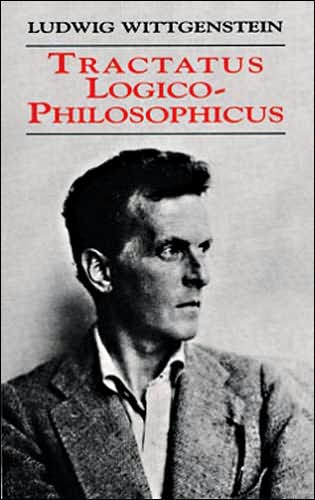
Book Review: Tractatus Logico Philosophicus, by Ludwig Wittgenstein

4.003    Most propositions and questions, that have been written about philosophical matters, are not false, but senseless. We cannot, therefore, answer questions of this kind at all, but only state their senselessness. Most questions and propositions of the philosophers result from the fact that we do not understand the logic of our language.
(They are of the same kind as the question whether the Good is more or less identical than the Beautiful.)
And so it is not to be wondered at that the deepest problems are really no problems.


I’ve been promising this review for some time. The problem has been – since this is a book not of philosophy but about philosophy – I’ve needed time for it to sink in. Furthermore, as much as I hate prefacing my opinion (or anyone else doing the same), due to the nature of this book I feel it fair to say a few words: I’m not an academic who specializes in philosophy. I do not have the names and concepts of all the world’s great thinkers at my fingertips. As such, I tackled this book as a reasonably intelligent layman. What I have to say about it should be seen through this particular lens. This is not a dissertation and most certainly this is not an academic exercise. So there.

Wittgenstein’s Tractatus Logico Philosophicus though only clocking-in at a svelte 108 pages, is a monster of a book. It is a perception-altering, densely laid treatise that attempts to clarify not a particular theory per se, but rather, pulls its focus back to comment upon the very scaffolding of philosophical understanding itself.

The way Wittgenstein sees it, there are too many fundamental errors and/or assumptions that sabotage philosophical propositions before they’re even written down on paper. The key is to first lay down exactly what a sound proposition is and to understand it in its elemental form. Technically, linguistically, even mathematically Wittgenstein has taken his understanding of what makes a philosophical proposition sound and distilled into a dense uber-logical lexicon.

It’s a fascinating (if insufferably semantic) approach: each point and sub-point are laid down like a revolutionary manifesto:


4.023    The proposition determines reality to this extent, that one only needs to say “Yes” or “No” to it to make it agree with reality.
Reality must therefore be completely described by the proposition.
A proposition is the description of a fact.
As the description of an object describes it by its external properties so propositions describe reality by its internal properties.
The proposition constructs a world with the help of a logical scaffolding, and therefore one can actually see in the proposition all the logical features possessed by reality if it is true. One can draw conclusions from a false proposition


Wittgenstein is intent on defining the way in which we attempt to interpret the world rather than the specifics of content. Wittgenstein’s reverence for the power and importance of how language is utilized in articulating the world is infectious. His approach, however, requires careful reading. I will be honest in saying that it’s difficult to review such a book without having spent a number of weeks re-reading it, making notes, checking out other people’s feelings about it, etc.. I have not had the time to do this, and have only managed to read Tractatus twice – however, I will say that while the first reading was a slog in the mud, during the second reading things became suddenly more clear and fascinating.

Who should read this book? Anyone interested in expanding their practical and theoretical understanding of language and logic. While Tractatus is dense and unsparing to the casual reader, those who give Wittgenstein’s treatise the time and effort it deserves will undoubtedly walk away richer for the experience (if not wiser). If Aristotle wrote the book on metaphysics, then Wittgenstein has written the book on metaphilosophy.

Tractatus Logico Philosophicus (ISBN 0-486-40445-5) is available at a fine independent bookstore near you. Also available online at various merchants. Note: this review is based upon the 1999 Dover republication (using the translation by C.K. Ogden, which is thought to be the definitive text).

Share

Book Review: Moby Dick, by Herman Melville

You may be asking yourself: “Moby Dick, eh? Not exactly current fiction, Mr. Blogger.”

No, it’s not. But if it’s good, it should be read. This is a good book. It’s a classic 1.

Published in 1851 (happy 155th anniversary!), Moby Dick is an originally rendered tale told by Ishmael (whose last name we never know…in fact, we never learn the full names of any of the characters), a young veteran of the merchant marines who longs to find work (and a new life) on a whaling vessel. Naturally, his interests take him to Nantucket, Massachusetts, where he finds a ship waiting to sail – the Pequod. With the help of an exotic tattooed harpooner, Queequeg, he hops aboard willingly, despite the warnings of a street prophet regarding the Pequod’s captain – Ahab.

Once aboard and sailing, the narrative eventually inverts from the wide-eyed first-person accounts of the opening to third-person, peppered with Ishmael’s astute observations – it’s clear from this narrative transformation that Ishmael himself becomes subsumed by his experiences at sea aboard the Pequod, obsessed with the details of her crew and captain, and with the object of their profession: whaling.

The problem begins soon after setting sail; Ahab, a remarkably bleak and forceful figure, announces that – contrary to their practical purpose – they have an ultimate quest ahead: to find and kill the White Whale, Moby Dick. This single whale, we learn, is the burning flame which drives the Pequod’s captain to “monomaniacal” ends, Moby Dick having claimed Ahab’s leg (and perhaps a part of his soul) on a previous voyage.

As the novel proceeds, the reader is consumed by the everyday life of a whaler at sea: the sometimes savage danger, the simple yet sublime pleasures, and the technologies of the day. Everyone from the sail-mast lookout to the blacksmith, from the cook to the boatsmen who trawl for prey – whales, and most importantly, their precious oil – are drawn in colourful detail. Readers expecting a fast-moving plot line should note that Moby Dick takes great pains to paint the seafarer’s life, specifically the dying years of the whaling industry (at least as it existed in its heyday); as such the novel has its peaks and valleys as regards pacing. I refuse to take the “this is an old book so you have to disregard its old style” stance – though it’s a masterpiece, its strengths will only be rewarding to those with a little patience.

Moby Dick is probably one of the best-written novels I’ve read. Melville is a writer’s writer; he loves language and is very particular about how he describes the life of his characters without it becoming an academic exercise, nor are the allegorical elements cryptically depicted so as to make reading it in a non-allegorical frame of mind impossible. Take any of Ahab’s monologues and read it aloud: you will instantly notice the cadence and perfect shape of the sentences – it’s like hearing Shakespeare. The book is rife with symbolism: the ship is the world, the crew its people. Moby Dick itself becomes a symbol of the capricious result of the burgeoning 20th-century-man’s fateful need to conquer nature.

I would like to point out that I read the paperback edition, published by Oxford University Press (pictured above). I mention this in particular for two reasons: it’s cheap (500+ pages = $10!), and it comes with a handy reference guide at the back to clarify any directly symbolic (Biblical or simply antiquarian) references in the text. Also, there is an Introduction (written by Tony Tanner) which, after you’ve read the novel 2, will give you some insight into some of the mainstream analyses of the book. There is also a set of letters Melville wrote to Nathaniel Hawthorne (to whom the novel was dedicated) at the back of this edition – can’t say there’s anything relevatory there, other than the fact that Melville clearly idolised Hawthorne.

Moby Dick is available for sale at a fine independent bookstore near you and online at…Powell’s, Amazon, Chapters, and others. Published by Oxford University Press (ISBN: 0192833855)

1. I don’t mean “It’s a classic.” in the sense that, because everyone calls certain books “classics” that they must always be superior. Some “classics” do not age well. This is not one of those.

2. This is my guide to reading “classic” books: by all means avoid anything written by someone other than the original author until after you’ve read the book, whether it be an introduction, a foreword, a preface, what have you. Most introductions are academic in nature and worse, full of spoilers. Stanislaw Lem wrote a book, inspired by his distaste for these after-the-fact literary addons. It’s called Imaginary Magnitude.

Share

Book Review: The Unconscious Civilization, by John Ralston Saul

As mentioned previously, House of Anansi recently re-released their acclaimed CBC Massey Lectures series. This news is a significant boon to the reader who values provocative, intelligent discussion which often straddles the fine line between social anthropology and philosophy. Having been pleasantly surprised with Doris Lessing’s Prisons We Choose to Live Inside (reviewed previously here), I picked-up John Ralston Saul’s The Unconscious Civilization with hesitant interestI say hesitant because I’m already well-acquainted with his work.

I was first introduced to Ralston Saul many years ago with his book Voltaire’s Bastards (ISBN 9780140153736). I was impressed with his bold and thoroughly-referenced perspective on what he contends is the growing paralysis of Western civilisation throughout history. However, in retrospect, this was probably the wrong book to start with; for one thing, it’s about 656 (trade paperback) pages which, considering his dense style and cogent analysis, makes for a bit of a brain slog. Nonetheless, I followed this with the successive releases of Confessions of a Siamese Twin (ISBN 9780140259889), his treatise on Canadian social/political identity, and On Equilibrium (ISBN 9780140288032), his elaboration on six foundational aspects of civilization.

I wish now that I had first read The Unconscious Civilization.

Clocking-in at a comparably svelte 205 pages, Unconscious Civilization finds Ralston Saul boiling down the magnum opus that was Voltaire’s Bastards into something much more approachable for the average reader without filing down its fangs. The thesis is partially revealed in the Preface, written for the 10th anniversary re-release:


When I wrote these Massey Lectures, I was convinced they would cause a shock. After all, I was describing the state of the West in a manner quite off the radar screen. I was saying there had been a persistent growth of corporatism in spite of the outcome of the last world war. And that this growth continued. Why would this be shocking? Because corporatism was part of the anti-democratic underpinnings of Fascist Italy in particular, but also of Nazi Germany. Beneath the uniforms and the military ambitions and the dictatorial leadership and the racism lay corporatism. It was the intellectual foundation of fascism. And it was supposed to have been destroyed along with both regimes in 1945.


So, it’s not exactly light reading. Throughout history though, concepts and arguments that heed us to re-evaluate our surroundings (whether or not we end up holding fast to them) are often dissonant to our day-to-day perspective on life – in other words, controversy often ensues difference. Ralston Saul is unafraid to call a spade a spade.

The Unconscious Civilization lays out in dense, history-shifting references, the problems and origins of corporatism and how it has become an increasingly acceptable means to run modern societies, in spite of its history of stifling democracy and rewarding conformism.

One of the key points made is how one can propose to adjudicate the underlying strength of any given society – that is, asking: where does its legitimacy lie? He proposes that this legitimacy lies in one of four areas: God, a king, groups, or civilian individuals working as a whole. While the history of Western society has largely been influenced by the former two, Ralston Saul feels that we are most certainly in the hands of groups: think-tanks, specialists, and managers.

The corporatist model, he argues, in the tradition of the Catholic Church, is obsessed with God and Destiny – albeit transposed onto contemporary concerns such as the trade markets and privatisation of public interests. Corporatist language is thus cloaked in a similar sense of inevitability and sycophantic awe that the Church used to instill fear and hold power over the populace.

Although the density of Ralston Saul’s arguments is impressive (in particular, his contention that Jung and Freud allowed the posterity of their work to fall victim to an inarticulated obsession with mythology) , I feel it’s this same quality that weighs down the over-arching themes of the book. At points, particularly with his repeated references to Athens in the days of Socrates, I longed for the simple first-person perspective that gave Doris Lessing’s Prisons We Choose To Live Inside its sprightliness and pactical immediacy. At times, Unconscious Civilization buckles under the considerable thickness of its content, which makes me wonder what the average reader will take away from it (without re-reading).

However, this doesn’t change the fact that this is powerful stuff. Not content to only point out what’s wrong with society, his last chapter is dedicated to thinking towards solutions. In particular, I found great interest in his contention that the public school system is out of step with the lifestyle changes over the last 20 years – as people are set to retire later and later, would it not make sense for children to enter into school later and then be required to receive a more complete education than the current system which is only concerned about cranking out specialists for the marketplace? Ralston Saul also delves into his equilibrium theory, to which he devoted a book in 2002, in which he postulates that individuals and society alike must work to remain balanced rather than hyper-focused on any one quality, in particular rationality, which has been used to justify abuses throughout history.

I would not hesitate to suggest this book to anyone interested in challenging views of society in general, and Ralston Saul’s ideas in particular. For the latter, The Unconscious Civilization is the ultimate primer. For the former, you will undoubtably find yourself spending a great deal of time wrestling with its well-researched and sometimes scathing message.

The Unconscious Civilization is available for sale at a fine independent bookstore near you and online at House of Anansi Press, as well as…Powell’s, Amazon, Chapters. Published by House of Anansi Press (ISBN: 0-88784-586X)

Share