
Writing Adv*ce: Tools

Welcome to another piece of writing adv*ce (here are some earlier entries), which eschews advice itself and instead asks questions or demonstrates different (not necessarily better but hopefully not worse) approaches.

I want to say, off the top, that however you end up writing your story, poem, book, essay is good so long as you get the work done. I’m against being too precious about my tools, even though, as I show, it can happen easily. Like any art form, writing can be self-absorbing. The trick is to give ourselves enough time, space, care and attention so that we capture the best of it in our work, without losing touch with day-to-day realities (interpersonal interaction, paying bills). So, yes, sometimes we don’t want to write in just any ol’ journal, but something that’s well-made and maybe looks cool at the same time.

I love fountain pens. I love their aesthetic, love the different inks and nibs. And for a while it’s what I used to do my writing. Now, I should make it clear: with few exceptions I go everywhere with a notebook and a pen. It helps me capture things, purge ideas. The problem I eventually found with fountain pens was that, depending upon the paper, the ink might smudge (I’ll come back to this). Or, I ran out of ink in the middle of a writing session. Or, maybe the nib had an annoying scratchy part that dragged against the paper. Ultimately, I was far too distracted by what my fountain pen brought to the endeavour of writing, or, rather, what it interrupted: work. The work is everything, and, though this need not be an either/if, if need be it takes precedence over the more procedural aspects of writing. Performance artists notwithstanding.

My fountain pens sit dejectedly in a coffee cup on my office desk. They are rarely touched. Some day perhaps, but not now. I’ve been using the same brand of rollerball pen (uni-ball deluxe fine) ever since. It just works, and I don’t have to think about it. It serves my purposes as a tool of my trade. As well as the same pen, I use the same type of notebook. Finding a decent brand and staying with it is another way I try to stay focused on the work without being tempted to switch my tools. That said, someone might easily consider this precious (lest I be accused of modelling my habit after Einstein, who owned multiple copies of the same grey suit). Speaking of notebooks, an interesting thing: a couple of years ago I switched brands for the first time in…let’s say, well over 10 years. My former notebook of choice was Moleskine. They’re perfectly fine, except I hold them partially responsible for my falling out of love with fountain pens. You see, Moleskines, despite appearing in a classic style, are a modern product based on the design of a French notebook from the early 20th century; while you and I would think, because of its pedigree, the quality of the paper Moleskine used would be perfectly suitable to fountain pens, they are, as I ruefully learned a couple of years ago, not. I have since switched to Leuchtturm and have no regrets. (I have to admit, this feels like writing about an ex-girlfriend.)

Writer, if you want to use an old fashioned typewriter, go for it. If you want to write diagonally across the page of your journal, go for it. I might suggest along the way you keep an eye on how your tools serve your task, and be open to asking whether simplifying the way you write would allow you to better focus on the work. Try not to get hung up on your tools. I write less and less in my notebook these days, and more and more I send texts to myself w/ my smartphone. All my smartphone is doing, because it’s practically attached to my hip, is making it easier to do what I achieve with the notebook, albeit with less character. Maybe this is my own preciousness coming out, as I do prefer the act of handwriting. But sometimes it’s just not practical.

Share

Comedy

The next book is going to different.

I’ve given up on “the next book isn’t going to be an ambitious book” because inevitably I churn out something that ends up doing so, or at least attempting. That said, I would like to write something funny, which is hard — at least if you’re aiming for something that is consistently funny. Then there’s the type of funny. Not all funny is funny to all, and that’s the main problem with writing something comedic: it has to have a consistency that you wouldn’t necessarily expect from other genres (as long as a thriller contains a handful of thrills then it earns the merit badge of its title), and not just in terms of how populated it is with humour; there’s consistency in terms of the volume of material but there’s also consistency in terms of texture — is this a satire that a smaller number of people with more rarefied knowledge will appreciate (think of the film The Square, a wry satire of the upper echelons of the art world), or a broader, more bombastic, plot-driven variety (see Hitchhiker’s Guide)?

It’s intimidating and I may abandon the whole thing, but Radioland, my second book (hello, publishers at this year’s London and Frankfurt Book Fairs — my agent will be looking for you!), took a lot out of me and I’m looking to try something stylistically different.

Wish me luck!

Share

Jean Vanier

Yesterday, I read the revelations concerning an internal report by L’Arche, an organization renowned for its work in changing the way society takes care of those with developmental and cognitive challenges. Its founder, Jean Vanier, has been accused by several women who worked with him of sexual assault. I was gutted to read this, as are many people around the world, I suspect. Let me be upfront, because I realize not everyone is going to follow the link I’ve posted (and sometimes I blog thinking that this will automatically be the case): these were women of faith who were working dedicatedly with his organization and/or directly with him, whom he coerced and pressured, sometimes over years, breaking so many personal and professional boundaries in the process, doing so much to hurt people while he was helping others.

Vanier, who passed away last year, was one of those people who, while I did not explicitly follow, I held in esteem. Ever since first learning about his work in my late 20s, his commitment to humanizing those who do not have a voice — which included the homeless, among other sectors of society — I’ve looked up to him as a high water mark of how to be a decent human being capable of walking the talk. And this makes the stories coming out all the more sickening, because of the extent of his abuse of power, how much harm he has done to his victims. 

So, what do we do?

I’m not on social media much but I can already imagine people dismissing everything to do with L’Arche, the organization. And while it would be healthy to see how the internal investigation evolved (in particular how quickly it responded to complaints), I am cognizant that the news is due to L’Arche’s internal investigation and not as a result (from what I can see) of an external journalistic exposé.

I want to continue to support the work of L’Arche in spirit, even if Vanier’s actions in private were so intoxicated and self-absorbed — in particular, for me, the accounts in which he justifies his actions to his victims as being in the spirit of God. While it appears that none of the people he cared for — the most vulnerable in society — were targeted, I am holding my breath on this last part. But there are already victims, women who trusted and believed in his work, in him, and who are scarred by their experience, and whose relationship with their religion I can only imagine must have exacted a great toll as well.

A question that is particularly relevant these days: is it possible to support the continuation of someone’s work despite their horrid private actions? Yes, I think it is, and I don’t think one requires a lawyer to parse out that logic, however I think in this particular instance L’Arche will need to gain the trust of the public, and to define themselves beyond (probably by expunging) Vanier’s image.

Incidentally, I’ve been reading Becoming Ethical, by Alan Jenkins, which provides ways for therapists and social workers to work with men who abuse. I appreciate Jenkins’ philosophy, part of what is called the invitational model, which is not to lock those who have abused into a permanent status of abuser, but allowing them an opportunity to represent themselves and find their own path through the pain they may have caused (as well as deep reflection on their own internal logic). I mention this because I deeply wish there had been a last act in Vanier’s career where he was able to recognize the damage he had done and at least had begun the work of transforming himself ethically.

I am so fucking angry at the man. And terribly saddened with yet another public figure – someone synonymous with raising the quality of the lives of others — has unveiled himself to be culpable of something so avoidable and destructive.

[For those who are curious, I’ve revised this piece many times. Why? The answer may be its own blog entry, but I feel I didn’t give as much space to the victims in the original post.]

Share

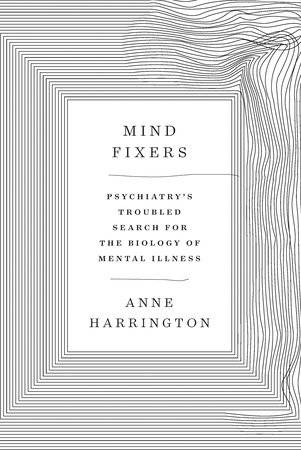
Book Review: Mind Fixers: Psychiatry’s Troubled Search for the Biology of Mental Illness, by Anne Harrington

image of

For the longest time I’ve been looking for an impossible book: an historic exploration of psychiatry and psychology over the last 150+ years that lays the groundwork of how we got to where we are (with the infighting, the arrogant spectacles, the tentacles of private interests), that also isn’t painfully academic or with too little (or too much) of the author’s own perspective of such a unwieldy topic. Well, as I said, it doesn’t exist, but Anne Harrington’s Mind Fixers comes very close.

As the subtitle states, Harrington (a science historian and the Franklin L. Ford Professor of the History of Science at Harvard University) has her lens steadied on the search for the (real, perceived, and ultimately elusive) biological underpinnings of mental health conditions. This is a terribly important topic and if this book has not ignited the debate it might have, it’s no reflection on the scholarship or insights gleaned from Mind Fixers, but perhaps a victim of timing and not being the loudest possible controversy to be found on Twitter. Even then, if you follow psychologists, psychiatrists, and those who specialize in related research on Twitter you’ll soon find yourself inundated with accusations of anti-psychiatry levelled at those who criticize prevailing notions of mental illness being caused by chemical imbalances in the brain, while the replication crisis undermines many of the foundations of Psychology 101.

If there’s a story here, it’s one of shifting hegemonies: from those who were concerned of their patient’s physical wellbeing, to those concerned with their brains, from those concerned about subconscious maternal conflict to those convinced the answer was in our brains, but only chemically. And with each shift in search of a possible answer to mental suffering there are reciprocal shifts in public investment and, eventually, interest from pharmaceutical companies. And at the end of the day what shifts the most are some of the most vulnerable people in our society: from sanitariums to hospitals; from wartime battlefields to community centres…only to be dumped onto the streets. It’s all here in Mind Fixers, and it’s a timely read considering the vested interests currently luring large investments in brain science, or in such promised but potentially dangerous remedies as ketamine, or those convinced of a genetic pathology. And if it sounds as if this book is strictly for history/psychiatry wonks you are dead-wrong.

What Harrington does very well is take reams of historical information and distill it into a narrative that ultimately maps out how those with what is generally called (though I hold some hesitations at times) mental illness were treated and what those in their charge felt was at play inside their bodies. Along the way we see ethical lapses in the form of wholesale human experimentation (i.e. injecting unknowing patients with blood infected with malaria), as well as the overreaching ideal of Freudian psychoanalysis as a Rosetta stone. Along the way we are introduced to ideas and theories which seemed to make sense at the time — narcosynthesis, insulin coma therapy — along with travesties such as deinstitutionalization, basically the dumping of people with mental health issues on the streets as a result of overambitious government policy that was out of sync with the realities of state coffers. Mind Fixers is also blunt about the influence of pharmaceutical companies, who increasingly figure in the narrative; the last quarter of the book is an admonishment of the profiteering that took place from the mid-1980s to the mid-00s as companies such as Eli Lilly were able to advertise directly to Americans and, with the help of an increasingly subjective DSM that allowed two people with completely different symptoms to be diagnosed with the same disease, exponentially increase their profits through prescriptions.

There are some issues. Repeatedly, Harrington refers to the “neo-Freudians” who, in their day (mid-20th century), held the reins of power with respect to diagnosis and how psychiatric trends were approved. There is a lot of confusion (just look at the definition provided on this U of C Berkeley page) about what a neo-Freudian is: those who studied but ultimately disagreed with Freud (however kept his strictly psychodynamic approach) or those who held Freudian views but refused to downgrade the role of biological processes? It may sound semantic, but in lieu of a definition the term’s repeated use without context begs for clarity. In the process it also makes it sound as if all psychoanalysts were in some way Freudian adherents. What about Melanie Klein and the rest of the object-relations movement? How did they differ? Indeed, the role of plain ol’ talk therapy — explicitly Freudian or not — is given short shrift, which might sound understandable in a book looking at biological underpinnings, but as a tool in the arsenal against so-called mental illness its absence feels odd, especially in light of the author’s emphasis on the misdirections of neo-Freudians. I get that Harrington could easily have written a book three times its size on her chosen topic. But if you’re going to talk about the influence of Freud and psychoanalysis in general then I feel you have to unpack and contextualize a bit more than what is on display here.

For the most part, however, Harrington is surprisingly fair-minded, not only unveiling the naked greed (and capricious biological arguments) of psychopharmaceutical manufacturers, but highlighting the testimony of those patients who were — placebo effect or not — helped by their medications, even if it came at a cost of other aspects of their health. She is by no means on a mission to dispel the notion of a biological source of mental illness, as I’m sure some vested interests might think looking at her book from a distance, but rather to show how partisanism, arrogance, and greed have wasted decades of valuable mental health research as we swing from trend to trend.

Mind Fixers: Psychiatry’s Troubled Search for the Biology of Mental Illness, is available at an independent bookseller near you, or online.

Share

The One I Feed

If I’ve learned anything this year it’s the command, perhaps even the primacy, that music holds over my creative life, which is strange(ish) for someone who isn’t a full- or even part-time musician. Let me qualify “someone who isn’t a full- or even part-time musician”: I can play drums decently well, I’m barely adequate on keyboards, and I’m beginning to develop confidence on electric guitar. But there are no stakes for me: I’m not in a band, I’m not hoping to become a recording artist. So, as an established/emerging writer, what’s the deal?

The deal is that music presents as part of a triumvirate of full-blooded influences on me: music, film, and writing. I am incomplete as an artist without one of these. Don’t get me wrong, I love other forms of art — dance, painting, sculpture, etc (to infinity) — it’s just that my DNA is activated by music, film, and writing.

But the predominancy of music in my life sometimes has me worried.

Let’s start with writing. Music twists around my work almost symbiotically. The Society of Experience involves a character whose day job is a music supervisor for film and TV productions, and thus the narrative is punctuated with songs from the very beginning; the main character is sometimes haunted by the sound of a jukebox in the bar beneath his apartment. And yes, of course I created a soundtrack for the book’s launch (which features music mentioned within as well as inspired by the themes and subject matter). My next novel, Radioland, involves a “successful” musician having a nervous breakdown. The novel I’m working on right now, [untitled matt cahill project], involves the power of a DJ on a young boy in the country. If I could afford the rights I would quote song lyrics to introduce book sections.

Even when it comes to film, music has been immensely influential. From the quirky soundtrack of Brazil to the Wagnerian flourishes of Excalibur, I have not only fed deeply on music scores and soundtracks but have followed a countless number of rabbit holes. If it hadn’t been for watching Underground, I wouldn’t have spent a year chasing down recordings of Serbian brass band music. In film school, one of the best things I ever did was a one-take b&w short I shot on a wind-up Bolex that I played back w/ The Jesus and Mary Chain’s Reverence blasting in the background.

I care deeply about music to the extent that, on a social occasion where we were taking turns playing songs on a nearby jukebox based on a chosen theme, I was asked to choose 3 songs I hated. I said I wouldn’t. And I wouldn’t because a) it meant sitting through 3 songs I hated, and b) life is too short to listen to songs you don’t like. It made for an awkward moment and I felt somewhat precious, but that’s how it goes when you take a principled stand about most things.

So, my worries, however ephemeral, are whether I’m suffering from a blindspot in how I prioritize music. Is it a blinder? Is my appreciation for it distorting my perspective insofar as my writing (in particular) might suffer? I don’t know. I don’t have a lot of artist friends, and the ones I do have probably wouldn’t deem this to be something worth much concern. That said, sometimes I wonder: am I using one art form to inform and/or expand another, or am I misusing either/both? Should I be concerned when things become sacrosanct? 

These are not really questions that require answers, but as an artist who wishes to be reasonably self-aware, they are good to ask nonetheless.

Share

Book Review: The Jazz of Physics, by Stephon Alexander

A publishing colleague posted this book’s cover on Twitter and I was immediately interested. If you know me or know my work, then the subjects of jazz and physics (particularly quantum physics) are both dear to me. To my surprise, I was subsequently sent a copy of Stephon Alexander’s The Jazz of Physics in the mail…which I then proceeded to neglect for over a year.

Why? Well, for one, I had a backlog of books I’d earmarked for reading and I was also finishing off the manuscript for my next novel. However, if I were to be perfectly honest, it was partly out of fear. Aside from the loose premise, I didn’t know Alexander as an author and I didn’t know what the thrust of the book and, perhaps most importantly, its tone would be like.book cover of The Jazz of Physics I was afraid it would be a beginner’s guide to physics using jazz as a loose, entertaining metaphor that ultimately ends up lacking specificity about either jazz or physics.

I could not have been more wrong. It’s the opposite. The Jazz of Physics is written by someone who is as serious and seriously accomplished a physicist (currently a professor at Brown University) as he is a dedicated and well-studied jazz musician. Rather than a figurative metaphor, Alexander uses jazz as a profound analogy for the very workings of our universe. He’s not using it to disingenuously sell physics. Growing up in the Bronx surrounded by musical influences (a story about the Five Percenter Nation is fascinating) as well as having a natural intuition for understanding the principles of science, The Jazz of Physics is a fascinating biographical narrative and nothing short of a passion project, an attempt to argue in the deadly-serious terms of cutting edge quantum theory that the relationship between music — specifically jazz, in how it centres on improvisation — and the formation of the universe is less figurative than literal.

Tall order? Yes.

First, let me stress how difficult a task it is for someone such as Alexander to pull this off. I have read well-argued books by esteemed physicists that ended up self-sabotaging themselves because they lost track of who their audience is — something I am inclined to believe is the chief challenge of any such endeavour. As an author writing for a general audience, the deeper you go into the macro and micro of physics (corresponding respectively to relativity and quantum theory), the harder it is to keep the reader’s attention. Alexander works hard, imaginatively and creatively, to find analogies to help the reader along — the use of analogies themselves are the cornerstone for him:

Next to mathematics, I learned that one of the most powerful tools involved with unraveling the secrets in the theoretical sciences is simplifying the system at hand and borrowing an analogy from what might, at first glance, be a completely unrelated discipline. It is in the limits of these analogies, where there exists a need for further research, that an avenue for discover lies.

Along his path, we are introduced to both eminent physicists — not just the usual suspects such as Einstein, Dirac, and Schrödinger, but contemporaries such as Lee Smolin, Faye Dowker, and Bill Unruh — and their musical equivalents: John Coltrane, Ornette Coleman, and MC Rakim. Yes, I wish there were more women represented in this book, but I’m not going to put that on Alexander because he’s drawing from direct experience.

What leaps off the pages of The Jazz of Physics is Alexander’s passion for both disciplines, and he goes to pains in order to lure the reader — the question of which, jazz fans or amateur physicists, are more likely to be interested is a question I will come back to — into the complexities of these distinct yet related worlds and his unfolding thesis — that, ultimately, the stuff of our current universe may very well have been formed via sound. A stumbling block for some readers might be the extent to which they are either a) versed in these subjects, and b) prepared (if not) to travel the highly sophisticated, often mathematically structured path Alexander is, by his own decision, obligated to illustrate. There might also be those who question the extent to which the term “music” is construed from what is ultimately sound. This latter concern is remarkably well handled by the author who ultimately provides a convincing argument.

With respect to the mathematics and formulae included in the book, there are two sides to look at this from. Alexander is careful in the beginning to encourage the casual reader to accept the parts that are over their head and keep following the tune, as it were. I am by no means adept at math, my interest in quantum physics being more conceptual than anything else. While I was able to proceed past sections where the author felt it necessary to draw the more mathematically-minded kids in the room closer without losing a beat, I have to admit that three-quarters in I began to get lost in the minutiae of quantum theory itself. Want to know what a brane is? Inflaton fields? Anyone? No? After a while, neither did I, and this is where I began to ask myself — as someone who felt that this book was written for me — how many other readers with a general-to-specific interest are going to find themselves skipping numerous paragraphs (if not the better parts of chapters) because of the growing complexity of these quantum building blocks that Alexander discovers in his journey. I can’t fault him because these are the very things that were stumping him so why should we be able to swallow it in one gulp? It has led me to ask myself how well this book sold, seeing as it might be too science-y for jazz fans, and the language of jazz itself can be a figurative mess for anyone who’s never needed to decipher a symmetric diminished scale.

This is a science book that draws its inspiration from a deep and abiding love of jazz (and music as a whole). Anyone expecting to understand music in the same way that Alexander attempts to illustrate his passion for physics might find themselves disappointed, although, to the author’s credit, his passion for both is infectious.

Lastly, there is something very significant in this book about mentorship. Alexander’s journey of discovery is also one of, to use a phrase from Sir Isaac Newton, standing on the shoulders of giants. Science, like jazz, is inherently collaborative — the thing is, not anyone off the street is going to be given room for a solo on the stage. You have to have chops, and I appreciate how the author comes back to this bargain one makes, that if you want to learn and grow with the more experienced colleagues in your field you have to first demonstrate your aptitude and willingness to learn.

The Jazz of Physics (ISBN: 978-0465034994) is available at an independent bookstore near you. Curiously, I wonder what it’s like as an audiobook?

Share

Content Discontent

I think I’ve had my fill of TV (streaming or otherwise) and mainstream films.

The first problem is mine, and is one of saturation. I worked in film and TV post-production for 20 years, watching everything from 15-second TV commercials to multi-part TV series, to box office-busting films. And part of working in film and TV is keeping up your fluency so that you can communicate effectively with each other (if a director makes a reference to Picnic at Hanging Rock you better be ready to watch it if you haven’t seen it already). Also, I’ve watched hundreds of films and countless TV shows over the course of my life — the seminal and forgettable, the laughable and the revelatory.

I’ve pretty much seen every storyline at least once. I’ve seen every twist and turn, every “surprise ending.” I’ve seen every plot device, every sort of villain, every sort of (male) anti-hero, every sort of Disneyesque sentimentality and every sort of nihilist purging of the arthouse soul. It’s hard for me to be taken in by a show or movie — either to suspend my disbelief or my anticipation of what the creators are going to do.

The second problem is out of my hands. In this age of streaming services, we are awash with content. Netflix, Amazon Prime, Crave, etc. all require things to put on their virtual shelves so that we can be enticed to part with our money in order to explore their goods. I have no problem with this business model — it’s basically turned into (back to?) cable TV. The problem is one of quality. It seems that, in the effort to fill the shelves  seasons are lengthened with filler and show renewals are rubber-stamped that end up being samizdat versions of the preceding season. Multiplexes are filled with the faddish (and profitable) notion that (see: Marvel) everything can be part of a franchise. If I hear another producer say “We originally imagined this as a trilogy/series in four-parts” I’m going to scream.

What bugs the shit out of me is how this affects what’s presented as upper tier programming. A good example is Good Omens, the heralded adaptation of Neil Gaiman & Terry Pratchett’s collaboration. I haven’t read the original book — I have a notion that it’s written in a larger-than-life, Douglas Adams-y style — but the show is painful to watch. It wants to be sly and slick satire and it has strong early moments, but it’s all so buffoonishly overplayed — the actors who aren’t line-reading chew their way through the scenery — to the degree where I had to wonder whether the producers might’ve considered making it for children. The worst is that for a six-part series there’s barely enough story to take up three. I lost count of how many time-sucking flashbacks and side-stories are introduced in order to lead to the telegraphed, overdue finale. Speaking of Gaiman, adaptations, and overdue finales, please see the meandering second season of American Gods (which I abandoned).

For the record, I don’t have a problem with the Marvel Universe franchise. They’re not hiding anything: it’s a stream of big-ass popcorn epics. They aren’t being released as exemplars of anything other than “hey, here’s a well-executed adaptation of a comic book most people haven’t read.” Sure, given the choice I’d rather watch an imperfect  Olivier Assayas film over Ant Man, but at least I can watch the latter and know where to keep my expectations dialled.

While I’m bleating, a trend I wish would die, pardon the pun, are films where it’s obvious the protagonist won’t get a scratch despite killing 100 hired assassins (see the three John Wick films, The Equalizer, and Colombiana). Where’s the suspense if you don’t allow the audience to imagine that, no, the protagonist might not make it. This is an inherent problem with films and TV shows that are made in the hope of infinite reboots: no suspense (see: Orphan Black, a prime example of where the producers missed multiple opportunities to draw more attention by killing off one of the clones).

Why can’t we make something, leave it be to stand on its own merits, and move on without exploiting its success with sequels and prequels and remakes and reboots? As good as the original was (and it is), who in god’s name, save for the cast and crew, asked for a second season of Big Little Lies? What part of that story begged for extended development? Note: Liane Moriarty, the author (whom I share a birthday with) whose novel was adapted into the show never wrote a sequel until the HBO adaptation achieved success (she ended up writing a novella by request, not exactly the way any author would like to work, let alone revisit characters, though I don’t blame her).

Anyhow, I sometimes wonder, in the industry’s effort to satisfy its appetite for content, whether we are sacrificing the magic of our relationship with entertainment for the sake of Say’s Law, the (questionable) belief that supply creates its own demand.

Share

Book Review: Casting Light on the Dark Side of Brain Imaging

Whenever a mental health authority is interviewed in the media it’s nearly inevitable that this person is a medical doctor, usually a psychiatrist. This individual typically isn’t a practicing therapist; they may only be able to speak of clinical diagnoses and/or the prescription of psychopharmaceuticals. I mention this because when this authoritative psychiatrist is interviewed in the media I end up listening to a depiction of the massively complex human interrelational landscape I see around me every day, as both a writer and psychotherapist, reduced to a chemical imbalance in someone’s brain. It’s like ascribing a boxer’s loss of a title match solely to the width of their biceps.

book coverThe gold standard for looking at mental health is through what’s called a biopsychosocial lens, a flexible model that allows professionals to consider the biomedical (for example, thyroid issues, dementia), the psychological (traumatic experiences, abusive relationships), and socio-economic factors (unemployment, impoverished environment) that might be at play in the mental health profile of any given individual, even if it ends up a combination of one or more parts. In North America there is unfortunately a sacred primacy around the biomedical approach to mental health, with the psychological and socio-economic as (at best) secondary considerations at the table of funding and education. At this moment there are medical doctors losing sleep wondering how to beat the shame of knowing there is a patient in their care whose condition might be psychogenic (meaning, whose pathology is not, strictly speaking, a biomedical end product). Continue reading “Book Review: Casting Light on the Dark Side of Brain Imaging”

Share

Writing Adv*ce: Character

I’ve been thinking lately about a couple of short stories I’ve been working on over the last few years that don’t seem able to find a home with a publication. Now, there are a thousand reasons for a story to get rejected, and some of these have little to do with whether or not a story has issues to be worked out: subject matter, “fit,” philosophical angle. The stories I’ve been thinking about felt fleshed out and yet I suspected — no matter how badly I wanted to believe they were “done” — they were missing something that kept them from being as good as they promised to be, and, if I were honest with myself, the sort of work I want to be known for: complex, nuanced, readable.

One clear-headed morning on my walk to work, I was feeling comfortable enough to get over my nearsighted, belligerent writerly arrogance and apply some frank analysis to these two works.

Rather than bang my head against the wall staring at the works themselves, which I’d done previously, I took a different tack and investigated what it was that made some of my previously published work resonate and these current works not. And I realized, thinking specifically about Snowshoe and There Is This Thing About You, that the characters in these works were relatable — you might even despise them, yet there was a rapport with the reader, an “in”. These are difficult characters, conflicted, and sometimes there will be the desire to sublimate these characters onto a two-dimensional plane that makes it easy to dislike them. Yet, though we might grow impatient with their lack of finesse, accomplishment, and patience, the reader can’t help but want to relate to them, to understand what makes them tick. And in the stories I’ve been troubleshooting I discovered this very thing — relatability, respect, empathy — to be at least part of the missing element.

I recognized that each of these problematic stories featured a supporting character who was, to some degree, the bane of the main character’s journey; in each story the protagonist couldn’t possibly move forward without the effort of this unwitting adversary for whom in each story the protagonist lacked respect on some basic level. And it occurred to me that if the protagonist so clearly lacked respect for them on the page then on some level maybe I did too.

Despite this revelation, the work ahead is not paint-by-numbers. If anything, I realize that there’s a deeper layer that’s missing and by nature deep layers don’t just get applied like false eyelashes. It’s going to take some more reflection before I understand the meaning of what needs to be done, otherwise whatever I do is going to have QUICK FIX written all over it and the wily reader will see it a mile away.

Oh, and for anyone reading this who is under the impression that once these changes are made getting these stories published is a slam dunk, think again. Unless your name is Alice Munro you’re always going to find yourself at the whims of an editor or editorial reader — that’s just the way it goes.

(* I hate advice-giving, so rather than doing that, I’m going to provide something more meditative and complex, and maybe useful to some)

Share

A book, some photos

I swear I’m not a packrat, but sometimes you hold on to things for reasons that seem more intuitive than logical. Which brings me to a book on our shelf at home — The Chrysalids, by John Wyndham. This was from Grade 9 English class, if I’m not mistaken.

oneIMG_20190308_1420386

Let’s get something out of the way, in case that book cover looks cool. It has absolutely nothing to do with the story, its characters, the themes. I am afraid to say there are no weapon-wielding anthropomorphic insects, which was a crushing blow as I turned the pages at the time. Don’t get me wrong, it’s a good book, and John Wyndham (The Midwich Cuckoos, The Day of the Triffids) was no slouch.

However, a couple of years ago, when I took it from the shelf to have a look, I found two photographs inserted. You see, back then I was a yearbook photographer, and these were a couple of photos I’d probably printed off at the time (this would have been 1985?) perhaps to give to one of the people pictured should I have seen them in the hallway between classes. It’s possible it was just a fancy bookmark. I don’t honestly remember, but I’m struck by the good condition of the paper (printed on glossy stock, which was verboten in the darkroom because of its cost and scarcity). If you look at the bottom margin of the upper photo below you can see that I didn’t square the cut.

twoIMG_20190308_1421453

This is not a John Hughes film. At the end of the day, we’re looking at three teenagers standing at the rear (smokers’) entrance to Memorial Composite High School, in Stony Plain, Alberta. I sorta knew a couple of them. The guy in the middle was an asshole straight out of Stephen King’s Christine. I suppose I could grab my yearbook and look up their names, but all that’s going to give me are facts, right? What strikes me about the Wyndham book, the photographs, is how much of a time capsule it all is, as a somewhat complete package. Of a kid who was yanked from town to town, school to school, who didn’t get to have much say of where I went, what I had to endure along the way, who became more preoccupied with getting through it as opposed to (cue Hughes, whose movies I grew up watching) Having The Time Of My Life.

I suppose there’s a clever thing I could do: to connect the misrepresentation of the cover of The Chrysalids vs the more complex content, to the misrepresentation of how high school is sold to us vs the reality of growing up for many of us. So I will.

Share