“Celebrities are not superlatives in our field of expertise. If celebrities that are schnoring in on our field started out trying to do what we do and were held to the standards we started out upholding, a great many of them would’ve never made it.”
– Billy West, voice actor (“Futurama”) on the use
of celebrity voice work in animated films.

For *’s Sake
It’s been one of those battle-cries of mine the last while. Everything in the world, culturally-speaking (and I don’t necessarily mean high culture) seems to be evaporating into mindless bullshit.
The AV Club – a site I admittedly have a love/hate relationship with already – just posted an interview with actor Paul Giamatti. In the opening summary, the interviewer describes the plot of his latest film, which reads like a counterscript of 1999’s Being John Malkovich and yet there is no mention of this parallel anywhere in the article, something even Entertainment Tonight would do. The interviewer talks about this upcoming film with Giamatti as if it and his role – the John Malkovich role, if it were Being John Malkovich – were just soulless objects to be discussed out of necessity. In other words, it’s just like any other media-junket interview, like something you would read in InStyle or Chatelaine. Not that those examples are b-a-d, but when you pride yourself as better, especially savvy, tongue-in-cheek better, you shouldn’t even be in the same postal code as InStyle or Chatelaine if you want to retain your reputation.
The Motley Fool – again, a site previously known for being savvy, even though they deal with the stock market – now reads like Ain’t It Cool News, complete with arguments which, under rational analysis, seem completely idiotic and antithetical to what one would assume is their mission statement (ie. being different than the rest of those brain-dead-and-short-sighted Money sites).
Oh, and CNN. Not that they’ve ever been more relevant than a Reuters news ticker, but they’ve gone from mediocre to stupid by allowing one of their show hosts, Lou Dobbs, to continuously question the origin of Barack Obama’s citizenship, a paranoid suspicion virulent in the libertarian/right-wing fringe of the U.S. that has been repeatedly disproved (read: he doesn’t want Johnny Foreigner running and ruining the most-possibly-greatest-country-ever-in-the-world).
Now, one of the arguments I can imagine hearing is: well, Matt, in a 24-hour newsday (whether on TV or the Internet) when people expect constant information there inevitably has to be weaker material. To which I say: I understand, but I’d settle for less information over less hours (if need be), if it means the information will be consistent and better. After all, you are what you eat, and in this day and age we feed on media in an astonishingly unconscious and voracious manner.
The Happiness Project
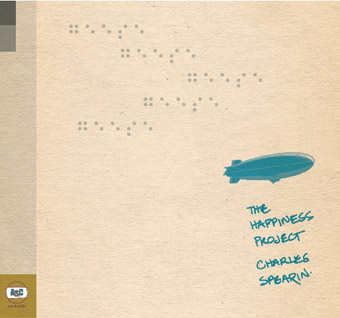
My friend, Charles Spearin, has released an innovative CD he calls “The Happiness Project“. The gist of it is that he began to interview his neighbours and recorded their conversations. Attuned to the tonality of how people expressed themselves he got the idea to replace the voices of his interviewee’s with musical instruments which mimicked each person’s voice pattern. The result is a unique (and very approachable) experiment which weaves voice, instrumentation, and environmental background sounds (birds, etc..). You may know Charles’ other projects, namely Broken Social Scene or Do Make Say Think. If you’re interested, please check out the site for “The Happiness Project” and see what he’s up to.
A quick note
I just wanted to point out that Ingrid’s photo/horoscope art project, Unbought Stuffed Dogs, has drawn to a close. She has a wonderful summary of the “point” and the experience of the process. Such things should not go unnoticed.
Miscellany: November 18, 2008
- Ingrid is approaching world domination. Her plaudit-winning reinterpretation of the cover for Cormac McCarthy’s The Road has not only received international online acclaim (Bookninja, The Guardian, Boston Globe), but her work was featured in Sunday’s New York (bloody) Times Book Review. Print and online editions (with the unfortunate misspelling of her last name in the print edition – needless to say this took a little of the shine off of the accolade. They will, however be printing a correction in an upcoming edition and the online version has her name spelled correctly).
- I’ve sent the first revised draft of my novel to a few selected readers. Unofficially looking for feedback and consensus that what I’m doing is worthwhile. Nervous. Anxious. Perhaps as a result of this and other things, I’ve been struck by some interesting what-if’s regarding a new book idea. I must be a masochist. At least it doesn’t hurt.
- I turned 38 on Saturday. I share that day with Ed Asner and Tilda Swinton (they were not in New York, unfortunately – I tried).
- Two films I worked on opened within two weeks of each other. One is a franchise horror film (of the “moral error leads to violent suffering” kind) which traditionally draws massive audiences and box office gold (if not good reviews). The other is (wait for it) a gore-Goth rock opera which is only receiving an eight-theatre release (if not good reviews). They represent what I’ve been working on for the last twelve months. Working in film/TV is “what I do for money”, a distinction I wish I didn’t have to make, save for the fact that the quality stuff (often Canadian) doesn’t pay my rent. It’s a quandary punctuated by background horror-movie funhouse screams.
Art in the City

Ingrid is having an art piece presented as part of the Gladstone Hotel’s 3rd Annual “Hard Twist” show. Opening night is November 7th (this Friday). She put a lot of time, energy, and commitment into this work and I hope it is received well. For all of you local visitors to this blog (or out-of-towners who find themselves in Toronto this weekend – hey, you never know), I encourage everyone to make it out.
You should also check out her unique photo blog, Unbought Stuffed Dogs.
Go, Ingrid!
And The Winner Is…
As previously noted, Ingrid and I submitted “re-branded” book covers to Bookninja for their contest. Guess what? Even with a handicap of -10 (she is, after all, a professional book designer), Ingrid took first place by popular vote! But wait, there’s more – a selection of the submissions are profiled in the (bloody) Guardian!
Congrats to her. As for my submissions, I placed somewhere in the honourable mentions, but sadly did not have any pieces profiled on the Guardian. I shall live vicariously through her success today.
Laissez-Faire Political Commentary, pt. #1

Requiems Not Required: Jazz and Classical
Just today, I was sitting in the kitchen of a post production audio house – my current temporary office – and found myself inexplicably tuning in to what was playing on the radio: Schubert’s Symphony No.5. It’s a dreadfully beautiful piece of music. I say dreadfully, because it’s so evocative as to remove my mind from the mountain of very important things I have to tend to.
Thing is, I’m pretty sure I’m the only one in the building who could either name what was being played, or who would allow themself to be affected (nay swoon). But it’s not like I set out one day in my youth, predetermined to “learn” classical music. I don’t think anyone does, regardless of what it is we end up liking. Often we come across these things circumstantially. If it hadn’t been for my watching A Death in Venice on TV one night long ago, I probably wouldn’t have sought Schubert’s symphony, nor the original story by Thomas Mann. I should also thank the old Warner Brothers cartoons, in particular the Bugs Bunny classic The Rabbit of Seville (riffing brilliantly and faithfully on Rossini’s Barber of Seville).
Jazz came to me later, introduced by my flipping around the radio, looking for something other than Top-40 pap. And like everything I love, once I get hooked I find myself wanting to know more, filling in the holes illuminated by the light of my curiosity. I’m prone to infatuation and, not entirely unlike the tragic protagonist of Mann’s Venice, find myself obsessed to learn as much as possible about these things.
The problem is that both Classical and Jazz, while not dead, are held in a stasis by so-called Classical and Jazz “lovers” who seek, paternalistically, to coddle them like glass-boned children, halting their growth (intentionally or not) and – as a dire result – their acceptance to new generations.
To some, this statement is nothing short of heresy. In Reflections of a Siamese Twin, John Ralston Saul – writing about the aggressive protectionism of French language in Quebec – made two valuable insights which also reflect on the state of Classical and Jazz music. First, that culture is not something which society should attempt to create, control, or destroy to meet our fashionable needs – it’s a living organism which follows its own path. Second, that the only languages which need protection are dead languages. That is to say, he was criticising those who strove to legally protect and manipulate something which didn’t require it in the first place.
The problem isn’t that most of us don’t tune-in to Classical or Jazz radio. The problem is that most everything programmed on these stations (with varying degrees, depending upon where you’re located) is safe, old, and terribly predictable. Say what you will about the soulless depths of corporate-run, computer-programmed Top 40 radio, but one thing you can’t deny is that they play songs written during this century (already nearly 8 years old). Jazz and Classical radio suffers from a predilection: only play the standards. Their philosophy: who cares if you play three different interpretations of Lullaby of Birdland seven times a day – it’s a standard. Who cares if the daily playlist is the same tired variation of Mozart, Brahms, and Beethoven – they’re popular.
They’re partially correct: Lullaby of Birdland is a standard, and those three dead white German guys are popular. For both genres, deservedly so. But, in a contemporary sense, it’s only to the extent of pleasing people who have no desire to see either Classical or Jazz develop in different directions. When was the last time you heard anything from Miles Davis’ Bitches Brew on the radio? That album was released almost 40 years ago – when was the last time you heard a single Classical composition written within this time?
We can’t rely on movie soundtracks and cartoons to bring notice to the brilliance of older forms of music – if we do, they will always remain “older forms of music” rather than the living, breathing spirits which they are. We do both Classical and Jazz a disservice by sneering at contemporary innovation – I contend that it’s the snobs who have done the most damage. We can’t rely solely on the likes of Wynton Marsalis as appointed sentinels to tell us what is or what is not jazz music. We can’t forsake contemporary composers, like Alexina Louie, to keep programming the same tiresome Mozart/Brahms/Beethoven lineup for our orchestras.
People should be freely exposed to different forms of music. Often. However, it should be neither prescriptive nor mandated. Assuming we are only as developed as the environment we are exposed to, it makes critical sense to see, hear, and experience as many things as possible. It is for this reason that protectionism makes no sense.
[author’s note: when using the terms “Classical” and “Jazz”, I’m using popular terminology. Technically, within both (admittedly very broad) genres, there are countless sub-categories (Baroque, Be-Bop, Fusion, Romantic…).]
Article/Comment: Watch Your Language
(This post is currently in competition in the Philosophy Blog War. Feel free to cast your vote for it. If you like, you can vote directly by pressing this button.)
I read a very interesting essay on the BBC News website entitled “Chaotic world of climate truth”. It’s written by Mike Hulme, Director of the Tyndall Centre for Climate Change Research and in it he criticises the hyperbole which casts a pall on the discussion of global warming.
This is not a partisan piece, in the sense that Mr Hulme is not one of a seeming endless army of paid-for voices in the climate change debate. By virtue of his office and his profession, he makes his argument clear from the outset:
Climate change is a reality, and science confirms that human activities are heavily implicated in this change.
But over the last few years a new environmental phenomenon has been constructed in this country – the phenomenon of “catastrophic” climate change.
It seems that mere “climate change” was not going to be bad enough, and so now it must be “catastrophic” to be worthy of attention.
The increasing use of this pejorative term – and its bedfellow qualifiers “chaotic”, “irreversible”, “rapid” – has altered the public discourse around climate change.
This blog entry isn’t about climate change (notice there are no stock images of ensuing storm clouds and other nature metaphors for imminent disaster). I’m not apathetic to the topic but, reading his essay, Mr. Hulme’s description of how hyperbole cheapens legitimate debate rang very true and has implications outside of the context of this particular subject.
We’re living in an increasingly ideological age. I cannot remember a time (I’m 36, so I gather there are precedents beyond “my years”) when words such as intolerance, fundamentalist, and radical were used so extensively (the trope intolerant fundamentalist radical, for example, is no longer the sole jurisdiction of religious persecution but rather has extended itself to include such diverse groups as environmentalists and, my personal favourite, secular progressives). I’ve written here about the decline of discussion and true debate in N. American society; it’s as if we feel that no one will listen to us unless we raise our voices to the sky and colour our points with invective. Nothing is important anymore: it’s imperative. Nothing is troubling anymore: it’s a crisis.
In exaggerating the situation with alarmist language (which is often disingenuously intended to get attention rather than be realistic/logical) we fall into a trap. Like the boy who cried wolf, if our standard for discussion is hyperbole, then who will truly believe us when there truly is something to be alarmed about?
I see this behaviour not only in the usual suspects (blogs, user groups, forums), but also emanating from supposedly respectable institutions (governments, scientific research institutes, charities). It’s in the newspapers, it’s on television, it’s in our RSS feeds. I suppose it’s the scale of it, and the feeling (or fear) that this is the “new normal” of discourse which concerns me.
The language of catastrophe is not the language of science.
Those words start Mr. Hulme’s summary. In the context of how I feel I would say that “the language of catastrophe is not the language of an evolved society”, but rather one that is becoming more and more tribal and classist.