Community

I’d almost given up on pick up soccer.

In Toronto, if you’re looking to play soccer on a semi-regular basis you’d have better luck finding an Ayahuasca ceremony than a game that starts before 9pm an hour away from you. I suppose credit is due to the fact that soccer is popular (this wasn’t always the case, and there was a humiliating period of time in the late 90s where more people were playing “Ultimate” frisbee than soccer). However, finding people to play with casually — the sort of pick up game I played when I first moved to the city — has gone by the wayside in lieu of organizations such as Toronto Sport and Social Club and apps such as OpenSports.

I ran a co-ed pick up game for several years. This was after several previous migratory years of word-of-mouth and occasionally stable runs with a group of friends and acquaintances at locations across the city (note: if you want to discover a city, this is a very good way). Back then there was no leader per se, however, as good as that sounds I feel that either this part, or someone electing themself as the certifiably wrong leader, led to the instability. The pick up game I ran was fairly stable: Sundays in Stanley Park. Sometimes we were hungover, sometimes we treated it with the reverence of Mass. I met some very interesting people over those years, from a variety of backgrounds, and I’m pretty sure that, beyond fresh air and exercise, it was these relationships that contributed to helping me find myself. A secure base, as we say in the therapy biz.

These things don’t last long. They just don’t. Whether it’s a writers’ group (which I co-ran for 9yrs) or pick up soccer, sometimes things just don’t work in the long-run. Democracy kinda sucks when it’s on the level of things like this: people don’t show without giving notice, or want to change the start time to suit their own needs. In a fictional country, as well as mandatory military service, there should also be the option of organizing a regular pick up sports game (as well as the option of working in a retail environment during the Christmas season, particularly in the Holt Renfrew concourse).

For the last 10 years, for better or worse, I’ve been involved with associations like TSSC in order to get my soccer fix — organizing things sucks, and why not pay for the privilege of walking onto a semi-pro pitch if you can, and not the community fields pockmarked with holes and strewn with tree branches and dog shit, using gym bags as goal posts. But I kinda lost my religion around these organized games over time. They were inconveniently scheduled (I can go into great detail about what it’s like to play soccer at 11pm on a Sunday) and if you weren’t able to put together a hand-selected team to register then you were individually thrown into a randomized team, which was basically admitting you weren’t going to win many games due to lack of familiarity with each other (that is, if you got along). I hated forgetting — because life — about each sign-up deadline only to discover that it was booked solid, then putting myself on a sub list.

One day, a bartender who is also a reader of mine, commented on my Ajax scarf (this was versus Juventus in the Champions League quarter finals, first round). We spoke a bit about playing pick up, and he mentioned that there was a bunch of people that met @ 3pm on Sundays at ________ Park. I didn’t know what to expect, and yet I secretly hoped it could work out. What with my partner on an extended trip across the Atlantic, I found myself available, and along came the first Sunday, and it was warm and sunny…so I went, secretly hoping magic would happen.

I had to stick my neck out. It looked like a bunch of older men at first, and I wondered if I’d intruded into a more private event, but as people showed up I could see this was a regular thing that had been going on for years, that travelled on word-of-mouth only. The range of ages went from 20-something to 50-something. Unlike a lot of pick up I played when I moved to Toronto there was no prima donna behaviour, although there were comically long periods where the older Latinx organizers argued over the size of the field-of-play and other distractions. On the sideline was a group of “fans,” friends of the older players, who brought beer and cheered any runs at goal. My Spanish has grown, let’s put it that way.

It was disorganized and basic, and I loved it. I instantly appreciated the casual nature of the group, their insistence that I bring people with me next time, the beer that one of the players handed me afterward. Everyone was there to have a good time, and there was to be a BBQ afterward (which I was unable to stay for). I can’t put it much more plainly, but this is the Toronto I adore. These are my people.

Share

Writing Adv*ce: Character

I’ve been thinking lately about a couple of short stories I’ve been working on over the last few years that don’t seem able to find a home with a publication. Now, there are a thousand reasons for a story to get rejected, and some of these have little to do with whether or not a story has issues to be worked out: subject matter, “fit,” philosophical angle. The stories I’ve been thinking about felt fleshed out and yet I suspected — no matter how badly I wanted to believe they were “done” — they were missing something that kept them from being as good as they promised to be, and, if I were honest with myself, the sort of work I want to be known for: complex, nuanced, readable.

One clear-headed morning on my walk to work, I was feeling comfortable enough to get over my nearsighted, belligerent writerly arrogance and apply some frank analysis to these two works.

Rather than bang my head against the wall staring at the works themselves, which I’d done previously, I took a different tack and investigated what it was that made some of my previously published work resonate and these current works not. And I realized, thinking specifically about Snowshoe and There Is This Thing About You, that the characters in these works were relatable — you might even despise them, yet there was a rapport with the reader, an “in”. These are difficult characters, conflicted, and sometimes there will be the desire to sublimate these characters onto a two-dimensional plane that makes it easy to dislike them. Yet, though we might grow impatient with their lack of finesse, accomplishment, and patience, the reader can’t help but want to relate to them, to understand what makes them tick. And in the stories I’ve been troubleshooting I discovered this very thing — relatability, respect, empathy — to be at least part of the missing element.

I recognized that each of these problematic stories featured a supporting character who was, to some degree, the bane of the main character’s journey; in each story the protagonist couldn’t possibly move forward without the effort of this unwitting adversary for whom in each story the protagonist lacked respect on some basic level. And it occurred to me that if the protagonist so clearly lacked respect for them on the page then on some level maybe I did too.

Despite this revelation, the work ahead is not paint-by-numbers. If anything, I realize that there’s a deeper layer that’s missing and by nature deep layers don’t just get applied like false eyelashes. It’s going to take some more reflection before I understand the meaning of what needs to be done, otherwise whatever I do is going to have QUICK FIX written all over it and the wily reader will see it a mile away.

Oh, and for anyone reading this who is under the impression that once these changes are made getting these stories published is a slam dunk, think again. Unless your name is Alice Munro you’re always going to find yourself at the whims of an editor or editorial reader — that’s just the way it goes.

(* I hate advice-giving, so rather than doing that, I’m going to provide something more meditative and complex, and maybe useful to some)

Share

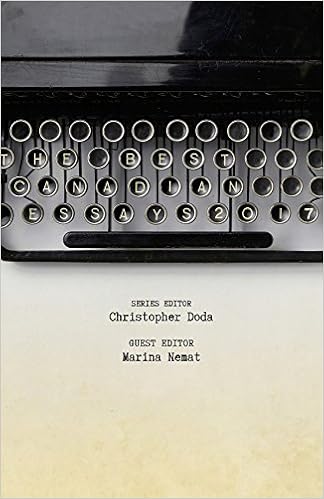
The Best Canadian Essays 2017

I’m proud to announce that my essay, On Madness Within Imagination (previously published in the Humber Literary Review) has been chosen for inclusion in The Best Canadian Essays 2017. It’s now available in-store and for online purchase.

Other authors included in the collection: Peter Babiak, Deni Ellis Béchard, Jane Campbell, Leonarda Carranza, Francine Cunningham, Larissa Diakiw, Alicia Elliott, Suanne Kelman, John Lorinc, Lauren McKeon, Susan Peters, Russell Smith, Joanna Streetly, Richard Teleky, and Jane Edey Wood.

If you live in Toronto, there’s a launch planned for November 16th @ Ben McNally’s on Bay Street. I will be reading along with a selection of other authors.

Share

The Brain & Science – The Problem With Wanting It All

As a psychotherapist, I have taken an interest in the rise of neurobiological research being applied to my field. At first, particularly upon hearing about “interpersonal neurobiology” (or IPNB), I was excited — I was seeing the intrapsychic and biological converge into what appeared to be a fascinating model of understanding human behaviour. But here’s the thing: while I have a deep reverence for the subjective life of the individual, I’m also interested in looking at things empirically, where applicable. Without this latter aspect, I feel we fall prey to magical thinking.

The more I looked into some of the new ideas permeating my field, I became aware of a few things. While certain concepts, such as the idea of neuroplasticity, were taken from science, the more I looked at who was writing about this, the more I noticed that the people applying these complicated concepts to psychotherapy weren’t neurologists or geneticists. One of the oft-referenced authors in the field of IPNB is Allan N. Schore, who is a psychologist and researcher. His books are popular with those looking to harmonize neurology and psychotherapy. And while I respect his multidisciplinary work, I have difficulty with binary conceptions of how the left and right brains work (whereas, supposedly, the right brain is responsible for emotional attunement, the left brain for insight and analysis). Why do I have difficulty with this? Because many neuroscientists would contend that this is too simplistic a way to look at the brain.

This is a blog post and not a long-form essay. I could go on. I suppose what irks me is the amount of material being written about a myriad of complex neurobiological research findings that skip over the necessary cautions that are the hallmarks of science. Correlation is not causation. How big was the sample size? Continue reading “The Brain & Science – The Problem With Wanting It All”

Share

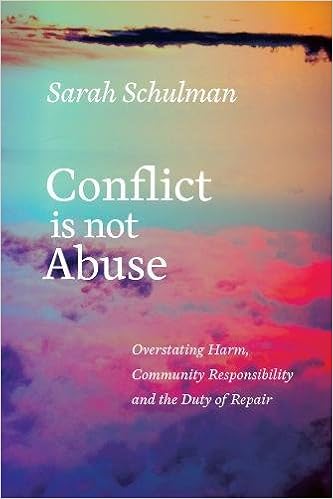
Book Review: Conflict Is Not Abuse, by Sarah Schulman

I’ve noticed more and more over the last decade that less and less people want to use the phone. I cannot help but draw a correlation between this observation and the ubiquitous rise of digital communication. Email? Sure. Text? Yup. And what’s wrong with this, you might ask? On paper it would objectively appear that text-based communication (particularly including social media) is superior at transferring information without error, if only us pesky humans didn’t make mistakes. And this last part is key: we are not objective, we balance the objective world with our much less easily measurable experiential (or personal) reality; this second reality is informed by our experiences, which are diverse and sometimes punctuated by trauma or loss. When we talk to someone on the phone we are leaving ourselves prone — to fallibility (stammering, going off on a tangent), or having our hesitations read as something we may not otherwise wish to reveal.


I was thinking about these things (and many others) when I began reading Sarah Schulman’s powerful book, Conflict Is Not Abuse: Overstating Harm, Community Responsibility, and the Duty of Repair. The problem with nearly all forms of digital communication and social media (with the exception of apps like Skype, etc) is that there is no actual dialogue — we aren’t allowed to have the sort of vulnerable conversations that speaking in-person or on the phone forces us into. And, in one of the book’s more important diagnoses, Schulman recognizes this as a key ingredient in the escalation of violence. Instead we are only allowed to trade unidirectional statements, leaving nuance and human connection by the wayside. So, when we have a disagreement with someone via text it becomes easy to pile on them, to vilify them. We can’t see them and there is no way for them to interject. On a social media platform like Twitter, this sort of conflict easily escalates into directing the wrath of groups upon an individual. Continue reading “Book Review: Conflict Is Not Abuse, by Sarah Schulman”

Share

Update: May 2017

My lack of updates (at least over the last few years) represent activity elsewhere (offline, or online somewhere else). In April I had the wonderful pleasure of being accepted at the Banff Centre for Arts and Creativity for a self-directed writing retreat. I hadn’t been to Banff since I was in my teens, so it was a great refresher on a very unique part of the country. It was also my second time visiting Alberta in the space of 6 months (previously over 20yrs before that), so with all that (including altitude and time changes) it was an intense, and dizzying, yet ultimately productive week. 

When I say “productive” I mean that I’ve been working on the next novel. I can’t say that I achieved any fist-pumping wordcount, but the quality of the content was my focus. I realized when I began to work that I’d written much of the “easy” stuff beforehand, leaving this idyllic escape the setting for me to enter a very challenging series of character mindsets. Not fun. There was beer. 

This past weekend, I got to take a getaway to Prince Edward County for some much-needed not work/not writing time away from home. I really love that neck of the woods. I have an affinity for rural environs: the smell of manure, the birdsounds, the expanse. And yes, the wonderful wine and beer, and cheese. Yet, coming back to Toronto, I realized that there were things missing that I would struggle to live without. Rural areas don’t have a lot of diverse culture (I will say that Picton has a very nice movie theatre, and Bloomfield has a cool-looking drive-in), and they also happen to be very white. By “very white” I mean they are almost exclusively enclaves of white people. I grew up in those sorts of enclaves and I am in no rush to return without some evidence that [wherever I fancy moving to one day]  welcomes POCs (persons of colour).

I’m working through a lot of ideas as a result of these two trips, some fictional, some filtered through autobiographical experience. Along the way, I’m hoping to begin posting writing-related ideas here (I say “ideas” because I’m not comfortable with “tips,” which springs from my work as a psychotherapist who eschews advice-driven approaches).

Stay tuned.

Share

ReLit 2016 Nomination!

I am honoured to have The Society of Experience shortlisted for the 2016 ReLit Awards. What are they, you ask, and wasn’t 2016 last year?

The ReLit Awards are, to quote the blurb on their site, “to acknowledge the best new work released by independent publishers — may not come with a purse, but it brings a welcome, back-to-the-books focus to the craft.” In other words, rather than being about money and televised coverage, it’s about quality. One distinguishing element of the ReLit Awards is that they select books from the previous year. Thus, the 2016 ReLit shortlist represents fiction, poetry, and short fiction from 2015.

I am with some good company:

The Capacity for Infinite Happiness, Alexis von Konigslow (Buckrider)
All-Day Breakfast, Adam Lewis Schroeder (Douglas & McIntyre)
One Hit Wonders, Patrick Warner (Breakwater)
Split, Libby Creelman (Goose Lane)
Chinkstar, Jon Chan Simpson (Coach House)
Too Much on the Inside, Danila Botha (Quattro)
Martin John, Anakana Schofield (Biblioasis)
Winnie’s Tongue, Nic Labriola (Insomniac)
One Hundred Days of Rain, Carellin Brooks (BookThug)
The Theory of Light at Midnight, Elizabeth Ukrainetz (Tightrope)
A Superior Man, Paul Yee (Arsenal)
A Free Man, Michel Basilieres (ECW)
The Man Who Saved Henry Morgan, Robert Hough (Anansi)
The Hunter and the Wild Girl, Pauline Holdstock (Goose Lane)
The Society of Experience, Matt Cahill (Buckrider)
Where Did You Sleep Last Night, Lynn Crosbie (Anansi)

I expect the selected category winners to be announced in a month’s time.

Share

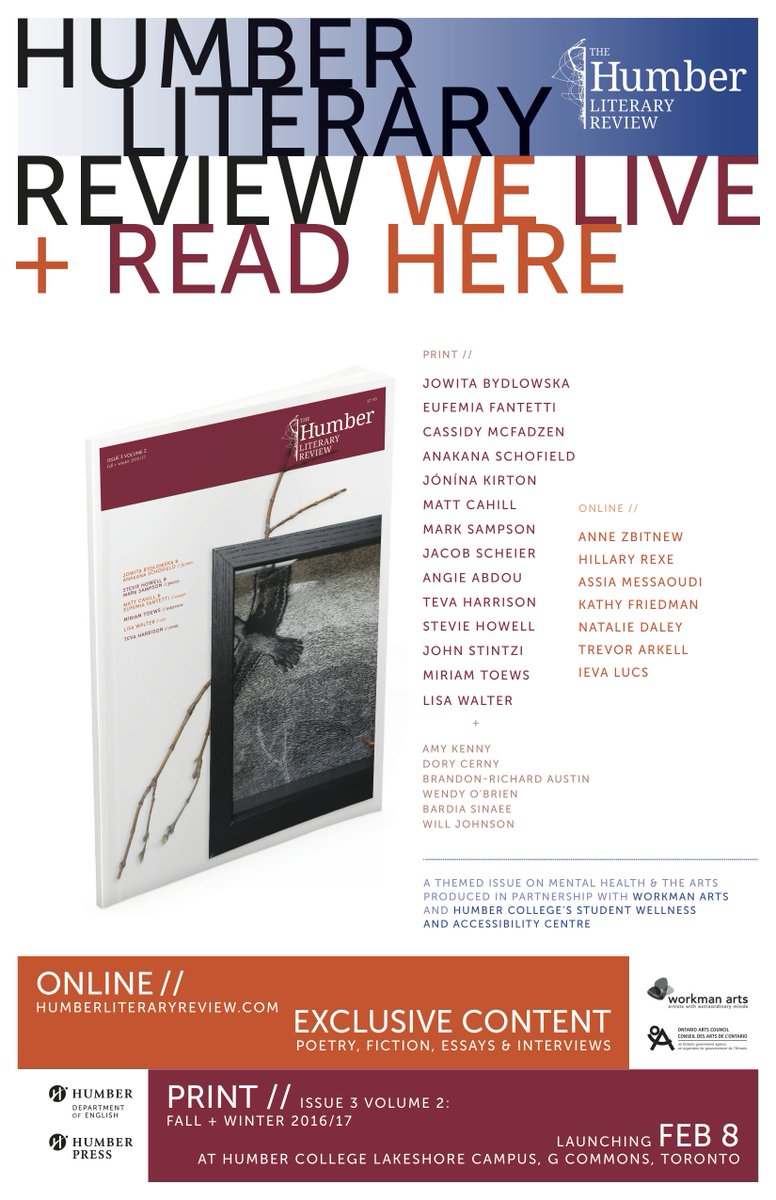
Essay in Humber Literary Review #6

I’m happy to say that the latest issue of Humber Literary Review (#6) is out, and I have an essay included. This is their first themed issue, and it’s about mental health. Because I’m a psychotherapist who is deeply reflective about the way in which we choose to see the world, I saw this as a golden opportunity to submit a pertinent perspective; my essay, On Madness Within Imagination, confronts a cultural blindspot – the depiction of madness in fiction.


It is available at the following Toronto bookstores:

Another Story (on Roncesvalles)
Book City on the Danforth
Book City on Queen
Book City on St Clair
Book City in the Village
Presse Internationale on Bloor
Presse Internationale in the Beaches
Type Books (on Queen)

It is available elsewhere, of course, but I have no clue where. You can also purchase a subscription from HLR.

Share

December

Driving from Camrose to Calgary AB in November

It’s been a hell of a run. I am exhausted and happy to focus on my (very busy – not complaining) day job.

November’s tour of Alberta was wonderful, and I’m happy I pushed myself to make it happen (and grateful my publisher was able to wave her travel grant wand my way). I met readers, old friends, new friends, and relatives. I saw Alberta — a place I haven’t set foot in for almost 30 years — with fresh eyes (and a driver’s license). I could not have asked for a smoother tour, and I am thankful.

I am also tired, and am happy to put The Society of Experience to rest so that I can focus on the next book. I don’t want to publicize anything for a while. That said, I will have an essay coming out in the next issue of the Humber Literary Review, looking at our skewed depictions of madness in film and literature – that’s coming out in January, I am told.

If you are reading this, I hope you have a good December, and are able to find light in what was quite a dark 2016 for many.

Share

IFOA Reading, Alberta Tour & A New Essay

I’ve got some great things in store for the next month or so:

October 25th: I’m going to be reading at the Literary Press Group‘s Boos & Books event, which is part of the International Festival of Authors. I’m thrilled to have been selected as well as honoured to be part of the IFOA. Because it’s a Halloween-themed event, I’m going to be reading an excerpt from my short story, Snowshoe (if you haven’t read it, it’s available at Found Press for the price of a cup of coffee – super cheap!)


November 9th – 13th: I’m going to be on a (very fast) tour of Alberta, reading/promoting my novel, The Society of Experience. Current dates are as follows:

November 9 – Camrose (University of Alberta campus)

November 12 – Calgary (location tbd)

November 13 – Edmonton (Audreys Books)

Somewhere in here I’m hoping to make an appearance in Red Deer – stay tuned! I’m looking forward to seeing old friends from when I lived there, as well as meeting readers, not to mention members of the Alberta publishing community (this last part may not sound exciting, but I think it’s significant!)

Lastly, I have an essay coming out in the next Humber Literary Review (due in November). This is a themed issue whose topic is mental health. My essay explores fictional depictions of madness in contemporary mainstream media, their worrisome undertones, and the challenges with working with the idea of madness. This is a very challenging piece, written from varying perspectives (as a psychotherapist, as an artist, and also someone who has a personal perspective on mental health challenges).

Stay tuned for updates — this is going to be a busy last quarter for 2016…

Share