Book Review: Therafields, by Grant Goodbrand

It was with considerable surprise when, browsing the shelves of our favourite used bookstore, Balfour Books, I was handed a book by my wife. “Did you see this?” It was purporting to be about a massive psychoanalytic commune which had its roots in downtown Toronto during the 60s and 70s. I was surprised because I’d never heard of it before – the group was called Therafields. I was immediately struck by the communal angle, the era, the emphasis on psychological investigation – it was like being handed a screenplay by David Cronenberg. The fact that I am studying psychotherapy and its theoretical/historic development made it irresistible.

Subtitled The Rise And Fall of Lea Hindley-Smith’s Psychoanalysis Commune, Grant Goodbrand’s Therafields is just that. From the mid-60s till the early-80s, what was eventually coined Therafields, became one of the largest active communes in North America (significant considering both the era and that it happened with virtually no physical or cultural traces left in this city), owning as many as 35 houses within, and 400 acres of farmland just outside Toronto. At its apex it had over 900 members.

Starting out with a modest practice in the Annex, Welsh émigré Lea Hindley-Smith began by seeing people in her home. Her open embrace of students combined with an uncanny ability to get to the bottom of her clients’ problems (not to mention her real estate acumen) conspired along with the socially progressive ideals of the 60s to develop a remarkable experiment in psychotherapy: a live/work environment which operated also as an ongoing group-process for its members, all under the auspices of Hindley-Smith who became their professor, CEO, and den mother. More houses were bought so that more living spaces could be added to accommodate new members, and new groups were developed. The story of Therafields is an account of how this creative hive eventually became an unmanageable empire. It is also an invaluable reflection of the changes happening at the time, guest-starring those stranded by the revoked promises of Vatican II, the back-to-the-farm movement, and the idea that psychotherapy could be about society rather than the individual.

I am a child of the 70s. Nothing could possibly be less meaningful than that statement. However, culturally speaking, I was surrounded by the 70s. The mid-70s to mid-80s were a formative time in Canadian television. In other words, we saw a lot of ourselves. And what we saw was produced and inflected by those who came of age in the 60s and early 70s (that’s the way it always worked until recently, by the way – the older generation helped the younger generation identify with their own generation). In other words, I can imagine Therafields, while reading about it. Goodbrand has done a good job of contextualizing the era in which his book takes place. It also helps that Goodbrand was a key member of Therafields himself, and as such is gifted with a familiarity which an outside author would struggle to develop. The flip-side to that statement is that an outside author might have had a better chance of keeping the rhythm of the book’s story consistent: there is a habit of temporal back-and-forth which does not make for smooth comprehension at times.

Considering Goodbrand’s credentials, Therafields unfortunately suffers from a detached perspective. He is as qualified as anyone to write about Lea Hindley-Smith and those who were key to the group’s skyward development – like esteemed poet bpNicol, for example – yet it seems only an accumulation of actions, the plotline of a biography, which gives us clues to the hearts beating behind the cast of characters. Goodbrand’s book sometimes reads like an account rather than an experience.

And here we come to a marketing dilemma: I’m not sure who the intended audience is. I am thankfully, luckily, well-suited to read, understand, and enjoy Therafields. Yet… With its insistence on differentiating what Hindley-Smith practiced (Kleinian) from classical psychoanalysis, without necessarily providing a debriefer for the reader on what makes Kleinian psychoanalysis different from it, I cannot imagine the “average reader” walking away knowing what that all should mean. Perhaps that won’t matter if they are keen on digging into a prime slice of Toronto history – complete with addresses, one could conceivably operate a motor-tour of where Therafields took place.

It is, nonetheless, an insightful read and an invaluable chronicle of a peculiar social/cultural phenomenon. Therafields, by Grant Goodbrand (ISBN: 978-1-55022-976-9), is available (evidently) from a used bookstore near you, and also online.

Share

Another One Bites The Dust

ARG! One of my favourite literary blogs is ending its run! I encourage you all to visit Ward Six. I really appreciated their approach: to book reviews, to the art of writing. To art itself.

The reasons they give are sensible, yet I will be selfish and whinge that I am now left with oh so very few relevant, intelligent, knowledgeable literary blogs to follow.

Nonetheless, I wish John and Rhian all the best.

Share

Brief Reviews: The Town vs. Animal Kingdom

When Ben Affleck’s The Town came out, many praised it as a powerful crime drama/action film. And yet, the shine seems to have come off of that project, probably as a result of people chasing the hype and actually watching it.

First, let’s discuss its poster. In recent years, I’ve become sensitive to bad marketing. A good example of this is the film Forgetting Sarah Marshall: the ad campaign (in Toronto at least) consisted of anonymous black and white bus and streetcar ads, with hand-scrawled “I HATE YOU SARAH MARSHALL!” (and the like) written on them*. In short, the campaign was cheap-looking, lame, and soured any potential expectation I had for the film – it wasn’t until much later, at my wife’s urging, that I caught it on DVD and found it to be one of the highlights of the year.

Similarly, the poster for The Town (displayed here) is a marketing mystery to me: it looks like a horror movie. It’s directed by and stars Ben Affleck, yet the poster is covered in evil nuns with automatic weapons. In short, I don’t get it: sure, it’s a “serious movie” but what were they thinking? Was it reverse psychology? Who knows. If it were me, it would be a close-up photo of John Hamm licking Ben Affleck’s unshaven face, with the caption: “Holy shit! It’s the guy from MadMen with Ben Affleck! And they  shoot weapons!”

Then there’s the film itself. Technically, it’s very impressive. Affleck’s direction is solid. The performances are gritty and engaging. It’s free of stunt-casting. Camerawork, editing, sound: great. But when the credits rolled, I realized what was wrong. The story’s been done a hundred fucking times before – twice by Michael Mann. So, for me, there was nothing being risked as a viewer because, having watched more than one crime drama in my life, there were no surprises in the script. Believe me when I say that I wanted this film to be as good as it promised – and, in fact, it is good. Just not as good as it clearly could’ve been when you take into account all that it has going for it.

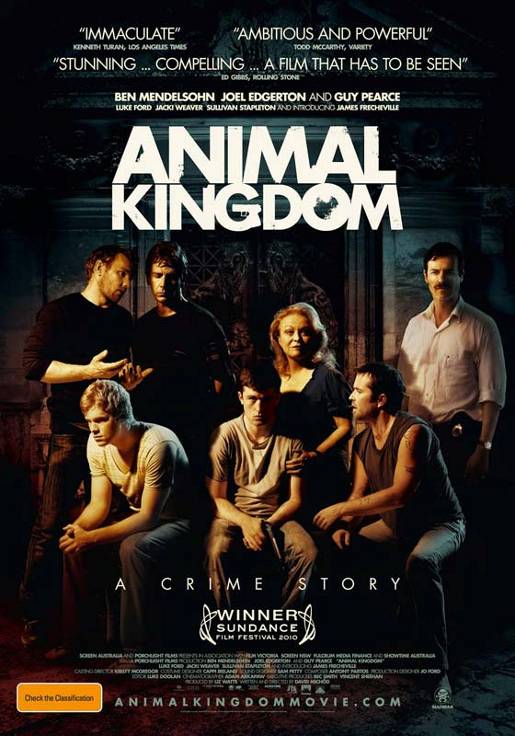
So what did I want The Town to be? I wasn’t sure…until I saw the Australian crime drama Animal Kingdom on DVD. It has all the grit, tension, and complexity of The Town, with less overt style and more substance, and no actors recognizable to most North American audiences (outside of Memento‘s Guy Pearce). Its poster? Have a look:

It reminds me of a Jeff Wall photograph. And in the middle of it all is the crafty look on the face of actor Jacki Weaver (nominated for Best Supporting Actress at the 2011 Oscars).

Animal Kingdom is a film fluent in the crime drama language – it even shares some of the tropes of The Town (the nervous druggie robber, the dutiful police detective) yet never once feels as if you are watching a re-treaded story. It is unpredictable and the performances are naturalistic and subtle.Its lack of artifice keeps us watching, whereas with The Town, each successive car chase weighed it down with Hollywood cliché. Where one carries broader tension, the other is quietly disturbing and takes a more nihilistic view of the cops and robbers game.

The good news is that both are available for your perusal on DVD, and both are extremely watchable. Neither, ultimately, will disappoint: it depends on where your expectations are set. I feel that Animal Kingdom is the film The Town wanted to be.

* I admit I’m particularly sensitive to ads which don’t make it clear that they are ads, especially if they look like actual public messages of hatred.

Share

Guilt By Association

An article I wrote back in March of 2010 (“I’ll Show You Stupid”) is getting a lot of steam, it seems. Nice to see new visitors. It’s nice to look back at something I’ve written in the past – the good stuff at least – and see that my instincts were well targeted. In the case of this particular article, it was about the dangers of denigrating (political) others on the basis of how intelligent they come across; the danger was that such actions back-fire more often than not. It mentioned a certain former governor of Alaska.

I’ve been thinking and discussing the subject of elitism quite a bit lately. There are many subtleties in the way we use the word “elite”, but when used in its current populist political form, what people are particularly referring to are those who are educated. Plain and simple. I’ve spent many an hour, day, year, working with and speaking to people who are very educated and worldly, and I must say that they desperately need to get organized if they are to live up to the hype of being the human whippets they are made out to be.

This last October, Toronto voted for a populist mayor – a champion of the surrounding suburbs – who played the “elite” card quite a bit. Regardless that the man is a millionaire from a millionaire family, that he went to Carlton University, he was able to parlay the us-versus-them thing quite well. Helps that he coaches football and is built like a linebacker and probably looks exactly as he did in high school. Thing is, by all rights, he is an elite. Meanwhile, the target of his vitriol, the downtown intellectuals that I hang with (I swear I don’t do it for this reason) – the people who think bike lanes are safe and that public transit is important – are positively victimized by the very thing they are accused of. You see, I think the intelligentsia failed Toronto, just as they typically do most civilizations: where were they (hell, we) during the ten months of the pre-election hype? Where were they when a candidate capable of beating Ford needed to be picked (I don’t think anyone really supported Smitherman – for *’s sake, he adopted a child six months before the election, how responsible is that?). Well, the “elites” were chattering amongst themselves, refuting Ford’s populist bullshit as just that. What everyone forgot is that elections are competitions and without a competitor we ended up with the bully from high school as our hall monitor for the next four years.

The point I’m trying to make (casually, and without credentials because this is a blog and I’m not a journalist) is that the so-called elitists are too busy looking at subtlety, too busy drawing examples from the history of civilization to actually stick their necks out and actually pick a candidate. In short, intellectuals hate making decisions and would rather prefer to show off how much they know about things. That’s how we end up with Rob Ford as mayor. That’s how we ended up with Stéphane Dion leading the Liberal party, or allowing members of the Reform Party to vote twice (if they belonged to both parties) in the merger of the Progressive Conservatives and Reform Alliance parties. The intellectuals – the so-called elites – were busy sitting on the sidelines trading notes, impressing each other with witty barbs.

And this is why I have a stake in the whole “elite” argument. In a sense, yes, they are the enemy. Not because they want anything, or that they are organized enough to have an agenda in the first place, but rather because they don’t know what they want for anyone other than themselves and most of them are too afraid of being politically active. In other words, they should know better, should do better, but they don’t. And as a result they doom the viability of the very life they live.

Share

Movies & A Book: Some of The Best Things I’ve Witnessed in 2010

Here’s the best of what I’ve seen this year. I haven’t seen everything. You may disagree with what I have seen. This is life.

FILM:

Inception

Go ahead. Try. Try disagreeing that this is one of the most technically (and perhaps conceptually) elaborate mainstream Hollywood productions released in years which also happens to work as a “movie” that a wide variety of audiences would enjoy watching.
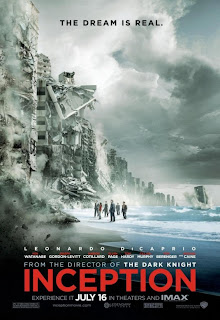
There has been a backlash against Inception. I don’t know how or why this is – perhaps it was over-sold as a deep “puzzle-solver” film, which it is not. And yes, the NYT’s A.O. Scott has a point in his comment that the film’s literal depiction of dreams are lacking psychological heft (outside of Marion Cotillard’s performance as DiCaprio’s wife). In any case, something has caused a revolt against this film and I say this revolt is missing the point.

Inception is, generally speaking, the most watchable, the most fascinating film of 2010. You are allowed to hate it.

A Prophet
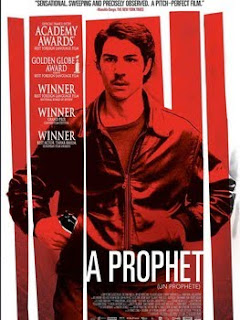
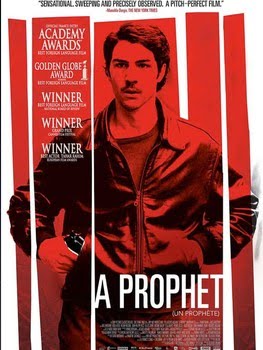
I am a huge fan of Jacques Audiard, a French director who has always rewarded the viewer with films (Read My Lips, The Beat My Heart Skipped) that balance passion with style. With A Prophet, Audiard expands his canvas, creating a gritty, novelistic masterpiece on-par with The Godfather (yes). The story concerns a young incarcerated Muslim who slowly rebuilds himself from within the treachery of prison life, rising from under the thumb of a vicious mob leader to become his own person and create his own empire. Epic, patient, and in places extremely violent. People will be referring to this film for years to come even if it has not really made a mark in North America. Again, a masterpiece.


The Eclipse

I realize this Irish film was released in 2009, but it didn’t get here until now. A compelling ghost story which eschews the two-dimensionality of ghost story films. It was around the twenty-minute mark that I realized it was a film which was going to confound my expectations (expectations based upon years and hundreds of similar plot lines): it wasn’t going to squander what it was and fall prey to hackneyed cliché. A gorgeous, touching, ultimately humanistic film with a stand-out performance by Ciarán Hinds as a grieving father of two children who must swallow his pride to escort a loud-mouthed Aidan Quinn through the motions of a book tour of the small coastal city of Cobh, in County Cork. A sublime achievement by director Conor McPherson.

Notable: Winter’s Bone – see it. It’s on DVD now. Like A Simple Plan, it’s a self-contained “rural thriller” (ugh) with a chilling undertone of barren hopelessness. Unlike A Simple Plan, it’s uncomplicated which is what gives it more of an honest strength. Exit Through The Gift Shop is the perhaps best film made about art and the art world that I have seen – like Inception, it’s not trying to be deep, just smart. Scott Pilgrim vs. The World blew me away because I expected it to be weak (perhaps because all the publicity photos inexplicably used a static image of Michael Cera standing against a fucking wall…imagine if you will, trying to sell Star Wars with a picture of Mark Hamill sitting cross-legged in the desert – sounds awesome, eh?). Not only was it not weak, it was the strangest case of “I don’t know why I love this movie but I really do”. Painstakingly, sublimely Toronto-centric (which, unlike the inexplicable promo photos of Michael Cera, shouldn’t be factored into explaining why it didn’t fare well at the box office) and wildly imaginative – those two things have never met before…oh but wait, I forgot the perfect companion piece: Kick Ass – also shot in TO, and also exceedingly expectation-defying (although the climax is kinda drawn-out). As far as performances go, Jesse Eisenberg (The Social Network) and Colin Firth (The King’s Speech) stand out, along with Winter’s Bone‘s Jennifer Lawrence, and Hailee Steinfeld for True Grit (who, at 14-years, shows huge promise as an actor).

BOOK:

I would have said “BOOKS”, but due to work and school I haven’t read anything published this year (that I can remember), with the exception of John Vaillant’s The Tiger. Lucky for me, since it is without doubt one of the best non-fiction titles I’ve read in years.

The Tiger is a meaty real-life tale of vengeance by the titular beast, in the winter hinterland of the Russian Far East (which the author calls, paradoxically, “the boreal forest”). Vaillant describes an environment historically, politically, and biologically unique, inhabited by hardened outcasts. The shadow of a predator male tiger, known never before to attack without cause, creates a wave of dread throughout the land, with only a small band of volunteers to figure out the mystery. Vaillant provides wave after wave of fascinating detail – examples of how man and beast have evolved throughout time, how human and animal behaviour have worked in similar paths – that by the end of the book you feel as if you should have a credit in Ethology. This is truly a page-turner and I cannot recommend it enough.

Share

Book Review: Never Let Me Go, by Kazuo Ishiguro

Sometimes things just line up in such a way that you can’t help feeling they were put there on purpose. Early this month, as part of a course I’m taking, I went to a weekend retreat, held at a secluded compound by the Credit River. It was a bit eerie, because many of my dreams take place in expansive compounds: wherever I go, even if it seems I’m outside, I just have to look up to see that there is a roof, or some sort of enclosure to remind me that I am not free. So, what book from our library did I take with me at the last minute? Why, Kazuo Ishiguro’s Never Let Me Go, of course. What I didn’t realize is that much of it takes place on a compound…but I’ll get back to this.

I’ve not read any books by Ishiguro – I haven’t even seen the movie adaptation of Remains of the Day. That said, I did work on Guy Maddin’s The Saddest Music In The World, an adaptation of one of his short stories. I’d heard good things about Never Let Me Go, and had always meant to read it. With it being released as a film recently (I don’t think it did that well, despite the critical praise), and since I needed something to read during my time away, I thought it would be a good pick.

Never Let Me Go concerns the story of Kathy, Ruth, and Tommy. It’s told from Kathy’s perspective in the present. She is a carer, who drives from centre to centre, visiting those she looks after. Very soon we are introduced to their beginnings, as children, in a place called Hailsham. It’s an isolated educational enclave, somewhere in England, where the students live, go to school, and grow up. But there’s something a little odd about it all. Perhaps it’s the isolation from the rest of the world. Something in the way some of their guardians regard them. All too soon, their sun-dappled childhood in Hailsham becomes something which haunts them as they grow into young adults. It’s practically all Kathy can use to mark the passing of her time.

Within these reminiscences, we are introduced to Tommy and Ruth, who become the foundational friendships Kathy clings to through adolescence, regardless that Ruth oscillates from friend to enemy – a colourful rather than careful individual who becomes a voice of danger in the fog of their relationship.

The magic of this book is the skill with which Kathy’s perspective is written. There is a purpose for Hailsham, for their being there. There is a reason she is a carer. Never Let Me Go is a capital-H haunting novel, inhabited by people who are slightly cold but reaching out, never quite managing to touch a meaning they hope is there. I can’t say much more without spoiling things, not that it’s a book laden with surprises, so much as layered with subtle, sad observations. A beautiful book for a rainy day.

Kazuo Ishiguro’s Never Let Me Go (ISBN: 978-0-676-97711-0) is available at an independent bookstore near you, or at various online retailers.

Share

I Don’t Want To Know

As a writer, even though I am not part of any sort of literati, I am still plugged into the lit scene. You need to be if you want to understand the general to-and-fro of any industry you are interested in becoming a part of (same goes for TV, music, theatre, etc..). That said, I must make an admission. I am making this admission because I think there are a lot of people like me out there who feel the same but are reticent to admit it.

Here goes: I don’t take any particular interest in the life of the artist outside of his or her art.

When I read a book, I don’t care if an author comes from the East Coast and studied journalism, had a drug problem and now lives in a shed with a mastiff. It’s not that I don’t care about this author personally, it’s that these facts shouldn’t have anything to do with the book that I am about to read. I should be able to pick up the book, knowing nothing about said author, and be able to read it, enjoy it, be fully affected by it, without substantially missing something due to a lack of familiarity with the author’s biography.

And yet, when you are culturally plugged-in (and by this I mean, you check out industry blogs, trade mags, etc.) there is so much white noise about the artists themselves that it seems divergent from what it is they are supposed to be doing: their work. We can talk about Picasso’s passions, but 100 years from now there will probably only be discussion of his work – your work is the only thing left after you and everyone who knew you has died. And if people are still talking more about you than your work after this point, then I would think the quality of your work was overstated.

Would knowing that Stephen King battled drug addiction offer an insight into some of his writing? Yes. But, my point is that if that insight is necessary in order to fully appreciate a piece of work then there is a problem. The work doesn’t work if you need a biographical cheat sheet to inject context into the material.

I think Bryan Ferry is an fantastic vocalist – and I don’t want to know anything more than that. Nor the details outside a director’s films, nor what inspired the playwright to write her play. I’ve got my own shit going on, thanks very much.

Ephemera is for journalists, fanzines, and those working on their Ph.D. The general public should not feel inadequate if they pick a DVD or book off a shelf, sit down in a theatre, or load a song without being prepared with supplemental information not contained within the medium which contains the work. The work inevitably has to stand up for itself. I write this for two reasons: first, with the likes of the AV Club and traditional print/TV media clamouring to add as much web-based context as possible to every article, there’s a growing sense that – for the everyman – if you aren’t savvy to the smallest details of each artist’s passings and goings, you are nothing but a tourist. Secondly, embracing social media to a claustrophobic degree, we can now read endless commentating on authors reading their work for a live audience!…something no one really asked for outside the publishing companies themselves and perhaps the authors’ parents. Let’s face it: most authors can’t read aloud to save their lives – it’s not their specialty.

There are reasons for digging deeper, but that’s up to the individual. It was interesting to learn more about HP Lovecraft when I reviewed Michel Houellebecq’s quasi-biography of him and his work. What’s funny, however – using that same example – is that when I proceeded to read the two works by Lovecraft contained in that same book, I don’t recall thinking to myself “Ahh – this is where his uncomfortable relationship with women takes shape!”. That’s because the stories were two of his masterpieces, and when you witness a masterpiece, peripheral biographical information is going to gunk-up your enjoyment.

The medium may be the message, but the work contains the words. Outside of this we are left with cultural “bonus features”. Nice to have, but not necessary.

Share

Ticket Stub: Spalding Gray

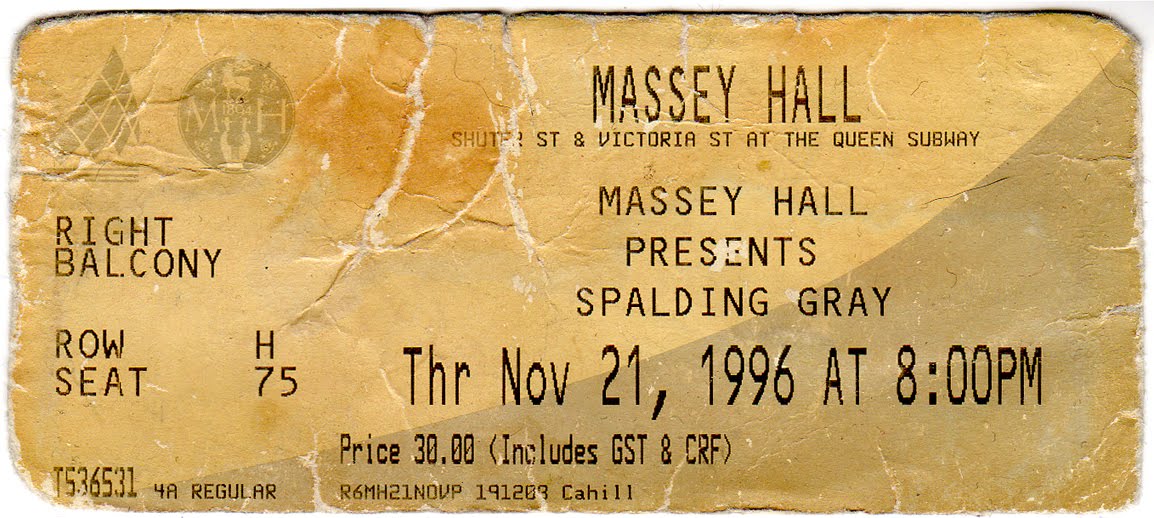
I have this ticket stub (above) from a one-man-show – Spalding Gray at Massey Hall. It was good. I don’t know how to describe his “show” in practical terms: he didn’t sing, he didn’t dance, he didn’t perform in the traditional sense. He talked. About himself. He was a monologuist. And his stories would encapsulate, in ever widening circles of narrative, the great many wonderful and (more often) terrifying things going on with his life.

He was an actor/playwright whose home was primarily New York. I’m not sure if New York makes people like Gray anymore. These performances were not “actor/playwright” shows – these shows were, in retrospect, a form of therapy. Gray talked about the things – worries, revelations, lost epiphanies – which affected him as a regular human being; the things which happen around the things we do with our lives.

His best-known performance, captured on film by Jonathan Demme, is Swimming To Cambodia. In it, with a desk, chair, and glass of water he discusses the events which surrounded the time he played a small role in the critically-acclaimed film, The Killing Fields. He talks of his research for the role in the film, of what actually happened during the reign of terror in Cambodia during the early-to-mid 70s.

Gray was a man given to self-exploration, perhaps painfully so. His mother committed suicide while he was in his 20s, and he exhibited symptoms of bipolar depression himself. Her death held an eerie fascination for him. In subsequent performances (also made into films), Monster in a Box (about writing a novel) and Gray’s Anatomy (about his fear that he was going blind), he explored his neuroses and anxieties and how they filtered through his relationships with those close to him.

The key to Gray is that he was funny as hell, which turned all of his painfully honest accounts, his public descriptions of private contortions all the more enlightening for the viewer, as opposed to merely sympathetic. Gray was neurotic, but he wasn’t looking for sympathy from the audience, and I think this is the second key to understanding him (as a performer, at least). When I saw him at Massey Hall in November of 1996, I don’t remember a lot of details (it was his It’s a Slippery Slope tour), with the exception of his description of sitting outside, trying to have a soulful discussion with his distant father while a fog horn sounds in the distance. I remember this because I was laugh-crying throughout most of it.

When I heard in 2004 that Spalding Gray was missing, that it was suspected he had jumped off a ferry into the East River, I was not shocked. Suicide – as an objective event, as a subjective idea – was something he had discussed since Swimming to Cambodia. Add to this that he had been in a terrible car accident a few years earlier which had left his right leg partially disabled (not to mention having a fractured skull), and you could see (in retrospect, of course) how, given his frame of mind, it might have pushed those dark thoughts further toward the limelight of contemplation.

It is a shame.

Share

Swirl

I am trying (desperately) to avoid a “boy, it’s been a wacky ride these last few months!” post. It certainly isn’t for lack of things to talk about, news to update you with, opinions to confess/shout.

Thing is, I don’t know who you are. Sure, I know there are some of you who are semi-regular visitors. There are others who happen upon this place by accident (via Blogger or StumbleUpon). There are also those who come here via Google searches, either via my name or – most likely – a book review (which admittedly I haven’t done in, oh, a year or so *). And no, this isn’t going to be a “Matt wittily evading accusations of being a lazy bastard by turning the camera on the reader” post.

I’ve been posting artsy stuff, writerly stuff, industry opinion stuff. I don’t mind the randomness, so long as there’s no fluff. I do mind the lack of output. I wish, for one, that I could post more photographs (which is to say, I wish I had a better selection of photos to post **).

It comes down to the fact that I’ve been working like a dog since May (note: this happens every year that I’m working on a SAW film). When I come out of these periods, I feel like Rip van Winkle: a little dazed, slow on the up-take. Whereas last year this time I started teaching, this time this year I am a student (part-time) †. I have a small (but good) feature and a small (but good and potentially controversial) TV show on my plate from now till February. If funds allow, I also hope to have an editor working with me on my novel, with an eye to approaching a publisher or self-publishing if that doesn’t seem feasible ††. I’m collaborating on a musical.

My plate is full.

– – – 

* which isn’t to say that I’m not reading or that I don’t want to do any more book reviews. I’m reading a lot of non-fiction, thank you. Much of it either out of professional or academic interest. However, if only to improve my Google ranking, here’s a quick book review of Antwerp by Roberto Bolaño: What the fuck was that? (ISBN-13: 978-0811217170)

** another casualty of working so much is my photography. I still have the same roll of film in my camera that I’d loaded in June. I think I’ve only taken 4 exposures since then. Of course, my cellphone camera gets all the fun these days, unfortunately.

† I will be continuing teaching, but for only two terms this year as opposed to three (which was exhausting and… exhausting)

†† It needs a new name, for one thing. And I know this is going to drive me up the wall more than any changes to the actual content of the book.

Share