May Miscellany or "Practise Makes Stuff Better"

Hello all,

I’m working on adding some more photos soon and I’m incubating some ideas for articles. Work has been going spectacularly well (in the sense that I’ll be employed full-time until October, and it’s a big-assed feature film too), but of course it keeps me away from this little piece of cyberspace (does anyone use that term any more? Has it been retired?)

Some things to note:

1. Bandcroft, the improv/jam band I joined will be appearing twice this month at the venerable Cloak & Dagger. We will be playing May 8th and May 29th (both are Tuesdays). Come for the drinks – stay for the music. The fun starts at 9pm.

2. Behind The Garage – our first gig, last Saturday, went wonderfully. It seems we got the best crowd reception and aside from some early sound issues we played very well together. I guess that’s what happens when you practise regularly. I’m not sure when our next gig will be, but I’ll post it here when I know. You can always check out our MySpace page here for updates.

3. Writing…as some of you know, I’m a fiction writer. I’m going to start a new round of submissions soon (I took a bit of a blow in January – three rejections in as many weeks, and one of them was very, very close). As well, I’m extremely happy with how The Novel is coming. As I said before, “I guess that’s what happens when you practise regularly”. Things get better.

Lastly, Facebook. Is it me or did e v e r y o n e in Toronto join in the last month? Apparently, Toronto is the most represented city right now, which is kinda neat. I must say – and this is not a plug – compared to, say MySpace, Facebook is such an elegant, simple community. And so few bloody ads.

Share

Book Review: The Magus, by John Fowles

They don’t write books like this anymore.

The Magus was published in 1965, after the success of John Fowle’s The Collector. However, The Magus was written first. As a writer – especially as a novelist who has placed his first novel on a shelf so that he can focus on new work – I can empathize. The Magus is big, ambitious, and in many ways (especially for its time) controversial – this in spite of the fact that it largely takes place on a Greek island and features only a handful of characters.

Meet Nicholas Urfe, an English Oxford-educated drifter whose parents died when he was young. It’s 1953, and with nothing holding him to the ground (neither a sense of mortality nor morality), he spends his time hooking up with women and moving without direction. Needing a job, he happens upon a teacher’s position on an obscure Greek island, called Phraxos. He takes to it as any man in his mid-20’s would: with abandon and a sense of escape from duty. But there’s something to take care of first – the girl he just met, Alison. Despite feeling closer to her than anyone previous, he tells her he’s off and thus ends a relationship whose occasional torridness masked a begrudging love.

In Phraxos, Nicholas learns quickly – due to the desolate environment, the stale classroom, and the lack of female comfort on the island – that he’s made a huge mistake and feels he’s reached a virtual and philosophical cul de sac. It’s at this point when he happens upon Maurice Conchis, a shadowy European millionaire who lives on the far side of the island. What at first begins as a budding acquaintance based on Nicholas’ curiosity of the old man’s life, slowly turns into a devilish (and dangerous) game.

Enter Lily – a mysterious young guest of Conchis who at first appears to Nicholas like an erotic Siren projected from his host’s nostalgia. He becomes obsessed with her, first sexually and then emotionally, and begins to spend his free weekends with Conchis as the old man relates, bit by bit, the fascinating and sometimes horrific story of his life. Conchis soon reveals an elaborate live theatre which he has put on for Nicholas’ benefit. All is comfortable (in the most guiltily voyeuristic way) until he discovers that the theatre doesn’t end on the weekends, and every calculated move he makes to thwart Conchis’ control over his life on the island and his attraction to Lily, he finds himself pulled deeper into an intellectual and emotional labyrinth.

The Magus deals very specifically with the raw rebellion of youth – in this case, a generation of post-war well-educated British men – and those who disingenuously eschew the seeming hangman’s noose of middle-class responsibility in favour of an existential aloofness. The book is beautifully written, blackly funny in the right places, and – considering it exceeds 650 pages – makes for the one of the fastest and most voracious reads I’ve had. There is so much going for this book: a story that slowly wraps around you, characters you can clearly visualize, a sumptuous eroticism, and plot twists which don’t feel tacked-on or pretentious. Sprinkle with a dash of the occult for good measure.

The Magus, by John Fowles (ISBN-13: 978-0316296199) is available at a friendly independent bookstore near you. Or online at any number of vendors

One last note: this review concerns the 1977 revised version. Yes, it was first printed in 1965, but the author wanted to clear up a number of elements that he felt were either ambiguous or, well, messy. First novels, eh?

Share

The Steppenwolf Effect, pt.1: Synchronicity

As mentioned in my previous post, a couple of things occurred to me while I started reading Steppenwolf.

As mentioned in a previous previous post (here), I write fiction. I’ve written one novel and have since completed the rough draft of a second. When I started reading Steppenwolf I realised (at the point where Harry meets Hermine 1) that it shared a parallel storyline with my second novel.

I clearly remember starting to sweat, followed by some muffled swearing.

If there was anything that freaked me out at the time, it was the fear that I was going to open a book (whether it be a novel or a collection of short stories) to discover that something I’ve written had been, as they say, “done before”. In retrospect there isn’t much reason for this fear – unless one is directly influenced by something it would be a hell of a coincidence to write something that was so similar to a previously published work that you should have to worry – particularly if it’s something as complex and individualistic as a novel.

But I was concerned; I thought to myself: F*!king bastard Hermann Hesse and his f$~king storylines. But I digress…

I turned to my writing group 2. I asked them: has anyone opened a book to discover some freak-assed psychic parallel to something you’re currently working on? The answer, surprisingly, was yes – all the time, in fact. Synchronicity happens more often than we think, as it turns out.

Thinking about it, it makes sense; assuming we aren’t forced to read the books that we do (as in school) we end up reading those works which appeal to us – as readers and perhaps subconsciously as writers also. So it should come as no surprise to find narratives, plots, or characters that ring familiar.

1. Harry & Hermine sounds like the name of a Hollywood adaptation.

2. I’m blessed to have such a good writer’s group – most of us were students of DM Thomas at the Humber College School for Writers.

Share

Profile: Yukio Mishima

It’s hard to discuss mercurial writer, playwright Yukio Mishima (January 14, 1925 -— November 25, 1970) without the spectre of his demise casting a pall on the dialogue.

From Wikipedia (edited for conciseness):

On November 25, 1970, Mishima and four cohorts visited the commandant of the Ichigaya Camp – the Tokyo headquarters of the Eastern Command of Japan’s Self-Defense Forces. Once inside, they proceeded to barricade the office and tied the commandant to his chair. With a prepared manifesto and banner listing their demands, Mishima stepped onto the balcony to address the gathered soldiers below. His speech was intended to inspire them to stage a coup d’etat and restore the Emperor to his rightful place. He succeeded only in irritating them and was mocked and jeered. As he was unable to make himself heard, he finished his planned speech after only a few minutes. He stepped back into the commandant’s office and committed seppuku (ritual suicide).

Now that’s an exit.

The full story on Mishima is complex and troubling: a sheltered child raised by a temperamental and artistocratic grandmother (who came from a samurai bloodline), only to return at the age of 12 to his parents. His father was a strict disciplinarian and it is suggested that his relationship with his mother bordered on incestuous.

Writing in secret (so that his father wouldn’t find out), Mishima’s stories focused on recurring themes of death, obsession, dishonour, and the consequences of unexamined emotions.

Mishima was gay, yet paradoxically (considering the society he inhabited) became obsessed with martial arts and militaristic self-discipline.

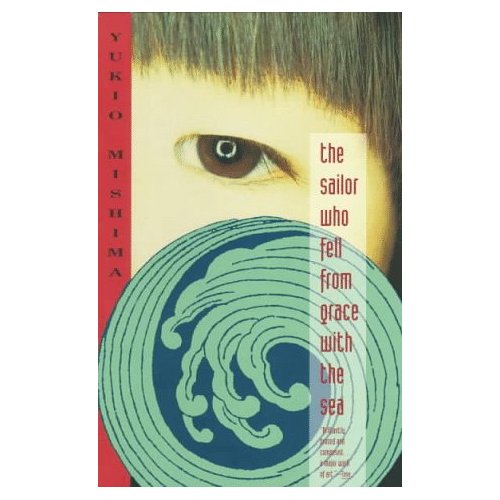
Of his more popular works is The Sailor Who Fell From Grace With The Sea.The novel takes place in post-WWII Japan and concerns the blooming love between a sailor on-leave and a wealthy industrialist whose son is part of a devilishly manipulative cabal of disaffected local children.

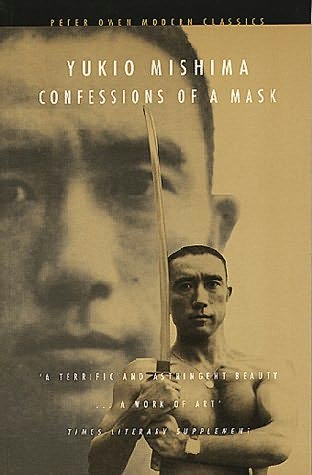
His critically-praised work includes the semi-autobiographical Confessions of a Mask and the fiction tetralogy Sea of Fertility. Mishima submitted the final draft of the fourth novel in the series, The Decay of the Angel, to his publisher on the same fateful day he and his colleagues would drive to the military school.

Having read a selection of his work (Confessions, Sailor, and the short story collection Acts of Wisdom), it’s clear that Mishima was an individual tortured by his own demons. One may argue he was born into a society which could never support his dynamic shape. His narrative style is poetic and sensual, though often critical of society and soaked with the tragedy of characters misdirected by love and self-discipline. Beautiful though they are, Mishima’s stories are often dark and painful. It’s for this reason I would be lying if I said I read his work regularly – though I wouldn’t hesitate to describe them as rewarding (if not seminal) works for the fiction reader.

If you’re curious about Yukio Mishima – and while I would not call it a definitive example – you may want to check out Mishima: A Life in Four Chapters, a film by Paul Schrader (who wrote Taxi Driver). It blends the story of his untimely death with lusciously visual renderings of some of his short stories.

Share