


Photo: Self-Portrait @ Western Hospital

I Don’t Want To Know
As a writer, even though I am not part of any sort of literati, I am still plugged into the lit scene. You need to be if you want to understand the general to-and-fro of any industry you are interested in becoming a part of (same goes for TV, music, theatre, etc..). That said, I must make an admission. I am making this admission because I think there are a lot of people like me out there who feel the same but are reticent to admit it.
Here goes: I don’t take any particular interest in the life of the artist outside of his or her art.
When I read a book, I don’t care if an author comes from the East Coast and studied journalism, had a drug problem and now lives in a shed with a mastiff. It’s not that I don’t care about this author personally, it’s that these facts shouldn’t have anything to do with the book that I am about to read. I should be able to pick up the book, knowing nothing about said author, and be able to read it, enjoy it, be fully affected by it, without substantially missing something due to a lack of familiarity with the author’s biography.
And yet, when you are culturally plugged-in (and by this I mean, you check out industry blogs, trade mags, etc.) there is so much white noise about the artists themselves that it seems divergent from what it is they are supposed to be doing: their work. We can talk about Picasso’s passions, but 100 years from now there will probably only be discussion of his work – your work is the only thing left after you and everyone who knew you has died. And if people are still talking more about you than your work after this point, then I would think the quality of your work was overstated.
Would knowing that Stephen King battled drug addiction offer an insight into some of his writing? Yes. But, my point is that if that insight is necessary in order to fully appreciate a piece of work then there is a problem. The work doesn’t work if you need a biographical cheat sheet to inject context into the material.
I think Bryan Ferry is an fantastic vocalist – and I don’t want to know anything more than that. Nor the details outside a director’s films, nor what inspired the playwright to write her play. I’ve got my own shit going on, thanks very much.
Ephemera is for journalists, fanzines, and those working on their Ph.D. The general public should not feel inadequate if they pick a DVD or book off a shelf, sit down in a theatre, or load a song without being prepared with supplemental information not contained within the medium which contains the work. The work inevitably has to stand up for itself. I write this for two reasons: first, with the likes of the AV Club and traditional print/TV media clamouring to add as much web-based context as possible to every article, there’s a growing sense that – for the everyman – if you aren’t savvy to the smallest details of each artist’s passings and goings, you are nothing but a tourist. Secondly, embracing social media to a claustrophobic degree, we can now read endless commentating on authors reading their work for a live audience!…something no one really asked for outside the publishing companies themselves and perhaps the authors’ parents. Let’s face it: most authors can’t read aloud to save their lives – it’s not their specialty.
There are reasons for digging deeper, but that’s up to the individual. It was interesting to learn more about HP Lovecraft when I reviewed Michel Houellebecq’s quasi-biography of him and his work. What’s funny, however – using that same example – is that when I proceeded to read the two works by Lovecraft contained in that same book, I don’t recall thinking to myself “Ahh – this is where his uncomfortable relationship with women takes shape!”. That’s because the stories were two of his masterpieces, and when you witness a masterpiece, peripheral biographical information is going to gunk-up your enjoyment.
The medium may be the message, but the work contains the words. Outside of this we are left with cultural “bonus features”. Nice to have, but not necessary.
Photo: Surfaces at Western Hospital

Photo: Eye

Ticket Stub: Spalding Gray
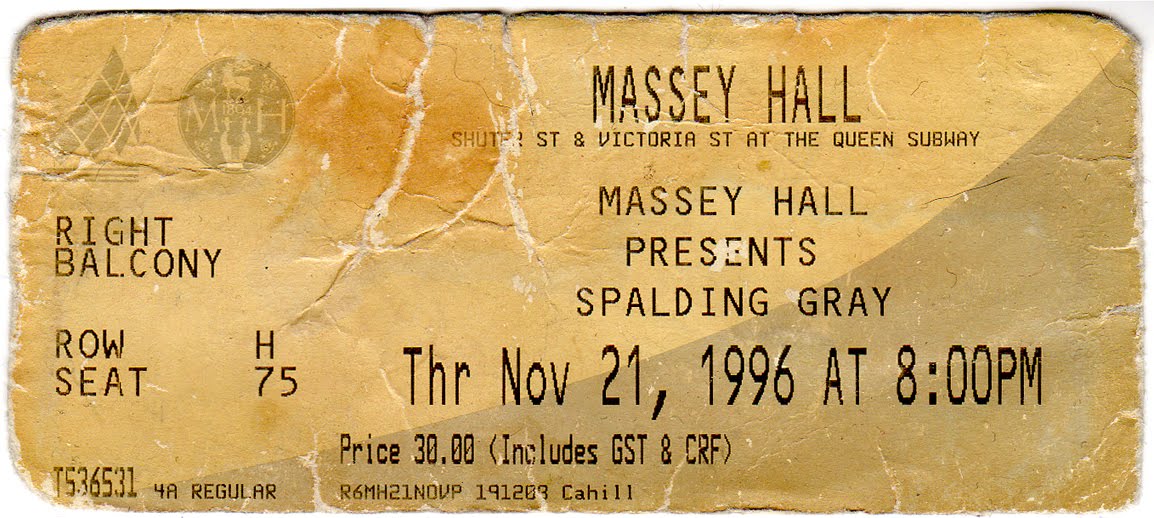
I have this ticket stub (above) from a one-man-show – Spalding Gray at Massey Hall. It was good. I don’t know how to describe his “show” in practical terms: he didn’t sing, he didn’t dance, he didn’t perform in the traditional sense. He talked. About himself. He was a monologuist. And his stories would encapsulate, in ever widening circles of narrative, the great many wonderful and (more often) terrifying things going on with his life.
He was an actor/playwright whose home was primarily New York. I’m not sure if New York makes people like Gray anymore. These performances were not “actor/playwright” shows – these shows were, in retrospect, a form of therapy. Gray talked about the things – worries, revelations, lost epiphanies – which affected him as a regular human being; the things which happen around the things we do with our lives.
His best-known performance, captured on film by Jonathan Demme, is Swimming To Cambodia. In it, with a desk, chair, and glass of water he discusses the events which surrounded the time he played a small role in the critically-acclaimed film, The Killing Fields. He talks of his research for the role in the film, of what actually happened during the reign of terror in Cambodia during the early-to-mid 70s.
Gray was a man given to self-exploration, perhaps painfully so. His mother committed suicide while he was in his 20s, and he exhibited symptoms of bipolar depression himself. Her death held an eerie fascination for him. In subsequent performances (also made into films), Monster in a Box (about writing a novel) and Gray’s Anatomy (about his fear that he was going blind), he explored his neuroses and anxieties and how they filtered through his relationships with those close to him.
The key to Gray is that he was funny as hell, which turned all of his painfully honest accounts, his public descriptions of private contortions all the more enlightening for the viewer, as opposed to merely sympathetic. Gray was neurotic, but he wasn’t looking for sympathy from the audience, and I think this is the second key to understanding him (as a performer, at least). When I saw him at Massey Hall in November of 1996, I don’t remember a lot of details (it was his It’s a Slippery Slope tour), with the exception of his description of sitting outside, trying to have a soulful discussion with his distant father while a fog horn sounds in the distance. I remember this because I was laugh-crying throughout most of it.
When I heard in 2004 that Spalding Gray was missing, that it was suspected he had jumped off a ferry into the East River, I was not shocked. Suicide – as an objective event, as a subjective idea – was something he had discussed since Swimming to Cambodia. Add to this that he had been in a terrible car accident a few years earlier which had left his right leg partially disabled (not to mention having a fractured skull), and you could see (in retrospect, of course) how, given his frame of mind, it might have pushed those dark thoughts further toward the limelight of contemplation.
It is a shame.
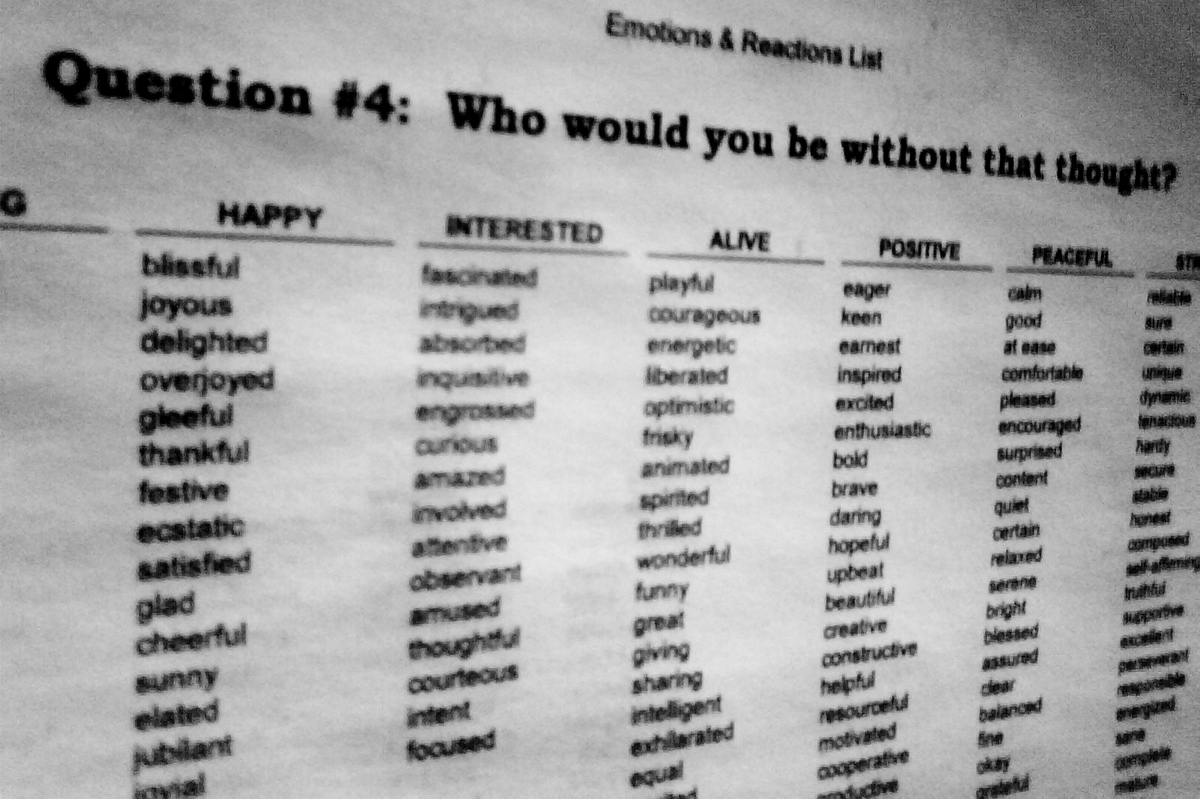
Who would you be without that thought?
Swirl
I am trying (desperately) to avoid a “boy, it’s been a wacky ride these last few months!” post. It certainly isn’t for lack of things to talk about, news to update you with, opinions to confess/shout.
Thing is, I don’t know who you are. Sure, I know there are some of you who are semi-regular visitors. There are others who happen upon this place by accident (via Blogger or StumbleUpon). There are also those who come here via Google searches, either via my name or – most likely – a book review (which admittedly I haven’t done in, oh, a year or so *). And no, this isn’t going to be a “Matt wittily evading accusations of being a lazy bastard by turning the camera on the reader” post.
I’ve been posting artsy stuff, writerly stuff, industry opinion stuff. I don’t mind the randomness, so long as there’s no fluff. I do mind the lack of output. I wish, for one, that I could post more photographs (which is to say, I wish I had a better selection of photos to post **).
It comes down to the fact that I’ve been working like a dog since May (note: this happens every year that I’m working on a SAW film). When I come out of these periods, I feel like Rip van Winkle: a little dazed, slow on the up-take. Whereas last year this time I started teaching, this time this year I am a student (part-time) †. I have a small (but good) feature and a small (but good and potentially controversial) TV show on my plate from now till February. If funds allow, I also hope to have an editor working with me on my novel, with an eye to approaching a publisher or self-publishing if that doesn’t seem feasible ††. I’m collaborating on a musical.
My plate is full.
– – –
* which isn’t to say that I’m not reading or that I don’t want to do any more book reviews. I’m reading a lot of non-fiction, thank you. Much of it either out of professional or academic interest. However, if only to improve my Google ranking, here’s a quick book review of Antwerp by Roberto Bolaño: What the fuck was that? (ISBN-13: 978-0811217170)
** another casualty of working so much is my photography. I still have the same roll of film in my camera that I’d loaded in June. I think I’ve only taken 4 exposures since then. Of course, my cellphone camera gets all the fun these days, unfortunately.
† I will be continuing teaching, but for only two terms this year as opposed to three (which was exhausting and… exhausting)
†† It needs a new name, for one thing. And I know this is going to drive me up the wall more than any changes to the actual content of the book.
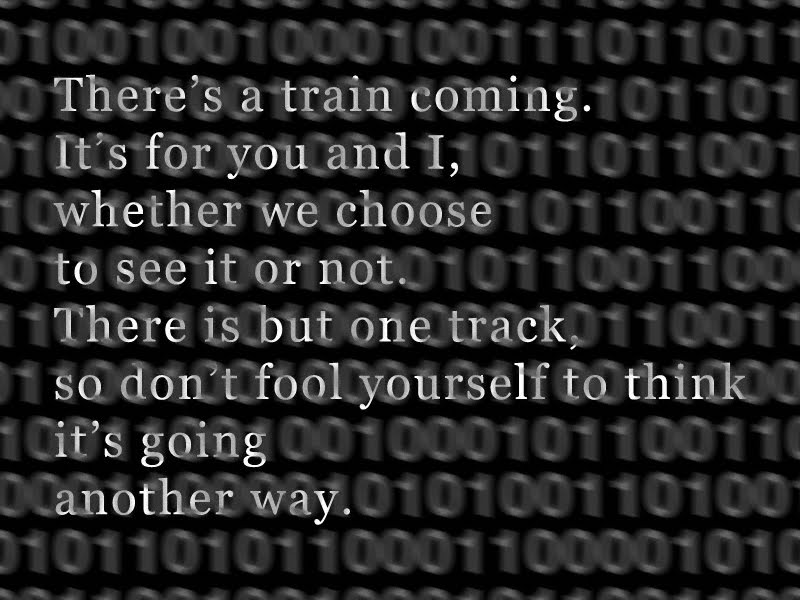
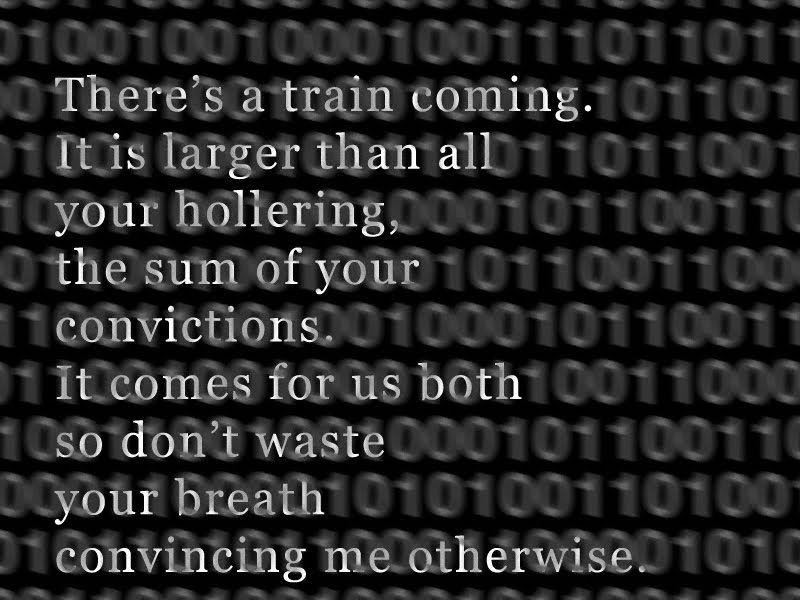
There’s a Train Coming
The Skinny on Stereoscopic Films, or, What’s Up With 3D?
This is one of those moments where I find myself on the inside of a phenomena which (increasingly) arouses strong opinions from members of the public. In this case, stereoscopic filmmaking – or 3D, for short (even though it’s not really 3D and tramples on a term which is used in animation for both stereoscopic and non-stereoscopic work).
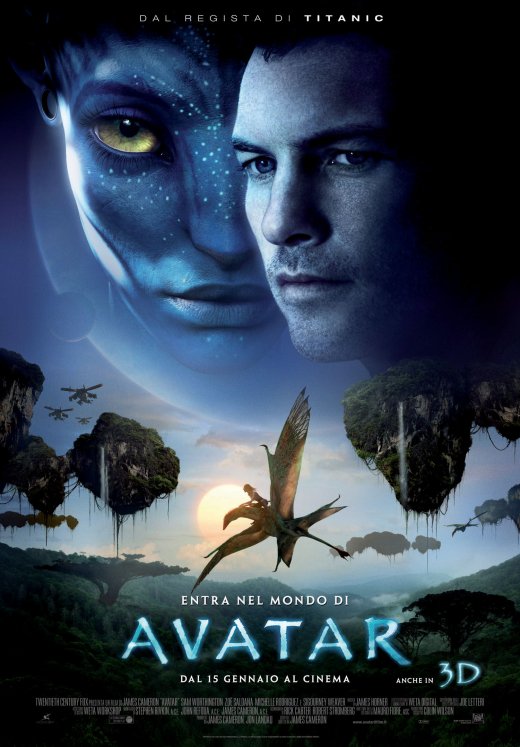
I’m currently working on a 3D film in an age (or, more precisely, over the course of a year, starting with James Cameron’s Avatar) where 3D technology is being pushed as the next in-thing. And yet there are many detractors, some of whom have some good ammunition for their opinions.
As someone who has been intimately involved with a 3D production, from beginning to end (well, almost – we’ll be in theatres in October) I find myself more and more a spokesperson for the technology, if not for the studios who currently are trying to cram every release into a 3D format, whether or not they were meant to be that way.
Let me begin by saying that I enjoy the notoriety of being the resident expert on 3D technology at parties and barbecues whenever the subject arises. Now that I have that out of the way, allow me to bitch…
Everyone keeps asking me: is 3D here to stay? The answer is a conditional “yes”. The condition being that film studios understand two things: First, that you can’t take a 2D movie and make it 3D using brain-dead rotoscoping software and expect it to be a success; second, that you can’t continue charging more for 3D films and not deliver a product that is both a good example of 3D and a relatively good film to boot.
To elaborate:
1) Since the release of Avatar, there seem to be just as many films released in theatres boasting 3D which were never shot in 3D, nor even envisioned in 3D prior to production. Some examples would be Tim Burton’s Alice in Wonderland and M. Night Shyamalan’s The Last Airbender. These films were taken by the studios after completion and put through a 2D-to-3D conversion process, using software to rotoscope the 3D effect, frame-by-frame, a process unsupervised by the director.
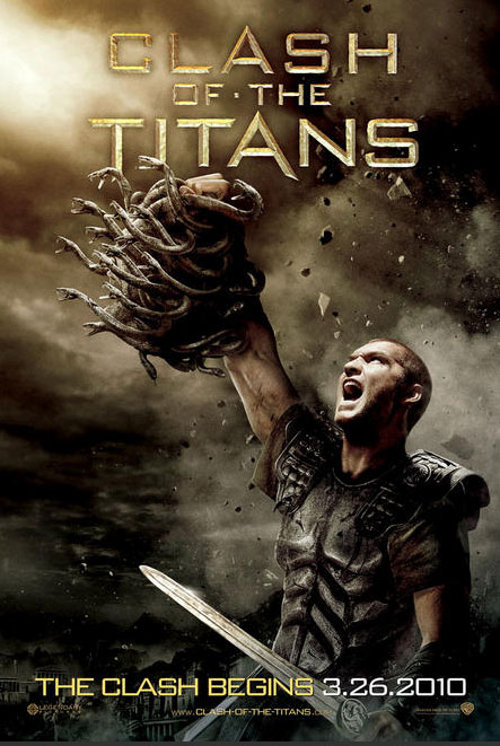
This process, while handy for converting short bits from 2D to 3D for films which originate in 3D, ignores a very large consideration for those producers and filmmakers who shoot in 3D from the outset: you have to plan to shoot in 3D from the start. You cannot take a script or a shot list for a 2D film and superimpose it onto a 3D film: your set design, your camera lenses, your blocking, your picture editing…so many things change as a result of switching from 2D to 3D. When you simply take a 2D show and auto-render it in faked-out 3D you get something which most viewers – critics and plebes alike – will say isn’t necessary. At worst, you get Clash Of The Titans – the current poster child for anyone with an axe to grind about 3D in general and post-converted 3D specifically. Not only was it a weak remake of the original (from what I hear), but the 3D post-conversion was done in two weeks. Two weeks. From what I hear, the subsequent “3D” is ridiculous to view.
2) Considering that theatres charge a premium for 3D films (about $3 more than usual depending upon where you go – sometimes more), when a poorly rendered post-converted 3D film is released it damages the viability of an already vulnerable new technology. It’s one thing if a film is bad, but when it’s bad in two dimensions, bad in a crappily-rendered pseudo-third dimension, followed by the sucker punch of having to pay MORE to see it…you get my point. I hope. Movie audiences can be forgiving, but there comes a point of revolt which I can see happening if there aren’t enough 3D films released which originate on 3D. Furthermore, the studios do no service to themselves if they don’t make a point of clarifying this to audiences: why can’t they say when a film is originally shot in 3D? Isn’t that a selling point? Likewise, why not be honest and say when a film has been post-converted? If it’s a case that no one wants it to be known that their film was post-converted…then why post-convert to 3D in the first place? There’s certainly no audience I know that is clamouring for blocky cut-out shapes which look like they were poorly separated from the background using Photoshop. To summarize this point, content is king: the quality of content, not the volume of illegitimate content.
Up until Avatar (and god knows how I long for the day when another film takes its place as the “gold standard”), the greatest accomplishment in 3D technology was the few seconds of the guy in House of Wax, standing outside a theatre with a ping-pong mallet, knocking the ball directly toward the camera. You could imagine people ducking for cover at the time. That was 1953. From that point onward, 3D technology didn’t change, largely due to the format never winning over audiences: the films were oft-times gimmicky and there were never enough 3D films at any given time to make it feel as if the aesthetic was going anywhere. With the recent advent of digital cinematography, 3D is much easier (logistically and technically) to achieve. And while I would love someone to make “art” (are you reading this, Wong Kar Wai?), I’m happy if, for the time being, the format stakes its territory in the ghetto where its strengths have always been: action/sci-fi/fantasy – hey, if it works, why not? I don’t hear anyone clamouring for a 3D Terms of Endearment…
Technicians and filmmakers are doing their part: they are taking a risk and trying to push forward innovatively with something daunting and new. Is 3D here to stay? Again, a conditional “yes”. What we need are studios and theatre chains to be honest with the audience and not do irreparable damage to the very thing they are hoping to profit from.