“Only those who attempt the absurd will achieve the impossible. I think it’s in my basement… let me go upstairs and check.”

– M. C. Escher
Share

May (pt. 2: My City Was Gone)

“I went back to Ohio
But my pretty countryside
Had been paved down the middle
By a government that had no pride
The farms of Ohio
Had been replaced by shopping malls
And Muzak filled the air
From Seneca to Cuyahoga Falls
Said, a, o, oh way to go Ohio”

– Chrissie Hynde

May was a time for me to explore: my self, my past, what has changed, what hasn’t. As all things similar, it starts with necessary rhetoric and then is up to the tenaciousness of the individual to sort out.

I rented a car and drove to Brantford.

I don’t have a hometown; our family moved much too much for me to lay claim to such a thing. Yet, if pressed, I will say Brantford, Ontario. Technically, we didn’t even live in Brantford proper, but rather on the outskirts, off a rural highway, where we had a house which stood near the bank of the Grand River, on the edge of Onondaga Township.
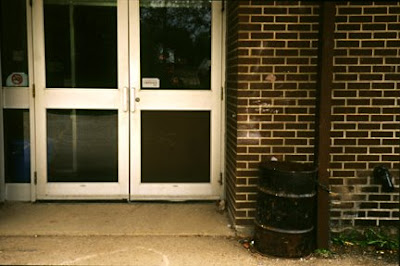
It was here where I spent my childhood years, which I’m only able to accurately map in terms of school rather than age or calendar time (Grades 3 through 8, to be exact). As regards my family life, this was the part which I sometimes refer to bittersweetly as The Camelot Years. We lived in a big, red brick Victorian house detached from the world, with a huge apple orchard behind us and acreage aplenty. Eventually, my father took advantage of a small barn on our property and we ended up owning hens, and subsequently more fresh eggs and Macintosh apples than we knew what to do with. I could go on, but you get the point.

School was another matter. To quickly summarize my scholastic life, I didn’t have a very good time until college. Part of this can be blamed on the cruelty of youth(s). Part of this can be blamed on me being who I was. Part of this can be blamed (if one could really use such a word) on the simple complexities of life and the logistics of time.
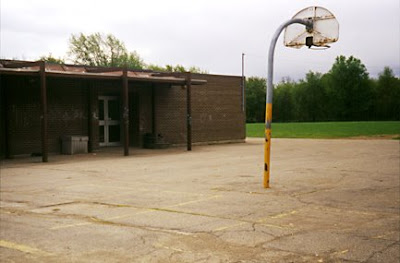
I went to find my old school – the last place I remember seeing my classmates who I loved and hated. I drove. I drove more (faster). Went back over my tracks, wondering if my memory had betrayed me.

It hadn’t. It was gone: Onondaga-Brant Public School was no longer there. Instead, the smaller one, the place I’d spent my introductory Grades 3 and 4 was still standing; furthermore, the town had renamed it from Brant Public School to the same moniker as the one I was searching for in vain.

In other words, if you didn’t know, you wouldn’t know – the one might as well have swallowed the other. I took pictures of what remained – the imposter school – and later found out from my mother that it too was slated to go. It really couldn’t be more metaphoric.

I drove by our old house, thankfully still standing, but of course everything around it has changed. The cattle barn on the property beside us had been replaced by several ugly houses, sitting there as if defying the logic of the land. The palatial (to the eyes of a child) homestead on the other side – the Bournes’ house, as we knew it then – is now a yoga retreat.

I went to capture something I didn’t quite know, me being an older version of the child who oscillated between having the best and worst times of his life there, and in the end I left it all with a handful of photographs and an emptier heart.

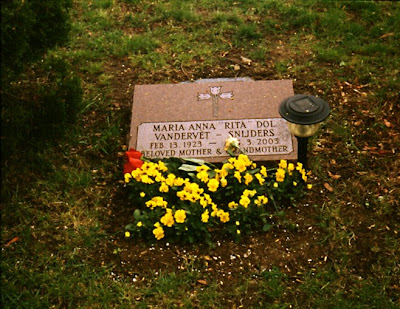
I drove into downtown Brantford and visited my grandmother’s grave, something I promised myself I would do on my own, without my mother’s prompting or my inability to schedule enough time on family visits. I knelt by her stone, having bought some long-stemmed roses, and spoke to her quietly.
The truth is that when we moved away long ago – to Alberta of all places – everything in Brantford went to shit. Two major manufacturing plants went bankrupt, laying off thousands. The city council then approved the replacement of the central downtown square with an Eaton’s Centre (a giant, ugly suburban mall placed in the middle of a beautiful classic town as if to clearly defy logic). It bombed and still sits there half-empty as a textbook lesson for how not to plan a city, Brantford now trying to dig itself up from “ghost town” status. There is a telemarketing centre in the mall; those people who call you from the 519 area-code during dinner are calling from Brantford.

It pained us to move away, but – similar to what happened a few years later when we abandoned Stony Plain, Alberta – it was probably a good decision no matter how difficult it was for my brother and I to swallow.

I drove home from Brantford, and on leaving felt closer to the past if not in full agreement with how it has shaped me, nor with the terms on which I am to live with it. I live in Toronto, but in some respects I think I’ll always feel rootless; grasping for something which historically has always been pulled away from me, even if for good intentions.
Share

Ankle Update

I can walk!

(slowly)

I can descend staircases!

(with the grace of an 80-year-old man)

Yes, two days of rest, ice, and bandaging has done me some good. That said, I’m falling behind on my “May” series, due to the need to scan slides in order to help tell the story. Hope to have that up by the end of the week (he says, in June).

I’d like to point out a couple of additions to the blog:

    1. The Euro 2008 news thingy on the side is a temporary widget to provide updates on the travails of Holland’s (most likely short-lived) run for the cup. During the Euro, this will not (I repeat, not) become a football blog.


  • I’ve added a few new links to the “Relevant Blogs” section (down on the right). Please check out the other sites – you will not be disappointed. Actually, you could be disappointed; I don’t pretend to understand you.


As you were…

Share

On the Injury List

Yes, I finally get to experience what my soccer-football heroes get to experience so often: injury.

There I was, near the end of my first Sunday game in three weeks, fetching the ball at a light trot. And then my left foot rolled over as it stepped into a pocket in the ground. Anguish. Shock. An audible “pop”, and there I was on the pitch, walloped by pain and fear. My thanks go out to those who helped me by purchasing ice and helping me to a taxi.

I sit here now, my leg raised on a pillow on a coffee table, my ankle wrapped with a Tensor bandage and an ice pack. The swelling has subsided in size from “squash ball” to “folded napkin”. I can walk (nay limp) and movement isn’t limited. That said, it’s only Day 2 (of what will probably be a total of 2-3 weeks of conservative mobility).

I decided not to go to a hospital or clinic, seeing as there isn’t much in the way of direct pain or dislocation. We shall see. It’s somewhere between a Grade 1 and 2 sprain (Grade 2 Lite, as I like to put it).

Oh, and it’s my first day on the new film. Thankfully they understand, and thankfully my job doesn’t necessarily require me to be present at all times.

The good news is that the summer can only get better.

Share

“Everything you add to the truth subtracts from the truth.”

Alexander Solzehnitsyn
Share

May (pt. 1: Cuba Libre)

As previously noted, I’ve had a work-reprieve this month. I cannot remember (outside of a slightly scary 3-month spat of unemployment in late 2001) when I’ve had more than a week off. So, fittingly, I wanted to do as much as possible with May as I could.

It started with my wife and I taking a well-deserved week’s trip to Cuba. I was extremely nervous leading up to it, as the film I’d completed had some last-minute snags (“What’s that? The print that went to Cannes has the wrong shot in it? [pause] Oh.”) and I had nightmares of me having to check my email and cellphone messages from the Caribbean. Thankfully – and I must make this clear because someone deserves it – everyone has left me alone. It’s as if I had a guardian angel come down from heaven and lift someone off the floor by their shirt in some office in L.A., saying to them “You mess with Cahill, and you’re messing with Jesus, pal.”. Or something like that.

It was my second time in Cuba, and my second at the same resort – a place on the outskirts of Havana province, about an hour’s drive from Varadero. It was my wife’s first trip, however. Her first trip, as well, to a country that inherently spoke neither English nor French. Of course, on the resort they do (even German – in fact, one of our guides was fluent in Czech). I’m not necessarily a “resort” person (though I will reflexively take the free drinks and snorkeling any day of the week), however I knew that the location of the place was central enough to allow us the latitude of taking day trips to Havana city and other areas. In other words: beach, drinks, sun, snorkeling, and the freedom to escape.

Our first outing was a morning hike, led by a guide, up the hill (250 ft.) that was directly south of the resort. A steep climb that claimed many. However, at the top, we were able to walk through some local farms where they processed sugar cane, fruits, and whatever crops were possible in the bone-dry soil (it being just prior to their rainy season).

Our second outing was Havana. I love Havana. It’s hard not to love it there. Yes, it’s dirty, sometimes smelly, and some of the locals like to prey on turistas. That said, in many respects, it’s a world frozen in time (like much of the country). Beautiful architecture, friendly people.

Our third outing was in a small port city, called Matanzas. It only recently opened itself up to tours and at times we found ourselves being stared at like aliens. As luck would have it, we were there for The World’s Longest Rumba. Apparently, a group of people were going across the country, from town to town, performing live rumba. It was amazing, which brings me to another thing I love about Cuba: the music. Even the potentially corny mariachi bands are amazing. Even if you’ve heard Guantanamera (trans: “girl from Guantánamo”) ten thousand times and feel as if you can retire it from your memory, you’ll still find your foot tapping under the table when it’s played there. Matanzas was a treat. Our guide – the one who was fluent in Czech – took us a local farmers’ market; a narrow maze of shacks where vendors sold fresh indigenous vegetables and grains, not to mention cuts of pork. Someone there handed us “ladies fingers” bananas (or “mini bananas”) – de-lish-ous.

I love Cuba. It’s a country of strange proportions; slightly surreal in the fashion of Latin American “fantastic reality” fiction. There are overpasses on the highway which remain unfinished after decades, old Soviet-era electricity generators which look like rust-bitten sci-fi nuclear reactors, short street dogs which roam the cities in curious packs. Unlike other countries I’ve been to, I must say that there are very few which can match Cuba for national pride. The people love their country – politics right or politics wrong – and this pride is immediately noticeable, regardless that the average monthly income is 350 Cuban pesos (roughly 15 Canadian dollars).

I wasn’t there to investigate politics. No one there knows what to expect from Raul Castro, short of taking his word that he requires a year to generate ideas to take Cuba forward (though tempting, I thought it pretentious to put quotes around “ideas” and “forward”; I’ve decided to keep it all verbatim). The Cuban people have come out of a very, very dark time. After the fall of the Soviet Union, they were essentially abandoned by their largest trading partner in the early 90s, which meant disaster for a country who’s main export was sugar cane; in other words, they were left to fend for themselves – another Haiti, albeit with a better music scene.

In the last decade they’ve managed to get back onto their feet economically, but it wasn’t without a number of years of extreme hardship. We were told stories of what people subsisted on and it reminded me of what I’d read about the siege of Leningrad: people eating leather for nourishment, cat becoming an ingredient in restaurant food…fun stuff. Canada has become a welcome trading partner since, helping with the development of their oil resources. They now trade their abundance of skilled doctors for petrol with Venezuela. Their greatest export now (aside from educated/skilled workers) is nickel, which they trade extensively with China. Running third is tourism.

I was happy to contribute, as I certainly (and always) learn much in return.

Share
