Cinema in Toronto: Three Rep Theatres to Close

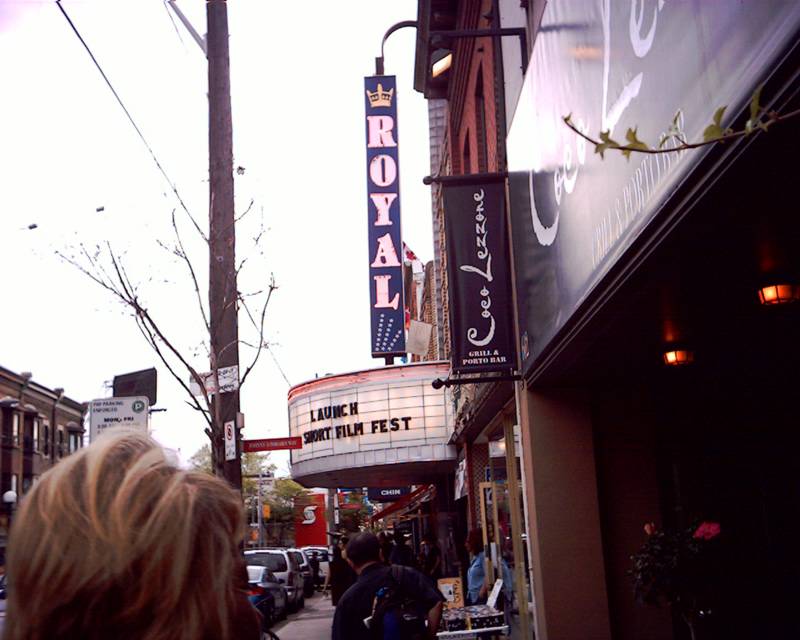
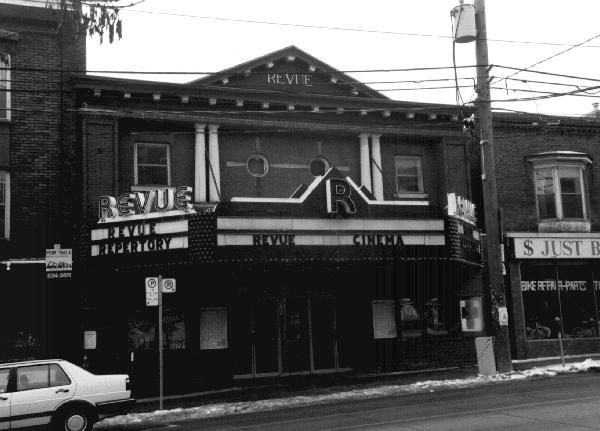
I was shocked to receive word that three of the most venerable rep cinemas in Toronto are about to close their doors at the end of June: The Royal (at College & Clinton Sts.), The Revue (on Roncesvalles), and The Kingsway (Bloor W.).

Excerpt from the Toronto Star:

The theatres — part of the Festival Cinemas group — were owned by cinema entrepreneur Peter McQuillan, who died in October 2004.

Last night, his son Mark told the Star that he and his two siblings made the decision to close the theatres reluctantly.

“The heart and soul was my father. Since (his death), we have been trying our best to run (the business).

“But we don’t have the time, the energy and the financial wherewithal to keep it going,” said McQuillan, noting difficult market conditions contributed to their decision.

“I feel bad if they are closing. We might get a few more customers but I don’t know what it says for the industry,” said Carmelo Bordonaro, owner of the Bloor Cinema.

“It’s a labour of love, these cinemas, believe me — a lot of hard work,” Bordonaro said. [read more]

It’s not hard to imagine how daunting a task it would be to run a rep cinema, even in a city as film/film-festival crazy as Toronto.

Film projectors in theatres are going to be cultural fossils within the next 5 years as the industry moves towards digital distribution. Film itself will probably be relegated to a shooting format only (alongside HD).

Yet…aside from being able to cheaply watch the latest films after their official theatrical run (they gotta make money after all), rep theatres are the ones that are able to show us – on film – works of the great filmmakers that came before us; the ones that painted our current cinematic archetypes. Soon, I realise, if you want to see anything by Kurosawa, Bergman, Tarkovsky, or Welles – it will have to be on DVD.

Of course, there are still a few rep cinemas left: The Bloor, The Paradise, The Fox…however, who knows how many years they have left? Pretty soon the Cinematheque will be the only one; a museum for film.

May I suggest that, if you live in downtown Toronto, you make a trek to one of these fleeting oases before they cease operations. Buy cheap popcorn, put up with dilapidated seats and sticky floors, and enjoy films as they were meant (or hoped) to be seen.

Share

Blog: Safari issues


A quick note that yesterday I checked out this blog using Safari…and nearly screamed. While the content appears fine (formatting etc.), the sidebar data is pretty scrambled. In detail:

  1. The orange category tags beneath the profile photo do not appear at all.
  2. The previous articles are not in list format, but placed side-by-side in a paragraph.
  3. My copyright info footer is in the sidebar when it should be at the bottom of the page.

I’m sure there’s more, and I’m looking into it. However, to be honest, having worked on HTML formatting before I realise that sometimes you can’t please every web browser. So far, this blog looks consistent in the latest versions of Firefox, Internet Explorer, Opera, and Konqueror. The fact that Safari is having rendering issues is something I’d like to address, but quite frankly I can’t promise much of anything for the immediate future.

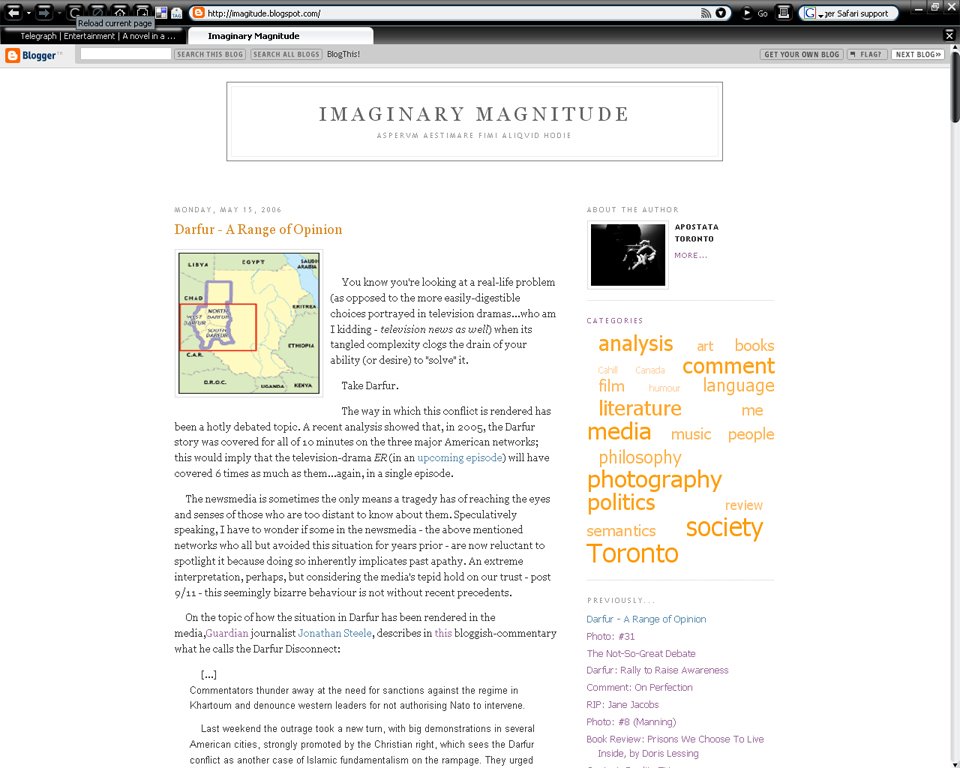
If you’re unsure whether you’re seeing this blog properly, below is an image of how it should look (taken from Firefox) – it shows at least the first half of the page for reference. I don’t want to be a browser fascist, but I would recommend that, if you currently use Safari, consider switching to Firefox (or Opera).


If you use Safari and don’t notice any issues, please let me know. Cheers.

UPDATE (May 17/06): I believe it’s safe to say that the above only applies to those people running Safari v1.x – I was checking the site from an old G3 iBook at the time. Anyone running v2.x of Safari shouldn’t experience any substantial incompatibilities. Carry on.

Share

Darfur – A Range of Opinion

You know you’re looking at a real-life problem (as opposed to the more easily-digestible choices portrayed in television dramas…who am I kidding – television news as well) when its tangled complexity clogs the drain of your ability (or desire) to “solve” it.

Take Darfur.

The way in which this conflict is rendered has been a hotly debated topic. A recent analysis showed that, in 2005, the Darfur story was covered for all of 10 minutes on the three major American networks; this would imply that the television-drama ER (in an upcoming episode) will have covered 6 times as much as them…again, in a single episode.

The newsmedia is sometimes the only means a tragedy has of reaching the eyes and senses of those who are too distant to know about them. Speculatively speaking, I have to wonder if some in the newsmedia – the above mentioned networks who all but avoided this situation for years prior – are now reluctant to spotlight it because doing so inherently implicates past apathy. An extreme interpretation, perhaps, but considering the media’s tepid hold on our trust – post 9/11 – this seemingly bizarre behaviour is not without recent precedents.

On the topic of how the situation in Darfur has been rendered in the media,Guardian journalist Jonathan Steele, describes in this bloggish-commentary what he calls the Darfur Disconnect:

[…]
Commentators thunder away at the need for sanctions against the regime in Khartoum and denounce western leaders for not authorising Nato to intervene.

Last weekend the outrage took a new turn, with big demonstrations in several American cities, strongly promoted by the Christian right, which sees the Darfur conflict as another case of Islamic fundamentalism on the rampage. They urged Bush to stop shilly-shallying and be tougher with the government of Sudan.

The TV reports are not wrong. They just give a one-sided picture and miss the big story: the talks that the rebels are conducting with the government. The same is true of the commentaries. Why demand military involvement, when western leaders have intervened more productively by pressing both sides to reach a settlement? Over the past few days the US, with British help, has taken over the AU’s mediation role, and done it well. Robert Zoellick, the state department’s number two, and Hilary Benn, Britain’s development secretary, have been in Abuja urging the rebels not to waste the opportunity for peace. Sudan’s government accepted the US-brokered draft agreement last weekend, and it is the rebels who have been risking a collapse.

[…]

An interesting, if divisive, point of view. I say divisive because it drags into the debate an almost unnecessary contention that there is some cabal of the (increasingly journalistic cliche) Christian right to portray this as a spectre of Muslim imperialism against Christian Darfurians – the truth of that particular matter is certainly more complex. I can certainly say that the rally I attended in Toronto had no religious overtones or other types of self-investment.

The more salient argument in this excerpt is whether, in pushing for military intervention, NATO/UN forces could unknowingly apply the wrong type of pressure and drive the conflict deeper or perhaps fragment it along ethnic/political lines – in this regard, it’s not as if there is a single Darfurian rebel organisation sitting at the negotiation table. There are several – some small, some large, and inevitably one would assume each may have their own agenda.

Don’t get me wrong. I’m not trying to spin this into something that it’s not – ie obfuscate the conflict to the point where inaction is seen as an option – but rather, I’m trying to see different points of view because I really don’t feel we’re getting it from the media.

On this note, the CBC is having a Foreign Correspondents Forum on June 1st. They are taking questions from viewers regarding international events/affairs. I’ve taken the liberty of posing some of the questions raised above. If you would like to do the same (about Darfur or any other area of the world), visit this page for more information.

Share

The Not-So-Great Debate

With every year, particularly since 9/11, it’s harder and harder to find reasoned debate. By ‘reasoned debate’, I mean a discussion where arguments are backed up with reason, a bit of logic, and some semblance of research/understanding of history. What doesn’t pass for ‘reasoned debate’ – what we currently have before us – is hyperbole, name-calling, grand-standing, and ridiculously partisan follies paraded in all forms of media.

Before I go any further, I encourage you to look at the dictionary definition of debate. The important word repeated throughout is discussion. I don’t think this word needs defining, though some days I think it should be printed on t-shirts and handed out to school children so that it’s not forgotten. But I digress.

Two reasons for the lack of true (as in useful) debate come to mind, although I’m sure there are more:

1) The replacement of individual thought with self-invested group-think.

2) The perversion of language and its subsequent use as a weapon.

– – –

The first point is as clear as it is demonstrable. Increasingly, individual citizen input (from either the public or private sector) is bypassed in favour of specialists from advocacy groups and so-called think-tanks. Some examples: in Canada, The Fraser Institute, the C.D. Howe Institute, and the Canadian Taxpayer Federation. In the U.S., examples include the CATO Institute, the Heritage Foundation, and the Alexis de Tocqueville Institution.

Whether leaning towards a particular side of the political spectrum or specialising in a particular avenue of advocacy, all of these groups have one thing in common: self-interest. In corporatist style, think tanks and advocacy groups have been propped up as representatives for a discussion which should take place within the public arena but doesn’t. It doesn’t because the public arena is seen as messy; in an increasingly corporatist society, messy doesn’t compute. Messy needs to be streamlined. The rise of advocacy groups, think-tanks and (increasingly) NGO’s often has nothing to do with the public and everything to do with establishing each group’s predominance in their field. Indeed, the first and last thing both the Canadian Taxpayer Federation and the CATO Institute have in common is making sure their organisations keep running – certainly not fostering independent thought.

One thing you can count on is that advocacy groups and think-tanks are consistent: everyone tows the line, everyone knows the script. Their facts, usually half-sided, are provided-for internally and what research they do is with the sole intent of reaching a pre-conceived conclusion that suits a pre-defined format, whether it be economic, social, or political.

When these organisations are inserted in place of the citizen’s voice, democracy becomes Kafka-esque. Often, one ideological think-tank is pitted against another, and what is discussed has no relation to truth (as either the citizen sees it or would like questioned) but to the safe consistency of “staying on-message”. Thus, there is very little debating in lieu of ideological advertisement.

It’s tempting to admire projects like Media Matters for America, which can be very effective at spotting media bias, but my frustration is that its interests are inherently one-sided: attack Republican bias, but support/protect Democrat initiatives. Indeed, it would be daunting for an organization devoted to highlighting media bias if it was looking at all sides of the media paradigm – and this comes to my concluding point: vested interests are easy to finance. Complexity is not.

– – –

The second blockade to real debate is the perversion of language. Media pundit Bill O’Reilly is probably one of the most accomplished when it comes to the distortion of language. His polemic style, his bullying aggression towards dissenting opinion, and his partisan hatred are broadcast every weekday to an audience of millions. He begins and ends most of his addresses with the well-worn cloak of false common-sense: everyone wants to protect freedom, everyone is concerned about terrorism, everyone knows that there are far-left extremists among us. Everyone. His consistent target is a group known previously as liberals, but most recently goes by the moniker secular progressives. In O’Rielly’s words, they are elitists and only Bill O’Reilly can identify this imminent threat to our safety. Obviously this is all very partisan and prejudicial and not dissimilar to what has been said and demonstrated throughout the 20th century by both fascists and Communists – but everything about O’Reilly and FoxNews is paradoxically draped in the opposite: his show is called The No-Spin Zone and his channel’s mantra is Fair and Balanced. The paradox continues the more attention is spent on their language: leftists are compared to Nazis…actually, that’s wrong: everyone who takes a different side ends up being portrayed as a Nazi…or alternately a Communist. (I suggest FoxNews create a doll that, on cue, devotees could raise and shake towards the TV screen at opportune times, whilst shouting “Ooogey boogey ooogey!”.)

A less outraged sentiment is echoed by newspaper columnists such as the Globe and Mail’s Margaret Wente, who habitually tut-tuts those who question authority (save for when she decides to). Her approach, albeit certainly less vitriolic than O’Reilly’s, is to portray dissenters as part of a privileged latté-sipping middle-class elite. Her motto seems to be: shut up and live with it – ostensibly the antithesis of debate itself.

Again, we come back to the word elitist. Elitism is, we are told, our enemy. It’s an easy way to cast aspersions on dissent – let’s face it, there are always going to be a smaller percentage of people who ask disinterested questions (that is, questions that are not self-serving but serve the ideals of the community). In her book, Prisons We Choose To Live Inside (reviewed here), Doris Lessing is philosophical about the word elitism and it’s accusatory usage. She goes so far as to determine it a necessary evil if it means the freedom to ask important, if unpopular, questions aloud. In other words, if painted an elitist – so be it.

– – –

From a local perspective, the debate disconnect was driven home – literally and figuratively – when in 2000, Toronto broadcaster CityTV refused to hold an election debate between the incumbent mayor, Mel Lastman and his opponents. This was the first time CityTV had decided to do this since they began hosting televised mayoral debates*. While it was arguable at the time as to the feasiblity of any of Lastman’s opponents winning (and it should be noted that Lastman won with 80% support), it was shocking to see a local broadcaster that wraps itself in a mantra of street-level community-building refuse to even go that simple distance. I remember watching an evening call-in show on CityTV, hosted by Lorne Honickman, whose guest was mayoral hopeful Tooker Gomberg – this took place after the announcement that there would be no debate. I clearly remember the disbelief, bordering on contempt, that Honickman displayed as caller after caller phoned-in to simply ask: why? Why no debate? His retisence to discuss the subject was as obvious as his clear disdain for his guest.

– – –

Debate is inclusive, not exclusive. Its aim is perspective – not the promotion of canned answers or unmovable positions. The object of debate is not disgracing dissent, but putting forth reasoned arguments. I think there’s a long road ahead as regards our ability to communicate, to argue respectfully, and to share ideas. These things happen at a smaller scale all the time in our communities, but I think we’ve forgotten how important they are, thus it’s going to take a while for citizens to feel attached to it again; to take command of their own voice, as it were.

The responsibility to restore true debate falls on civilians – when the citizenry abdicates responsibility for public discussion, we shouldn’t be surprised when the gap is filled by self-interested interest-groups. When societies forget about their social responsibilities those responsibilities are often annexed as anachronisms, and replaced by the empty comfort of technology (ie televised think tanks). The Internet is a good tool for the restoration of debate, but it’s only a tool and not in and of itself anything more. What’s needed is the will to reform, reason, and a sense of responsibility to society as a whole.

* (I can find no record to refute this, but I’m open to correction)

Share

Darfur: Rally to Raise Awareness

Tomorrow (Sunday April 30th) there will be a series of rallies happening around North America to raise awareness of the terrible situation in Darfur, Sudan.

You can find out where in your vicinity this rally is happening here.

It is important that our political leaders, who have all cut back support to this region recently, understand the gravity of the situation: routine killings, rapes, and ethnic cleansing.

Is this the only place in the world (or Africa for that matter) that needs attention – no. It’s easy to say “What about Somalia?” or “What about this other country?”. The thing is, in the absence of a perfect solution to those questions I would rather err on the side of helping than sitting at my desk trying to address an impossibly large problem that satisfies all criteria.

If you live in Toronto, the rally starts tomorrow @ 1pm at Queen’s Park. Info located here.

If you are interested in getting involved, please do.

(for context on this problem, please see this entry in Wikipedia)

Share

Comment: On Perfection


per·fec·tion·ism n.

  1. A propensity for being displeased with anything that is not perfect or does not meet extremely high standards.

Never trust a self-professed perfectionist. There are two reasons for this:

1) People who identify themselves as perfectionists usually aren’t perfectionists, but insecure people with naive aspirations of greatness.

2) True perfectionism is a mental illness, not a quality worth admitting to.

Essentially, perfectionism is a neurosis which, contrary to common understanding of the term, imposes set boundaries on accomplishment. This may seem at odds with our popular understanding of it. Perfectionism, as commonly seen, is an aim towards a standard of accomplishment which is exceptionally high. It is for this badge of honour that the insecure wrap themselves in this garment. I would argue however that the perfectionist mindset is so captained by the end result (“perfection”) that the person under this condition is actually unable to see other possibilities.

Perfectionism is thus the inability to see beyond a single result. To the afflicted, this single result is everything, but in actuality it is a foolish construct; it denies the natural or realistic ebb and flow of performance and quality.There are always going to be greater and lesser works in a person’s output.

A profound example was illustrated in “Art & Fear: Observations on the Perils (and Rewards) of Artmaking, by David Bayles and Ted Orland (ISBN: 0961454733). A pottery teacher splits his class into two groups; one group is to focus on making one exceptional, perfect object for the end of the course. The other group is to focus on creating a series of objects. At the end of the course, the latter class ended up with the more impressive end result. Why? Because their output was steady; even though their first examples were weak (as would be expected), with each successive piece of pottery there was steady improvement to the extent where they often surpassed those classmates in the other group whose itinerary it was to create “perfection”.

When someone says something is perfect (in all seriousness), they deny the flexibility and infinite variables that surround us. The fact is, nothing is perfect – if it were, there wouldn’t be much point in carrying on, would there?

Share

RIP: Jane Jacobs

The point of cities is multiplicity of choice.”
– Jane Jacobs, 1916-2006


From CBC News:

Toronto-based urban critic and author Jane Jacobs died Tuesday morning.

Jane Jacobs, shown in 2004, influenced a generation of urban planners with her critiques about North American urban renewal policies. (Adrian Wyld/CP)

Jacobs, author of The Death and Life of Great American Cities, and most recently, Dark Age Ahead, was 89.

Her powerful critiques about the urban renewal policies of North American cities have influenced thinking about urban planning for a generation.

Born May 4, 1916, in Scranton, Penn., Jacobs had made her home in Canada since the late 1960s.

Educated at Columbia University, she met her husband, architect Robert Jacobs, at the Office of War Information in New York, where she began writing during the war.

Known for protesting sprawl

The strong themes of her writing and activism included opposition to expressways, including the Spadina Expressway in Toronto, and the support of neighbourhoods. Jacobs has been arrested twice while protesting urban plans she believed to be destructive.

She also explored these ideas in books such as The Economy of Cities, Cities and the Wealth of Nations and Systems of Survival: A Dialogue on the Moral Foundations of Commerce and Politics.

The Death and Life of Great American Cities, published in 1961, questioned the sprawling suburbs that characterized urban planning, saying they were killing inner cities and discouraging the economic vitality that springs organically from neighbourhoods.

Inspired ‘Ideas That Matter’ gathering

Jacobs settled in Toronto in 1969. There she supported developments such as the St. Lawrence neighbourhood, an inner-city development for people of all income levels.

In 1997, the City of Toronto sponsored a conference entitled Jane Jacobs: Ideas That Matter, which led to a book of the same name.

Her most recent book, Dark Age Ahead is “a grave warning to a society losing its memory,” jurists said in awarding her the $15,000 Shaughnessy Cohen Prize for Political Writing in 2005.

“In spare, exquisite prose, Jane Jacobs alerts us to the dangers facing the family, higher education, science and technology, the professions, and fiscal accountability. Drawing on history, geography, and anthropology, this book reflects a lifetime of study and observation, offering us lessons to avoid decline,” the jury said.

Dark Age Ahead finds comparisons between our current North American culture and European culture before the fall of the Roman Empire and the subsequent Dark Ages.

Interviewed by Canadian Press when she won the Shaughnessy Cohen Prize, Jacobs said, “People really know themselves that the dark age is ahead. They’re worried, and they haven’t articulated it, but they feel it.”

“I think it’s late but we don’t need to go down the drain,” she said. “But we will if we aren’t aware. It’s a cautionary book.”

Share