Happy New Year & More…

Hello all,

Not much updating lately. There is a reason. Actually, two:

1)  I’ve signed with a literary agency who are interested in my current novel. This is great/fabulous/OMG news. However, because there are substantive revisions to be made (in order to clarify some of the details in the book and make it easier to sell to a publisher), my time is taken up with that.

2)  I am beginning my career transition, from film/TV Post Production Supervisor to Psychotherapist. I haven’t really made that public here, but it’s happening. I will begin to discuss it soon, because obviously it will need some explanation. Part of the transition has been renovating our basement to be an office – while this is a great idea (even still), it’s also been a great deal of work and stress and cost.

So, as you can see, particularly when you factor-in work-work, my plate is full. I will send updates here as they happen – or you can simply subscribe to updates. I will obviously have much to share with you about how both of these developments…um, develop.

Needless to say, it’s an exciting, somewhat scary time.

Share

The Dread of Zombies

Everyone is waiting for the zombie genre (in books, television, and particularly film) to whither away like a desiccated corpse. I argue that it’s here to stay – that, in fact, it has stronger legs (ugh) than most other genres of the macabre.

The dread of zombies imagined – the tiredness some of us feel with each iteration (Pride and Prejudice and Zombies, The Walking Dead, Zombieland) – is understandable. Less understandable than with vampires, but understandable still. There are too many zombie and zombie-like (for the record, 28 Weeks Later is not, strictly-speaking, a zombie film, yet it more or less qualifies itself by virtue of many shared) themes in books, shows, and movies these days. But I would argue that it’s because – due to our increased connectedness to each other via the Internet and social media – we are exposed to real life zombies. Thematic zombies. Metaphorical zombies. And the exposure stands to increase.

A shitload of people voted for a complete ass to be the mayor of Toronto. A shit. Load. Mind you, not many who lived downtown did. Still, it was a rout. People like me – people who prize intelligent discourse over pot shots, people who would prefer to be ruled by someone with an informed conscience rather than a bullet-list of to-dos – were incredulous. It didn’t even matter what quadrant of the political spectrum Rob Ford occupied: he was the last person any reasonably well-informed person would have wanted. And yet he won in spades.

Thematic zombies. Metaphorical zombies. The dread of zombies.

Who voted for him? Who can say that they “understand” him? Are they too not also zombies by virtue of his succession to the throne of city council? Faceless, nameless, godless, conscience-less hordes hefted Mr. Ford to office, and we stand here still – a year later – asking ourselves just what the hell happened, watching the circus of political buffoonery before our eyes.

Lest this become a solely personal treatise, isn’t this the same for everyone? Aren’t we witnessing “zombie activity” in other guises: large groups of seemingly nameless, faceless, godless, conscience-less hordes blindly enabling things we fundamentally disagree with but are powerless to dispell? For me it’s the rise of Rob Ford, for others it could be the Occupy movement. For others still, it could be the revolution in Tahrir Square. The massive, faceless but powerful other. The faceless, godless, conscience-less hordes…with agency.

Thematic zombies. Metaphorical zombies. The dread of zombies.

No, it is not going away. Make popcorn.

Share

Book Review: Therafields, by Grant Goodbrand

It was with considerable surprise when, browsing the shelves of our favourite used bookstore, Balfour Books, I was handed a book by my wife. “Did you see this?” It was purporting to be about a massive psychoanalytic commune which had its roots in downtown Toronto during the 60s and 70s. I was surprised because I’d never heard of it before – the group was called Therafields. I was immediately struck by the communal angle, the era, the emphasis on psychological investigation – it was like being handed a screenplay by David Cronenberg. The fact that I am studying psychotherapy and its theoretical/historic development made it irresistible.

Subtitled The Rise And Fall of Lea Hindley-Smith’s Psychoanalysis Commune, Grant Goodbrand’s Therafields is just that. From the mid-60s till the early-80s, what was eventually coined Therafields, became one of the largest active communes in North America (significant considering both the era and that it happened with virtually no physical or cultural traces left in this city), owning as many as 35 houses within, and 400 acres of farmland just outside Toronto. At its apex it had over 900 members.

Starting out with a modest practice in the Annex, Welsh émigré Lea Hindley-Smith began by seeing people in her home. Her open embrace of students combined with an uncanny ability to get to the bottom of her clients’ problems (not to mention her real estate acumen) conspired along with the socially progressive ideals of the 60s to develop a remarkable experiment in psychotherapy: a live/work environment which operated also as an ongoing group-process for its members, all under the auspices of Hindley-Smith who became their professor, CEO, and den mother. More houses were bought so that more living spaces could be added to accommodate new members, and new groups were developed. The story of Therafields is an account of how this creative hive eventually became an unmanageable empire. It is also an invaluable reflection of the changes happening at the time, guest-starring those stranded by the revoked promises of Vatican II, the back-to-the-farm movement, and the idea that psychotherapy could be about society rather than the individual.

I am a child of the 70s. Nothing could possibly be less meaningful than that statement. However, culturally speaking, I was surrounded by the 70s. The mid-70s to mid-80s were a formative time in Canadian television. In other words, we saw a lot of ourselves. And what we saw was produced and inflected by those who came of age in the 60s and early 70s (that’s the way it always worked until recently, by the way – the older generation helped the younger generation identify with their own generation). In other words, I can imagine Therafields, while reading about it. Goodbrand has done a good job of contextualizing the era in which his book takes place. It also helps that Goodbrand was a key member of Therafields himself, and as such is gifted with a familiarity which an outside author would struggle to develop. The flip-side to that statement is that an outside author might have had a better chance of keeping the rhythm of the book’s story consistent: there is a habit of temporal back-and-forth which does not make for smooth comprehension at times.

Considering Goodbrand’s credentials, Therafields unfortunately suffers from a detached perspective. He is as qualified as anyone to write about Lea Hindley-Smith and those who were key to the group’s skyward development – like esteemed poet bpNicol, for example – yet it seems only an accumulation of actions, the plotline of a biography, which gives us clues to the hearts beating behind the cast of characters. Goodbrand’s book sometimes reads like an account rather than an experience.

And here we come to a marketing dilemma: I’m not sure who the intended audience is. I am thankfully, luckily, well-suited to read, understand, and enjoy Therafields. Yet… With its insistence on differentiating what Hindley-Smith practiced (Kleinian) from classical psychoanalysis, without necessarily providing a debriefer for the reader on what makes Kleinian psychoanalysis different from it, I cannot imagine the “average reader” walking away knowing what that all should mean. Perhaps that won’t matter if they are keen on digging into a prime slice of Toronto history – complete with addresses, one could conceivably operate a motor-tour of where Therafields took place.

It is, nonetheless, an insightful read and an invaluable chronicle of a peculiar social/cultural phenomenon. Therafields, by Grant Goodbrand (ISBN: 978-1-55022-976-9), is available (evidently) from a used bookstore near you, and also online.

Share

Another One Bites The Dust

ARG! One of my favourite literary blogs is ending its run! I encourage you all to visit Ward Six. I really appreciated their approach: to book reviews, to the art of writing. To art itself.

The reasons they give are sensible, yet I will be selfish and whinge that I am now left with oh so very few relevant, intelligent, knowledgeable literary blogs to follow.

Nonetheless, I wish John and Rhian all the best.

Share

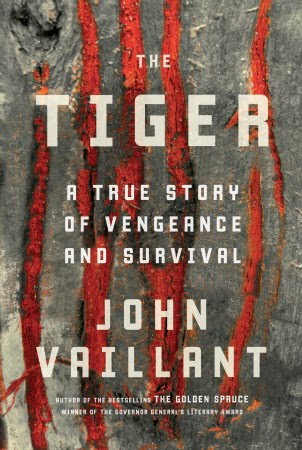
Book Review: The Tiger, by John Vaillant


(I had done a mini-review of this on my end-of-the-year post, but thought it merited its own entry)

I found myself flipping through the Globe and Mail book section one weekend in the fall of 2010, and found myself staring at a review for a non-fiction book called The Tiger, by author John Vaillant. Let me begin by saying that I am a prolific reader, yet not someone fazed by what’s new so much as what interests me. To this extent, given my eclectic tastes, I will switch from Turgenev to Bukowski, from John Ralston Saul to Stanislaw Lem, and so on. I sometimes don’t have a lot of time to read books, period, owing to a fairly full schedule of projects (which includes working on a novel). As a result, I sometimes feel a little out of touch with the contemporary world of books, especially when there are people on Twitter who are aiming to read fifty books this year.

Getting back to me and the review, I glanced at the synopsis and was struck by how meaty it was: the Russian far east, a vengeful killing machine, a dark exploration of our ties to nature. It seemed to be everything I was looking for (especially as a Russophile) and gave me an opportunity to actually read something published in the year that I was reading it.

It is, in short, a fabulous book. Fabulous, above all, because of the depth of Vaillant’s research into his subjects and his skill at balancing this collective learning against the white knuckle tension that is at the heart of the story. The Tiger begins with the stalking and subsequent killing of a tayozhnik – a Siberianism for forest dweller – named Markov and the series of events it sets in motion against the backdrop of the merciless taiga (or “boreal forest”) surrounding the little logging town of Sobolonye.

The tension is established early, not by Markov’s demise so much as the complex relationship between humans and tigers in this paradoxical part of the world, much of the relationship predicated on the aboriginal teaching that a tiger will never attack a human, so long as the former respects the latter’s spiritual and physical superiority. This superiority is laid out in full measure: from a zoological perspective, the tiger is perhaps the most sublime killing machine that exists in the world of mammals and Vaillant spares no time outlining how every inch of the beast exceeds any comparable hunter on the planet – both in physicality and mentality. The tiger thinks. The tiger learns. Most compelling of all, the tiger remembers.

It is this last quality which lends much tension, because, as the tiger is tracked by a team of professional hunters over the course of two weeks, the question is repeatedly asked: did Markov bring this on himself? And how?

The Tiger is a stunning combination of layered storytelling and educational insight into the evolutionary relationship between man and animal. Indeed, given the barren environment of the setting, it feels sometimes as if the conflicts between man and animal are staged in a prehistoric past rather than their modern setting in the late 90s. There are also some sad truths made about the aftereffects of the economic collapse of the former Soviet Union and the perennial designs China has on the taiga’s natural resources – tigers included.

The Tiger, by John Vaillant (ISBN: 978-0307268938) is published by Knopf and is readily available in your local, independent bookstore.

Share

Movies & A Book: Some of The Best Things I’ve Witnessed in 2010

Here’s the best of what I’ve seen this year. I haven’t seen everything. You may disagree with what I have seen. This is life.

FILM:

Inception

Go ahead. Try. Try disagreeing that this is one of the most technically (and perhaps conceptually) elaborate mainstream Hollywood productions released in years which also happens to work as a “movie” that a wide variety of audiences would enjoy watching.
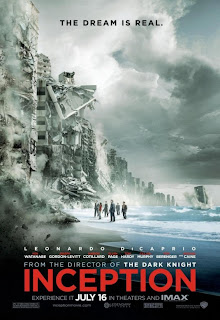
There has been a backlash against Inception. I don’t know how or why this is – perhaps it was over-sold as a deep “puzzle-solver” film, which it is not. And yes, the NYT’s A.O. Scott has a point in his comment that the film’s literal depiction of dreams are lacking psychological heft (outside of Marion Cotillard’s performance as DiCaprio’s wife). In any case, something has caused a revolt against this film and I say this revolt is missing the point.

Inception is, generally speaking, the most watchable, the most fascinating film of 2010. You are allowed to hate it.

A Prophet
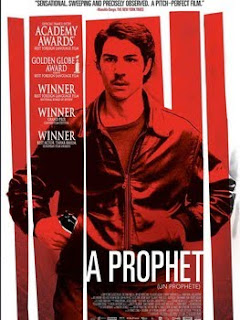
I am a huge fan of Jacques Audiard, a French director who has always rewarded the viewer with films (Read My Lips, The Beat My Heart Skipped) that balance passion with style. With A Prophet, Audiard expands his canvas, creating a gritty, novelistic masterpiece on-par with The Godfather (yes). The story concerns a young incarcerated Muslim who slowly rebuilds himself from within the treachery of prison life, rising from under the thumb of a vicious mob leader to become his own person and create his own empire. Epic, patient, and in places extremely violent. People will be referring to this film for years to come even if it has not really made a mark in North America. Again, a masterpiece.


The Eclipse

I realize this Irish film was released in 2009, but it didn’t get here until now. A compelling ghost story which eschews the two-dimensionality of ghost story films. It was around the twenty-minute mark that I realized it was a film which was going to confound my expectations (expectations based upon years and hundreds of similar plot lines): it wasn’t going to squander what it was and fall prey to hackneyed cliché. A gorgeous, touching, ultimately humanistic film with a stand-out performance by Ciarán Hinds as a grieving father of two children who must swallow his pride to escort a loud-mouthed Aidan Quinn through the motions of a book tour of the small coastal city of Cobh, in County Cork. A sublime achievement by director Conor McPherson.

Notable: Winter’s Bone – see it. It’s on DVD now. Like A Simple Plan, it’s a self-contained “rural thriller” (ugh) with a chilling undertone of barren hopelessness. Unlike A Simple Plan, it’s uncomplicated which is what gives it more of an honest strength. Exit Through The Gift Shop is the perhaps best film made about art and the art world that I have seen – like Inception, it’s not trying to be deep, just smart. Scott Pilgrim vs. The World blew me away because I expected it to be weak (perhaps because all the publicity photos inexplicably used a static image of Michael Cera standing against a fucking wall…imagine if you will, trying to sell Star Wars with a picture of Mark Hamill sitting cross-legged in the desert – sounds awesome, eh?). Not only was it not weak, it was the strangest case of “I don’t know why I love this movie but I really do”. Painstakingly, sublimely Toronto-centric (which, unlike the inexplicable promo photos of Michael Cera, shouldn’t be factored into explaining why it didn’t fare well at the box office) and wildly imaginative – those two things have never met before…oh but wait, I forgot the perfect companion piece: Kick Ass – also shot in TO, and also exceedingly expectation-defying (although the climax is kinda drawn-out). As far as performances go, Jesse Eisenberg (The Social Network) and Colin Firth (The King’s Speech) stand out, along with Winter’s Bone‘s Jennifer Lawrence, and Hailee Steinfeld for True Grit (who, at 14-years, shows huge promise as an actor).

BOOK:

I would have said “BOOKS”, but due to work and school I haven’t read anything published this year (that I can remember), with the exception of John Vaillant’s The Tiger. Lucky for me, since it is without doubt one of the best non-fiction titles I’ve read in years.

The Tiger is a meaty real-life tale of vengeance by the titular beast, in the winter hinterland of the Russian Far East (which the author calls, paradoxically, “the boreal forest”). Vaillant describes an environment historically, politically, and biologically unique, inhabited by hardened outcasts. The shadow of a predator male tiger, known never before to attack without cause, creates a wave of dread throughout the land, with only a small band of volunteers to figure out the mystery. Vaillant provides wave after wave of fascinating detail – examples of how man and beast have evolved throughout time, how human and animal behaviour have worked in similar paths – that by the end of the book you feel as if you should have a credit in Ethology. This is truly a page-turner and I cannot recommend it enough.

Share

Book Review: Never Let Me Go, by Kazuo Ishiguro

Sometimes things just line up in such a way that you can’t help feeling they were put there on purpose. Early this month, as part of a course I’m taking, I went to a weekend retreat, held at a secluded compound by the Credit River. It was a bit eerie, because many of my dreams take place in expansive compounds: wherever I go, even if it seems I’m outside, I just have to look up to see that there is a roof, or some sort of enclosure to remind me that I am not free. So, what book from our library did I take with me at the last minute? Why, Kazuo Ishiguro’s Never Let Me Go, of course. What I didn’t realize is that much of it takes place on a compound…but I’ll get back to this.

I’ve not read any books by Ishiguro – I haven’t even seen the movie adaptation of Remains of the Day. That said, I did work on Guy Maddin’s The Saddest Music In The World, an adaptation of one of his short stories. I’d heard good things about Never Let Me Go, and had always meant to read it. With it being released as a film recently (I don’t think it did that well, despite the critical praise), and since I needed something to read during my time away, I thought it would be a good pick.

Never Let Me Go concerns the story of Kathy, Ruth, and Tommy. It’s told from Kathy’s perspective in the present. She is a carer, who drives from centre to centre, visiting those she looks after. Very soon we are introduced to their beginnings, as children, in a place called Hailsham. It’s an isolated educational enclave, somewhere in England, where the students live, go to school, and grow up. But there’s something a little odd about it all. Perhaps it’s the isolation from the rest of the world. Something in the way some of their guardians regard them. All too soon, their sun-dappled childhood in Hailsham becomes something which haunts them as they grow into young adults. It’s practically all Kathy can use to mark the passing of her time.

Within these reminiscences, we are introduced to Tommy and Ruth, who become the foundational friendships Kathy clings to through adolescence, regardless that Ruth oscillates from friend to enemy – a colourful rather than careful individual who becomes a voice of danger in the fog of their relationship.

The magic of this book is the skill with which Kathy’s perspective is written. There is a purpose for Hailsham, for their being there. There is a reason she is a carer. Never Let Me Go is a capital-H haunting novel, inhabited by people who are slightly cold but reaching out, never quite managing to touch a meaning they hope is there. I can’t say much more without spoiling things, not that it’s a book laden with surprises, so much as layered with subtle, sad observations. A beautiful book for a rainy day.

Kazuo Ishiguro’s Never Let Me Go (ISBN: 978-0-676-97711-0) is available at an independent bookstore near you, or at various online retailers.

Share

Swirl

I am trying (desperately) to avoid a “boy, it’s been a wacky ride these last few months!” post. It certainly isn’t for lack of things to talk about, news to update you with, opinions to confess/shout.

Thing is, I don’t know who you are. Sure, I know there are some of you who are semi-regular visitors. There are others who happen upon this place by accident (via Blogger or StumbleUpon). There are also those who come here via Google searches, either via my name or – most likely – a book review (which admittedly I haven’t done in, oh, a year or so *). And no, this isn’t going to be a “Matt wittily evading accusations of being a lazy bastard by turning the camera on the reader” post.

I’ve been posting artsy stuff, writerly stuff, industry opinion stuff. I don’t mind the randomness, so long as there’s no fluff. I do mind the lack of output. I wish, for one, that I could post more photographs (which is to say, I wish I had a better selection of photos to post **).

It comes down to the fact that I’ve been working like a dog since May (note: this happens every year that I’m working on a SAW film). When I come out of these periods, I feel like Rip van Winkle: a little dazed, slow on the up-take. Whereas last year this time I started teaching, this time this year I am a student (part-time) †. I have a small (but good) feature and a small (but good and potentially controversial) TV show on my plate from now till February. If funds allow, I also hope to have an editor working with me on my novel, with an eye to approaching a publisher or self-publishing if that doesn’t seem feasible ††. I’m collaborating on a musical.

My plate is full.

– – – 

* which isn’t to say that I’m not reading or that I don’t want to do any more book reviews. I’m reading a lot of non-fiction, thank you. Much of it either out of professional or academic interest. However, if only to improve my Google ranking, here’s a quick book review of Antwerp by Roberto Bolaño: What the fuck was that? (ISBN-13: 978-0811217170)

** another casualty of working so much is my photography. I still have the same roll of film in my camera that I’d loaded in June. I think I’ve only taken 4 exposures since then. Of course, my cellphone camera gets all the fun these days, unfortunately.

† I will be continuing teaching, but for only two terms this year as opposed to three (which was exhausting and… exhausting)

†† It needs a new name, for one thing. And I know this is going to drive me up the wall more than any changes to the actual content of the book.

Share

All That Glitters Isn’t Oranje

It should come as no surprise that my postings have been less frequent, in proportion to the success or lack thereof of the Dutch at the World Cup, which has just (mercifully) ended.

First: I’m happy we made it to the Final.

Second: I’m happy we lost (even though I wanted us to win at the time).

Allow me to explain: I will always support Oranje, but that doesn’t mean I have to suspend my critical faculties while doing so. It also doesn’t mean I am living in a nostalgic cloudbank in which Holland must either play soccer like the Kirov ballerinas dance or else they are “cynical” – a word bandied about by once-every-four-years-I-pay-attention-to-soccer pundits.

In case I haven’t beaten this point enough, my Oranje is the team of 1998. It always will be. They were beautiful to watch (take a look at my Ryeberg essay if you haven’t already) and most aficionados consider that squad the greatest team of the competition, regardless that they lost to Brazil in the semi-finals. The thing is, if you accept that, then you must also accept they were the very same team who flamed-out against Italy in Euro 2000 in the quarters, in perhaps one of the most humiliating games I’ve seen us play: same squad, folks. How’s that for beauty?

The toughest question in the world if you are a Dutch international soccer player: What can you do when the public, the pundits, the former stars from the Golden Age all want to see you play ballet if playing ballet doesn’t win anything? Don’t get me wrong: I like the Oranje ballet – I am one of those people who can walk away from a loss, still chuffed that we played “as we should”. I do side with author David Winner’s thoughts about Dutch soccer philosophy, as laid out in his (brilliant) book, Brilliant Orange: The Neurotic Genius of Dutch Soccer. But inevitably you want to win something, and the only silverware the Dutch have is the Euro title in 1988.

This brings us to the present. Sadly. Sadly, because for the most part Oranje did not live up to the philosophy we had come to World Cup 2010 expecting. Under the direction of Bert van Marwijk, they took a detour: individual beauty, sure, when necessary, but collectively less a ballet than an assembly line with a very narrow directive: win, above all else. And they did. They were rusty at first and their games, outside of pockets of that ol’ Clockwork Oranje we hoped to see, were not pretty, but they won, and continued to win. Lord, I wanted them to win, too – I was a willing enabler.

When the final against Spain came, I was a nervous wreck. I can only imagine how it must have been in Holland, for those making their way to the Museum Square in Amsterdam where the games were shown for the public. They had come so far, had been through so much, for so many years: 1974, 1978, the glimmer of 1998, the disappointment of missing 2002. So much baggage that you wanted them to win just to shake off the voodoo of the past.

But as I got prepared that morning I visualized what it would be like if we won, if for the first time ever we won the Cup. Instead of tears of joy, I have to tell you, I saw that it would have felt as if we had cheated. As if in winning, we had not done so as ourselves but as a cunning machine, as if someone had invented a “Dutch Soccer Team” to take our place. I cannot describe how difficult it was to deal with that: to stare at a historic vindication within reach of your fingertips, knowing simultaneously there was something inherently inauthentic about it. In fact, had we won, I fear the “victory” would have irrevocably punctured the heart of Dutch soccer, as opposed to the bittersweet reality I live with now: we lost, Dutch soccer is merely dented. Coach van Marwijk’s corporatist approach has been repudiated, that is for sure. What I don’t know is who or what, philosophically speaking, has been vindicated, since we are bridesmaids once again.

Perhaps it is our souls? I can’t speak for yours, but mine is in a better if not exactly comfortable place right now.

Share

Book Review: Night Work, by Thomas Glavinic

One of the nice things about following blogs (certain blogs at least, or at least the few that are still being updated) is the wealth (and depth) of recommendations one can find. In this case, I happened upon Ward Six one day and found a description of an interesting novel, called Night Work. I’d never heard of it before and probably would not have if it weren’t for their recommendation. This is the nice thing about the Internet.

Written by Austrian author Thomas Glavinic, Night Work tells the story of Jonas, a young professional living and working in Vienna, who one day while waiting for the morning bus finds that the bus isn’t coming. It isn’t coming because, as he soon discovers, everyone is gone. Every living soul in Vienna seems to have disappeared and there is no television or radio reception. He calls his girlfriend, Marie, who had just left the day before to visit relatives in England. No answer. Everything is silent.

There is a decided chill to the first half of Night Work, with Jonas dealing with an overwhelming fear that he is not alone, that he is being watched. His unexplained predicament, while extraordinary, is rendered in ways which make it easy to relate to. His fears are human fears: being alone, being permanently separated from those he loves, not knowing what lurks in the dark. There is a pronounced longing for his family; one of the first things Jonas does is move into his father’s townhouse. As the novel progresses, his preoccupation with his childhood and family life becomes an evolving theme, particularly – as he explores the city and the remnants of places he knew – the question of what is left when people leave the earth.

The book’s title takes its form as Jonas suspects that something may be happening around him – perhaps to him – when he sleeps at night. What begins with a single video camera taping his sleeping patterns evolves into an elaborately orchestrated multi-camera obsession: to solve the haunting clues left behind on the videotapes he watches the next day.

No matter how far the book progresses, Glavinic manages to keep taut the suspense surrounding the question of whether Jonas is truly alone. We share his childlike fears as he attempts to methodically explore his surroundings, eventually to make one last attempt to contact Marie. Obviously, it’s a challenge for any writer to keep the reader’s interest given a single character, his reminiscences, and a world filled with abandoned artifacts. Glavinic manages to do this without cheating the reader or over-spicing the soup with unnecessary (or illogical) scares. Indeed, Night Work is about atmosphere and memory: these are, after all, the only things Jonas is left with. And, despite its sci-fi/speculative nature, it evolves into a rather touching literary and philosophical tale.

There are some small quibbles: not knowing Vienna (or Austria for that matter), Glavinic’s reliance on Viennese street names/neighbourhoods to denote where the story is taking place can be a little confusing (Brigittenaur Lände, anyone?). Also, I wish at times there had been a deeper view into Jonas’ emotional realm – that said, not to dwell on Austrian cultural stereotypes, the protagonist is an entirely practical, self-reliant character. This aside, I would recommend this novel for those looking for something different; perhaps for readers who like a little speculative fiction mixed in with their personal journeys.

Night Work, by Thomas Glavinic [ISBN: 978-1847671844] is published in North America through Canongate U.S. and is available at an independent bookseller near you, or readily available online. This edition was translated into (UK) English by John Brownjohn (I mention this in case you don’t know what a lorry is, etc..).

Share