Book Review: Slouching Towards Kalamazoo, by Peter De Vries

There’s nothing sadder than to have contributed your soul to the world, and as a writer this contribution is more like a communion of flesh, only to find that, at the end of your life, everyone has forgotten about you.

Considered one of the greatest American humourists of his day, on par with the likes of James Thurber and Mark Twain, Peter De Vries was a prolific novelist who wrote over 20 books over the span of his life, most notably Tunnel of Love, The Blood of the Lamb, and Slouching Towards Kalamazoo. There is a fascinating, heartbreaking story about American society’s collective memory loss as it regards De Vries’ work here.

Humourist. The word feels like an anachronism. It conjures the image of an old man in suspenders, sitting on some honeysuckle scented Midwestern porch spinning tales of the County Fair of ’36 when Old Man Smucker’s pig got loose and… but this is all presumption. In other words, we’ve equated “humourist” with “rustic”. It’s wrong. We need humourists, whether they be satirists, parodists, or even the most groan-inducing vaudevillian showmen. We need to laugh – not just with grotesque cruelty, which is our current fixation, but thoughtfully.

Slouching Towards Kalamazoo is classic American humour: an extremely well written (De Vries was an accomplished linguist as well as an editor) portrait of a boy’s disoriented steps toward adulthood and independence in small-town society. It’s also terribly funny in places. His narrative style is never creaky or mannered; he tells the story, adds some window dressing, but always gets back to the point. The point: Anthony Thrasher, an intelligent yet under-achieving Grade 8 student falls for his teacher and winds up getting her pregnant. Compounding this is the fact that, due to his age and immaturity in the realm of the hands-on world, he doesn’t even fully understand the implications of what’s happened, having only the mythology of a boy’s speculation to cope with the problem. Meanwhile, his father, a devout church minister with a passion for reading literary classics aloud at the dinner table, is driving Anthony’s mother toward infidelity…with an equally devout atheist.

Combining a witty parallel retort to The Scarlet Letter – required reading in Anthony’s Grade 8 class – with a prescient view of the theist/atheist debates currently raging around us, De Vries manages to portray vivid characters that, aside from being given satirical names such as Bubbles Breedlove (a friend whom Anthony becomes smitten with later in the book), are touchingly real.

Profundity…? Perhaps. I’m not sure that would be the chief reason for reading Slouching Towards Kalamazoo. It’s delightful, character-driven storytelling with some killer dialogue. What more do you need?

Of all De Vries books, only two are currently in print – out-of-print editions are available via eBay and AbeBooks. Other than Slouching, there is his “dark book” as it’s been referred to, The Blood of the Lamb. I encourage people to give preference to independently-owned bookstores, but in this regard, given the scarcity of De Vries work, I’ll simply say that you owe it to yourself to check him out.

But don’t forget him.

Share

Book Review: The Master and Margarita, by Mikhail Bulgakov

Readers of this blog (both of you!) may have caught my previous mention of the strange road I took in finding Mikhail Bulgakov’s The Master and Margarita – not only the book itself but also this particular translation (self-published by Michael Karpelson – more on this later). Without exaggerating, it was well-worth the effort.
How does one describe this book? Well, considering all the fuss over Harry Potter as of late (or perennially, as it would seem), The Master and Margarita would seem a perfect literary tonic for anyone looking for speculative adult fiction. Hailed as one of the best pieces of Russian literature (not just speculative) of the 20th century, such praises can also be intimidating; visions of a depressing, Dostoevskian St. Petersburg, and the obligatory poverty and mental illness which filter to a bleak (if well-rendered) conclusion. This is not that kind of book.

One day, two members of the reigning literary elite meet in a park to discuss problems with the subject matter of one of their poems – it’s not atheistic enough, says the elder, and thus not worthy of publishing (this being Soviet Russia, under Stalin’s rule). No sooner is the question (and denial) of the devil raised, than the two are greeting by a tall, dark stranger who appears out of the blue and proceeds to describe how one of them will die. And, albeit under fantastic circumstances, it comes true.

Pretty soon, the stranger and his motley troupe – a clownish bloke with a broken pince-nez, a fang-toothed redheaded goul, and a large, talking black cat who walks on his hind legs – occupy a townhouse in the centre of Moscow from which they direct a chaotic spell over the city. Anyone it seems who gets in their way – usually members of the cultural privileged classes – either vanishes, winds up in the sanatorium, or is vanquished to another part of the country.

Who are they? What are they doing? All of this is unravelled (and exploded) the further into the book one reads. We meet the eponymous Master, a discouraged writer whose seminal work on Pontius Pilate is lain to waste by the bureaucratic tendrils of the sycophantic literary scene, and his faithful lover, Margarita – a married woman who would do anything to be free of her chains and reunited with him.

The Master and Margarita is a wild, throw-the-rulebook-out-the-door tale which manages to weave outrageous satire with eloquent speculation on morality. Bulgakov’s novel confidently navigates between deft, fantastic comedy and touching, emotional drama – without one disregarding the power of the other. Written under the tyrannical reign of Stalin from 1929 until Bulgakov’s death in 1940, it is both a response to the madness of that period and a triumphant individual statement.

I wouldn’t hesitate to recommend this book to anyone who is looking for something fantastic and unpredictable to consume them. It is truly a book that can be read and re-read numerous times, with each pass being as fulfilling as the next.

The Master and Margarita, by Mikhail Bulgakov (ISBN: 978-1411683051) is available at a friendly independent bookstore near you. Or online at any number of vendors.

A note about this translation: The translation I refer to above is the latest, by Michael Karpelson. While listed on Amazon, he is currently making small revisions to this edition which, combined with other projects in the works (another book by Bulgakov as well!), means it will not be available for the next while. If you like, I’ve received permission from Michael to post his email address – if you contact him, he can arrange for a copy of the existing edition to be shipped to you, as he did with me. His email address is: mkarpelson (at) gmail (dot) com. {psst – support independent publications}

Another note (June 24, 2010): I recently read another translation of M&M, by the prodigious team of Richard Pevear and Larissa Volokhonsky. I’m a little surprised, because it seems as if it’s longer than the Karpelson version (ie. it has slightly more content in places). Maybe that’s just me. It’s certainly the easier of the two to purchase, so I put this out there for you to contemplate.

Share

Translation, Traducción, and перевод

I used to hang-out in cafés when I was in my early twenties. It was a means to get out of the house without going to bars. Chances were, the conversations were better in cafés, and – depending upon the type of café – the people were usually a little more sophisticated [why writing that word feels like an elitist thing, I’m not sure – is there something wrong with sophistication?]. Most of all, cafés are cheaper than bars, and when you’re in college and starving, it made sense to choose the former if you wanted to avoid the bottleneck of debt.

There was a place in Burlington (Ontario, sorry Vermont) which lasted perhaps only a year (as all good things die early in Burlington, including the dreams of its youth…but I digress). I can’t even remember the name – French, I think. The owner was a very interesting fellow, an accomplished academic who’d lived and studied in Paris previously. I’m not sure how he managed to afford a café in the middle of a very chi chi shopping square, but he made the best of it: poetry readings, live music, parties. It was all very fin de siècle; nothing like that can live for very long in a town as complacent and suburban as Burlington was at the time.

I remember one afternoon, sitting with him (his name escapes me…so much of the years from 1990 -> 1995 escape me), and chatting. The topic arose of translation. He revealed that he wrote about the aesthetics and potential controversies of translation. Can you imagine having a book published about translation? I couldn’t then – it was something I simply took for granted and sometimes still do. The more we talked, the more I realised how much blind trust we put in the hands of the person whose job it is to convert the prose of the world’s great non-English-speaking writers. It never crosses our minds that a translator could be culturally prejudiced, or simply unimaginative for that matter.

Let’s face it: when I recently read Crime and Punishment I didn’t hesitate to think that I was reading anything but the prose of Fyodor Dostoevsky. But, of course, it was a translation. I can only assume it was accurate, not that I would have any way to tell as I only have an elementary understanding of Cyrillic (let alone Russian). What is astounding to me, is to think of how effortless and transparent the best translations are – when I consider the acrobatics some of them must go through in order to preserve the magic of the original text (the rhythm, the flow, the style, the weight, the economy) I always conclude that it must be such a rewarding and paradoxically unheralded role to play. Who translated the copy of Crime and Punishment that I just finished reading? Couldn’t tell you. I didn’t look.

This was brought to my attention most recently, and most magically, with the appearance of the book The Master and Margarita in my life. I was speaking with a Russian composer one day, relating how much I enjoyed speculative fiction from former-Soviet countries (Stanislaw Lem, the Strugatsky brothers…) when he mentioned, “Have you read Master and Margarita, by Bulgakov?”. “Who??” was my response. Let’s face it, Bulgakov is not a name etched in the collective memory of popular literature. “You must read Master and Margarita.” was all he said, with that particularly curt Slavic insistence which intones the inherent universal importance of whatever it is that’s being recommended, without question. So, I went on my laptop and did some searching – what I found was that there were, at last count, five English translations of the book.

Five.

As it turned-out, one was based on the censored Soviet text, another was marked as simply not in-depth enough, with three more ranging in response from capable to great. So – aware of the inherent importance of translation and having my curiosity piqued by the book itself – I did more research and found that the most recent translation had been done in 2006 by a fellow Canadian, Michael Karpelson (highlighted in this article from an otherwise obscure right-wing news site). To make a long story short, this translation was self-published through LuLu.com and was off-line due to small revisions Karpelson wanted to make. I ended up getting his email address from LuLu and contacted him directly – he was very nice and offered to sell me a copy from the existing print run. By the time I received it, I had no less than five other people, without prompting, ask whether I’d read the book. Talk about destiny.

So, for the Michael Karpelson’s of the literary world, without whom authors as diverse as Camus, Marquez, Borges, and the Dalai Lama would have no means to speak to English-speaking readers, I raise a toast of appreciation.

[note: I will have a proper review of The Master and Margarita within the next week or so]

Share

The Steppenwolf Effect, pt.2: Books, Covers, and Judgement

####

Achtung: it seems Comments were disabled on this and another post recently. This was not intentional. I will try to be more diligent in making sure that visitors can respond (when Blogger will allow).

####

One thing I wanted to mention, way back when I was in Steppenwolf mode (see here), was that book covers have come a long way since I was a kid.

Let me put it this way, if you have a faint interest in reading, let’s say, Pride and Prejudice (figuring that you hadn’t seen any of the filmed adaptations, but simply heard good things), what would go through your head when you saw this:

Let me guess: the most boring book in the world? Tedium personified? 300 pages about drollness?

Of course that’s not true. Most people who’ve read P&P consider it a classic. People get into arguments about its film/TV adaptations, which is a good sign that the book rules over them all. But the cover! The cover stinks! Let’s face it, this is not a cover intended to sell a book, it’s a cover intended to put you to sleep (unless you are a Victorian fetishist).

Now, you say, look here chap – don’t you know you shouldn’t judge a book by its cover? Yes. I agree. But why bother having an illustration on the cover, or some semblance of design if it does nothing for what it represents? The only reason Jane Austen allows that cover on her book is that she’s dead and there’s nothing she can do about it.

Quite frankly, I prefer this as an alternative, if I had the choice:

Why?

Because it doesn’t fill me with preconceived notions about the subject matter.

If I wanted to read P&P, the above cover wouldn’t stop me from doing so. I’d be forced to read it in order to find out if I liked it or not, without the mediation of what is often for “classic literature” terrible book design.

This is why Steppenwolf figures into this story. Check out the cover that I grew up looking at:

While yes, technically it incorporates many of the elements of the book, it’s such a literal and terribly dated approach, it’s always turned me off. It’s a James Bond poster by way of Aldous Huxley. *Blech* – no thank you.

Now, when I finally picked up a copy last year, this is what I saw on the shelf:

It’s a book! It’s a book! Not a movie, not an illustrated story, but a book, with an author! I like this approach because it’s direct yet cryptic at the same time – it’s telling me nothing about the novel, yet ties in the title of the book with a visual artifact. That’s it. Nothing more. Aside from the synopsis on the back cover, you’re on your own.

To me – and I should tread carefully here because my wife happens to design books – this is what book design is about. Forget about “don’t judge a book by its cover” – that’s a nice aphorism as it applies to people, but to books – considering there are so many vying for our attention, the covers should support the material they…um…cover.

If you’ve got a moment, check out this f-a-n-t-a-s-t-i-c site which shows all of the major cover designs of HG Wells’ The War of the Worlds. That is, from 1898 to the present, from different countries and featuring a vast array of designs and interpretations. It gives you a fascinating look at how book design has evolved over the decades.

Share

Book Review: Steppenwolf, by Hermann Hesse

We often lack depth when looking backward, particularly as it regards cultural history. For example, if I were to ask you “Name some book titles or authors whose style you would describe as hallucinogenic?”, you’d probably name the likes of William S. Burroughs and such books as Brave New World. And if I asked “What period would you pin the advent of this style to?”, you’d probably say, and without much pause, the 60’s. Because, you would reason, everything before then was formal and disciplined; rational if enlightened.

The problem is that this is entirely wrong. It is an assumption which benefits too much the artists of the mid-50’s to late-60’s 1 and by ignorance does disservice to those who came before and made such efforts feasible in the first place. Most people wouldn’t know that one of the most commonly-associated hallucinogenic novels, Brave New World, was not a product of the 50’s-60’s. It was written in 1932, nearly 50 years before Burroughs’ Junkie (1953).

Another of these books is Steppenwolf, by Hermann Hesse. Written in 1927, it is a cracker of a novel, injected with a dream-like existential narrative, intermingled with undercurrents of Eastern mysticism and Western philosophy.

The novel opens with a brief (although I would’ve preferred a briefer) forward by the son of a rooming house matron who describes his relationship with a mysterious boarder who had inexplicably left without notice one night. The tenant, a temperamental stranger in his early 50’s, named Harry Haller, left a manuscript behind which the son hopes will some day shine some light on the capricious personality of the tenant who disappeared. The manuscript which follows is a revelatory and harrowing first-person account of Haller’s self-discovery.

Harry Haller is a man out of place and out of step with his time and his country (in this context, post-WWI Germany). He has grown accustomed to referring to himself as the Steppenwolf: a wolf who has come down from the Steppes to live among men, and as such can neither fully be at ease with an increasingly bourgeois society nor, as a man, the divisively lonesome and eternally longing animal within.

Arriving at a nameless town, he finds himself trying to fit-in as best as possible, but always restless and battling with his duality and the thirst for an end to his seemingly infinite inner conflict. He can’t seem to relate to others and increasingly begins to loathe the life he has led. Just as he begins to obsess over the thought of suicide, he meets a mysterious and vibrant young woman, Hermine. Harry discovers that, unlike anyone around, she is able to understand him and, in a way that is once playful and scolding, is able to direct him away from self-destruction.

Hermine introduces Harry to a colourful and sensual existence with the help of her friends, yet this experience comes at a price. There is a tragedy beneath Hermine’s hedonistic demeanour, and Harry realises that the path she offers him is one not only of liberation, but necessary destruction. As the story proceeds, Harry is enveloped into a seductive world of physical pleasure which unleashes within him a mystical inspiration which serves to alleviate his natural displeasure with the world and his place in it.

However, Harry Haller is Harry Haller. He can’t help but feel as if he has stepped into a world that is not his, inspirational though it may be. As before, just as he feels freed from the shackles of his own prison, the Steppenwolf beckons; the conflict between righteousness and desire, formality and inspiration. He cannot help but grip his traditional way of thinking, torn as he is by the transcendent pleasure Hermine unfolds for him.

The story comes to an end, a hallucinatory multi-layered climax, as Hermine introduces Harry to the Magic Theatre, which becomes an existential funhouse mirror through which Harry comes face to face with his predicament. Face to face with death. Face to face with the nature of the Steppenwolf.

I’m not going to give anything away here – not that there are many “spoilers” to concoct out of this novel. Hesse injects a whirl of thoughts and feelings, sometimes painful and possibly autobiographic, from the necessary tragedy of Romanticism to the bewildering transcendence of Eastern mysticism. While the climax may be highly conceptual and perhaps too ambiguous for some, I must say that I ate this book as if it were my last dinner: reverently.

I will be writing separately about a couple of experiences which happened in relation to my reading Steppenwolf. It is a book that still haunts me and if you haven’t read it (and what I’ve written above doesn’t bewilder you too much) I strongly suggest you do.

Steppenwolf, by Hermann Hesse (ISBN-10: 0312278675) is available at a friendly independent bookstore near you. Or online at any number of vendors.


1. A problem compounded by the Baby Boomer generation’s evergreen self-obsession, combined with their control of the media.

Share

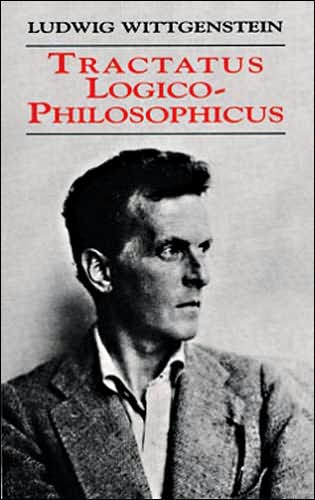
Book Review: Tractatus Logico Philosophicus, by Ludwig Wittgenstein

4.003    Most propositions and questions, that have been written about philosophical matters, are not false, but senseless. We cannot, therefore, answer questions of this kind at all, but only state their senselessness. Most questions and propositions of the philosophers result from the fact that we do not understand the logic of our language.
(They are of the same kind as the question whether the Good is more or less identical than the Beautiful.)
And so it is not to be wondered at that the deepest problems are really no problems.


I’ve been promising this review for some time. The problem has been – since this is a book not of philosophy but about philosophy – I’ve needed time for it to sink in. Furthermore, as much as I hate prefacing my opinion (or anyone else doing the same), due to the nature of this book I feel it fair to say a few words: I’m not an academic who specializes in philosophy. I do not have the names and concepts of all the world’s great thinkers at my fingertips. As such, I tackled this book as a reasonably intelligent layman. What I have to say about it should be seen through this particular lens. This is not a dissertation and most certainly this is not an academic exercise. So there.

Wittgenstein’s Tractatus Logico Philosophicus though only clocking-in at a svelte 108 pages, is a monster of a book. It is a perception-altering, densely laid treatise that attempts to clarify not a particular theory per se, but rather, pulls its focus back to comment upon the very scaffolding of philosophical understanding itself.

The way Wittgenstein sees it, there are too many fundamental errors and/or assumptions that sabotage philosophical propositions before they’re even written down on paper. The key is to first lay down exactly what a sound proposition is and to understand it in its elemental form. Technically, linguistically, even mathematically Wittgenstein has taken his understanding of what makes a philosophical proposition sound and distilled into a dense uber-logical lexicon.

It’s a fascinating (if insufferably semantic) approach: each point and sub-point are laid down like a revolutionary manifesto:


4.023    The proposition determines reality to this extent, that one only needs to say “Yes” or “No” to it to make it agree with reality.
Reality must therefore be completely described by the proposition.
A proposition is the description of a fact.
As the description of an object describes it by its external properties so propositions describe reality by its internal properties.
The proposition constructs a world with the help of a logical scaffolding, and therefore one can actually see in the proposition all the logical features possessed by reality if it is true. One can draw conclusions from a false proposition


Wittgenstein is intent on defining the way in which we attempt to interpret the world rather than the specifics of content. Wittgenstein’s reverence for the power and importance of how language is utilized in articulating the world is infectious. His approach, however, requires careful reading. I will be honest in saying that it’s difficult to review such a book without having spent a number of weeks re-reading it, making notes, checking out other people’s feelings about it, etc.. I have not had the time to do this, and have only managed to read Tractatus twice – however, I will say that while the first reading was a slog in the mud, during the second reading things became suddenly more clear and fascinating.

Who should read this book? Anyone interested in expanding their practical and theoretical understanding of language and logic. While Tractatus is dense and unsparing to the casual reader, those who give Wittgenstein’s treatise the time and effort it deserves will undoubtedly walk away richer for the experience (if not wiser). If Aristotle wrote the book on metaphysics, then Wittgenstein has written the book on metaphilosophy.

Tractatus Logico Philosophicus (ISBN 0-486-40445-5) is available at a fine independent bookstore near you. Also available online at various merchants. Note: this review is based upon the 1999 Dover republication (using the translation by C.K. Ogden, which is thought to be the definitive text).

Share

Thoughts on Truth & Medium

I’ve been reading Wittgenstein’s Tractatus Logico-Philosophicus. Intimidating little book. Seems to be written in its own language: cold fucking logic. Still, there are some fascinating ideas relating to how we choose to define the world around us. It’s easy to see how revolutionary this book may have been for some people, as concepts of truth and falsity take a back-seat to the greater question of a proper logical confine for the philosophy itself – in doing so, Wittgenstein is saying that the structure of a philosophy is greater than the veracity of its content.

Gleaning from this, I couldn’t help but be reminded of Marshall McLuhan’s 1 observation, “the medium is the message” (which was also the name of the resulting book he published 2), which seems resonant of Wittgenstein’s approach (if not somewhat parallel).

From Tractatus:

3.332 No proposition can say anything about itself, because the propositional sign cannot be contained in itself (that is the “whole theory of types”).

3.333 A function cannot be its own argument, because the functional sign already contains the prototype of its own argument and it cannot contain itself.

It would be rather trite to pit Wittgenstein against McLuhan based upon a couple of sentences (foundational though they may be). However, from this discourse I’m curious to take a closer look at what McLuhan was trying to say – I suppose I carry a vain hope of tripping over a Unified Theory.

You know you’re part-geek when things like this really interest you. However, I swear, I’m also part-superhero 3.

1. I always get this guy’s name mixed up with the guy who created the Sex Pistols (Malcolm McLaren)…if only they were the same person.

2. Although, technically speaking, due to a copy-edit error, the book was first published as The Medium is the Massage. I shit you not.

3. …as opposed to the Nietzschean concept of the Superman (*chortle*)

Share

Book Review: Moby Dick, by Herman Melville

You may be asking yourself: “Moby Dick, eh? Not exactly current fiction, Mr. Blogger.”

No, it’s not. But if it’s good, it should be read. This is a good book. It’s a classic 1.

Published in 1851 (happy 155th anniversary!), Moby Dick is an originally rendered tale told by Ishmael (whose last name we never know…in fact, we never learn the full names of any of the characters), a young veteran of the merchant marines who longs to find work (and a new life) on a whaling vessel. Naturally, his interests take him to Nantucket, Massachusetts, where he finds a ship waiting to sail – the Pequod. With the help of an exotic tattooed harpooner, Queequeg, he hops aboard willingly, despite the warnings of a street prophet regarding the Pequod’s captain – Ahab.

Once aboard and sailing, the narrative eventually inverts from the wide-eyed first-person accounts of the opening to third-person, peppered with Ishmael’s astute observations – it’s clear from this narrative transformation that Ishmael himself becomes subsumed by his experiences at sea aboard the Pequod, obsessed with the details of her crew and captain, and with the object of their profession: whaling.

The problem begins soon after setting sail; Ahab, a remarkably bleak and forceful figure, announces that – contrary to their practical purpose – they have an ultimate quest ahead: to find and kill the White Whale, Moby Dick. This single whale, we learn, is the burning flame which drives the Pequod’s captain to “monomaniacal” ends, Moby Dick having claimed Ahab’s leg (and perhaps a part of his soul) on a previous voyage.

As the novel proceeds, the reader is consumed by the everyday life of a whaler at sea: the sometimes savage danger, the simple yet sublime pleasures, and the technologies of the day. Everyone from the sail-mast lookout to the blacksmith, from the cook to the boatsmen who trawl for prey – whales, and most importantly, their precious oil – are drawn in colourful detail. Readers expecting a fast-moving plot line should note that Moby Dick takes great pains to paint the seafarer’s life, specifically the dying years of the whaling industry (at least as it existed in its heyday); as such the novel has its peaks and valleys as regards pacing. I refuse to take the “this is an old book so you have to disregard its old style” stance – though it’s a masterpiece, its strengths will only be rewarding to those with a little patience.

Moby Dick is probably one of the best-written novels I’ve read. Melville is a writer’s writer; he loves language and is very particular about how he describes the life of his characters without it becoming an academic exercise, nor are the allegorical elements cryptically depicted so as to make reading it in a non-allegorical frame of mind impossible. Take any of Ahab’s monologues and read it aloud: you will instantly notice the cadence and perfect shape of the sentences – it’s like hearing Shakespeare. The book is rife with symbolism: the ship is the world, the crew its people. Moby Dick itself becomes a symbol of the capricious result of the burgeoning 20th-century-man’s fateful need to conquer nature.

I would like to point out that I read the paperback edition, published by Oxford University Press (pictured above). I mention this in particular for two reasons: it’s cheap (500+ pages = $10!), and it comes with a handy reference guide at the back to clarify any directly symbolic (Biblical or simply antiquarian) references in the text. Also, there is an Introduction (written by Tony Tanner) which, after you’ve read the novel 2, will give you some insight into some of the mainstream analyses of the book. There is also a set of letters Melville wrote to Nathaniel Hawthorne (to whom the novel was dedicated) at the back of this edition – can’t say there’s anything relevatory there, other than the fact that Melville clearly idolised Hawthorne.

Moby Dick is available for sale at a fine independent bookstore near you and online at…Powell’s, Amazon, Chapters, and others. Published by Oxford University Press (ISBN: 0192833855)

1. I don’t mean “It’s a classic.” in the sense that, because everyone calls certain books “classics” that they must always be superior. Some “classics” do not age well. This is not one of those.

2. This is my guide to reading “classic” books: by all means avoid anything written by someone other than the original author until after you’ve read the book, whether it be an introduction, a foreword, a preface, what have you. Most introductions are academic in nature and worse, full of spoilers. Stanislaw Lem wrote a book, inspired by his distaste for these after-the-fact literary addons. It’s called Imaginary Magnitude.

Share

Oh, right – the world

If I’ve relented from espousing opinions on the world lately, it’s because of two things (primarily):

    1. The world is nuts.


  • Too many people are trying to make sense of #1


Let me qualify this…well, actually no. No, I don’t think it’s necessary to qualify either of these. This isn’t a formal academic essay.

Ludwig Wittgenstein, whose work I’ve found myself inexplicably drawn to lately, believed that the role of philosophy wasn’t to change the world, but rather to articulate it 1. I’ve played with this aphorism for quite a while, objectively and personally; while not conclusive, I suspect it applies to more than just philosophy.

Music, calculus, meditation…essentially, the Big Three 2 : Art, Science, and Religion.

I suppose what I’m getting at (as I type this on borrowed time, with little sleep, on an old laptop, knowing that at any minute someone’s going to drop the proverbial Anvil of Stress on my head) is that rather than having a Romantic notion that the world needs to be changed, perhaps we should focus primarily on expressing what exactly it is first, unwieldy though it may be. We can’t even start to explain what the world is (and thus, life) without starting from the beginning: how we individually see it, how we individually live our lives, and the extent to which our individual morals and ethics weigh our actions. Let’s face it, if we can’t articulate these foundational (and certainly more practical) questions then the world, try as we might to change it, will most likely turn and laugh in our face…or just walk by, carrying shopping bags, without looking (in Toronto, anyway).

Instead of trying to ram our passions down the throats of others 3 in the (rather selfish) hope that everyone’s life will change as a result of our unbottled wisdom, what if we changed our approach? What if, instead of proselytizing, we simply worked on articulating ourselves as well as possible (as if that wasn’t formidable enough)? I would argue that a well-conceived, original articulation of an individual point of view would have a much better chance of affecting our environment in the long term than all the thunder and plunder of what essentially boils down to a Crusade To Make The World Understand The Way [place name here] Sees It.

It’s funny that, when the emphasis of our philosophical passions are changed from “tell it like it is” to “tell your story well”, you wind up with less fire and brimstone (ie outrage) and a greater sense of awareness.


1. Michael Dummet, “Vagueness: A Reader”, Edited by Rosanna Keefe and Peter Smith, (essay: Wang’s paradox, pg.100), MIT Press 2002

2. (articulated previously here)

3. (boy, could this sentence be misconstrued)

Share

Profile: Yukio Mishima

It’s hard to discuss mercurial writer, playwright Yukio Mishima (January 14, 1925 -— November 25, 1970) without the spectre of his demise casting a pall on the dialogue.

From Wikipedia (edited for conciseness):

On November 25, 1970, Mishima and four cohorts visited the commandant of the Ichigaya Camp – the Tokyo headquarters of the Eastern Command of Japan’s Self-Defense Forces. Once inside, they proceeded to barricade the office and tied the commandant to his chair. With a prepared manifesto and banner listing their demands, Mishima stepped onto the balcony to address the gathered soldiers below. His speech was intended to inspire them to stage a coup d’etat and restore the Emperor to his rightful place. He succeeded only in irritating them and was mocked and jeered. As he was unable to make himself heard, he finished his planned speech after only a few minutes. He stepped back into the commandant’s office and committed seppuku (ritual suicide).

Now that’s an exit.

The full story on Mishima is complex and troubling: a sheltered child raised by a temperamental and artistocratic grandmother (who came from a samurai bloodline), only to return at the age of 12 to his parents. His father was a strict disciplinarian and it is suggested that his relationship with his mother bordered on incestuous.

Writing in secret (so that his father wouldn’t find out), Mishima’s stories focused on recurring themes of death, obsession, dishonour, and the consequences of unexamined emotions.

Mishima was gay, yet paradoxically (considering the society he inhabited) became obsessed with martial arts and militaristic self-discipline.

Of his more popular works is The Sailor Who Fell From Grace With The Sea.The novel takes place in post-WWII Japan and concerns the blooming love between a sailor on-leave and a wealthy industrialist whose son is part of a devilishly manipulative cabal of disaffected local children.

His critically-praised work includes the semi-autobiographical Confessions of a Mask and the fiction tetralogy Sea of Fertility. Mishima submitted the final draft of the fourth novel in the series, The Decay of the Angel, to his publisher on the same fateful day he and his colleagues would drive to the military school.

Having read a selection of his work (Confessions, Sailor, and the short story collection Acts of Wisdom), it’s clear that Mishima was an individual tortured by his own demons. One may argue he was born into a society which could never support his dynamic shape. His narrative style is poetic and sensual, though often critical of society and soaked with the tragedy of characters misdirected by love and self-discipline. Beautiful though they are, Mishima’s stories are often dark and painful. It’s for this reason I would be lying if I said I read his work regularly – though I wouldn’t hesitate to describe them as rewarding (if not seminal) works for the fiction reader.

If you’re curious about Yukio Mishima – and while I would not call it a definitive example – you may want to check out Mishima: A Life in Four Chapters, a film by Paul Schrader (who wrote Taxi Driver). It blends the story of his untimely death with lusciously visual renderings of some of his short stories.

Share