New Author Site

Hello all. In order to promote my upcoming book and to (eventually) be a hub for promoting any published works I do between now and then, I thought it best to have a standalone author site created: mattcahill.ca. This task was handily undertaken by Ingrid Paulson, and it looks great.

Eventually I will start adding pages to the site, to flesh it out (so that it is more than just a page, but an actual “site”).

The question currently stands: what will happen to this here blog? I’m not sure. The more I focus on writing gigs, the less time I have for blogging, and yet – paradoxically – I have more things to blog about because potentially I have more gigs. In other words, there is still a need for the blog, so imagitude will stay where it is and perhaps be linked-to from the author site at some point.

Share

Big News

I’ve been sitting on something pretty big for the last while. Rather than tell you in my own words, I will use one of the rare opportunities in my life where a press release does the talking:


Wolsak & Wynn senior editor Paul Vermeersch has acquired North American rights to Matt Cahill’s debut novel, Someone Else and You (working title). The story is about a man whose life changes irrevocably when he volunteers to take part in a secret society’s time-travel experiment. Kelvin Kong of The Rights Factory arranged the deal.


So yes. This. Huge news.

It’s been a very long road, and while it is not yet over (not by many miles more) I’m grateful for the opportunity to have something of mine released into the public. One less writer polishing his stones, wondering whether to keep bothering.

This would not have been possible without representation from The Rights Factory, specifically my agent (extraordinaire) Kelvin Kong. I look forward to working with everyone at Wolsak & Wynn, particularly my editor, Paul Vermeersch.

Onward and upward. Hugely excited.


Share

Author Author

I am represented by a literary agency now and, without going into great detail, my novel has undergone some major changes. Mainly structural. The story hasn’t changed, most of the plotting is still intact, no new characters. But some major changes were made and these changes happened very quickly, and as a result I don’t think what I surrendered (because no experienced author would willingly call any work “done”) was the best effort I could have made. And so, when I realized the extent to which the book needed first-aid, I told my agent to hit the brakes – stop distributing the book and ask those publishers who have not yet read it to not, please and thank you.

I’m writing this from the perspective of someone who has just finished, if finished may be used about any art form, a necessary revision. I am relatively new to this – not writing, but revising. There is an art to revision which is as unique as the art of writing itself. This may sound alien to many, but to fellow writers – novelists especially because of the weight of material we are burdened with – this is a necessary conversion: the realization that you cannot know everything, do everything in your first, second, or even seventh revision. And that potentially great ideas not only require blending with the rest of the work, but the time and space to be seen again with fresh eyes and, if need be, changed once again.

When you don’t respect the process – of writing, of revision (because the two are intertwined like the snakes on a caduceus) – you risk damaging your gains. I ended up not happy with what went out under my name and I am not the first nor will I be the last reluctant person to go through this sometimes necessary experience. I have spent the past four months rejigging, reconsidering, reaching deeper, and sometimes just removing clutter. I worked on my laptop, and after that I had the manuscript printed so that I could look at it like a real book, so that I could see what you can’t easily see on a computer screen. I’ve switched and changed, shortened and lengthened, pared-down and elaborated for clarity.

I think it’s ready now. If not “done” then “done enough”. Or, at the very least, I’m done. And, corny and cliché though it may sound, lessons have been learned.

Share

Sales Pitch

Not that I am hoping for this to be the only entry this year, but having a literary agent pitch my novel, invoking a stylistic similarity to Philip K. Dick, is certainly making the top of the highlight reel of 2012.

Share

Robertson Davies: Elitist

I was once accused by the chaplain of Massey College of being a gnostic. He was very angry with me indeed. But part of being gnostic was using your head if you wanted to achieve salvation or even a tolerable life. That is something that the Christian church tends rather to discourage. Salvation is free for everyone. The greatest idiot and yahoo can be saved, the doctrine goes, because Christ loves him as much as he loves Albert Einstein. I don’t think that is true. I think that civilization—life—has a different place for the intelligent people who try to pull us a little further out of the primal ooze than it has for the boobs who just trot along behind, dragging on the wheels. This sort of opinion has won me the reputation of being an elitist. Behold an elitist.

This is from a wonderful interview with the multifaceted author, Robertson Davies, for the Paris Review. His responses are well-considered, done as they were before everyone felt pressured to distill themselves into soundbites. He provides a wonderful perspective on fiction writing, the role of the writer, what his own background lends to his writer’s toolkit, as well as an assortment of miscellany (including a very interesting reflection on the differences between Freudian and Jungian psychology, no less). He was a true character.

Share

Happy New Year & More…

Hello all,

Not much updating lately. There is a reason. Actually, two:

1)  I’ve signed with a literary agency who are interested in my current novel. This is great/fabulous/OMG news. However, because there are substantive revisions to be made (in order to clarify some of the details in the book and make it easier to sell to a publisher), my time is taken up with that.

2)  I am beginning my career transition, from film/TV Post Production Supervisor to Psychotherapist. I haven’t really made that public here, but it’s happening. I will begin to discuss it soon, because obviously it will need some explanation. Part of the transition has been renovating our basement to be an office – while this is a great idea (even still), it’s also been a great deal of work and stress and cost.

So, as you can see, particularly when you factor-in work-work, my plate is full. I will send updates here as they happen – or you can simply subscribe to updates. I will obviously have much to share with you about how both of these developments…um, develop.

Needless to say, it’s an exciting, somewhat scary time.

Share

The Dread of Zombies

Everyone is waiting for the zombie genre (in books, television, and particularly film) to whither away like a desiccated corpse. I argue that it’s here to stay – that, in fact, it has stronger legs (ugh) than most other genres of the macabre.

The dread of zombies imagined – the tiredness some of us feel with each iteration (Pride and Prejudice and Zombies, The Walking Dead, Zombieland) – is understandable. Less understandable than with vampires, but understandable still. There are too many zombie and zombie-like (for the record, 28 Weeks Later is not, strictly-speaking, a zombie film, yet it more or less qualifies itself by virtue of many shared) themes in books, shows, and movies these days. But I would argue that it’s because – due to our increased connectedness to each other via the Internet and social media – we are exposed to real life zombies. Thematic zombies. Metaphorical zombies. And the exposure stands to increase.

A shitload of people voted for a complete ass to be the mayor of Toronto. A shit. Load. Mind you, not many who lived downtown did. Still, it was a rout. People like me – people who prize intelligent discourse over pot shots, people who would prefer to be ruled by someone with an informed conscience rather than a bullet-list of to-dos – were incredulous. It didn’t even matter what quadrant of the political spectrum Rob Ford occupied: he was the last person any reasonably well-informed person would have wanted. And yet he won in spades.

Thematic zombies. Metaphorical zombies. The dread of zombies.

Who voted for him? Who can say that they “understand” him? Are they too not also zombies by virtue of his succession to the throne of city council? Faceless, nameless, godless, conscience-less hordes hefted Mr. Ford to office, and we stand here still – a year later – asking ourselves just what the hell happened, watching the circus of political buffoonery before our eyes.

Lest this become a solely personal treatise, isn’t this the same for everyone? Aren’t we witnessing “zombie activity” in other guises: large groups of seemingly nameless, faceless, godless, conscience-less hordes blindly enabling things we fundamentally disagree with but are powerless to dispell? For me it’s the rise of Rob Ford, for others it could be the Occupy movement. For others still, it could be the revolution in Tahrir Square. The massive, faceless but powerful other. The faceless, godless, conscience-less hordes…with agency.

Thematic zombies. Metaphorical zombies. The dread of zombies.

No, it is not going away. Make popcorn.

Share

Book Review: Therafields, by Grant Goodbrand

It was with considerable surprise when, browsing the shelves of our favourite used bookstore, Balfour Books, I was handed a book by my wife. “Did you see this?” It was purporting to be about a massive psychoanalytic commune which had its roots in downtown Toronto during the 60s and 70s. I was surprised because I’d never heard of it before – the group was called Therafields. I was immediately struck by the communal angle, the era, the emphasis on psychological investigation – it was like being handed a screenplay by David Cronenberg. The fact that I am studying psychotherapy and its theoretical/historic development made it irresistible.

Subtitled The Rise And Fall of Lea Hindley-Smith’s Psychoanalysis Commune, Grant Goodbrand’s Therafields is just that. From the mid-60s till the early-80s, what was eventually coined Therafields, became one of the largest active communes in North America (significant considering both the era and that it happened with virtually no physical or cultural traces left in this city), owning as many as 35 houses within, and 400 acres of farmland just outside Toronto. At its apex it had over 900 members.

Starting out with a modest practice in the Annex, Welsh émigré Lea Hindley-Smith began by seeing people in her home. Her open embrace of students combined with an uncanny ability to get to the bottom of her clients’ problems (not to mention her real estate acumen) conspired along with the socially progressive ideals of the 60s to develop a remarkable experiment in psychotherapy: a live/work environment which operated also as an ongoing group-process for its members, all under the auspices of Hindley-Smith who became their professor, CEO, and den mother. More houses were bought so that more living spaces could be added to accommodate new members, and new groups were developed. The story of Therafields is an account of how this creative hive eventually became an unmanageable empire. It is also an invaluable reflection of the changes happening at the time, guest-starring those stranded by the revoked promises of Vatican II, the back-to-the-farm movement, and the idea that psychotherapy could be about society rather than the individual.

I am a child of the 70s. Nothing could possibly be less meaningful than that statement. However, culturally speaking, I was surrounded by the 70s. The mid-70s to mid-80s were a formative time in Canadian television. In other words, we saw a lot of ourselves. And what we saw was produced and inflected by those who came of age in the 60s and early 70s (that’s the way it always worked until recently, by the way – the older generation helped the younger generation identify with their own generation). In other words, I can imagine Therafields, while reading about it. Goodbrand has done a good job of contextualizing the era in which his book takes place. It also helps that Goodbrand was a key member of Therafields himself, and as such is gifted with a familiarity which an outside author would struggle to develop. The flip-side to that statement is that an outside author might have had a better chance of keeping the rhythm of the book’s story consistent: there is a habit of temporal back-and-forth which does not make for smooth comprehension at times.

Considering Goodbrand’s credentials, Therafields unfortunately suffers from a detached perspective. He is as qualified as anyone to write about Lea Hindley-Smith and those who were key to the group’s skyward development – like esteemed poet bpNicol, for example – yet it seems only an accumulation of actions, the plotline of a biography, which gives us clues to the hearts beating behind the cast of characters. Goodbrand’s book sometimes reads like an account rather than an experience.

And here we come to a marketing dilemma: I’m not sure who the intended audience is. I am thankfully, luckily, well-suited to read, understand, and enjoy Therafields. Yet… With its insistence on differentiating what Hindley-Smith practiced (Kleinian) from classical psychoanalysis, without necessarily providing a debriefer for the reader on what makes Kleinian psychoanalysis different from it, I cannot imagine the “average reader” walking away knowing what that all should mean. Perhaps that won’t matter if they are keen on digging into a prime slice of Toronto history – complete with addresses, one could conceivably operate a motor-tour of where Therafields took place.

It is, nonetheless, an insightful read and an invaluable chronicle of a peculiar social/cultural phenomenon. Therafields, by Grant Goodbrand (ISBN: 978-1-55022-976-9), is available (evidently) from a used bookstore near you, and also online.

Share

Another One Bites The Dust

ARG! One of my favourite literary blogs is ending its run! I encourage you all to visit Ward Six. I really appreciated their approach: to book reviews, to the art of writing. To art itself.

The reasons they give are sensible, yet I will be selfish and whinge that I am now left with oh so very few relevant, intelligent, knowledgeable literary blogs to follow.

Nonetheless, I wish John and Rhian all the best.

Share

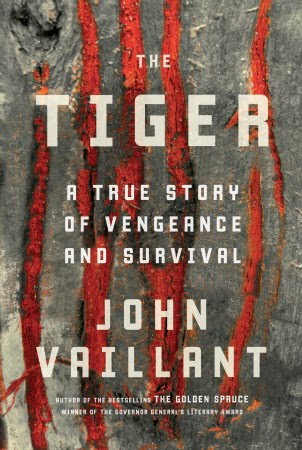
Book Review: The Tiger, by John Vaillant


(I had done a mini-review of this on my end-of-the-year post, but thought it merited its own entry)

I found myself flipping through the Globe and Mail book section one weekend in the fall of 2010, and found myself staring at a review for a non-fiction book called The Tiger, by author John Vaillant. Let me begin by saying that I am a prolific reader, yet not someone fazed by what’s new so much as what interests me. To this extent, given my eclectic tastes, I will switch from Turgenev to Bukowski, from John Ralston Saul to Stanislaw Lem, and so on. I sometimes don’t have a lot of time to read books, period, owing to a fairly full schedule of projects (which includes working on a novel). As a result, I sometimes feel a little out of touch with the contemporary world of books, especially when there are people on Twitter who are aiming to read fifty books this year.

Getting back to me and the review, I glanced at the synopsis and was struck by how meaty it was: the Russian far east, a vengeful killing machine, a dark exploration of our ties to nature. It seemed to be everything I was looking for (especially as a Russophile) and gave me an opportunity to actually read something published in the year that I was reading it.

It is, in short, a fabulous book. Fabulous, above all, because of the depth of Vaillant’s research into his subjects and his skill at balancing this collective learning against the white knuckle tension that is at the heart of the story. The Tiger begins with the stalking and subsequent killing of a tayozhnik – a Siberianism for forest dweller – named Markov and the series of events it sets in motion against the backdrop of the merciless taiga (or “boreal forest”) surrounding the little logging town of Sobolonye.

The tension is established early, not by Markov’s demise so much as the complex relationship between humans and tigers in this paradoxical part of the world, much of the relationship predicated on the aboriginal teaching that a tiger will never attack a human, so long as the former respects the latter’s spiritual and physical superiority. This superiority is laid out in full measure: from a zoological perspective, the tiger is perhaps the most sublime killing machine that exists in the world of mammals and Vaillant spares no time outlining how every inch of the beast exceeds any comparable hunter on the planet – both in physicality and mentality. The tiger thinks. The tiger learns. Most compelling of all, the tiger remembers.

It is this last quality which lends much tension, because, as the tiger is tracked by a team of professional hunters over the course of two weeks, the question is repeatedly asked: did Markov bring this on himself? And how?

The Tiger is a stunning combination of layered storytelling and educational insight into the evolutionary relationship between man and animal. Indeed, given the barren environment of the setting, it feels sometimes as if the conflicts between man and animal are staged in a prehistoric past rather than their modern setting in the late 90s. There are also some sad truths made about the aftereffects of the economic collapse of the former Soviet Union and the perennial designs China has on the taiga’s natural resources – tigers included.

The Tiger, by John Vaillant (ISBN: 978-0307268938) is published by Knopf and is readily available in your local, independent bookstore.

Share