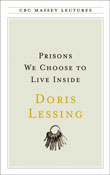

As mentioned previously, House of Anansi recently re-released their acclaimed CBC Massey Lectures series. This news is a significant boon to the reader who values provocative, intelligent discussion which often straddles the fine line between social anthropology and philosophy. Having been pleasantly surprised with Doris Lessing’s Prisons We Choose to Live Inside (reviewed previously here), I picked-up John Ralston Saul’s The Unconscious Civilization with hesitant interest – I say hesitant because I’m already well-acquainted with his work.
I was first introduced to Ralston Saul many years ago with his book Voltaire’s Bastards (ISBN 9780140153736). I was impressed with his bold and thoroughly-referenced perspective on what he contends is the growing paralysis of Western civilisation throughout history. However, in retrospect, this was probably the wrong book to start with; for one thing, it’s about 656 (trade paperback) pages which, considering his dense style and cogent analysis, makes for a bit of a brain slog. Nonetheless, I followed this with the successive releases of Confessions of a Siamese Twin (ISBN 9780140259889), his treatise on Canadian social/political identity, and On Equilibrium (ISBN 9780140288032), his elaboration on six foundational aspects of civilization.
I wish now that I had first read The Unconscious Civilization.
Clocking-in at a comparably svelte 205 pages, Unconscious Civilization finds Ralston Saul boiling down the magnum opus that was Voltaire’s Bastards into something much more approachable for the average reader without filing down its fangs. The thesis is partially revealed in the Preface, written for the 10th anniversary re-release:
When I wrote these Massey Lectures, I was convinced they would cause a shock. After all, I was describing the state of the West in a manner quite off the radar screen. I was saying there had been a persistent growth of corporatism in spite of the outcome of the last world war. And that this growth continued. Why would this be shocking? Because corporatism was part of the anti-democratic underpinnings of Fascist Italy in particular, but also of Nazi Germany. Beneath the uniforms and the military ambitions and the dictatorial leadership and the racism lay corporatism. It was the intellectual foundation of fascism. And it was supposed to have been destroyed along with both regimes in 1945.
So, it’s not exactly light reading. Throughout history though, concepts and arguments that heed us to re-evaluate our surroundings (whether or not we end up holding fast to them) are often dissonant to our day-to-day perspective on life – in other words, controversy often ensues difference. Ralston Saul is unafraid to call a spade a spade.
The Unconscious Civilization lays out in dense, history-shifting references, the problems and origins of corporatism and how it has become an increasingly acceptable means to run modern societies, in spite of its history of stifling democracy and rewarding conformism.
One of the key points made is how one can propose to adjudicate the underlying strength of any given society – that is, asking: where does its legitimacy lie? He proposes that this legitimacy lies in one of four areas: God, a king, groups, or civilian individuals working as a whole. While the history of Western society has largely been influenced by the former two, Ralston Saul feels that we are most certainly in the hands of groups: think-tanks, specialists, and managers.
The corporatist model, he argues, in the tradition of the Catholic Church, is obsessed with God and Destiny – albeit transposed onto contemporary concerns such as the trade markets and privatisation of public interests. Corporatist language is thus cloaked in a similar sense of inevitability and sycophantic awe that the Church used to instill fear and hold power over the populace.
Although the density of Ralston Saul’s arguments is impressive (in particular, his contention that Jung and Freud allowed the posterity of their work to fall victim to an inarticulated obsession with mythology) , I feel it’s this same quality that weighs down the over-arching themes of the book. At points, particularly with his repeated references to Athens in the days of Socrates, I longed for the simple first-person perspective that gave Doris Lessing’s Prisons We Choose To Live Inside its sprightliness and pactical immediacy. At times, Unconscious Civilization buckles under the considerable thickness of its content, which makes me wonder what the average reader will take away from it (without re-reading).
However, this doesn’t change the fact that this is powerful stuff. Not content to only point out what’s wrong with society, his last chapter is dedicated to thinking towards solutions. In particular, I found great interest in his contention that the public school system is out of step with the lifestyle changes over the last 20 years – as people are set to retire later and later, would it not make sense for children to enter into school later and then be required to receive a more complete education than the current system which is only concerned about cranking out specialists for the marketplace? Ralston Saul also delves into his equilibrium theory, to which he devoted a book in 2002, in which he postulates that individuals and society alike must work to remain balanced rather than hyper-focused on any one quality, in particular rationality, which has been used to justify abuses throughout history.
I would not hesitate to suggest this book to anyone interested in challenging views of society in general, and Ralston Saul’s ideas in particular. For the latter, The Unconscious Civilization is the ultimate primer. For the former, you will undoubtably find yourself spending a great deal of time wrestling with its well-researched and sometimes scathing message.
The Unconscious Civilization is available for sale at a fine independent bookstore near you and online at House of Anansi Press, as well as…Powell’s, Amazon, Chapters. Published by House of Anansi Press (ISBN: 0-88784-586X)