Film Review – Zidane: A 21st Century Portrait

[july 13 – I’ve updated the information on the game played in the film. Thanks “SM”!]

I don’t normally do film reviews – so many other places provide this (for better or worse) – but I thought the following would be of interest…

When I heard that the documentary Zidane: A 21st Century Portrait was playing a one-night show at the Bloor Cinema, I couldn’t resist getting tickets for myself, my wife, and my good friend – let’s call him “SM”.

My friend and I both work in film/TV and both are big soccer fans, so there was potentially a lot here for us to appreciate (or at least make fun of afterwards). I’d separately heard the Mogwai soundtrack beforehand and thought it was interesting – very meditative. A short synopsis on the film: it recounts French soccer star Zenedine Zidane’s club game with Real Madrid, in a match with Spanish cup rival Villareal on April 23rd, 2005.

After the screening, we stood on the street, slowly coming to the conclusion that we all had problems with the film. Yet, rather than write it off as a “bad film” and drink with purposeful abandon, we found ourselves talking about it – trying to make sense of what it was that did or didn’t work.

What follows are a set of emails I exchanged with “SM”, which I feel demonstrates better than a formal film review our thoughts on the film. I am “MC” and my wife shall be known as “G”.

—-
From SM:

I now think that I really didn’t like the film beyond a technical
appreciation, especially for the sound design. I have slept on it and feel
fairly strongly about this.

It could be that I brought too much baggage to the film, or perhaps as
“G” suggested, it didn’t lend itself well to the theatre environment
(even if only on that day). But during the film I found myself missing the
wide screen coverage of the action at least for some sense of geography. Or perhaps more variance on the close up detail of ZZ – ie, exaggerated time stretching of actions to capture muscle tone/movement. Perhaps something to break the tedium. And that was perhaps the biggest frustration – the tedium. If the point was to study someone performing a Sisyphean task so closely that you really couldn’t tell what the task was at any given time, then that mission was accomplished. But for me it didn’t inform or entertain but left me detached, distracted and unmoved.

Also, it became a side issue to see what kind of possible image rights
issues they may have had to deal with. The animated sideboards were all in English – Kellogg’s “Frosties”, Gillette razors. In Madrid? Perhaps that is so. But it stuck in my mind. As did the peripheral existence of Michael Owen. I’m positive I saw him running on the fringes of the screen, but no image of him straight on lasted long enough for recognition, neither did his jersey name or number. But there was a lot of everyone else. And so I started to wonder, hmm, what if some players were not willing to lend their image to the film? But I don’t think I should have been thinking that. In fact I was frustrated that I was doing that. But the film left me little else to think or feel.

—-
From MC:

I do agree with your after-sleep assessment – in particular what you wrote about rights clearances. I must admit, the exact same thing was going through my head the entire time: did they need permission from Beckham? Did they need permission to show the Frosted Flakes ad? What about Zidane’s clothing sponsorship (Adidas)? However, two questions arise from this:

1) If we’re asking ourselves those questions in the first place, is that not indicative that the film has problems?

2) Again, to take the “naive media soul” approach, would the average person ask those questions? Are we being too savvy/media-aware? Mind you, considering our tastes and how potentially this film could have catered to them, if *we* were thinking about rights clearances what the hell was the Annex chick with the $200 haircut and the flip flops focusing on (that would be the “proverbial Annex chick…” not anyone in particular)?

I must say that I would like to see it again (not soon) on home video. I think that, aesthetically speaking, it would/could be a better experience seeing it in an intimate environment.

At least we’re talking about it! Maybe the director just wanted to make something people could chat about?? Eh?

—-
From SM:

Yeah, but the director of “The People Under The Stairs” had me talking after the film too. Just not anything I can repeat in mixed company.

The “naive media soul” might not drift to the kinds of thoughts we were (image rights) but perhaps instead might think “do I need to pick up some eggs?” or “hey I need to Lemon Pledge my tables this weekend” to help fill in the void left by watching this film

on imdb there’s two polar opposite reviews (see below)

POINT

“This is the most affecting, profound piece of documentary film I have seen in years. That said, it is a challenging work that doesn’t fully reveal it’s power until well into the viewing. As much a meditation as a film, the net effect is similar to that of watching “Winged Migration”. Watching the simple, relatively unaffected actions of Zidane over the course of a match begins to work on you. I pondered politics, commercialism, world conflict, fame, economics, the media and more over the course of my first viewing. There is no easy way to encapsulate the overall feeling, the ebbs and tides experienced while watching the film, but afterward you will view the world in as if with new eyes. It is also a masterpiece technically. I couldn’t help but admire the precise and exquisite sound design and music, how they blended to the action and psychological state being portrayed to the moment. The cameras seamlessly take the viewer from sprawling, epic points of view to the most intimate. The use of subtitle without voice over narration used to portray Zidane’s thoughts is nothing short of revolutionary. This film may disappoint a soccer fan simply seeking a piece of sports entertainment, but for a lover and student of film it is groundbreaking, important work that must be seen.”

COUNTERPOINT
“The guys who made this movie got it so wrong. They actually show Zidane as a tired static player and not the football god he is. Zidane is my idol for many years and what makes him a great player is: 1. his absolute vision of whats going on on the football field 2. His abilities to make the players around him better. Yes, he’s got amazing control of the ball and elegant movements that wont put to shame even a ballet dancer. But thats not it. For example, to show the amazing abilities of the conductor Zubin Mehta, you wont film him waving his hands for an hour of a silence movie. You must record his orchestra and show the connection between the conductor’s brilliance and its outcome on his “TEAM” of musicians. The same goes to Zidan. It is pretty obvious that the film makers here, do not understand football and what really made Zidane the amazing player he is. They showcase a too long, too static performance, mostly in close ups. Most of the time you don’t know where Zidane is located on the pitch, or how does he reacts to the opponents formation or plays. Sorry. Nice try but the results are poor and boring.”

BACK TO ME

The frustrating thing is, I agree and disagree with both of them. The first guy is a bit lofty with his praise, but I agree with his assessment of it being a technical masterpiece (well maybe not that high up, but you know). I don’t however think “it is groundbreaking, important work that must be seen.” I miss not really being able to see the attributes that the second reviewer describes. But I think too that it would then verge on “highlight reel” stuff.

I wondered if it would have been more engaging if this had been a vocal midfield general like Roy Keane or someone who saw more of the ball (maybe a Beckham). I really would like to hear an honest opinion of a professional footballer to this film. Not that they’re better players, but perhaps there’d be more range of emotion? And maybe that’s what I was missing. By the time Zidane’s emotions showed (smiling with Roberto Carlos, getting in the brawl), it was too late; I had stopped caring at half time.

—-
From MC:

I fall between the two points also.

I do think there is a mantric quality to the film which, combined with the half-time segment and the sound design, provides a larger (albeit arguably more “wispy”) palette for the viewer – it becomes less about soccer and more about…well, who the fuck knows. Spin the wheel. However, this last point starts getting more into the territory of Art and Art Appreciation – the lack of a fixed message isn’t the point. However, not to let the director off the hook, I’m not entirely sure his intent was clear or if it was, whether it was achieved.

On the other hand, yes, anything else probably would’ve become a sports-porn highlight reel. I wondered if, instead of Zidane it would’ve been more effective to choose someone else – either a name or another position – but that too poses just as many problems. Zidane isn’t a Chatty Cathy and his largely mute performance works because it’s all about his focus or lack thereof. You could say the same about most goaltenders, but then again if you thought the focus on Zidane was static, imagine someone standing within two goalposts for 90m would be? Keane…that would be interesting. Certainly more dynamic, but would it have the same quiet grace and reflectiveness?

Yes – I would like to have a pro footballer’s perspective on the film. I’m hoping the Guardian or someone else thinks of this. Better still would be a moderated discussion between the director, a professional footballer, and an interviewer. Unfortunately this would only ever be shown on television in France. Still…

—-
From SM:

Yes yes and yes.

The intention was unclear.

The quiet grace and reflectiveness works for a moment for me. But it became ironically grating over time. A shorter film would probably achieve more.
Or more accurately, if this approach were applied to a smaller scene in a film where the protagonist is followed like this in a climactic match or just an fairly important match this would be quite effective as a montage.

Reminds me, if memory serves correct, of the Raging Bull fight where LaMotta finally wins the title – the camera stays mostly on him/his face throughout the fight. But with Raging Bull, there had been a connection to the subject previous to this – mostly thanks to it being a narrative form and that the subject was an expressive actor – as well as throughout.

With the Zidane film one’s only connection was any expectations you brought to the film based on your knowledge of the subject from your reality (World Cups 98 thru 2006 etc etc). And the silent disconnect experienced here can only lead to a let down from that expectation.

Here’s the stick, you want one last go?

I decided not – I think we both had our turns at it. Yet, irregardless of whether Zidane was a success or failure, any film which can elicit these sorts of thoughts is worth a mention.

Share

Defending Tideland

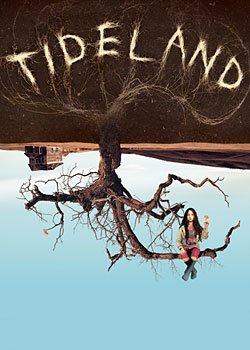
As well as working in the industry, I am first and foremost a fan of films. Films are just as capable of articulating the world (inner and outer) as any other art form 1. I’m taking it upon myself to defend a film which will undoubtedly appear on many Worst of 2006 lists, which is a shame.

Tideland is a film by Terry Gilliam, a director who has a reputation for being a maverick. He packs his work with unbridled fits of imagination and passion – often much to the chagrin of his investors. One only needs to research the making of films such as The Adventures of Baron Munchausen (1988), Brazil (1985), and more recently his unfinished Don Quixote project 2 to understand that this is someone who doesn’t listen to reason if reason gets in the way of a neat idea. Tideland is no exception.

Though released only weeks ago it was actually completed in 2005 and spent a long time floating around festivals until it dropped into theatres unceremoniously in October. With few exceptions the film was summarily eviscerated by the critics and subsequently shunned by the movie-going public. It will go on Gilliam’s track record as yet another “ambitious failure” 3.

I’m here to say that I’ve seen Tideland, and it’s good. Beguiling at times, but good. The story concerns Jeliza-Rose (Jodelle Ferland), a ten-year-old girl whose abusive mother dies of a drug-overdose. Escaping the city with her scallywag father (played by Jeff Bridges), they wind up at a ramshackle house in the middle of the prairie that once belonged to her grandmother. It has since been abandoned and pretty soon – after her father suffers from a fate similar to her mother – Jeliza-Rose is left alone to fend for herself. The greatest weapon at her disposal, however, is a seemingly bottomless imagination (her friends, from the beginning of the film, are three doll heads she fits onto her fingers and engages in conversation with). Along the way, she encounters her neighbours (which, on the prairie, means a mile away), Dell and Dickens, a rather odd brother and sister; she (played by Janet McTeer) is a taxidermist with a witch-like demeanor and a dire fear of bees. Her brother (wonderfully rendered by Brendan Fletcher) had his brain operated on long ago to counter epilepsy and seems to be more child than man. Dickens and Jeliza-Rose becomes close friends, seemingly mental and emotional equals.

As much as I don’t like to say what a film (or any piece of art) is “about”, it’s clear – particularly given Gilliam’s repertoire – that one of the key messages of the film deals with the power of imagination in the face of bleakness. It is a bleak story, I won’t kid you (in case my synopsis didn’t get it across). However, the key difference between Gilliam and other directors is that his philosophy is never misanthropic; he always shows us a type of reality that is equal parts magical and bittersweet. Jodelle Ferland’s performance is this best I’ve seen this year and an astounding achievement for a child of her age; she is able to render the inner world and perspective of her character without ever being less than convincing.

I went into this film expecting a stinker and I walked away with a lot of haunting questions about childhood and the resilience of imagination. It’s a fair criticism to say that, in a film that so intimately (and disturbingly) inhabits a child’s world, there could have been an injection of objective perspective so that the audience had a better sense of what was real and what was fantasy. However, aside from that, the film stands comfortably on its own and proudly – in my opinion – beside the best of Gilliam’s work. This makes it all the more unfortunate that it got trounced in its theatrical release. While not the first time Gilliam has experienced such disappointment, it seems the price he has had to pay to give us some of the most inspiring and wild flights of fancy.


1. It was Sergei Eisenstein who said that editing is the only art form native to filmmaking (all its other elements originating in either theatre or photography)

2. See: Lost in La Mancha

3. Aside from Munchausen which reported a record-loss in its day, his last feature, The Grimm Brothers was characterized by the sort of producer-led sabotage the Weinstein brothers are famous for. It’s not a very good film and I don’t quite understand what the intent was behind it – but that’s another story. I’m a champion of Gilliam but I won’t stop short of staring at Grimm suspiciously.

Share

Comment: There is nothing inherently masturbatory about film

Eric Bogosian wrote in 1995 :

It’s a truism to say that movies, TV and canned music are all dead media. In fact, they are machine-made. Might as well have electrodes sunk into my gray matter as a pair of headphones and some house music. Now, don’t get me wrong. I like a blasting boom-box as much as I love jerking off and I’d be sad if I couldn’t slink into a refrigerated movie theater in the middle of a hot, stinking New York afternoon and sedate my self with greasey [sic] salted corn while watching illuminated photos of people killing each other.

But it’s all dead. Which is to say, un-unique. Every one the same as the other. The movie (or TV show or record) is the same whether I’m there or not. That’s why it’s like porno as opposed to sex. Good theater is like having sex. It’s different depending on who you’re with.

I originally read this in a newspaper article, though paraphrased more succinctly: theatre is like sex while film is like masturbation.

So as to not give the impression that I’ve withheld a decade’s worth of disagreement, this is not the first time a theatre actor has publicly pissed on filmmaking (in general, no less) whilst implying theatre as sacrosanct. More recently, a local theatre actor with a sizeable list of TV/film roles had done the same in a local weekly. And every time someone takes this approach it’s hard not to view them as precious ideologues.

Arguments like this are easy to make, especially when you opt to side-step the reality of that which you are criticizing. To be fair (some may say too fair), I like to think Bogosian was championing theatre (specifically New York’s scene) as opposed to condemning film, seeing as he was distressed at the brain-drain occurring at the time (and I’m sure continuing to this day).

The truth is that there is nothing inherently masturbatory about film or filmmaking, or at the very least the threshold is no greater than in – dare I say it – theatre. If I may borrow Bogosian’s turn of phrase, it’s a truism that there is more to filmmaking than the inflated mediocrity we see passing through our cinemas on their way to the DVD shelf. How difficult would it be for anyone to use the same argument about theatre: Mama Mia, anyone? Is it fair to base an argument about theatre on Tarzan? Truth is, every artistic medium has its share of sequined fluff and it is patently unfair to point to the worst (or, in the case of LA, the home of the worst) for validation. It’s an argument which ignores the power (abetted, I argue, by actors also) of such a wide array and long history of great filmmaking that tallying a list (as I’ve attempted for the last 20 minutes) seems as asinine as Bogosian’s comment.

Every artist works with the bells of his pursuit’s downfall ringing in the background. This is part of the very thing which pushes artists to do their best work: namely, being pissed-off (or, depending upon your local caste system, “outraged”). Being pissed-off gives us the plays, films, and yes – television – we as a society need to have around us (if not to watch). So, if Bogosian was simply sounding a pro-theatre rallying cry, I can understand. What I can’t understand is when reasonably intelligent people denigrate perfectly analogous pursuits for sake of expressing their petty love of another.

Share

Cinema in Toronto: Three Rep Theatres to Close

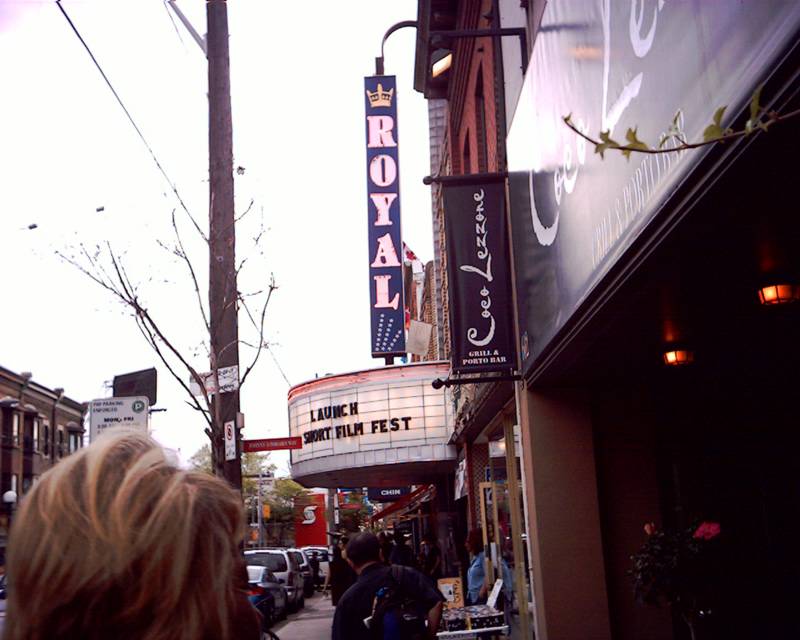
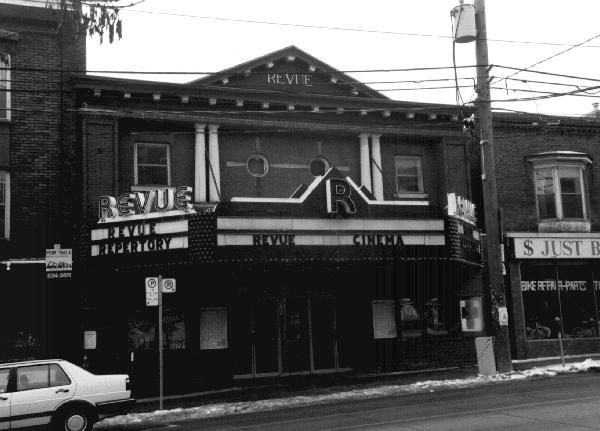
I was shocked to receive word that three of the most venerable rep cinemas in Toronto are about to close their doors at the end of June: The Royal (at College & Clinton Sts.), The Revue (on Roncesvalles), and The Kingsway (Bloor W.).

Excerpt from the Toronto Star:

The theatres — part of the Festival Cinemas group — were owned by cinema entrepreneur Peter McQuillan, who died in October 2004.

Last night, his son Mark told the Star that he and his two siblings made the decision to close the theatres reluctantly.

“The heart and soul was my father. Since (his death), we have been trying our best to run (the business).

“But we don’t have the time, the energy and the financial wherewithal to keep it going,” said McQuillan, noting difficult market conditions contributed to their decision.

“I feel bad if they are closing. We might get a few more customers but I don’t know what it says for the industry,” said Carmelo Bordonaro, owner of the Bloor Cinema.

“It’s a labour of love, these cinemas, believe me — a lot of hard work,” Bordonaro said. [read more]

It’s not hard to imagine how daunting a task it would be to run a rep cinema, even in a city as film/film-festival crazy as Toronto.

Film projectors in theatres are going to be cultural fossils within the next 5 years as the industry moves towards digital distribution. Film itself will probably be relegated to a shooting format only (alongside HD).

Yet…aside from being able to cheaply watch the latest films after their official theatrical run (they gotta make money after all), rep theatres are the ones that are able to show us – on film – works of the great filmmakers that came before us; the ones that painted our current cinematic archetypes. Soon, I realise, if you want to see anything by Kurosawa, Bergman, Tarkovsky, or Welles – it will have to be on DVD.

Of course, there are still a few rep cinemas left: The Bloor, The Paradise, The Fox…however, who knows how many years they have left? Pretty soon the Cinematheque will be the only one; a museum for film.

May I suggest that, if you live in downtown Toronto, you make a trek to one of these fleeting oases before they cease operations. Buy cheap popcorn, put up with dilapidated seats and sticky floors, and enjoy films as they were meant (or hoped) to be seen.

Share

Article: Telefilm in the Hotseat

In the latest Maclean’s magazine, Brian D. Johnson writes a perfect summation of what is wrong with English Canadian filmmaking: not one thing, but several – and most paths lead back to the government-backed, taxdollar-fuelled funding agency, Telefilm. The article in question isn’t available online, so I suggest you purchase your copy at the local store.

Titled “The Lost Picture Show”, Johnson articulates exactly the frustration amongst established and independent filmmakers who’s goal is to shoot commercially accessible films; this stands in contrast to the long line of edgy/anti-hero ridden/low-key releases which have largely gone straight to video with little mainstream acclaim and fewer people who could vouch to have seen them.

As Johnson notes in his interview with Paul (Due South, Men With Brooms) Gross:

‘English Canadian cinema is wedded to an auteur model based on the early festival breakthroughs of some “really terrific filmmakers like Atom Egoyan.” Then [Gross] adds, “It’s been stuck in that mode for a while. Festivals are composed of audiences that you never see replicated in a normal theatre. We’ve hidden behind this intellectual rampart. And we end up in this perverse situation where we assign to any failed film a great deal of intellectual integrity.”‘

As much as I love/support/appreciate the dark, edgy and ultimately hard-to-market work of filmmakers such as Guy Maddin, I admit that it cannot be our only cultural sustenance. We cannot survive soley on a meal of dark introspection (though it makes for such a wonderful – somtimes necessary – dish from time to time).

The thrust of much of the article is the war between producers, distributors (roundly accused by many of taking the money and running), and the English-language arm of Telefilm – whose opaque methods and logic would astound even The Knights of Templar.

As would be predicted, the producers want distributors to take more risk (to discourage the habit of flipping their investment by selling broadcast rights to films and then spending a fraction of their profit on a weak/token theatrical release that no one will see), the distributors want everyone to take more risk, and Telefilm, recently headed by semi-autonomous robot Wayne Clarkson, can only field the disgruntlement by reacting not like the head of a company (as we would expect) but like your typical corporate lackey:

“Is there any issue? Absolutely. Is the present system working? Not to the degree that we all wish it would. Do there have to be changes? Absolutely.”

Great stuff, Wayne.

Some modest suggestions of my own:

1) Non-Quebec film exhibitors must be obligated to devote 10-15% of screen time to Canadian-made features (English and/or French-language). If Can-Con (Canadian content regulations) can apply to radio and television, it makes perfect sense that theatres should shoulder this as well.

2) Telefilm should drop the “envelope system” (whereby a successful film’s producer is granted a no-strings $3.5 million each year for three years to invest as he/she wishes). It only leads to the anemic creative impasse we’ve been stuck with for the past 10 years: the same people support the same people and there is no incentive towards quality or success.

Share