The Memphis Effect

As mentioned in my last post, going to Memphis had an effect on me. One thing that it affected that I didn’t have the space to mention was how I was influenced musically.

First, let me tell you about American museums (or at least museums in Memphis): unlike here in Toronto (I’m thinking of the ROM) where you are basically in an Ikea and are able to roam about and find the exits freely, the museums I went to in Memphis (namely the National Civil Rights Museum and the Stax Museum of American Soul Music) subscribed to a similar script. First, thou shalt sit and watch an obligatory documentary for at least 12 minutes before entering said museum. Second, after said documentary has been screened, thou shalt exit through appointed theatre exits and continue through a prescribed path until the gift shop approacheth, not unlike a mouse in a maze.

Thing is, during the Stax documentary (which was very well done, as was the NCRM doc), I witnessed the apparition of Sister Rosetta Tharpe. Now, if you have a decent knowledge of rock-and-roll, you might have heard Sister Tharpe’s name as an early influence on the genre. This is similar to how some of us might hear the name Kepler attributed to astronomy or Cruyff as pertains soccer. I sat there on that Saturday afternoon (I was amongst a cohort of three people) and watched an excerpt of her performing the gospel standard Down By The Riverside with a choir behind her, ripping into her white Gibson SG for a ridiculously soulful guitar solo.

That did it.

Leaving Stax, I proceeded to watch everything I could on Tharpe, with particular attention to her electric guitar performances. This was not someone playing rhythm guitar while she sang, strumming chords. Just as her voice had a beautiful, soaring quality with a lot of power behind it, so did her guitar work. Technically and tonally she was (and is) extremely expressive, demonstrating a vocabulary of electric guitar playing that predated rock-and-roll as we know it, combining both religious and secular gospel with R&B. There are a number of good places to read more about her — here’s one. And another. It’s no surprise that when she was finally (belatedly) inducted into the Rock and Roll Hall of Fame, it was Alabama Shakes’ Brittany Howard who introduced her.

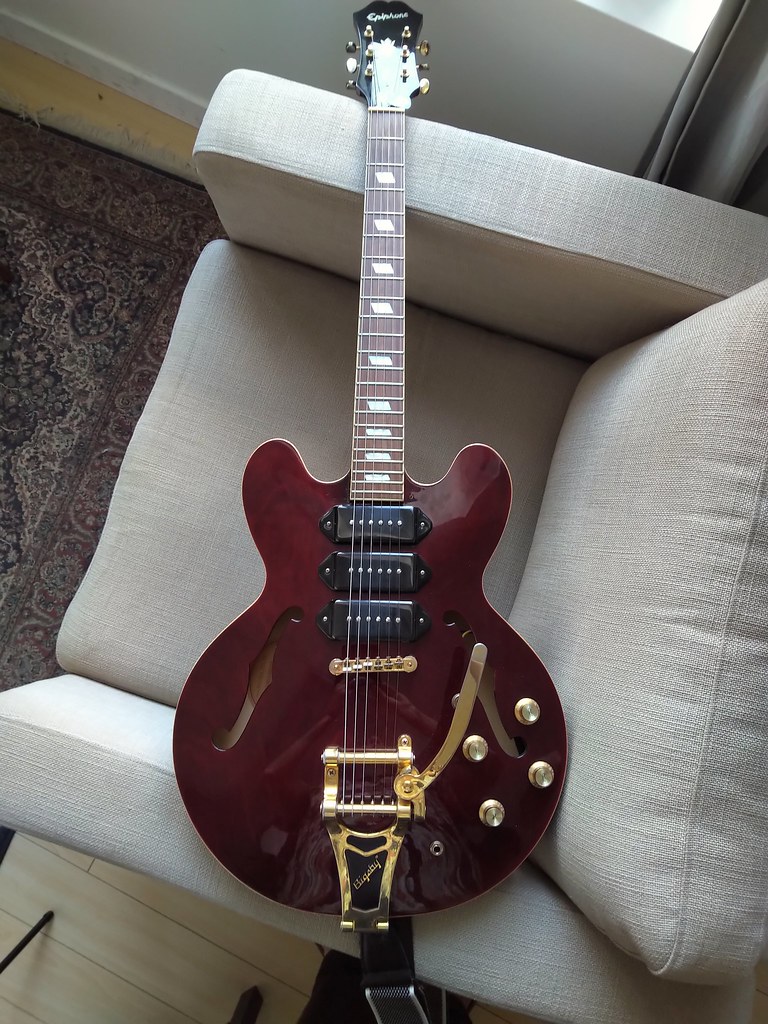
But I wanted more. I was inspired to the degree that I wanted to explore what I saw beyond listenership. And so I did my research, and after a couple of weeks, I located a guitar teacher. And after a lesson or two, I ended up locating a semi-hollowbody guitar — an Epiphone Riviera Custom P-93 (pictured) that someone was selling because they weren’t finding use for it.

An Epiphone Riviera Custom P-93

I play drums and can do adequate keyboards, but I’ve never (ever) wanted to learn to play guitar (just magically “play” it? Sure, but not actually learn the thing), despite the fact that some of the greatest influences on me are from guitar-driven music. Learning guitar is a strange yet rewarding process of teaching the increasingly calloused finger tips of my left hand to traverse the frets and coordinate themselves, touching the strings at first hesitantly, then, with practice, confidently. Oh, and then there are the pickups, the tuning, the tremolo bar. I’m not doing this because I want to start a band or play on stage, but rather because I’m drawn to this process, and a relationship that I am building with the instrument.

What am I learning? Mostly surf and rockabilly, for the time being.

Here’s more SRT:

Share

Memphis

Let me start with a question people ask me when I tell them I spent a weekend getaway in Memphis: “So, why Memphis?”

I needed to get away. The “staycation” I took in April was basically a cold, miserable rainout. I decided it was going to be either Nashville or Memphis, because I hadn’t been to either city and I needed to be somewhere where there would be good music, hot sun, and Southern vibes. I’ve been boycotting the US since #45 took office (in case you feel this is an idle threat considering I live in Toronto, I have close family in Texas) but I seriously needed to get the fuck out of Canada and Europe was too expensive and logistically unfeasible for a weekend getaway.

I did my research and was swayed by three things: downtown Memphis was quoted as being very walkable (which meant that I didn’t need to rent a car if I wanted to get around), Memphis has blues whereas Nashville has country (no disrespect to the latter, but I lean heavily towards the former), and, in the words of someone on Reddit, “Frank Black never wrote about Nashville.”

Done deal.

There’s something about grabbing a travel bag and going somewhere alone, whether it be a country or city you haven’t been, and all you have to go on is some preliminary research and intuition. I wanted the three Bs: blues, booze, and BBQ. As long as I could secure those things, the rest would sort itself out. I prefer to immerse myself and come to my own conclusions.

This is the point where I should get something out of the way: you can’t talk about Memphis without talking about race. The city’s composition is over 60% Black. When I skimmed some forum posts about where to go and how to get around Memphis, I would come across terms like “rough areas” and “locals” (as in, don’t take public transit because only locals do that). While not explicit those terms can very easily be cover-talk for Black, as in “Black neighbourhoods” (rough areas) and “Black people” (locals). This is the place where Martin Luther King Jr. was assassinated while intervening in a sanitation workers’ strike.

You can go to Memphis and pretend that Elvis didn’t exist (seriously, there are few signs, literal or figurative, of the other King outside of Graceland). But you can’t go to Memphis and pretend that Martin Luther King Jr. didn’t. Getting back to my 3Bs ethos, the first thing I did when I walked out of the airport was direct a taxi driver to a BBQ place downtown. As I got out of the cab and looked around me (this is in a former warehouse and light industrial district which has gentrified over the last 5 years), I looked across the street and saw the Lorraine Motel.

Exterior of the Lorraine Motel, Memphis TN

This is both the home of the Civil Rights Museum and, more significantly, the place where MLK was fatally shot on the second floor balcony. Now, I knew the Museum was downtown, however, when your only point of reference is Google Maps I didn’t realize it was also smack dab, right across from a popular BBQ joint. And so, I proceeded to eat a beef brisket sandwich (which was divine, btw) while staring at a very sobering national monument. Continue reading “Memphis”

Share

Book Review: The Jazz of Physics, by Stephon Alexander

A publishing colleague posted this book’s cover on Twitter and I was immediately interested. If you know me or know my work, then the subjects of jazz and physics (particularly quantum physics) are both dear to me. To my surprise, I was subsequently sent a copy of Stephon Alexander’s The Jazz of Physics in the mail…which I then proceeded to neglect for over a year.

Why? Well, for one, I had a backlog of books I’d earmarked for reading and I was also finishing off the manuscript for my next novel. However, if I were to be perfectly honest, it was partly out of fear. Aside from the loose premise, I didn’t know Alexander as an author and I didn’t know what the thrust of the book and, perhaps most importantly, its tone would be like.book cover of The Jazz of Physics I was afraid it would be a beginner’s guide to physics using jazz as a loose, entertaining metaphor that ultimately ends up lacking specificity about either jazz or physics.

I could not have been more wrong. It’s the opposite. The Jazz of Physics is written by someone who is as serious and seriously accomplished a physicist (currently a professor at Brown University) as he is a dedicated and well-studied jazz musician. Rather than a figurative metaphor, Alexander uses jazz as a profound analogy for the very workings of our universe. He’s not using it to disingenuously sell physics. Growing up in the Bronx surrounded by musical influences (a story about the Five Percenter Nation is fascinating) as well as having a natural intuition for understanding the principles of science, The Jazz of Physics is a fascinating biographical narrative and nothing short of a passion project, an attempt to argue in the deadly-serious terms of cutting edge quantum theory that the relationship between music — specifically jazz, in how it centres on improvisation — and the formation of the universe is less figurative than literal.

Tall order? Yes.

First, let me stress how difficult a task it is for someone such as Alexander to pull this off. I have read well-argued books by esteemed physicists that ended up self-sabotaging themselves because they lost track of who their audience is — something I am inclined to believe is the chief challenge of any such endeavour. As an author writing for a general audience, the deeper you go into the macro and micro of physics (corresponding respectively to relativity and quantum theory), the harder it is to keep the reader’s attention. Alexander works hard, imaginatively and creatively, to find analogies to help the reader along — the use of analogies themselves are the cornerstone for him:

Next to mathematics, I learned that one of the most powerful tools involved with unraveling the secrets in the theoretical sciences is simplifying the system at hand and borrowing an analogy from what might, at first glance, be a completely unrelated discipline. It is in the limits of these analogies, where there exists a need for further research, that an avenue for discover lies.

Along his path, we are introduced to both eminent physicists — not just the usual suspects such as Einstein, Dirac, and Schrödinger, but contemporaries such as Lee Smolin, Faye Dowker, and Bill Unruh — and their musical equivalents: John Coltrane, Ornette Coleman, and MC Rakim. Yes, I wish there were more women represented in this book, but I’m not going to put that on Alexander because he’s drawing from direct experience.

What leaps off the pages of The Jazz of Physics is Alexander’s passion for both disciplines, and he goes to pains in order to lure the reader — the question of which, jazz fans or amateur physicists, are more likely to be interested is a question I will come back to — into the complexities of these distinct yet related worlds and his unfolding thesis — that, ultimately, the stuff of our current universe may very well have been formed via sound. A stumbling block for some readers might be the extent to which they are either a) versed in these subjects, and b) prepared (if not) to travel the highly sophisticated, often mathematically structured path Alexander is, by his own decision, obligated to illustrate. There might also be those who question the extent to which the term “music” is construed from what is ultimately sound. This latter concern is remarkably well handled by the author who ultimately provides a convincing argument.

With respect to the mathematics and formulae included in the book, there are two sides to look at this from. Alexander is careful in the beginning to encourage the casual reader to accept the parts that are over their head and keep following the tune, as it were. I am by no means adept at math, my interest in quantum physics being more conceptual than anything else. While I was able to proceed past sections where the author felt it necessary to draw the more mathematically-minded kids in the room closer without losing a beat, I have to admit that three-quarters in I began to get lost in the minutiae of quantum theory itself. Want to know what a brane is? Inflaton fields? Anyone? No? After a while, neither did I, and this is where I began to ask myself — as someone who felt that this book was written for me — how many other readers with a general-to-specific interest are going to find themselves skipping numerous paragraphs (if not the better parts of chapters) because of the growing complexity of these quantum building blocks that Alexander discovers in his journey. I can’t fault him because these are the very things that were stumping him so why should we be able to swallow it in one gulp? It has led me to ask myself how well this book sold, seeing as it might be too science-y for jazz fans, and the language of jazz itself can be a figurative mess for anyone who’s never needed to decipher a symmetric diminished scale.

This is a science book that draws its inspiration from a deep and abiding love of jazz (and music as a whole). Anyone expecting to understand music in the same way that Alexander attempts to illustrate his passion for physics might find themselves disappointed, although, to the author’s credit, his passion for both is infectious.

Lastly, there is something very significant in this book about mentorship. Alexander’s journey of discovery is also one of, to use a phrase from Sir Isaac Newton, standing on the shoulders of giants. Science, like jazz, is inherently collaborative — the thing is, not anyone off the street is going to be given room for a solo on the stage. You have to have chops, and I appreciate how the author comes back to this bargain one makes, that if you want to learn and grow with the more experienced colleagues in your field you have to first demonstrate your aptitude and willingness to learn.

The Jazz of Physics (ISBN: 978-0465034994) is available at an independent bookstore near you. Curiously, I wonder what it’s like as an audiobook?

Share

Ambient

I don’t know how or when I got into ambient music. I can tell you there have been a few seminal contributors: classical music, movie soundtracks, minimalist and so-called world music composers, and the more spacious actors in pop/rock music.

Let’s start with a sort-of definition of ambient music, and I will begin by saying that I have no formal education in this realm. Ambient music is typically experimental and tends toward spaciousness and a lack of traditional (Western) song structure; it has its roots in the likes of 20th century composers such as John Cage, as well, during its development, contributions from traditional music from India and Japan, as well as from jazz. It can be a formless and electronic haze, or it could be all about exacting pattern and repetition using traditional instrumentation. There is also often a sense of the tactile. I will include some examples toward the end of this piece to begin to provide some context. At the end of the day, what is and isn’t strictly termed “ambient” is often more a question of the composer’s intent. You will just as likely see genre labels such as “minimalist,” “drone,” and “experimental” instead, as the term “ambient” can be a sort of kludge.

As a primary influence on me, classical music is a no-brainer, and like a lot of kids who grew up at the time I did, we were treated (or as I like to say, inculcated) to classical music through Bugs Bunny and Disney cartoons. As an adult I love the flourish and bombast of Shostakovich and Borodin, and the aching lyricism of Vivaldi and Bach. However, there is something undeniably mesmerizing about a brief section of Act II of Wagner’s opera Siegfried, where, through gorgeous use of instrumentation and dynamics we are surrounded by the quiet stirrings of nature — it surrounds the listener and one has no choice but to surrender to its formlessness. This formlessness is not something we often associate with something so strictly structured as classical* music.

the cover of Twine, an album by Taylor Deupree and Marcus Fischer. This image shows 1/4" audio tape loops hanging from the top of the frame.

As a movie buff, it makes perfect sense, given my exposure to classical music as a child, that movie soundtracks would inspire my appreciation of ambient music. Even in an epic space opera such as The Emperor Strikes Back there are many moments — particularly the suspenseful, quiet bits — where John Williams draws from classical roots, but of course, in order to create mood and retain timbre, sections end up as long stretches of almost abstract-sounding composition. Another perfect example would be the use of György Ligeti’s Lux Aeterna in Stanley Kubrick’s 2001: A Space Odyssey during the monolith scenes. Funny how sci-fi tends toward this direction.

A movie and a soundtrack that shook my foundations as a teenager was Godfrey Reggio’s Koyaanisqatsi. While the imagery was both disturbing and inventive, it was my introduction to Philip Glass’ minimalist composition that entranced me. Its mantric dedication to repetition using an orchestral ensemble and use of church organ and choir during its more climactic parts was catnip to this kid. When, a year or so later after seeing this, I discovered that Glass had collaborated on an album with Ravi Shankar (1990’s Passages) I couldn’t resist picking up a copy at a classical/jazz record shop near where I worked as a photolab technician. It was love at first listen; while some might’ve thought that the two were at odds with each other — one an avant-garde composer, the other an Indian classicist — their collaboration (each took turns orchestrating the other’s compositions) was a major influence on me.

To save space here, I will briefly name three other significant musical influences: David Sylvian, Talk Talk, and Miles Davis. Sylvian’s Japan reunion of-sorts, Rain Tree Crow, only put out one album but it was a low-key combination of rock/jazz/experimental soundscapes with African rhythms that has had a lasting influence on how I decided to listen to music. Talk Talk’s last two albums — Spirit of Eden and Laughing Stock — are rightly hailed as experimental masterpieces of pop-meets-improv jazz however a single song deserves mention, from their comparatively more formal pop album The Colour of Spring: April 5th. You can see where they were going with only that one song (and the album is wonderful as it is). Lastly, discovering Miles Davis’ album In A Silent Way was another key piece in my ad hoc self-education: the tactile nature of the instrumentation has been hugely influential on composers of all genres since then (and you can hear a motif from this album used on Taylor Deupree and Marcus Fischer’s Twine).

Over the last seven or more years, I’ve become deeply involved with ambient/experimental works by composers such as Stephan Mathieu (who not only composes but masters others’ work at his studio) , Deupree (who established the influential ambient label 12K), and France Jobin, as well as those, like Ryuichi Sakamoto and Christian Fennesz, who dip in and out of the ambient genre.

In an age where we are bombarded with divisive and interruptive dialogs encouraging us to be outraged at every turn (not to mention the very real aspects of society that are worth our outrage, if only we had the time and energy to devote to them while being able to support ourselves financially), experimental ambient music allows me — on a good day — to reset my thoughts and tune into a more free-form sonic world. Ambient is not pablum. Ambient is not “new age music.” If anything ambient has been about transcending the boundaries of “instrument” and “technology”, something all genres of music have attempted at one time or another; hip-hop does this particularly well.

Here are some examples that have been influential for me:

Radioland, by Stephan Mathieu: https://schwebung.bandcamp.com/album/radioland-2

Perpetual, by Ruyuichi Sakamoto / Illuha / Taylor Deupree: https://12kmusic.bandcamp.com/album/perpetual

Duo, by France Jobin + Richard Chartier: https://matterlabel.bandcamp.com/album/duo

~~~, anna roxanne: https://anaroxanne.bandcamp.com/album/-

Arrow, by Richard Youngs: https://preservedsound.bandcamp.com/album/arrow

Tracing Back The Radiance, by Jefre Cantu-Ledesma: https://jefrecantu-ledesma.bandcamp.com/album/tracing-back-the-radiance

Allister Thompson hosted a blog, Make Your Own Taste, that contains a lot of ambient artists and contextual information on the genre. You would do well to visit if this is your thing.

*note: I use the term “classical” generically; technically I prefer the Baroque and Romantic periods best, truth be told.

Share

Content Discontent

I think I’ve had my fill of TV (streaming or otherwise) and mainstream films.

The first problem is mine, and is one of saturation. I worked in film and TV post-production for 20 years, watching everything from 15-second TV commercials to multi-part TV series, to box office-busting films. And part of working in film and TV is keeping up your fluency so that you can communicate effectively with each other (if a director makes a reference to Picnic at Hanging Rock you better be ready to watch it if you haven’t seen it already). Also, I’ve watched hundreds of films and countless TV shows over the course of my life — the seminal and forgettable, the laughable and the revelatory.

I’ve pretty much seen every storyline at least once. I’ve seen every twist and turn, every “surprise ending.” I’ve seen every plot device, every sort of villain, every sort of (male) anti-hero, every sort of Disneyesque sentimentality and every sort of nihilist purging of the arthouse soul. It’s hard for me to be taken in by a show or movie — either to suspend my disbelief or my anticipation of what the creators are going to do.

The second problem is out of my hands. In this age of streaming services, we are awash with content. Netflix, Amazon Prime, Crave, etc. all require things to put on their virtual shelves so that we can be enticed to part with our money in order to explore their goods. I have no problem with this business model — it’s basically turned into (back to?) cable TV. The problem is one of quality. It seems that, in the effort to fill the shelves  seasons are lengthened with filler and show renewals are rubber-stamped that end up being samizdat versions of the preceding season. Multiplexes are filled with the faddish (and profitable) notion that (see: Marvel) everything can be part of a franchise. If I hear another producer say “We originally imagined this as a trilogy/series in four-parts” I’m going to scream.

What bugs the shit out of me is how this affects what’s presented as upper tier programming. A good example is Good Omens, the heralded adaptation of Neil Gaiman & Terry Pratchett’s collaboration. I haven’t read the original book — I have a notion that it’s written in a larger-than-life, Douglas Adams-y style — but the show is painful to watch. It wants to be sly and slick satire and it has strong early moments, but it’s all so buffoonishly overplayed — the actors who aren’t line-reading chew their way through the scenery — to the degree where I had to wonder whether the producers might’ve considered making it for children. The worst is that for a six-part series there’s barely enough story to take up three. I lost count of how many time-sucking flashbacks and side-stories are introduced in order to lead to the telegraphed, overdue finale. Speaking of Gaiman, adaptations, and overdue finales, please see the meandering second season of American Gods (which I abandoned).

For the record, I don’t have a problem with the Marvel Universe franchise. They’re not hiding anything: it’s a stream of big-ass popcorn epics. They aren’t being released as exemplars of anything other than “hey, here’s a well-executed adaptation of a comic book most people haven’t read.” Sure, given the choice I’d rather watch an imperfect  Olivier Assayas film over Ant Man, but at least I can watch the latter and know where to keep my expectations dialled.

While I’m bleating, a trend I wish would die, pardon the pun, are films where it’s obvious the protagonist won’t get a scratch despite killing 100 hired assassins (see the three John Wick films, The Equalizer, and Colombiana). Where’s the suspense if you don’t allow the audience to imagine that, no, the protagonist might not make it. This is an inherent problem with films and TV shows that are made in the hope of infinite reboots: no suspense (see: Orphan Black, a prime example of where the producers missed multiple opportunities to draw more attention by killing off one of the clones).

Why can’t we make something, leave it be to stand on its own merits, and move on without exploiting its success with sequels and prequels and remakes and reboots? As good as the original was (and it is), who in god’s name, save for the cast and crew, asked for a second season of Big Little Lies? What part of that story begged for extended development? Note: Liane Moriarty, the author (whom I share a birthday with) whose novel was adapted into the show never wrote a sequel until the HBO adaptation achieved success (she ended up writing a novella by request, not exactly the way any author would like to work, let alone revisit characters, though I don’t blame her).

Anyhow, I sometimes wonder, in the industry’s effort to satisfy its appetite for content, whether we are sacrificing the magic of our relationship with entertainment for the sake of Say’s Law, the (questionable) belief that supply creates its own demand.

Share

Book Review: Casting Light on the Dark Side of Brain Imaging

Whenever a mental health authority is interviewed in the media it’s nearly inevitable that this person is a medical doctor, usually a psychiatrist. This individual typically isn’t a practicing therapist; they may only be able to speak of clinical diagnoses and/or the prescription of psychopharmaceuticals. I mention this because when this authoritative psychiatrist is interviewed in the media I end up listening to a depiction of the massively complex human interrelational landscape I see around me every day, as both a writer and psychotherapist, reduced to a chemical imbalance in someone’s brain. It’s like ascribing a boxer’s loss of a title match solely to the width of their biceps.

book coverThe gold standard for looking at mental health is through what’s called a biopsychosocial lens, a flexible model that allows professionals to consider the biomedical (for example, thyroid issues, dementia), the psychological (traumatic experiences, abusive relationships), and socio-economic factors (unemployment, impoverished environment) that might be at play in the mental health profile of any given individual, even if it ends up a combination of one or more parts. In North America there is unfortunately a sacred primacy around the biomedical approach to mental health, with the psychological and socio-economic as (at best) secondary considerations at the table of funding and education. At this moment there are medical doctors losing sleep wondering how to beat the shame of knowing there is a patient in their care whose condition might be psychogenic (meaning, whose pathology is not, strictly speaking, a biomedical end product). Continue reading “Book Review: Casting Light on the Dark Side of Brain Imaging”

Share

Revival

As mentioned in this blog’s archives, not only was my uncle Mike the victim of a fatal interrupted burglary in April of 1979 (Austin TX), but I had the absurd experience of watching this played out on television in 2007 when the producers of America’s Most Wanted chose my uncle’s cold case to spotlight.

For a while there were people getting in touch with me, most whom had benevolent intentions: tips, recollections, perspectives on my uncle’s murder and the cultural scene of the time. I’ve also had a couple of troglodytes holding “vital” information over my head in the hope that somehow I would allow them the glory of solving this case.

Very recently, however, perhaps because the 40th anniversary came and went, I’ve been receiving a new stream of emails from people who have known Mike. And as much as I appreciate it, I have to admit that I don’t know what to do with it. I’m not talking about tips or any bits of info that would solve the case. I’m talking about personal memories of Mike the human being.

It’s draining.

I’m a psychotherapist. I stickhandle a lot of deeply personal information on a daily basis, but at the end of a session (barring a particularly resonant narrative) I’m not processing the information. It stays in the session. These days, when I receive an email recounting a lot of personal information about a relative I never had the chance to meet, who died tragically, and whose case will probably never be brought to justice, I find myself left…well, numb. I have a natural respect for those who wish to share their thoughts and feelings about my uncle, but I don’t know what to do with it. I can only imagine what it’s like for families whose tragedies are caught in the public eye who receive torrents of public well-wishing. It’s heart-warming and overwhelming, then after a while you begin to feel like a cipher for others’ projected feelings.

Anyhow, just giving y’all a little taste of the glory that is having a dead relative on TV.

Share

Community

I’d almost given up on pick up soccer.

In Toronto, if you’re looking to play soccer on a semi-regular basis you’d have better luck finding an Ayahuasca ceremony than a game that starts before 9pm an hour away from you. I suppose credit is due to the fact that soccer is popular (this wasn’t always the case, and there was a humiliating period of time in the late 90s where more people were playing “Ultimate” frisbee than soccer). However, finding people to play with casually — the sort of pick up game I played when I first moved to the city — has gone by the wayside in lieu of organizations such as Toronto Sport and Social Club and apps such as OpenSports.

I ran a co-ed pick up game for several years. This was after several previous migratory years of word-of-mouth and occasionally stable runs with a group of friends and acquaintances at locations across the city (note: if you want to discover a city, this is a very good way). Back then there was no leader per se, however, as good as that sounds I feel that either this part, or someone electing themself as the certifiably wrong leader, led to the instability. The pick up game I ran was fairly stable: Sundays in Stanley Park. Sometimes we were hungover, sometimes we treated it with the reverence of Mass. I met some very interesting people over those years, from a variety of backgrounds, and I’m pretty sure that, beyond fresh air and exercise, it was these relationships that contributed to helping me find myself. A secure base, as we say in the therapy biz.

These things don’t last long. They just don’t. Whether it’s a writers’ group (which I co-ran for 9yrs) or pick up soccer, sometimes things just don’t work in the long-run. Democracy kinda sucks when it’s on the level of things like this: people don’t show without giving notice, or want to change the start time to suit their own needs. In a fictional country, as well as mandatory military service, there should also be the option of organizing a regular pick up sports game (as well as the option of working in a retail environment during the Christmas season, particularly in the Holt Renfrew concourse).

For the last 10 years, for better or worse, I’ve been involved with associations like TSSC in order to get my soccer fix — organizing things sucks, and why not pay for the privilege of walking onto a semi-pro pitch if you can, and not the community fields pockmarked with holes and strewn with tree branches and dog shit, using gym bags as goal posts. But I kinda lost my religion around these organized games over time. They were inconveniently scheduled (I can go into great detail about what it’s like to play soccer at 11pm on a Sunday) and if you weren’t able to put together a hand-selected team to register then you were individually thrown into a randomized team, which was basically admitting you weren’t going to win many games due to lack of familiarity with each other (that is, if you got along). I hated forgetting — because life — about each sign-up deadline only to discover that it was booked solid, then putting myself on a sub list.

One day, a bartender who is also a reader of mine, commented on my Ajax scarf (this was versus Juventus in the Champions League quarter finals, first round). We spoke a bit about playing pick up, and he mentioned that there was a bunch of people that met @ 3pm on Sundays at ________ Park. I didn’t know what to expect, and yet I secretly hoped it could work out. What with my partner on an extended trip across the Atlantic, I found myself available, and along came the first Sunday, and it was warm and sunny…so I went, secretly hoping magic would happen.

I had to stick my neck out. It looked like a bunch of older men at first, and I wondered if I’d intruded into a more private event, but as people showed up I could see this was a regular thing that had been going on for years, that travelled on word-of-mouth only. The range of ages went from 20-something to 50-something. Unlike a lot of pick up I played when I moved to Toronto there was no prima donna behaviour, although there were comically long periods where the older Latinx organizers argued over the size of the field-of-play and other distractions. On the sideline was a group of “fans,” friends of the older players, who brought beer and cheered any runs at goal. My Spanish has grown, let’s put it that way.

It was disorganized and basic, and I loved it. I instantly appreciated the casual nature of the group, their insistence that I bring people with me next time, the beer that one of the players handed me afterward. Everyone was there to have a good time, and there was to be a BBQ afterward (which I was unable to stay for). I can’t put it much more plainly, but this is the Toronto I adore. These are my people.

Share

The “patchwork”

Note: this was originally a letter to the editor at The Globe & Mail, which in turn was published April 26th. It was in response to two articles posted in the G&M, the first a featured essay by Norman Doidge MD, a psychiatrist and psychoanalyst, and the second an op-ed by Ari Zaretsky, chief of the department of psychiatry at Sunnybrook Health Sciences Centre. Each of these were responding to cuts by the province of Ontario to the provision of psychotherapy. I have expanded upon my original letter, which was edited for publication.

Every few months I’m asked by someone seeking information on the process of finding a psychotherapist to describe what the landscape and rules are. The word “patchwork” is the first to come up in my attempt at an answer, what with it being a maze of publicly funded dead ends and privately available add-ons. But to call the mental health system in Canada a “patchwork” is to insult quilt-making. One only needs to scan the pieces by Norman Doidge and most recently Ari Zaretsky to discover how confusing this might be for the average person seeking support.

If this average person exists let’s attempt to make sense of the road ahead from their angle: a day devoted to research will show there are psychiatrists and psychologists, who, as it turns out, may or may not have extensive training in psychotherapy. Then you have psychotherapists, whose profession may or may not be regulated depending upon the province you live in. Assuming our average person isn’t privately wealthy we must then ask: which profession — psychiatrist, psychologist, psychotherapist, social worker — is covered by what public or private health plan, and for whom is this available? Imagine being in the midst of a panic attack then trying to find support when you most need it only to discover that, to use Ontario as an example, despite being the only profession covered by OHIP, more and more psychiatrists are less and less interested in delivering psychotherapy versus managing prescriptions where, coincidentally, they can see more clients in a day and make a larger income. Meanwhile social workers enjoy vastly more private health benefits coverage than do psychotherapists.

Both Doidge’s and Zaretsky’s pieces are coming from a perspective that seems to make things more about the therapist, justifying their modal belief system or cost benefit analysis over the basic needs of those who are not privately insured. They rightly hail the benefits and importance of psychotherapy, but in their own ways go on to mount a self-interested defence of their turf: psychodynamic vs cognitive delivery methods. This battle over which therapeutic approach is more quantitatively or qualitatively effective than the other reeks of the privilege of those who have probably never been in long-term individual therapy themself.

The cart before the horse is that there is too little public access to trained professionals — particularly those who don’t have the MD designation of psychiatrists or the PhD of a clinical psychologist, but nonetheless have specialized training in psychotherapy — while we are in the midst of a steadily growing demand, with grave consequences for some who aren’t able gain access to professional assistance. Let individuals decide on the right approach for them. To qualify for the College of Registered Therapists of Ontario (CRPO) I cannot practice psychotherapy in this province without qualifying for membership, which means being a graduate of (or currently in training with) one of the approved training institutes registered with the college. Given this thorough certification process why should we then disregard the diverse modalities the CRPO explicitly acknowledges and pretend that this can be boiled down to a binary choice between a conservative interpretation of psychoanalysis or the limitations of CBT? In my experience as both a therapist and someone who has been in long-term personal therapy as part of my training program’s ethos — an ethos I feel should be obligatory for anyone training to be a psychotherapist — therapy works best when the “fit” is good, not about which style is supposedly better than the other.

The most important point — and one lost in both Doidge’s or Zaretsky’s articles — is the primacy of allowing Canadians the ability to gain access to psychotherapy in the first place.

[I would also recommend reading Heather Weir’s contribution to the G&M letters to the editor]


Share

Pain, pt. 3

So, according to the chiropractor I was referred to, I have an irritated disc [“subacute grade III mechanical low back (irritation of the L5/S1 disc, affecting the L5 nerve root on the left”)]. It’s nice having an answer. It’s also nice to hear that, contrary to what my impatience tells me, I’m doing very well (though I’d leave out the “…for your age” part, ahem). Basically, she said to keep doing what I’m doing and give it time.

The pulled Achilles is slowly healing. Ironically, though it didn’t stop me from running that 8K race, it does prevent me from doing my baguazhang forms due to the crouching stance required.

In the meantime, the weather is warming up, my winter coat is spending most of its time unused.

Again: give it time.

Share