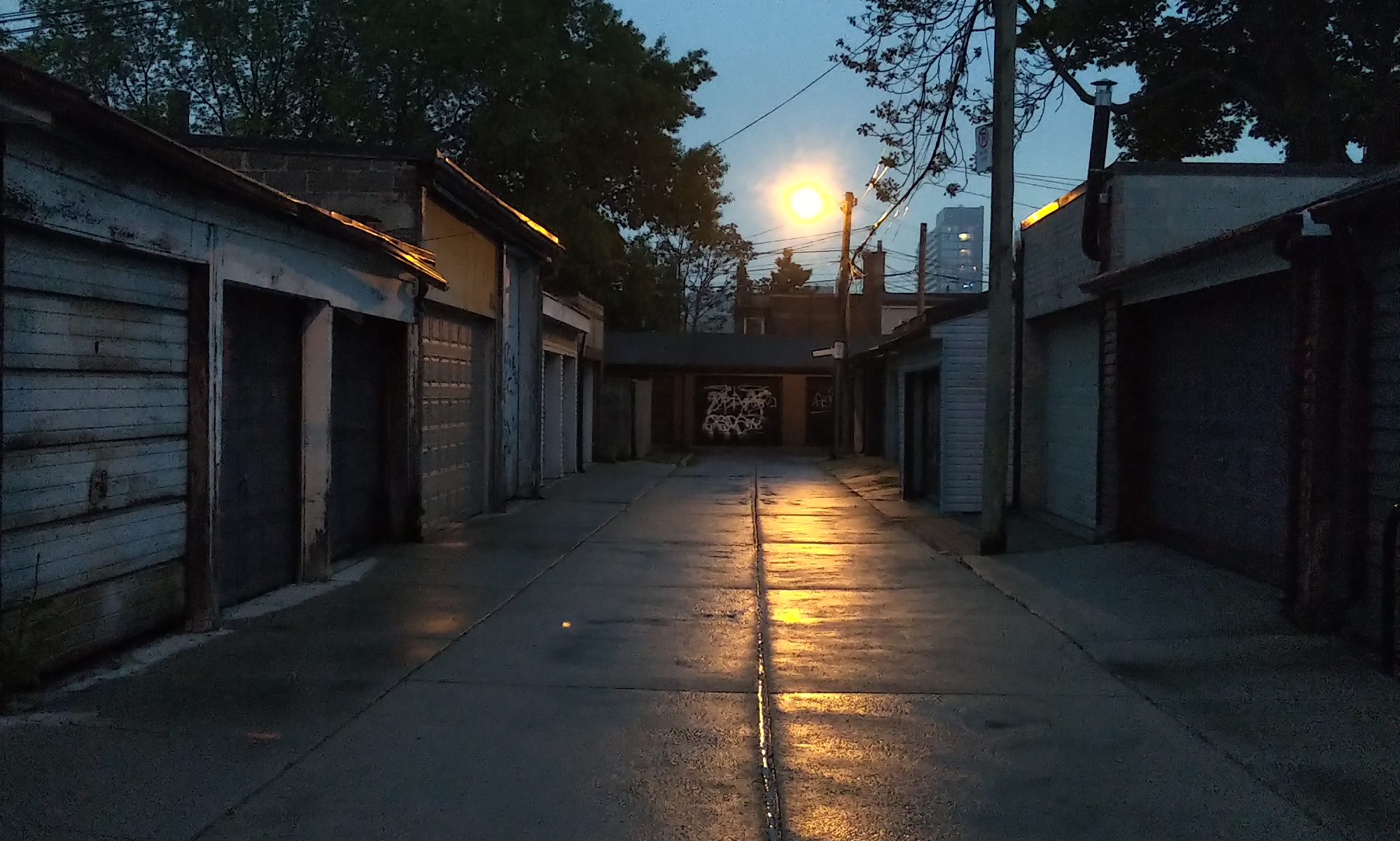
The Dark Side

I was flipping through the NYT last Sunday and came across a short collection of riffs from filmmakers about their favourite “Holiday Movies”. The following, submitted by screenwriter David Benioff, was regarding Planes Trains and Automobiles by the late John Hughes:

Hughes once wrote: “I understood that the dark side of my middle-class, middle-American suburban life was not drugs, paganism or perversion. It was disappointment. There were no gnawing insects beneath the grass. Only dirt. I also knew that trapped inside every defeat is a small victory, and inside that small victory is the Great Defeat.”


I immediately caught the reference Benioff (via Hughes) was making and it struck a chord. You see, when we (in filmic terms) discuss the “dark side” of the middle-class in America, who else is this synonymous with? Correct: David Lynch. And was it not Lynch’s seminal dark-side-of-middle-class-America, Blue Velvet, which features – literally – gnawing insects beneath the grass at the beginning? Oh, and the drugs and sexual perversion? Still don’t believe me? Try this: Blue Velvet came out in ’86. Planes Trains and Automobiles? That was 1987.

When I read Hughes’ quote, I knew he had more to say about it. I could tell that he thought Hughes’ film (and perspective on America) got short shrift.

In any case, what I’m saying is Hughes was picking on Lynch, perhaps more so picking on all of the cineastes and self-styled torch holders of American Surrealism. Look, he’s saying (or I’m paraphrasing), why does any intelligent discussion of the “dark side” have to fast-forward to the DevilWhy are we in such a rush to point to the murkiest common denominator?

I think Hughes’ perspective is more realistic. Perhaps even more frightening because it is anything but abstract. If there’s anything which immobilizes the positivism of American  can-do – an adult Boogeyman if you will – it is the spectre of defeat. It is, after all, failure. There is nothing which cuts to the heart of our civilized fears with more power than failure, pure and simple. We do not want it infecting us. We do not want it living beside us, dying slowly.

I like the drama (nee opera) of Lynch’s perspective. But it is only that: one perspective. I feel we cheat ourselves by claiming that one perspective as definitive before we’ve truly allowed ourselves to look at the whole landscape of the human psyche.

I also think John Hughes had a good soul.

Share

quote

“Celebrities are not superlatives in our field of expertise. If celebrities that are schnoring in on our field started out trying to do what we do and were held to the standards we started out upholding, a great many of them would’ve never made it.”

Billy West, voice actor (“Futurama”) on the use
of celebrity voice work in animated films.

Share

Hello, It’s Me

Hi there,

First: everything’s fine with me (and I define fine as being “things are going well, no dramas, no chronic issues for me to be concerned with”).

I realized that the previous blog post – written/posted in a vague cyber-scrawl – could be misconstrued. All is well in Cahillland. In fact, things are going well enough that I have very few opportunities to blog.

I wanted to express what I considered to be rumbles (predictions) of change around me.

A diner I went to on the east end (near work) that I hadn’t been to in about a month, where the same waitress asked me the same question she (and the owner) asked a month ago: how’s the new house? I wanted to pick up my plate and whip it across the vintage 50s decor’d aisle, preferably smashing violently against a wall. The new house? I wanted to respond. I’ve been there – every single day – for the past three months! I imagined yelling. I’ve seen its insides, I know what it is, I’m intimate with it. It is many things, but – in the name of the Lord Baby Jesus – it’s not new! I imagined saying, holding my arms out dramatically, waiting for the curtain to close and for the audience to clap.

I didn’t say that. I hunched my shoulders and said: it’s good. Thanks.

At work I felt I had been snappy, officious.

Later I dropped by a sometimes getaway, an Irish pub downtown I know. I sat there with a Guinness and the bartender, a lovely person, said: “You okay? You don’t seem yourself today.”. I was tired. Tired of non-stop work, frustrated that I was frustrated with the waitresses’ question from lunch, my crankiness on the job, and now – apparently – the answer to the question that I didn’t know how to ask was written on my face for her to see: You okay? You don’t seem yourself today.

I’m fine, I said. All’s good. It’s just this (I thought): when it seems that I am triangulated by revelations of change (which I interpret the above to be) or change-which-needs-t0-be-made, I cannot help but ask whether this is a fin de siècle in some way, or whether I’m just looking for fatalistic icons. Stressed and desperate for more drama?

And this: it’s hard to be eloquent with a cellphone, so I appreciate the responses of those who were concerned with the content of my previous post.

All is good, if not necessarily crystal clear.

(One of the problems of being busy is not only not enough time to write, but also not enough time to revise for clarity.)

Share

Mobile: Not Myself

If I am not myself at work.

If I am not myself at the diner @ lunch.

If I am not myself at the bar.

Who am I, if not different? And when, in retrospect, did this revolt happen? And will there be a ransom posted, or will the old me be shot or brainwashed?

All I ask is that I live honestly, if not with clear intents. Or answers.

[Sent via BlackBerry]

Share

Mobile: quote

“He blamed himself for not realizing that the area of leprosy was also the area of this other sickness. He had expected doctors and nurses: he had forgotten that he would find priests and nuns.”

– Graham Greene, “A Burnt-Out Case”

[Sent via BlackBerry]

Share