Moronity

One sometimes discovers that a word like “moronity” exists, not because your gifted intuition plucked it from the ether and nimbly inserted it into a witty essay, but rather because you felt compelled to use it, whether or not it existed, to describe your actions within the context of a bloody stupid mistake you made.


Share

Connectedness, Social Media, and Syntheticism

If there’s something to be said about going on a vacation – whether that means renting a car and driving two hours away from your town, or buying a plane ticket and flying six hours away from your country – it’s that it provides something crucial: distance. Physical (and, one should hope, subsequently mental) distance.

When I go away I take that idea of “distance” seriously. I don’t check Facebook, I don’t check Twitter. I don’t even check voicemail (unless it looks important). My only transgression is occasionally checking newspaper headlines to make sure that the world isn’t on the brink of collapse (which it often seems to be).

Upon returning, I find myself staring at my computer (or, more often, my BlackBerry) and wondering: what’s the point? Sure, I’ll go back to checking email, scheduling things, occasionally making sure the world isn’t on the brink of collapse, but re-entering the world of social media is another question. A daunting one, to be honest. I respect social media, yet, against its purpose, I often find it paradoxically alienating.

It started with Facebook, which began as a unique way to stay in touch with friends without relying upon email – a communal sandbox with multimedia extensions. With time (and popularity) came the inevitable mediocrity of a lot of people (along with the watering-down of “friend”-ship) without a lot of ideas posting a lot of crap that I found myself more often than not skipping. Continue reading “Connectedness, Social Media, and Syntheticism”

Share

My Psychotherapy Blog

As some of you (now more of you) know, I recently began a practice as a psychotherapist. I have a website, which gets a fair bit of traffic (allowing that summer is a traditionally slow time of the year), but recently I added an adjunctive blog.

The purpose was to get more of me out there, rather than have people rely on their preconceptions of what a psychotherapist is/does just by staring at my business card. I figured it would help both me and potential clients (including curious onlookers) deal up-front with questions that often go unasked yet which people would like answered.

For example: Do I need to know what’s wrong with me in order to see a therapist? Will I lose my creativity if I see one?

These are some of the things people ask, sometimes in passing, sometimes directly to me. I was inspired to address them, if only so that I could clarify the process of therapy.

That said, it’s a challenge. Unlike this space where I can tear away at preconceptions without concern for who I may be offending, I have to alter the timbre of my voice when blogging for the benefit of those who may be potential clients – it’s not always cut and dry. I ran into this recently with a post I wrote about men and how men tend to have preconceptions about psychotherapy (and how some of this may have to do with the language/imagery predominant in the latest barrage of public service announcements). My partner brought to my attention that what I’d wrote (and published) was in fact meant for this blog, not the one I originally thought it was intended for. So…I went back and changed the voice, as if I were revising a short story.

The lesson? Know your audience. People curious about psychotherapy don’t need to read hard-hitting op/ed-style commentary – the challenge was to go back and revise what I’d done so that, rather than focusing on a political critique of the way society isolates men from seeking help and agitating for personal growth, I retreated/reverted/went back to the more digestible core point of therapy is good for men, too.

Perhaps I will post both versions here to demonstrate how I revised it. In any case, feel free to visit the other blog (and tell your friends).

Share

Sales Pitch

Not that I am hoping for this to be the only entry this year, but having a literary agent pitch my novel, invoking a stylistic similarity to Philip K. Dick, is certainly making the top of the highlight reel of 2012.

Share

Health & Illness

There has been a lot of work done over the last few years to bring to the foreground how mental health and well-being affects everyone, from every quadrant of society, regardless of their geography, culture, race, or class. And I say, as both an emerging mental health professional and citizen: bravo.

There is, however, something which bothers me in the midst of this accelerated (but otherwise welcome) media awareness campaign. It is the habitually casual use of the term “mental illness”, rather than “mental health”. There is more than a semantic difference between the two.

“Illness” is a medicalized notion. It correlates to somatic cause and effect: the patient’s body is sick, so the patient must take x to get better. When you have an illness, you take drugs to get better. Illness implies sickness, which implies the prescription of medicine. “Health” is a generalized notion, which may incorporate the taking of medication but certainly also encompasses needs which do not strictly apply to treatment via medication.

When we lump such disparate problems as schizophrenia, post-traumatic stress disorder, cigarette addiction, and behavioural/emotional anxiety under a catch-all phrase, that term should not imply that everything which falls under its domain be medicalized or seen as a medical problem.

If you fear that you may have a problem which is affecting the quality of your life, slapping the word “illness” on it is needlessly stigmatizing. Illness = something is wrong. And when “illness” comes after “mental”, it can then seem to someone that they are wrong or somehow broken. In other words, the constant use of “mental illness” as a generalized term for discussion actually perpetuates a needless (and ironic) branding upon those who are affected.

Quite frankly, to use “mental health” is to say that someone who feels that something is affecting the quality of their life is not ill. They may not feel well, but they still have agency. It’s well-documented that what may appear to some as “symptoms” of behavioural or emotional disorders are in actuality subconscious attempts by the person affected to become healthy. We can facilitate this quite easily by not stigmatizing the language around mental health with terms that needlessly cast an onerous light on the problem.


Share

Ask The Zombies in July, or, How Are The Dutch Going To Do at Euro 2012?

In less than two weeks, various qualifying teams from throughout Europe are going to get together in Poland and Ukraine for Euro 2012. It’s like the World Cup, but without most of the World. Still, some of soccer’s (which I will call football going forward) greatest stars will be competing for glory.

Now, about the Dutch. Yes, the country is called (provoking visions of clouds and grey veils) the Netherlands or, more quaintly (insert visions of tulips and blonde farm wives in wooden shoes), Holland. But, whether you are a fan or an opponent, they are often referred to as “the Dutch”.


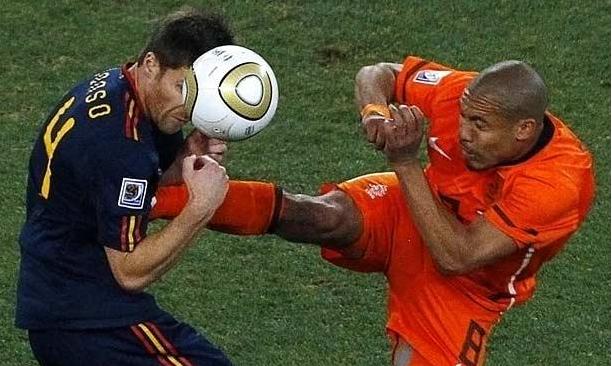
The Dutch met Spain in the World Cup finals in 2010. It should have been the seminal moment of my football-loving/Dutch-cheering life, but (see here for more) I was turned-off by their strategy, which – with the exception of some honest-to-God deserved victories against mortal foes such as Brazil – seemed kind of cynical.

There’s winning and then there’s winning. The Dutch, since the early 70s, have always emphasized beautiful football: flowing, sexy, unpredictable, and effective. Unfortunately, since World Cup 98, that effectiveness came into question as a combination of generational talent turnover (Ruud van Nistelrooy was not exactly Dennis Bergkamp) and some daft coaching decisions (chief in my mind, Louis van Gaal’s decision to squander a two-goal lead against Portugal in the WC 2002 qualifiers) created an existential crisis. Beautiful football wasn’t getting results.

Continue reading “Ask The Zombies in July, or, How Are The Dutch Going To Do at Euro 2012?”

Share

Narratives & Messages

We live in an atmosphere concentrated with media: we are drenched so deep that we don’t often realize how integral it has become in our lives. In my fiction, which can be speculative and sometimes nodding to “the future”, I don’t mention this much. I was wondering if, by not speaking to this (awesome/scary) fact of life, I was missing out on saying something substantial about our lives; then again, a writer with the intent to say “something substantial about our lives” is often asking for more than they can deliver to begin with. Perhaps I intentionally avoid the subject. Perhaps I want, fictionally, to portray a world where the reader can escape our media fishbowl, not content to stare into our monitors and smartphones – into any one of the many shining screens around us. *

 (*This is not to say that, as someone who writes stories to be read, I am exempt from any of what I go on to describe.)


As Madge the manicurist in the Palmolive commercials used to say: “You’re soaking in it.” And we are.

My concern, as far as this post goes, is not the number of screens surrounding us, nor is it the gross subsidization of our environment by advertising (vis à vis self-interested parties). Content is king, after all. And, unlike ads and the proliferation of screens, I feel we don’t look at content very closely.

We are essentially surrounded by narratives.

Continue reading “Narratives & Messages”

Share

Robertson Davies: Elitist

I was once accused by the chaplain of Massey College of being a gnostic. He was very angry with me indeed. But part of being gnostic was using your head if you wanted to achieve salvation or even a tolerable life. That is something that the Christian church tends rather to discourage. Salvation is free for everyone. The greatest idiot and yahoo can be saved, the doctrine goes, because Christ loves him as much as he loves Albert Einstein. I don’t think that is true. I think that civilization—life—has a different place for the intelligent people who try to pull us a little further out of the primal ooze than it has for the boobs who just trot along behind, dragging on the wheels. This sort of opinion has won me the reputation of being an elitist. Behold an elitist.

This is from a wonderful interview with the multifaceted author, Robertson Davies, for the Paris Review. His responses are well-considered, done as they were before everyone felt pressured to distill themselves into soundbites. He provides a wonderful perspective on fiction writing, the role of the writer, what his own background lends to his writer’s toolkit, as well as an assortment of miscellany (including a very interesting reflection on the differences between Freudian and Jungian psychology, no less). He was a true character.

Share