The Dread of Zombies

Everyone is waiting for the zombie genre (in books, television, and particularly film) to whither away like a desiccated corpse. I argue that it’s here to stay – that, in fact, it has stronger legs (ugh) than most other genres of the macabre.

The dread of zombies imagined – the tiredness some of us feel with each iteration (Pride and Prejudice and Zombies, The Walking Dead, Zombieland) – is understandable. Less understandable than with vampires, but understandable still. There are too many zombie and zombie-like (for the record, 28 Weeks Later is not, strictly-speaking, a zombie film, yet it more or less qualifies itself by virtue of many shared) themes in books, shows, and movies these days. But I would argue that it’s because – due to our increased connectedness to each other via the Internet and social media – we are exposed to real life zombies. Thematic zombies. Metaphorical zombies. And the exposure stands to increase.

A shitload of people voted for a complete ass to be the mayor of Toronto. A shit. Load. Mind you, not many who lived downtown did. Still, it was a rout. People like me – people who prize intelligent discourse over pot shots, people who would prefer to be ruled by someone with an informed conscience rather than a bullet-list of to-dos – were incredulous. It didn’t even matter what quadrant of the political spectrum Rob Ford occupied: he was the last person any reasonably well-informed person would have wanted. And yet he won in spades.

Thematic zombies. Metaphorical zombies. The dread of zombies.

Who voted for him? Who can say that they “understand” him? Are they too not also zombies by virtue of his succession to the throne of city council? Faceless, nameless, godless, conscience-less hordes hefted Mr. Ford to office, and we stand here still – a year later – asking ourselves just what the hell happened, watching the circus of political buffoonery before our eyes.

Lest this become a solely personal treatise, isn’t this the same for everyone? Aren’t we witnessing “zombie activity” in other guises: large groups of seemingly nameless, faceless, godless, conscience-less hordes blindly enabling things we fundamentally disagree with but are powerless to dispell? For me it’s the rise of Rob Ford, for others it could be the Occupy movement. For others still, it could be the revolution in Tahrir Square. The massive, faceless but powerful other. The faceless, godless, conscience-less hordes…with agency.

Thematic zombies. Metaphorical zombies. The dread of zombies.

No, it is not going away. Make popcorn.

Share

Brief Reviews: Incendies

For someone like myself, who makes his living working in film, it would seem perilous to declare a “favourite” Canadian filmmaker. However, it’s a no-brainer that one of them is Denis Villeneuve. Ever since I saw his Genie award-winning Maelstrom, I knew I was watching someone who was not burdened by the shackles of mediocrity so commonly on display in the end-product of so many emerging or established Canadian filmmakers.
Incendies, nominated for Best Foreign Language Film at the 2011 Academy Awards, is devastatingly good. It tells the story of fraternal twins who, while coping with the death of their mother, are handed two envelopes by the estate lawyer. One is to give to their father, whom they presume is either dead or estranged. The other is to give to their brother, whom they’ve never known existed. Neither know what any of this means and what follows is a side-winding story that is equal parts tragic and breath-taking.

Based on a play by Wajdi Mouawad, the film spends most of its time in a Middle Eastern country that is never identified for the audience. It’s a curious technique which may frustrate some, and yet it was refreshing for a film to sidestep our cultural preconceptions or prejudicial baggage by focusing strictly on the unfolding of its complex tale and its toll on the characters, past and present. At the core of Incendies is the devastating journey of the twins’ mother, played by Lubna Azabal, told in flashbacks.

There are moments of heightened violence in this film. Moments where you say to yourself: no, no, no – please don’t show us what I think you are about to show us. And yet, to Villeneuve’s credit – something I noticed in Maelstrom – he is one of a short list of directors capable of portraying material which may be extremely unsettling in ways which are neither insensitive to the audience nor disrespectful to the spirit of the story. Yet, the weight of what is ultimately revealed in the circuitous route of the twins will certainly haunt the audience long after the film is done.

Share

Brief Reviews: Certified Copy

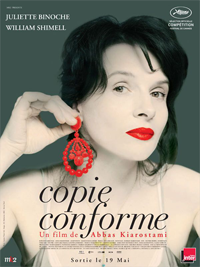
Certified Copy is certainly in the running for one of the best films I have seen in 2011. You would not guess this by looking at the poster or the anonymity of its title. Two things do stand out to me immediately: actor Juliette Binoche and director Abbas Kiarostami. Binoche is one of the greatest of her generation, able to transform herself at will. Kiarostami is not a household name but is nonetheless a master of intimate cinematic storytelling (A Taste of Cherry). Certified Copy is about an English writer (William Shimell) and a French art dealer (Binoche) who spend the day in Tuscany together. He is there on a book tour, and she is there ostensibly as his handler.

What transpires requires some delicacy in explaining. While having coffee in a small village, a presumption is made about them by a local: that they are a married couple. The presumption and all that follows lies at the heart of what is a masterful piece of work by Kiarostami. Cutting is kept to a minimum, but that’s fine because often the actors are staring right at us (rather than each other), and what actors: Binoche displays such a range of emotion and depth of feeling in her role as the conflicted half of the presumed couple, and Shimell – an opera singer in real life (believe it or not, this is his first film) – is hypnotic as the edgily self-consumed, emotionally opaque other half.

I am tempted to compare this film in some respects, stylistically at least, to Michael Haneke (Funny Games, Caché), with whom Binoche has collaborated many times. And yet, Certified Copy lacks the brutality, the near-misanthropy of Haneke. Which is not to say that you won’t be kept on the edge of your seat wondering just what is going on between the two leads, and within them. A must-see for anyone looking for depth in their drama.

Share

Two TIFF Reviews

The Keyhole world premiere at TIFF went over quite well (see here for more). I had the opportunity to catch two other films over the same weekend:

360: Fernando Meirelles’ latest film is a continent-spanning, Wim Wenders-esque meditation on fidelity and perseverance in a world whose inhabitants’ stories are increasingly inter-threaded. The cinematography is beautiful, with exquisite long shots which accentuate each locale intimately, while the characters sort out their broken hearts and wandering eyes. The cast is solid: Jude Law, Anthony Hopkins, Rachel Weisz, and many others, with yet another gritty, soul-churning performance by Ben Foster. It is a movie with a clear moral conscience at its core, which may disappoint some who are looking for a string of happy endings, and others who alternately want the world to conform to a cynical philosophy. One to elicit discussion, for sure.Jude Law and Rachel Weisz, in a scene from "360"Jude Law & Rachel Weisz in "360"

Anonymous: It’s weird to see a movie at TIFF which you know will be rolled out into movie theatres soon. Weirder still to stand in line and see a massive-sized poster for the movie you are about to see across the street from you, telling you that it will premiere in a month’s time. The tickets were comps, so I didn’t let this hang me up. Sam Reid as the Earl of Essex, in "Anonymous"

Anonymous isn’t a great film, I will say that now. In an effort to dramatize its thesis – that our notion of Shakespeare is based on a ruse, and that The Bard’s works were actually written by a nobleman, the Earl of Oxford (Rhys Ifans) – it crams in so many plot points to justify its theory (and it is a leading Shakespeare-alternate theory, for what that’s worth) that I felt separated from the characters (and eventually the story) on the screen. And this is a shame, because it’s a gorgeous-looking film and the filmmakers obviously spent a dear load of time making everything look authentic. The performances as well are quite strong, with a cast which also includes Vanessa Redgrave as Queen Elizabeth I and David Thewlis, who all but lives beneath the skin of the calculating William Cecil. The great tragedy, if you will pardon the pun, is that Rhys Ifans’ affecting lead performance, an actor who for so long has held films together in often comic-serving supporting roles, seems sacrificed to some degree – scattered across a time-spanning storyline – so that we only see him intermittently. Pity. Still, for those who love movies with codpieces and horse hooves clop-clop-clopping on cobblestone, you could do worse.

Share

Chaos Cinema

I posted this for my Humber College students on their blog. I posted this on Facebook and Twitter. As such, I should probably post it here.

If you are a film lover who feels increasingly unable to understand or orientate yourself watching action movies made in the last decade, I implore you to watch this video essay about what the author calls chaos cinema.

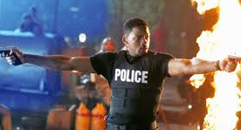
Bad Boys 2It describes quite succinctly what has frustrated me as a film viewer: action sequences (or entire films) are becoming little more than jagged-edged stimulation devices and not the shared experiences that they should be (see: chase scene in Batman: The Dark Knight)

Essential viewing.

Share

Quote

“Trust only movement. Life happens at the level of events, not of words. Trust movement.”

Alfred Adler (1870-1937), Austrian psychotherapist

Share