Guy Maddin’s Keyhole

Good news #1: I’m supervising the post production on the new film by Guy Maddin, Keyhole.

Good news #2: I’ve been asked to do a blog/diary of its progress. Sweet!

Here’s the link to my Keyhole post production blog. Don’t be surprised if it takes my attention away from here for the next while. I will endeavour to keep Imaginary Magnitude updated.

Share

Weekender

I love looking at The Onion’sWeekender“, their satirical take on the weekend magazine that comes with your major newspaper (a la The New York Times’ Sunday magazine).

They’re brilliant when, behind the jabs at fluff/news magazine inanity, there’s a “meta” quality. Their satirization of the way fonts and type placement are abused, for example.

They’ve even gone so far as spoofing the NYT fashion magazine

My recent favourite:

Share

No Such Thing As a One-Ended String

I am beginning a small bout of learning, if that is possible, into what is called “string theory” (there is a nice article here, which summarizes the basics at the bottom). I’m learning about it, because there is so much controversy directed at it. On the one hand, it is a contender for The Theory Which Explains Everything (Ultimately). Yet, there is (after over 40 years of theorizing) no documentable proof of its existence. This would be a question of trivia were this theory not so heavily influential – and invested into – within academia (particularly in America’s most elite universities), where there is growing concern that this theory has become a self-propelling conceptual vehicle which is capable of using unanswered questions of its existence to justify its existence.

I once chatted up someone who revealed himself to be a retired physics professor, and the subject of string theory came up. He smirked and said dryly, “String theory is a cult, waiting for its Jonestown.”

How could I not take that as a cue to learn more?

Share

Brief Reviews: The Town vs. Animal Kingdom

When Ben Affleck’s The Town came out, many praised it as a powerful crime drama/action film. And yet, the shine seems to have come off of that project, probably as a result of people chasing the hype and actually watching it.

First, let’s discuss its poster. In recent years, I’ve become sensitive to bad marketing. A good example of this is the film Forgetting Sarah Marshall: the ad campaign (in Toronto at least) consisted of anonymous black and white bus and streetcar ads, with hand-scrawled “I HATE YOU SARAH MARSHALL!” (and the like) written on them*. In short, the campaign was cheap-looking, lame, and soured any potential expectation I had for the film – it wasn’t until much later, at my wife’s urging, that I caught it on DVD and found it to be one of the highlights of the year.
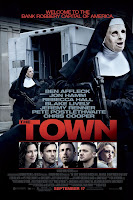
Similarly, the poster for The Town (displayed here) is a marketing mystery to me: it looks like a horror movie. It’s directed by and stars Ben Affleck, yet the poster is covered in evil nuns with automatic weapons. In short, I don’t get it: sure, it’s a “serious movie” but what were they thinking? Was it reverse psychology? Who knows. If it were me, it would be a close-up photo of John Hamm licking Ben Affleck’s unshaven face, with the caption: “Holy shit! It’s the guy from MadMen with Ben Affleck! And they  shoot weapons!”

Then there’s the film itself. Technically, it’s very impressive. Affleck’s direction is solid. The performances are gritty and engaging. It’s free of stunt-casting. Camerawork, editing, sound: great. But when the credits rolled, I realized what was wrong. The story’s been done a hundred fucking times before – twice by Michael Mann. So, for me, there was nothing being risked as a viewer because, having watched more than one crime drama in my life, there were no surprises in the script. Believe me when I say that I wanted this film to be as good as it promised – and, in fact, it is good. Just not as good as it clearly could’ve been when you take into account all that it has going for it.

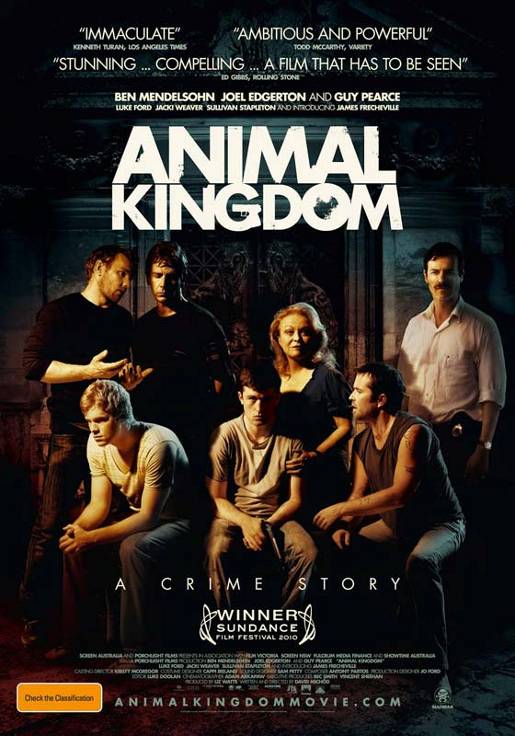
So what did I want The Town to be? I wasn’t sure…until I saw the Australian crime drama Animal Kingdom on DVD. It has all the grit, tension, and complexity of The Town, with less overt style and more substance, and no actors recognizable to most North American audiences (outside of Memento‘s Guy Pearce). Its poster? Have a look:

It reminds me of a Jeff Wall photograph. And in the middle of it all is the crafty look on the face of actor Jacki Weaver (nominated for Best Supporting Actress at the 2011 Oscars).

Animal Kingdom is a film fluent in the crime drama language – it even shares some of the tropes of The Town (the nervous druggie robber, the dutiful police detective) yet never once feels as if you are watching a re-treaded story. It is unpredictable and the performances are naturalistic and subtle.Its lack of artifice keeps us watching, whereas with The Town, each successive car chase weighed it down with Hollywood cliché. Where one carries broader tension, the other is quietly disturbing and takes a more nihilistic view of the cops and robbers game.

The good news is that both are available for your perusal on DVD, and both are extremely watchable. Neither, ultimately, will disappoint: it depends on where your expectations are set. I feel that Animal Kingdom is the film The Town wanted to be.

* I admit I’m particularly sensitive to ads which don’t make it clear that they are ads, especially if they look like actual public messages of hatred.

Share

Guilt By Association

An article I wrote back in March of 2010 (“I’ll Show You Stupid”) is getting a lot of steam, it seems. Nice to see new visitors. It’s nice to look back at something I’ve written in the past – the good stuff at least – and see that my instincts were well targeted. In the case of this particular article, it was about the dangers of denigrating (political) others on the basis of how intelligent they come across; the danger was that such actions back-fire more often than not. It mentioned a certain former governor of Alaska.

I’ve been thinking and discussing the subject of elitism quite a bit lately. There are many subtleties in the way we use the word “elite”, but when used in its current populist political form, what people are particularly referring to are those who are educated. Plain and simple. I’ve spent many an hour, day, year, working with and speaking to people who are very educated and worldly, and I must say that they desperately need to get organized if they are to live up to the hype of being the human whippets they are made out to be.

This last October, Toronto voted for a populist mayor – a champion of the surrounding suburbs – who played the “elite” card quite a bit. Regardless that the man is a millionaire from a millionaire family, that he went to Carlton University, he was able to parlay the us-versus-them thing quite well. Helps that he coaches football and is built like a linebacker and probably looks exactly as he did in high school. Thing is, by all rights, he is an elite. Meanwhile, the target of his vitriol, the downtown intellectuals that I hang with (I swear I don’t do it for this reason) – the people who think bike lanes are safe and that public transit is important – are positively victimized by the very thing they are accused of. You see, I think the intelligentsia failed Toronto, just as they typically do most civilizations: where were they (hell, we) during the ten months of the pre-election hype? Where were they when a candidate capable of beating Ford needed to be picked (I don’t think anyone really supported Smitherman – for *’s sake, he adopted a child six months before the election, how responsible is that?). Well, the “elites” were chattering amongst themselves, refuting Ford’s populist bullshit as just that. What everyone forgot is that elections are competitions and without a competitor we ended up with the bully from high school as our hall monitor for the next four years.

The point I’m trying to make (casually, and without credentials because this is a blog and I’m not a journalist) is that the so-called elitists are too busy looking at subtlety, too busy drawing examples from the history of civilization to actually stick their necks out and actually pick a candidate. In short, intellectuals hate making decisions and would rather prefer to show off how much they know about things. That’s how we end up with Rob Ford as mayor. That’s how we ended up with Stéphane Dion leading the Liberal party, or allowing members of the Reform Party to vote twice (if they belonged to both parties) in the merger of the Progressive Conservatives and Reform Alliance parties. The intellectuals – the so-called elites – were busy sitting on the sidelines trading notes, impressing each other with witty barbs.

And this is why I have a stake in the whole “elite” argument. In a sense, yes, they are the enemy. Not because they want anything, or that they are organized enough to have an agenda in the first place, but rather because they don’t know what they want for anyone other than themselves and most of them are too afraid of being politically active. In other words, they should know better, should do better, but they don’t. And as a result they doom the viability of the very life they live.

Share

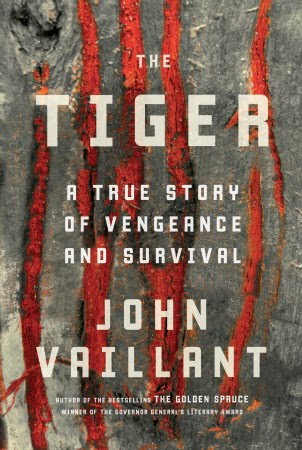
Book Review: The Tiger, by John Vaillant


(I had done a mini-review of this on my end-of-the-year post, but thought it merited its own entry)

I found myself flipping through the Globe and Mail book section one weekend in the fall of 2010, and found myself staring at a review for a non-fiction book called The Tiger, by author John Vaillant. Let me begin by saying that I am a prolific reader, yet not someone fazed by what’s new so much as what interests me. To this extent, given my eclectic tastes, I will switch from Turgenev to Bukowski, from John Ralston Saul to Stanislaw Lem, and so on. I sometimes don’t have a lot of time to read books, period, owing to a fairly full schedule of projects (which includes working on a novel). As a result, I sometimes feel a little out of touch with the contemporary world of books, especially when there are people on Twitter who are aiming to read fifty books this year.

Getting back to me and the review, I glanced at the synopsis and was struck by how meaty it was: the Russian far east, a vengeful killing machine, a dark exploration of our ties to nature. It seemed to be everything I was looking for (especially as a Russophile) and gave me an opportunity to actually read something published in the year that I was reading it.

It is, in short, a fabulous book. Fabulous, above all, because of the depth of Vaillant’s research into his subjects and his skill at balancing this collective learning against the white knuckle tension that is at the heart of the story. The Tiger begins with the stalking and subsequent killing of a tayozhnik – a Siberianism for forest dweller – named Markov and the series of events it sets in motion against the backdrop of the merciless taiga (or “boreal forest”) surrounding the little logging town of Sobolonye.

The tension is established early, not by Markov’s demise so much as the complex relationship between humans and tigers in this paradoxical part of the world, much of the relationship predicated on the aboriginal teaching that a tiger will never attack a human, so long as the former respects the latter’s spiritual and physical superiority. This superiority is laid out in full measure: from a zoological perspective, the tiger is perhaps the most sublime killing machine that exists in the world of mammals and Vaillant spares no time outlining how every inch of the beast exceeds any comparable hunter on the planet – both in physicality and mentality. The tiger thinks. The tiger learns. Most compelling of all, the tiger remembers.

It is this last quality which lends much tension, because, as the tiger is tracked by a team of professional hunters over the course of two weeks, the question is repeatedly asked: did Markov bring this on himself? And how?

The Tiger is a stunning combination of layered storytelling and educational insight into the evolutionary relationship between man and animal. Indeed, given the barren environment of the setting, it feels sometimes as if the conflicts between man and animal are staged in a prehistoric past rather than their modern setting in the late 90s. There are also some sad truths made about the aftereffects of the economic collapse of the former Soviet Union and the perennial designs China has on the taiga’s natural resources – tigers included.

The Tiger, by John Vaillant (ISBN: 978-0307268938) is published by Knopf and is readily available in your local, independent bookstore.

Share