On Elitism

There is a lot of anger these days being directed towards a group known as “the elites”. I’m not sure who they are. Sometimes I am part of them. Sometimes I’m not, but standing apart from a crowd, with their torches, storming toward the castle gates which protect “the elites”.

The elites are the rich.

The elites are liberals.

The elites are the well-educated.

The elites are neo-conservatives.

The elites are the well-connected and entitled.

I keep hearing this term: the elites. And when I step back I think of Pol Pot’s Khmer Rouge movement, and how they ultimately targeted people who wore glasses. And when I say targeted, I mean murdered.

When I hear, in that angry, spittle-on-the-microphone voice – elites – I think of the ease with which we can take a non-specific swath of individuals from various classes, ethnicities, and educational backgrounds, and clump them together almost by magic. And they suddenly become something standing in the way of common sense, progress, Providence. Those fucking elitists.

I can take everything that makes your life hard – the year-to-year complexities of living in a society with others – and compel you to believe that if it wasn’t for some small band of conniving intellectuals things would be better, simpler.

I can blame the elites.

Doris Lessing:

There is a certain social process that is known and very visible, but perhaps not acknowledged as much as it should be. It is that one where a new idea (or an old one in new form) is accepted by a minority, while the majority are shouting treason, rubbish, kook, Communist, capitalist, or whatever is the valued term of abuse in that society. The minority develop this idea, at first probably in secrecy, or semi-secrecy, and then more and more visibly, with more and more support until…guess what? This seditious, impossible, wrong-headed idea becomes what is known as “received opinion” and is loved and valued by the majority. Meanwhile, of course, a new idea, still seditious etc. and so forth, has been born somewhere else, and is being cultivated and worked out by a minority. Suppose we redefine the word elite, for our present purposes, to mean any group of people who for any reason are in the possession of ideas that put them ahead of the majority?

If holding certain beliefs or regarding some aspects of life as being too complex to reduce to unconditional conclusions sets me apart from the crowd, and if this standing apart-ness is sedition, and if this is what it means to be an elitist, then I am an unrepentant elitist.

Share

Movies & A Book: Some of The Best Things I’ve Witnessed in 2010

Here’s the best of what I’ve seen this year. I haven’t seen everything. You may disagree with what I have seen. This is life.

FILM:

Inception

Go ahead. Try. Try disagreeing that this is one of the most technically (and perhaps conceptually) elaborate mainstream Hollywood productions released in years which also happens to work as a “movie” that a wide variety of audiences would enjoy watching.

There has been a backlash against Inception. I don’t know how or why this is – perhaps it was over-sold as a deep “puzzle-solver” film, which it is not. And yes, the NYT’s A.O. Scott has a point in his comment that the film’s literal depiction of dreams are lacking psychological heft (outside of Marion Cotillard’s performance as DiCaprio’s wife). In any case, something has caused a revolt against this film and I say this revolt is missing the point.

Inception is, generally speaking, the most watchable, the most fascinating film of 2010. You are allowed to hate it.

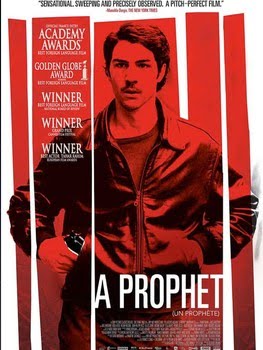
A Prophet

I am a huge fan of Jacques Audiard, a French director who has always rewarded the viewer with films (Read My Lips, The Beat My Heart Skipped) that balance passion with style. With A Prophet, Audiard expands his canvas, creating a gritty, novelistic masterpiece on-par with The Godfather (yes). The story concerns a young incarcerated Muslim who slowly rebuilds himself from within the treachery of prison life, rising from under the thumb of a vicious mob leader to become his own person and create his own empire. Epic, patient, and in places extremely violent. People will be referring to this film for years to come even if it has not really made a mark in North America. Again, a masterpiece.


The Eclipse

I realize this Irish film was released in 2009, but it didn’t get here until now. A compelling ghost story which eschews the two-dimensionality of ghost story films. It was around the twenty-minute mark that I realized it was a film which was going to confound my expectations (expectations based upon years and hundreds of similar plot lines): it wasn’t going to squander what it was and fall prey to hackneyed cliché. A gorgeous, touching, ultimately humanistic film with a stand-out performance by Ciarán Hinds as a grieving father of two children who must swallow his pride to escort a loud-mouthed Aidan Quinn through the motions of a book tour of the small coastal city of Cobh, in County Cork. A sublime achievement by director Conor McPherson.

Notable: Winter’s Bone – see it. It’s on DVD now. Like A Simple Plan, it’s a self-contained “rural thriller” (ugh) with a chilling undertone of barren hopelessness. Unlike A Simple Plan, it’s uncomplicated which is what gives it more of an honest strength. Exit Through The Gift Shop is the perhaps best film made about art and the art world that I have seen – like Inception, it’s not trying to be deep, just smart. Scott Pilgrim vs. The World blew me away because I expected it to be weak (perhaps because all the publicity photos inexplicably used a static image of Michael Cera standing against a fucking wall…imagine if you will, trying to sell Star Wars with a picture of Mark Hamill sitting cross-legged in the desert – sounds awesome, eh?). Not only was it not weak, it was the strangest case of “I don’t know why I love this movie but I really do”. Painstakingly, sublimely Toronto-centric (which, unlike the inexplicable promo photos of Michael Cera, shouldn’t be factored into explaining why it didn’t fare well at the box office) and wildly imaginative – those two things have never met before…oh but wait, I forgot the perfect companion piece: Kick Ass – also shot in TO, and also exceedingly expectation-defying (although the climax is kinda drawn-out). As far as performances go, Jesse Eisenberg (The Social Network) and Colin Firth (The King’s Speech) stand out, along with Winter’s Bone‘s Jennifer Lawrence, and Hailee Steinfeld for True Grit (who, at 14-years, shows huge promise as an actor).

BOOK:

I would have said “BOOKS”, but due to work and school I haven’t read anything published this year (that I can remember), with the exception of John Vaillant’s The Tiger. Lucky for me, since it is without doubt one of the best non-fiction titles I’ve read in years.

The Tiger is a meaty real-life tale of vengeance by the titular beast, in the winter hinterland of the Russian Far East (which the author calls, paradoxically, “the boreal forest”). Vaillant describes an environment historically, politically, and biologically unique, inhabited by hardened outcasts. The shadow of a predator male tiger, known never before to attack without cause, creates a wave of dread throughout the land, with only a small band of volunteers to figure out the mystery. Vaillant provides wave after wave of fascinating detail – examples of how man and beast have evolved throughout time, how human and animal behaviour have worked in similar paths – that by the end of the book you feel as if you should have a credit in Ethology. This is truly a page-turner and I cannot recommend it enough.

Share

Taking a Breath

For the first time in a few Decembers, I approach the end of the year without a knot in my stomache, without a brain scrambled by the to-and-fro of this and that. This is not to say that I’m not busy, that I do not (as I type this) sit with a few plates spinning above my head. This is also not to say that I do not face an onslaught of tasks once the merriment of New Year’s Eve has ebbed.

I feel compelled these days to start putting things in perspective. Perhaps this is what happens when you turn 40 – perhaps I am being cliché. Seeking context and sketching narratives seem like writerly enough goals to aim for, but even as a writer there are a lot of things – tangents, curves, frays, tears – to reconcile within that task.

A strong influence stems from my current study of psychotherapy, which requires that I be in therapy also. You find yourself relating a story from your past – from your childhood, from your 20s – and you find yourself saying something you realize you haven’t really mentioned to anyone before. Not necessarily secrets, but impressions of events. Sometimes events themselves. It allows you to discover how unintentionally secretive we can all be.

I have been struck by as often as I have been able to dodge the things thrown at me in life. Sometimes you don’t have a choice: I think that’s one of the first things you learn, but the hardest to reconcile. That is, if you don’t want to subscribe to fatalism (which isn’t to say that everything should boil down to some atheist/libertarian screed). Ultimately, life has but one author, and if you do not have a hand on the pen there is a problem.

It is thus, in the spirit of pen holding, that I try to take some time over the next while to add to the picture of my understanding of my self, with the aim of broadening that understanding (as opposed to solipsism) so that the rest of the (human) world may not be as strange and foreboding as it can seem.

Perhaps, some day, we will see that we are all artists.

Share

Book Review: Never Let Me Go, by Kazuo Ishiguro

Sometimes things just line up in such a way that you can’t help feeling they were put there on purpose. Early this month, as part of a course I’m taking, I went to a weekend retreat, held at a secluded compound by the Credit River. It was a bit eerie, because many of my dreams take place in expansive compounds: wherever I go, even if it seems I’m outside, I just have to look up to see that there is a roof, or some sort of enclosure to remind me that I am not free. So, what book from our library did I take with me at the last minute? Why, Kazuo Ishiguro’s Never Let Me Go, of course. What I didn’t realize is that much of it takes place on a compound…but I’ll get back to this.

I’ve not read any books by Ishiguro – I haven’t even seen the movie adaptation of Remains of the Day. That said, I did work on Guy Maddin’s The Saddest Music In The World, an adaptation of one of his short stories. I’d heard good things about Never Let Me Go, and had always meant to read it. With it being released as a film recently (I don’t think it did that well, despite the critical praise), and since I needed something to read during my time away, I thought it would be a good pick.

Never Let Me Go concerns the story of Kathy, Ruth, and Tommy. It’s told from Kathy’s perspective in the present. She is a carer, who drives from centre to centre, visiting those she looks after. Very soon we are introduced to their beginnings, as children, in a place called Hailsham. It’s an isolated educational enclave, somewhere in England, where the students live, go to school, and grow up. But there’s something a little odd about it all. Perhaps it’s the isolation from the rest of the world. Something in the way some of their guardians regard them. All too soon, their sun-dappled childhood in Hailsham becomes something which haunts them as they grow into young adults. It’s practically all Kathy can use to mark the passing of her time.

Within these reminiscences, we are introduced to Tommy and Ruth, who become the foundational friendships Kathy clings to through adolescence, regardless that Ruth oscillates from friend to enemy – a colourful rather than careful individual who becomes a voice of danger in the fog of their relationship.

The magic of this book is the skill with which Kathy’s perspective is written. There is a purpose for Hailsham, for their being there. There is a reason she is a carer. Never Let Me Go is a capital-H haunting novel, inhabited by people who are slightly cold but reaching out, never quite managing to touch a meaning they hope is there. I can’t say much more without spoiling things, not that it’s a book laden with surprises, so much as layered with subtle, sad observations. A beautiful book for a rainy day.

Kazuo Ishiguro’s Never Let Me Go (ISBN: 978-0-676-97711-0) is available at an independent bookstore near you, or at various online retailers.

Share