Completion

A quick note: I’ve just finished Tolstoy’s War & Peace. I’ve been reading it for just over a year – the gi-normous, anti-public-transit hardcover version of the Pevear/Volokhonsky translation – and finally read the last of the last pages last night (if that sounds awkward, the thing has an Epilogue in two parts, each spanning several chapters, plus an Appendix by Tolstoy). I would’ve finished sooner had the second half of the Epilogue not consisted of an essay by the author on the philosophical/socio-historical implications of freedom vs. necessity in society.

So, yes, in the upcoming days, I will post a formal review. There shall be more book reviews in general in the coming months, seeing as those are the things which are responsible for 50% of this blog’s traffic. I’m assuming this percentage consists, in equal measure, of both curious readers-to-be and desperate students cramming for their essays/tests (Question 2a: “What are the themes in Hesse’s Siddhartha?”).

Share

Book Review: Unended Quest, by Karl Popper

“Pfuel was one of those theorists who so love their theory that they forget the purpose of the theory – its application in practice; in his love for theory, he hated everything practical and did not want to know about it. He was even glad of failure, because failure, proceeding from departures from theory in practice, only proved to him the correctness of his theory.”

– Leo Tolstoy, War & Peace, Vol. III, Pt. 1, Chpt. X


My self-guided study in philosophy brought me to Karl Popper this past summer. Yes, another 20th century Austrian (seeing as the last philosopher’s book I reviewed was Wittgenstein’s Tractatus Logico Philosophicus). Another logician as well, but what’s compelling about Popper is that he did not limit himself to one particular field of study (in his case, science). He was just as passionate and knowledgeable about social dynamics, art, and politics.

Popper approached the long-held observational scientific method with distrust; rather than prove a theory to be correct with empirical evidence, he took inspiration from Einstein’s openness to critique (when he released his theories on relativity) and insisted that falsification was a better method (ie. allowing one’s theory to be refuted by opening it up to the community-at-large for inspection from more angles). This, he argued, protected the world from the success of pseudoscientific “pet theories”. His inspiration for this came from his disenchantment with social and academic institutions of the day which rigidly held the works of Marx and Freud in high esteem.

Allow me to stop here and say the following: there is no way in hell I can sufficiently (to my own or anyone else’s satisfaction) and clearly lay-out the man’s theories, justifications, and *how* he came about his all in what I always hope and aim to be a succinct blog entry. It has taken me a day to revise the above paragraph and I’m still not particularly happy with it.

That said, I found Unended Quest to be a fascinating portrait of a great mind who refuses to stop questioning. His way of thinking about the underpinnings of logic and about systemic, ingrained assumptions in society is nothing short of radical. Under Popper’s means of demarcation such seemingly scientific pursuits as economics, climatology, and even dietetics are left looking like…well, not quackery, but certainly not anything approaching science.

So, yes, feet get stomped on, lines get drawn…and this brings me to what makes a great philosophical treatise: it forces you, whether you like it or not, to recalibrate your assumptions about society. Even if you have fundamental disagreements, you are forced to work hard to justify them. In other words, it’s the perfect way to give your brain a shake (perhaps even your foundations of understanding).

Unended Quest is full of ideas and strong opinions, with the socio-political history of the 20th century as its backdrop. This is a man who lived through two World Wars, whose early experiences as a social worker with neglected children made him fundamentally question the learning process, and who ended up being on a first-name basis with some of the greatest minds of the then-burdgeoning realm of quantum physics (Einstein, Schrödinger, Bohr).

That’s it. That’s all I can write without this becoming a term paper. All I can add to this is that I aim to re-read this book on a yearly basis, which is perhaps the best complement I can pay to an author.

Unended Quest (ISBN: 978-0-415-28590-2), by Karl Popper is available at an independent bookstore near you, or online at any number of vendors.

Share

Book Review: H.P. Lovecraft: Against the World, Against Life, by Michel Houellebecq

When I first noticed a series of novels in a local bookstore by a writer I’d never heard of, with a strange last name (reminiscent of Benelux origins rather than French), I proceeded to do some research – as I often do when faced with a writer I’ve discovered – to find which book I should read first. This writer was Michel Houellebecq.

I ended up picking The Elementary Particles, which I reviewed earlier this year. However, during my search I discovered – to my astonishment – that he had written a biography of H.P. Lovecraft (!)…complete with an introduction by Stephen King (!!?!). I will tell you that, even if I ended up throwing Elementary Particles across the apartment in disgust, I would still have purchased the biography. How do I put it… It’s as if Vincent Price wrote a biography of Boris Karloff, or if David Lynch wrote a biography (inevitably it would be a Faber edition, you know this) on Andrei Tarkovsky. Irresistible to this mere mortal.

In the end, though tempted on a few occasions to throw said novel across said apartment (and/or unsaid streetcar), I liked Elementary Particles. It’s a tough novel; not “tough” in a muscular, masculine sense, but rather “tough” in a mentally-I’m-squinting-because-he’s-pouring-acid-on-humanity-in-the-way-only-a-French-intellectual-can sorta way.

Back to the book at-hand. When I was a kid I read a lot of horror/mystery books, and yes, Stephen King was among them. I also recall reading H.P. Lovecraft, whose style I found to be as instantly recognizable as, say, a painting by Mondrian or Kandinsky. One only needs to read the first paragraph (or sentence) and you know it’s Lovecraft. The same instant familiarity cannot be said of many writers, whether they be pigeon-holed in lit or genre fiction. The thing is, I never really got around to reading much of Lovecraft’s work, seeing as the time at which I discovered him was a sort of indeterminate period in my teenhood, from which I have few fond memories; as often happens when you step away from darkness, you also step away from everything else that was appended to the darkness, good or bad.

Lovecraft has always been at the back of my head as a writer I wanted to read more of, so this biography served a dual purpose; not only does it have the introduction by King, but it also contains two of HPL’s “great texts” (as Houellebecq refers to them, rightly so), The Call of Cthulhu and The Whisperer in Darkness.

Indeed, King’s introduction is as predictably King-like as one familiar with his work would expect: engaging, funny, poignantly personable. And yet, when you stand back, you realise he probably just read the first twenty pages of the biography and, as they say, phoned it in. The thing is, I’ll take an introduction that’s phoned-in as long as it is two things: short and good. An introduction to a book, after all, is a like an opening-act at a rock concert; as long as their instruments are tuned and they keep an eye on the clock, I’ll clap.

The biography itself is not a traditional (read: dry, linear, boring, historicist) one. One must first understand, as I had an inkling of going in, that H.P. Lovecraft wasn’t a happy man. Nor was he likely to win a Humanitas Award for his insights into the enriching possibilities of mankind’s potential. And so, with his biography being written by Houellebecq – arguably a misanthropist’s misanthropist – the reader will have a unique opportunity: to see darkness filtered through another, somewhat sympathetic darkness.

Houellebecq does a very good job of tapping the man who was Lovecraft – his deep prejudices, his emotional and intellectual isolation from society – as well as postulating how the events of his life influenced the outcome of his work without the current populist habit of divining what isn’t known for sake of milking controversy. Lovecraft was a man who based much of what he wrote on dreams, whose one and only relationship with a woman ended with financial destitution and heartbreak. His racism leaked into the grim depths of his “weird tales” in the form of the onlooking “savages” and “half-bloods” who – particularly in The Call of Cthulhu – seemed to aid and abet the ancient evil lurking among us. Not a pretty picture in retrospect. There is also some interest in how Houellebecq calls to attention HPL’s habit of never mentioning two things in all his work: sex and finances.

And yet, while we may not wish to embrace Lovecraft the man, one cannot dismiss Lovecraft the writer. In reading The Whisperer in Darkness, arguably his masterpiece, one beholds a very seminal kind of horror; a slow, creeping alien night descending upon a remote Vermont farmhouse, revealed mostly through correspondence with the narrator, a professor of literature in Massachusetts. There is a poetry in Lovecraft’s prose, and by that I mean the ability to articulate flourished description with condensed, exacting verbiage. It is for this reason that HPL was (and is) such a seminal literary influence, not just in so-called genre circles.

I would not say Against the World, Against Life is essential reading. In fact, if you were to just read The Whisperer in Darkness or any of his other “great texts” you would be well served. However, there’s something alluring about having the life of such a tortured soul (remember that Lovecraft never lived to know his fame and fortune) rendered by someone so well-placed to plumb his depths. I suppose the question I would ask is: to what end? In this, I would say the book is not a great success, but there are nuggets of great interest for those drawn to both H.P. Lovecraft and Houellebecq alike.

H.P. Lovecraft: Against The World, Against Life, by Michel Houellebecq (ISBN:1932416188) is available at an independent bookstore near you, or online at any number of vendors.

Share

Book Review: A History of the World in 10 1/2 Chapters, by Julian Barnes

It’s been well over a month since my last book review, coincidentally enough regarding another book by the same author: England, England by Julian Barnes. I was impressed by his skill in crafting an inventive satire as well as the philosophical depths he explored, though as a whole the book was not entirely satisfying. My wife had warned me it was not his best book. She suggested instead that I read A History of the World in 10 1/2 Chapters. And hey, it was already there on our bookshelf, so being the frugal person I am (and honestly wishing to explore more of his compelling style) I considered it a win-win situation.

The short version of this review follows: I really liked this book

The long version of this review, admittedly, I must approach with trepidation, the sort of which I have not had to experience in previous reviews. The reason I shall submit up-front: the very first chapter contains elements that I can only surmise (if I may craft this sentence in a way that is both fair while not attracting the undue curiosity of lawyers) were lifted from another author’s book. I’m not going to go into great detail, as I don’t wish to write a J’accuse, so much as innocently hope that someone – perhaps even Barnes himself – would clarify the situation. I shall touch upon this again, later.

A History of the World in 10 1/2 Chapters is not, strictly speaking, a formal history of the world, though it does shift throughout time. Essentially, it is a collection of stories and one or two essays, the whole of which makes some attempt to summarize the haphazard longings and deceits of humanity through history, with the recurring theme of Noah’s Ark sprinkled throughout in variously literal and metaphorical techniques. Some narratives are light-hearted and satirical, others are solemn and erudite. It is a book which, as a whole, has something to say about mankind – the big and small picture of mankind – from various viewpoints, the majority of which is not flattering. Yet, Barnes is not a nihilist; he sees our faulty strengths and compelling weaknesses as part of the way humanity is wired.

This is illustrated with both striking description and considerate attention to detail, particularly in the series of “chapters” (which sometimes are really just separate, standalone stories) regarding the shipwreck of the French frigate Medusa off the coast of Mauritania in 1816. With this as the central focus, the author devotes three perspectives on the event: one which describes the horrific facts of the shipwreck and its survivors, another which takes an entirely different approach by offering a historical critique of Théodore Géricault‘s famous painting based on the shipwreck, and yet another – this time purely fictional – which touches upon the themes of representation vs. idolatry with the painting serving as an afflatus for its determinedly devout protagonist.

There are no prescriptions for mankind’s delusions, no salve provided to alleviate our existential isolation, or our violent impulses. At the end of the day, summarized lovingly in the last chapter, we find ourselves compelled to go through the same motions, but not without circumspection which perhaps is our only saving grace. In Barnes’ world, humanity will always, ultimately, shit the bed (a phrase my cousin passed on to me), but not without looking for a means to change, even if that change is perpetually out of reach. It is evident that Barnes’ is one of us; he respects those, regardless of mental state, who are compelled to find the truth, particularly those truths which are only revealed to the individual and ignored by society-at-large.

And now, the bane of the book I mentioned earlier. In the very first chapter, a satirical narrative of Noah’s Ark and the Biblical flood, Barnes’ seems at first to take inspiration from Timothy Findley’s Not Wanted on the Voyage (Barnes’ book was published in 1989, Findley’s in 1984), a novel whose story is an equally slanted (and somewhat vicious) satire on the flood narrative. In both – told by a non-human passenger on the Ark – Noah is a drunken, abusive man whose pious subservience to God’s will pushes him and his family to violent extremes. However, the similarities – particularly in two passages – became so blatantly identical that I had to throw up my hands in dismay (a perfect case in point being Barnes’ use, in similar reference – just as Findley used in the prologue to his novel – the phrase “Not Wanted On The Voyage”, with Findley upping the ante originally by putting this in full-caps). Again, I don’t know what to do with this. After some research, I know that Findley was shocked by the similarities, however he decided not to pursue legal action because he didn’t want A History of the World to gain any more publicity than it had. My hope is that – at some point – Barnes will address it, “it” being so blatant when you’ve read both the novel and the short chapter. The fact that I can still recommend Barnes’ book is a testament to his skill as a writer, though this ethical discrepancy unsettles me.

A History of the World in 10 1/2 Chapters (ISBN: 978-0679731375) is available at any number of friendly, independently-owned bookstores. Or you can purchase it online. You can also find Timothy Findley’s wonderful novel, Not Wanted on the Voyage (ISBN: 978-0140073065) as well.

Share

Book Review: England, England by Julian Barnes


“Dying is easy. Comedy is hard.”. Those are the apocryphal words someone once spoke on their deathbed. I would up the ante and add that “Satire is harder”.

As a writer, I’ve dabbled with satire, having only dedicated a small number of short stories to being “pure satire” (that is, not dipping in and out of some subplot for sake of levity/irony, but keeping the absurdity afloat throughout). On that note, I must continue to paraphrase others; I remember a late night classical radio announcer who was prompted to list his all-time favourite opera. I cannot recall the specific opera he listed as I’d never heard of it at the time. However, afterwards, he assuredly qualified the choice, saying “[…] Because it’s very. Very. Short.”

Satire in some respects is like opera. The shorter the better (within reason – I’m not lobbying for some new “blitz opera” or anything). The reason for this is that, if one is truly writing a “pure satire” (as I call it, noting that it does not necessarily mean “broad satire”, though I would argue that most “broad” satires are “pure” by necessity), then one has to create an entire environment that is somehow consistently out-of-whack, which also means characters who have to live in said environment. In doing so, there is always a tension between the narrative and the audience as to how long we (that is, the audience) must endure the ruse; that the “comedic absurdity” be taut enough to hold our interest, but not so complex that our suspension of disbelief becomes a claustrophobic mess.

While I wouldn’t call it a “pure satire”, Julian Barnes’ England, England is by-the-book enough to warrant leaning more in that direction than any other. It too, tends to suffer from “long opera” syndrome, ie. taking too much of a good thing and extending it into territories where the lightness (and broadness) of the satire seems incongruous to the author’s need to explore the interior drama of its protagonist.

The setup is inspired: a wealthy, eccentric industrialist – Sir Jack Pitman – conspires to one last show-stopper to top off his (slightly dubious) career. His idea: use the Isle of Wight as a tourist attraction which distills everything that England is (to the imaginations of “Top Dollar” or “Long Yen” clients; those, in the words of Pitman, interested in “Quality Leisure”), under the pretence that England proper is too large and unsightly to provide a satisfactory arena. As Sir Jack muses early in the going, England’s “tits have fallen”.

We are introduced to the protagonist, Martha Cochrane, in a prologue, who later in the book is hired onto Pitman’s planning committee. We are given a glimpse of her childhood, her streak of perfectionism/competitiveness (revealed between a jigsaw puzzle of England and her county’s yearly farm fair), and the hole left by her father’s sudden departure from the family.

The consistent conjecture throughout England, England is whether, after time, there is any substantial difference between the authentic article and the replica. This argument is addressed by several characters, from Pitman to his historical adviser (a part-time television host), to Martha – all of them, to Barnes’ credit, putting their own spin on what often becomes a profound if aesthetically controversial discussion.

In the words of a French intellectual Pitman’s team hires as a consultant: “[…] Once there was only the world, directly lived. now there is the representation – let me fracture that word, the re-presentation – of the world. It is not a substitute for that plain and primitive world, but an enhancement and enrichment, an ironisation and summation of that world. This is where we live today. A monochrome world has become Technicolor, a single croaking speaker has become wraparound sound. Is this our loss? No, it is our conquest, our victory.”

In other words, how is art imitating life any different after time than life itself? Where does its boundaries begin and end? This is ultimately illustrated in a fascinating turn in the plot as, long after the Isle is converted to a exclusive tourist destination complete with WWII fighter pilots, Robin Hood, and an actual royal presence, the actors playing seemingly stereotypical characters begin to accept their roles as real. The farmers begin to farm, Robin’s Merry Men make real demands, to the degree that a new civilization is almost formed in the process.

Yet, while I will not hesitate to point out that the first half of the novel, in particular the planning stages of what is to be called “England, England”, is satiric gold – in Sir Jack, Barnes’ has created a template of outrageous corruption who is not entirely unsympathetic – the rest of the book is a bit of a mess. First, we simply aren’t introduced to Martha Cochrane’s character – events: yes, personality: yes, history: yes – in a way that allows us to (for lack of a better word) give a shit about her anymore than the broadstroked Sir Jack, which wouldn’t be a bad thing if his character were not a duplicitous clown. Martha is given a prologue, an epilogue, and even a love interest. And while there are beautifully characteristic passages relating her inner doubts, it’s written so objectively that it seems the reader is being given access to her by proxy of the author (as opposed to the sort of intimacy one would normally expect). It’s rather like being slipped notes in class when you wish what you were getting were in the lesson itself.

England, England (ISBN: 978-0375705502) is an odd combination of broad (laugh-out-loud) satire and eloquent philosophical musing on the nature of authenticity. As a whole, it simply doesn’t work, but if you can overlook the weaknesses, the satirical side of Barnes’ world is formidable and honestly hilarious. It is available at a good independently-owned bookstore near you, or online from any number of vendors.

Share

Book Review: The Elementary Particles, by Michel Houellebecq

I honestly don’t know much about Michel Houellebecq. I typically don’t take a lot of interest in the lives of authors (or musicians, artists, etc.). The only reason I came across his name – and thus this book – was browsing the shelves of a local independent bookstore, killing time. I saw his name, which I thought was odd/familiar, and glancing through the several tomes on the shelf I realised that I’d found a rather curious writer: controversial, philosophical, with a tinge of “speculative fiction” about him.

So, with his name in my head, I did some research later and decided to start with an earlier (1998) but well-considered novel, The Elementary Particles, tempted though I was by another book of his, on H.P. Lovecraft no less.

Not one for believing the publicity machine, yet knowing next to nothing about the man as a writer, the blurb on the back cover of Particles compares him to Huxley, Beckett, and Camus. If I may take the liberty of rearranging this, having read the book, I would say – if anything – it’s Huxley via Camus. However, to make direct comparisons, though tempting, would be an insult to all involved. Houellebecq is Houellebecq – he’s not channelling anyone in his prose. Hark: a unique voice.

The Elementary Particles is a study of the moral murk of modern society, a result, Houellebecq’s omniscient narrative posits, of a world that has moved well-past the relevance and supremacy of religion, and in the middle of a phase of rational/scientific investigation. Without the guidance of a supreme set of rules, society embraced a virulent individuality and in doing so eventually begot a generation of spiritual and sexual materialists, beginning in the late 50’s. It is the aftermath of this wave which Particles concerns itself.

Meet Michel and Bruno. Michel is an accomplished molecular biologist. Bruno is a civil servant. They are half-brothers, mutually and separately abandoned by their common mother, a libertine and prototype of everything wrong with the “me” generation. Despite his success, Michel is emotionally dead, and at the beginning of the book decides to step away from his position at a prestigious university research department. He remains in his apartment, contemplating his life and inability to feel anything. Bruno on the other hand, is a self-destructive hedonist with no aims or aspirations, aside from pleasuring himself in any way he sees fit.

I know what you’re saying: Matt, where can I find this book! It sounds riveting!

Okay. Sarcasm aside, it may seem repellent to some on the surface. I found it repellent at first. And yet, the more I read, the more I wanted to keep reading. Not because it was misanthropic, but because of its philosophical undertow. Houellebecq is making a statement – it’s unapologetic, citric, and compelling. Whereas it may seem he paints society with a thick brush, underneath it all – in the structure of the book, and certainly in its eye-raising epilogue – there are layers of fascinating subtlety and important questions which rise in well-crafted crescendos.

To be honest with you, I’ve been thinking a lot about The Elementary Particles. After I completed it, I wanted to dislike it. I wanted to find faults – and there are faults. There are moments where Houellebecq’s prose is extremely dry and clinical (nay acetic), and while it can be justified by certain plot elements, these unnecessarily antithetical flourishes simply didn’t make it easier to care about the characters, or the point of the book for that matter. That said, if anything, I have a greater regard for it now than when I read it almost a month ago – it is a book with the power to haunt.

What was particularly difficult for me was that I began reading this book right after Eugene Zamiatin’s We. In other words, from a dystopian anti-collective polemic to a dystopian anti-individualist polemic. My head hurts, but I’ve decided it’s a good hurt.

The Elementary Particles, by Michel Houellebecq (ISBN: 978-0375727016) is available at an independent bookstore near you, or online at various retailers. Note: this review is based upon the English translation by Frank Wynne.

Share

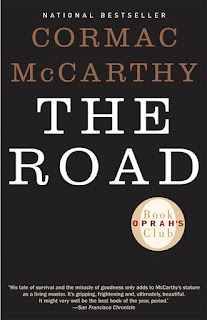
Book Review: The Road, by Cormac McCarthy


Yes, new(-ish) fiction, lest you all think I’m a Classics Guy. I’ve been wanting to read Cormac McCarthy for a while, having noticed his novel Blood Meridian on many Best Novels Of All Time No Go-Backs lists. Nothing like a book with the word “blood” on a best-of list – it could be written by Margaret Laurence and I’d still want to read it. Good for Cormac that he didn’t decide to call it “The Orchid Parasol” or something more ubiquitously “literary”. In any case, I have still to read Blood Meridian. However, I did get The Road, McCarthy’s latest book, for my birthday in November, so I figured it would be a good introduction to his work.

I remember, a while back, seeing a hardcover edition sitting rather dejectedly in Balfour Books (one of the best used bookstores in Toronto). I asked the person at the counter: “Is that new?”. “Yes.” he said. I was surprised, knowing then that McCarthy was a respected author, or at least his previous work was respected. “It’s really depressing.” he said, answering whether he’d read it. And you know, looking at the cover (which, yes, one should not necessarily judge a book by), which is all black with bleak lettering, I thought to myself: he’s probably right.

Flash-forward to 2007: a lady on television whose name starts with “O” picks it for her influential “reading club”. Suddenly, The Road, depressing or not, is receiving the sort of attention that poor little hardcover at Balfour couldn’t have imagined. Next thing you know, there’s a major film being released, based on McCarthy’s No Country For Old Men. In other words, his exposure went from zero (or “obscure”, in the mainstream sense) to sixty (recognized by-name in the mainstream, though I doubt he’s signing autographs for people stopping him on the street). While not trying to suggest the end result of McCarthy’s career is that I got The Road as a birthday present, it is a rather convenient way for me to spin this into a review.

The Road is set in a post-apocalyptic world: something happened a few years back which levelled civilization. What is left are abandoned buildings, ash-strewn landscapes, corpses, and a handful of survivors. The book concerns a man and his young son (whose names we never know) pushing a grocery cart with all of their belongings down a road, heading south to where the father hopes there is warmth, food, and perhaps life. They find sustenance wherever it is available, in whatever form, but more often than not push-on while fighting starvation. The father has binoculars, which he uses to scout the road ahead: for others. In this environment, as he tells his son, there are good guys and bad guys. For them, he carries a pistol. With only a couple of bullets remaining, the gun is intended to ward off scavengers, but the father comes to realise that, if it looks like they can’t survive, it may be necessary to use it on themselves.

Aside from their single-minded determination to keep moving south, above everything else is the father’s need to protect and provide for his son. There is a tragic necessity on every page of The Road, for the father to teach his son right from wrong, good from bad…and in turn, despite the savage necessities that happen upon them, his son is more often the one who inspires his conscience. When the father sleeps, we see his dreams – glimpses of a life before catastrophe. When he lies awake, watching over his son, he meditates on the brutal choices that lie ahead for them.

There are two profound fears expressed in The Road: first and primary is the spectre of other survivors. People roam about, often in small groups, killing others. The father and son spend much of their time hiding in the snowy woods, building fires out of plain sight to avoid being discovered by survivors. Looking for their clothing. For food. On this last point, there are passages in the book that are about as unsettling as one will ever read. The second fear, a more existential one, is one of separation and the question of how someone who spent most of their life in a settled world can teach a child born in the aftermath of its destruction, with no sense of what came before.

The Road may be depressing (especially if you’re reading it in the middle of winter, and listening to the new Radiohead CD), but it’s hard to put down. The father’s inner struggles are captivating, and the terror of not knowing what lies ahead for them is equally so. I cannot remember reading a book so quickly. McCarthy’s prose is stark. You realise that there are no apostrophes in words like don’t and can’t. Most of the book consists of clear, taught sentences that are not decorated with elaboration. Yet, there are moments of deep, poetic reflection in the narrative which, from a philosophical standpoint, convey a humanity extracted from the world as it has become. The Road manages to be both chilling, horrific, and touching, sometimes within the space of a single page. To that extent, it stands as a remarkable piece of fiction.

The Road, by Cormac McCarthy (ISBN: 978-0307265432) is available at a fine independent bookstore (used or new) near you, or online at any number of vendors.

Note: his previously-mentioned novel, Blood Meridian, is set to become a film, directed by Ridley Scott. Let me tell you, I can’t imagine anyone doing as good a job as the Cohen brothers did for No Country For Old Men. If you haven’t seen it, please do.

[3:11pm I’ve re-edited this for some factual mistakes, clarified some opinions, and added 5% more humour, all due to faulty memory and a lack of coffee – ed.]

Share

Book Review: St. Petersburg: A Cultural History, by Solomon Volkov

This was one of the 500lb (226.79 kg) gorillas I had on my plate, which I was delighted to finish before the end of 2007. Delighted, I say, not necessarily because it is the best book but rather that I’ve been reading it on and off for the last three years and, like a stagnant relationship, I was looking forward to the inevitable end.

I’m an involuntary Russophile. There is no Russian blood in my family, not even neighbours. I suppose it started when I was living in Alberta, just outside of Stony Plain. It was Grade 9, and we happened to be taught Russian history. I couldn’t get enough of it. I loved it more than anything I’d had shoved down my throat to that point.

Anything I can say about Russia, I can only say as someone who’s never been there and has only read about it. In other words, I only know enough to get me in trouble. However, when I read Russian authors, hear Russian music, and see Russian art, I see a tenacious, almost ruthless, intellectual veracity. If something passionate can be dispassionately analyzed and then expressed upon, the Russians will find a way to do it definitively, the first time, and do it in such a way as to set an example for the rest of the world. When you look at Russia’s cultural contributions (art, literature, dance, film), even when produced under the worst of political/economic circumstances, the sheer quantity of excellence is devastating. I won’t even go into chess…

So, when a colleague lent me their copy of Solomon Volkov’s St. Petersburg: A Cultural History, I felt obligated to read it, if only to broaden my understanding of this cold, isolated country (as opposed to mine). Volkov is best known to music aficionados for Testamony, his controversial account of composer Dmitri Shostakovich’s life in relationship to the chilling environment set by then-ruler Josef Stalin. In St. Petersburg, Volkov tells the story of what used to be more than just the cultural capital of Russia (indeed, since the time it was forged by Peter the Great, up until when the Communists decided to uproot its status in 1918, it stood above Moscow as the nation’s crown jewel). From the inspired/tyrannical vision of Peter to build a European-styled capital, through the fall of the tsars, the rise of Communism and its slow dissolution, St. Petersburg accounts for the artists whose work boldly defined the city, its people, and who helped contribute to what Volkov puts forth as a tragic mythos.

St. Petersburg’s cultural icons are represented chapter-by-chronological chapter: Pushkin, Diaghilev, Akhmatova, Balanchine, Shostakovich, Brodsky, as well as tens (if not hundreds) of others within each part. Volkov’s effort buckles under the weight of its inclusion of *every* notable figure – the book is 624 pages long. Too long, to be honest, if you’re looking for “breezy”. I’m not sure if anyone is (or should be) looking for a “breezy” historical cultural synopsis of St. Petersburg, but this ain’t it. As a result, the book is not only exhaustive in content, but exhausting as a read. However, Volkov approaches St. Petersburg with a desire to put on paper the lives and trials of everyone who mattered – a commendable effort, if difficult to absorb for anyone who isn’t working on a thesis.

Reading how St. Petersburg was renamed Petrograd during the First World War (as a measure of anti-German sentiment), only to have it re-renamed Leningrad (regardless that Lenin couldn’t stand the place) after the rise of the Soviet Union demonstrates how the city was often cruelly abused by political authority of different stripes. For me, the horrific tragedy of what happened (not only to St. Petersburg, but to the whole of the country) after the second revolution is fascinating to read. People disappearing in the night, to be killed for treason or sent to gulags with little in the way of a trial. The state criticizing your art as “formalist” as means to bury you and any reputation you have. This is the stuff that people need to understand, not just so they understand what happened specifically during Soviet rule, but so that similar developments can be thwarted in the future.

Whether this is the book people should be reading to have an understanding of St. Petersburg’s history is another question. As mentioned, it’s extremely dense and the tone is often encyclopedic, which is not exactly easy on the eyes. Volkov is successful in portraying a parallel mythology of the city that is transmuted by history, but less successful in creating any real urgency to keep reader’s attention. Constructed in chronological chapters, the sixth and final is a mess in places – obvious copyediting errors and the sense that, structurally, it was pieced together in a rush. In the end, this is a worthy reference piece for its extensive (and sometimes first-hand) information, but I wouldn’t recommend this for someone looking for a digestible (read: concise) narrative.

St. Petersburg: A Cultural History, by Solomon Volkov (ISBN: 978-0028740522), is available at a fine independent bookseller near you, or online at various sources.

Note: I would like to go to St. Petersburg some day. If you are familiar with the city and have any tips on places to stay (or not stay), sights to see, and/or cultural anomalies that a traveller should be aware of, any information would be appreciated.

Share

Book Review: The Odyssey, by Homer

“As soon as Dawn with her rose-red fingers shone once more […]”

Homer’s Odyssey is one of the 500lb (or 226.796kg) gorillas I’ve been reading as of late. I came to it strangely. You see, eventually I want to read James Joyce’s Ulysses (a gorilla estimated to weigh a half-tonne). I knew that it was going to be a slog, so I did some research in preparation. Lo, it was suggested I read The Odyssey, as Ulysses tends to make reference to it. And thus, the Fates, if not Athena herself, recommended my next book.

The Odyssey isn’t a novel, but rather a song/poem much in the same way as the ancient epic, Gilgamesh (and if you don’t know what that is – and no, it’s not a reference to the evil magician from the Smurfs – don’t worry about it. I’m just trying to find another example that isn’t also another Greek work from the same period). It was never originally written down, but rather carried from person to person in the same way you would hand someone a CD of a song you’d like them to hear. Preserved through history as an oratorical epic, Homer’s Odyssey is an account of Odysseus, the Achaean king/hero, and his Job-like 10 year quest to return to his homeland, Ithica, having fought a decade before in the Battle of Troy (recounted in Homer’s earlier work, The Illiad).

What’s immediately engaging about the telling of The Odyssey is its surprisingly non-linear construction. We don’t start with the fall of Troy and Odysseus’ return to Ithica. Rather, we begin with the immortal goddess, Athena, seeking to undo the curse laid upon Odysseus from the earthquake god, Poseidon. From there, she confronts Odysseus’ son, Telemachus, living with his mother, Penelope, in Odysseus’ Ithican palace, now taken over with young suitors angling to wed Odysseus’ abandoned wife, laying waste to his kingdom in the process (note: the Greek gods tended not to come down and appear to mortals as themselves, but rather as fellow mortals – presumably shy folk that they are).

It is only after this substantial preamble that we – in filmic terms – cut to Odysseus, stranded on the isle of the immortal goddess, Calypso, where she has kept him for years as her…well…is “recalcitrant love-slave” applicable? Yes? Okay then. It is only through Athena’s indirect intervention that Odysseus is allowed to leave and finish his journey. Along the way, he is eventually allowed to provide the details of his painful journey since the fall of Troy: the land of the Cyclops, the Sirens, the Lotus Eaters, the thunder of Zeus, the House of Death, the nature of Poseidon’s curse. If you have any inkling or interest in swashbuckling adventure, heroic tragedy, monsters, mythology, or men transformed into sheep, there is no reason not to follow Odysseus’ tale.

Even preserved in verse-form (read: there’s half as much text on the page as in a typical novel), The Odyssey moves at a fast clip – though its thickness may intimidate you at first glance on the shelf. It’s a legendary tale that’s not like cough syrup to read – in fact, you may just find inspiration in its construction, evocativeness, and imagination.

The Odyssey, by Homer (ISBN: 978-0140268867) is available at a fine independent bookseller near you, or at any number of online sources. Please note: this review is based on the award-winning 1996 translation by Robert Fagles, who also produced a version of Homer’s Illiad. For those on the fence, there is a very readable summary of the book and its history here.

Share

Book Review: Introducing Quantum Theory, by J.P. McEvoy

Never let it be said that I’m only a fiction-reader…

I’ve been fascinated with the concepts (and the idea) of quantum theory since I was but a boy in high school. There were several problems, however, that stood in my way:
1) I sucked in both math, physics, and chemistry (though I attained a rather impressive “B” in biology).

2) Quantum theory is notoriously difficult to visualize, and if you’re an artsy-type person who sucks in mathematics, it will perennially seem somehow “just around the corner” from one’s understanding.

However, as Bukowski said, “perseverance is greater than strength”. I’ve never given up my interest in quantum theory, even though I long ago realized that I would probably never truly understand it within the language it was conceived (ie. math). For a writer, not being able to visualize with language is a form of impotence.

One day, during a “second wind” of faith – that I could find a book which could magically explain quantum theory comprehensively – I posted my question to a message board. It would be a year later before someone responded. After adjudicating my level of “maths”, a kind person suggested Introducing Quantum Theory by J.P. McEvoy.

Having previously read (surprise, surprise) Introducing Wittgenstein, I was familiar with the format of the Introducing series; essentially, they are well-written and concisely distilled comic books. I know of no better way to describe them and I can think of no better series of books that manage to grapple subjects as diverse as Keynesian Economics and Kafka for the curious mind. They also make great streetcar reads.

It took some hunting – let’s face it, this isn’t exactly a top-seller – but eventually I found a copy (with thanks to Toronto’s World’s Biggest Bookstore).

And now that you’ve read my heart-warming prelude, the review…

The most important paragraph in this book, as I discovered about a quarter of the way through, is on the second last page, in the Further Reading section:


Quantum theory cannot be explained. Physicists and mathematicians from Niels Bohr to Roger Penrose have admitted that it doesn’t make sense. What one can do is discover how the ideas developed and how the theory is applied. Our book has concentrated on the former.


I wish I’d known this when I was a kid.

That said, Introducing Quantum Theory is an excellent primer. It focuses on the historical impetus which led to the stumbling-upon of the theories which now formulate our current (if not fixed) understanding of quantum phenomena. It starts with establishing the era of Classical (Newtonian) Physics – so assured were scientists of the day with the prevailing theories that it was referred to as the Age of Certainty…and, rather deliciously, it began to unravel via the route science often is forged: experimentation. Thanks, primarily, to Max Planck, Albert Einstein, and Niels Bohr, foundational rules of Classical Physics were brought into question and a new, quantum, world was revealed.

The book is full of formulae – it has to be – however, it’s not necessary for the casual reader to use the formulae or to necessarily understand what any given formula does (although the latter would be nice). The concepts are outlined well by J.P. McEvoy – the conflicts, the dead-ends, and the frustrations of the worlds greatest minds as each took turns refining the prevailing speculation. He has done a great job outlining, linearly and non-linearly, the essential questions: how did this happen, when did this happen, who was involved, and – most importantly – why we should care.

It is a book that deserves (requires, perhaps) that the reader approach it from the beginning straight to the end, on several occasions in order to fully grasp the evolution of quantum theory. I fear that, in one read, it may all be too much for most – personally, I look forward to approaching this book again, as I feel it of great value which, over the course of several reads, will keep inspiring me in different ways. It’s important to realize that this isn’t necessarily about science, but about the refinement of how mankind perceives the world around us.

Introducing Quantum Theory, by J.P. McEvoy (ISBN: 1-84046-577-8) is available at an independently owned bookstore near you, or available at various online vendors. I should add, since this book incorporates original illustrations on every page, the graphic artist: Oscar Zarate.

Share