Just giving everyone a heads up that I will be having a short story included in the late-October / early-November issue of The Quarantine Review (more about them here). I’m very happy to have another piece available to the world, and once I get a confirmation of the publication date (it will be e-pub only, fyi) I will post here and on my author site. Cheers.

A Hard Week
Last week was hard. Overwhelmed by the end of it. Head full. No room to deal with the quotidian what do you thinks and what would you like to dos that approach us from friends and loved ones. These sorts of periods are not necessarily rare in my profession, as a psychotherapist. A common underlying cause, what makes it so overwhelming, is, naturally, holding the weight of my clients’ concerns, their varied life events, the precipices, and shadows.
But this past week especially, it felt like I was talking to myself in parallel to my clients. We were touching on things, incidentally, that seemed to resonate with me, my own past and present*. We talked about broken romantic relationships, we talked about unresolved dynamics with parents that likely may never be resolved, we talked about feelings of professionally lacking when up against our peers. We talked about death. We talked about heartache, complicity, and that fucking word “selfishness.”
So there was this sort-of doubling effect, like when you’re on a smartphone call and suddenly you can hear your own voice echoing because there’s a bad connection, and no matter how much you try to tune it out you can still hear every UM and YES echoing a second after you say it, in the shitty way your voice sounds like when you hear it played back to you.
One of those weeks. Material that, using its own logic, veers a little too close to mine. Most of the time this wouldn’t cause much in the way of distortion — that echoing voice. However, given the state of the world (remember when people used this as a figure of speech?) and where my mind happened to be, it was harder than it needed to be.
This week will be better.
* these are anonymized/defocused to protect both my clients’ and my own material
Anticipation
Like most people, I have been dealing with the lockdown in waves. Sometimes my mindset is functional — I can don my mask and walk to my office through empty streets, work with clients via videoconferencing, and come home. Repeat and rinse. Other times my mindset is quasi-functional — I find myself forgetting to follow the arrows taped to the floor of the grocery store, find myself asking myself how long I can go on with the current lockdown conditions. This isn’t helped that one of my parents had to go in for surgery to remove a tumour recently. Talk about helpless. Like anyone else, I’m not immune to situational depression and anxiety — and there are plenty of reasons for us to feel this way, given the unprecedented situation we are in.
One thing in particular I’ve noticed is how I’m getting hung up on correspondences, especially (though not exclusively) with retailers I’m purchasing items from. Over the course of the last 40+ days I’ve had to order various things by phone or email for delivery or curbside pickup: a new pair of jeans, DVD rentals, cans of cat food. And with each inquiry I find myself anticipating their response, going so far as to reserve space in my head for the response, looking forward to it when it comes. I’m not sure what this is about, however I think there’s something significant about the word anticipation in this context.
Anticipation as in looking forward to something sure, that tomorrow holds something firm for me, even if it’s a denim retailer in Vancouver confirming that, no, the jeans I ordered don’t require hemming because the inseam is an acceptable length. Quotidian things that, six thousand years ago, back in February, would’ve been quaint, if routine, correspondences.
The technicolor truth is that we are all living our lives without knowing what each subsequent week is going to look like — and I’m not even talking about geopolitical events, I’m talking about these quotidian things: when will the gardening centres be re-opened so we can pick up soil in order to plant basil seedlings, when will I be able to speak with people again without wearing a mask and standing 2m away? When will I be able to walk into a coffee shop and sit at a table, when will I be able to give a friend a hug. Receive a hug. Talking, touching, lingering. Unguarded.
So, when I get that email from the retailer in Vancouver, a little bit of normalcy has been temporarily restored, and I feel rejuvenated: we’re going to get through this shit, everyone. But then the opposite happens: a place I’ve done tonnes of business with is offering curbside pickup — just contact us on Facebook! And I do, and there is some preliminary back-and-forth…and then nothing. I nudge, reminding them that I’m waiting to hear back from them. Nothing. I nudge again. Nothing. Two weeks pass. I leave a message on their business phone…nothing. All the while, the Facebook group for the store is updated with thanks for all those people putting in orders. And I want to punch a hole in the wall, because this very simple, straight-forward thing that I was looking forward to has — for entirely unknown reasons — been thwarted. And on bad days the little paranoid voice in the back of my head is wondering whether I’m being snubbed for some reason, which — believe me — is the last thing you want to have nagging you during a global pandemic whose key feature is self-isolation, while you’re waiting to hear about your parent’s cancer surgery.
I think we all, to varying degrees, want or need to know what’s coming around the corner, and the current situation has made that opaque. Amidst the not-knowing we are party to a lot of speculation through ill-informed social media posts and the spectacular mismanagement happening across the border in the US, and to a slightly lesser degree in the UK. We look for signs of normalcy, of hope (though I am suspicious of how much weight Western society puts on hope) around us. But it’s a tremulous state of normalcy, and so no wonder part of me gets upset that the sole proprietor of a particular store, for whatever reason (mistake, coincidence, “new normal”), isn’t returning my inquiries — just as I feel rewarded from those who make their best attempts to get in touch so to does the opaqueness of silence reinforce the dark, seemingly interminable bullshit we are living through.
This isn’t normal, I remind myself. People are trying, I remind myself. Yet, still, there is this forward-looking part of me, wanting seemingly superficial reassurances which — if I’m honest — isn’t superficial, but practical (if only to help me get through to the next week).
Michael Cahill, Coda
Let me begin by saying that this is the short version…
For those who haven’t been following my blog, my uncle, Michael Cahill, was shot and killed in 1979, in Austin Texas. This happened as he came upon someone burglarizing his apartment, who fled on foot with my uncle’s prized possession — a Guild D40 acoustic guitar. As I covered in 2006, this sad episode in my family’s life was resurfaced by journalist Denise Gamino of the Austin American-Statesman (Gamino is now a former staffer and her very excellent article is no longer on their site, however I’m linking to a copy of it here). Fortuitously, a producer from America’s Most Wanted came across it and reached out to my aunt for permission to spotlight this cold case on one of their episodes. And so, in 2007 I got to see the story of my uncle’s murder not only re-explained and re-contextualized, but also recreated with actors on broadcast TV.
And then…nothing happened. I wrote about it here and here and that generated interest. People reached out to share their theories, sometimes the odd story about Michael. Over time — especially given the cancellation of America’s Most Wanted (and the erasure of its online presence which wiped out all of the stories they covered, a crime in itself for families whose only hope for justice was the information that site provided) I grew ambivalent to any suggestion that I should be hopeful my uncle’s murder would find any sort of resolution.
On February 7th of this year, I got on a plane to Tulum, Mexico, for a vacation. When the jet landed on the tarmac of Cancún International Airport, I saw that I’d received a voicemail. I ignored it, assuming it was work-related, or maybe just spam — it was from an area code I didn’t recognize — until I returned to my office on the 18th. It was a Tuesday.
The message was from Randy Crafton the owner of Kaleidoscope Sound, a recording studio in New Jersey. While doing an inventory of their music equipment, they looked up the serial number of one of their studio guitars. Unlikely as it may seem, even as I write this, that serial number was the same as the one my uncle died chasing in 1979. It had likely changed hands many times; at some point I’m sure someone will investigate this.
This past Friday — Good Friday — the guitar was delivered by UPS to my father in Houston, just in time for the 41st anniversary of my uncle’s death. My family down there is, to say the least, ecstatic, and I am still gobsmacked at how this all came to be. Let’s face it, the probability is beyond calculation. I’m grateful, which feels like a tremendous understatement. Grateful to the people at the studio in New Jersey. Grateful to everyone who has shared Michael’s story (including that serial number!) on the web. I will most likely write something more comprehensive about this, because there are so many moving parts — names, places, people — and the story is much larger than what I’m able to encapsulate here. But I’ll get to that when the dust has settled.

Comedy
The next book is going to different.
I’ve given up on “the next book isn’t going to be an ambitious book” because inevitably I churn out something that ends up doing so, or at least attempting. That said, I would like to write something funny, which is hard — at least if you’re aiming for something that is consistently funny. Then there’s the type of funny. Not all funny is funny to all, and that’s the main problem with writing something comedic: it has to have a consistency that you wouldn’t necessarily expect from other genres (as long as a thriller contains a handful of thrills then it earns the merit badge of its title), and not just in terms of how populated it is with humour; there’s consistency in terms of the volume of material but there’s also consistency in terms of texture — is this a satire that a smaller number of people with more rarefied knowledge will appreciate (think of the film The Square, a wry satire of the upper echelons of the art world), or a broader, more bombastic, plot-driven variety (see Hitchhiker’s Guide)?
It’s intimidating and I may abandon the whole thing, but Radioland, my second book (hello, publishers at this year’s London and Frankfurt Book Fairs — my agent will be looking for you!), took a lot out of me and I’m looking to try something stylistically different.
Wish me luck!
The One I Feed
If I’ve learned anything this year it’s the command, perhaps even the primacy, that music holds over my creative life, which is strange(ish) for someone who isn’t a full- or even part-time musician. Let me qualify “someone who isn’t a full- or even part-time musician”: I can play drums decently well, I’m barely adequate on keyboards, and I’m beginning to develop confidence on electric guitar. But there are no stakes for me: I’m not in a band, I’m not hoping to become a recording artist. So, as an established/emerging writer, what’s the deal?
The deal is that music presents as part of a triumvirate of full-blooded influences on me: music, film, and writing. I am incomplete as an artist without one of these. Don’t get me wrong, I love other forms of art — dance, painting, sculpture, etc (to infinity) — it’s just that my DNA is activated by music, film, and writing.
But the predominancy of music in my life sometimes has me worried.
Let’s start with writing. Music twists around my work almost symbiotically. The Society of Experience involves a character whose day job is a music supervisor for film and TV productions, and thus the narrative is punctuated with songs from the very beginning; the main character is sometimes haunted by the sound of a jukebox in the bar beneath his apartment. And yes, of course I created a soundtrack for the book’s launch (which features music mentioned within as well as inspired by the themes and subject matter). My next novel, Radioland, involves a “successful” musician having a nervous breakdown. The novel I’m working on right now, [untitled matt cahill project], involves the power of a DJ on a young boy in the country. If I could afford the rights I would quote song lyrics to introduce book sections.
Even when it comes to film, music has been immensely influential. From the quirky soundtrack of Brazil to the Wagnerian flourishes of Excalibur, I have not only fed deeply on music scores and soundtracks but have followed a countless number of rabbit holes. If it hadn’t been for watching Underground, I wouldn’t have spent a year chasing down recordings of Serbian brass band music. In film school, one of the best things I ever did was a one-take b&w short I shot on a wind-up Bolex that I played back w/ The Jesus and Mary Chain’s Reverence blasting in the background.
I care deeply about music to the extent that, on a social occasion where we were taking turns playing songs on a nearby jukebox based on a chosen theme, I was asked to choose 3 songs I hated. I said I wouldn’t. And I wouldn’t because a) it meant sitting through 3 songs I hated, and b) life is too short to listen to songs you don’t like. It made for an awkward moment and I felt somewhat precious, but that’s how it goes when you take a principled stand about most things.
So, my worries, however ephemeral, are whether I’m suffering from a blindspot in how I prioritize music. Is it a blinder? Is my appreciation for it distorting my perspective insofar as my writing (in particular) might suffer? I don’t know. I don’t have a lot of artist friends, and the ones I do have probably wouldn’t deem this to be something worth much concern. That said, sometimes I wonder: am I using one art form to inform and/or expand another, or am I misusing either/both? Should I be concerned when things become sacrosanct?
These are not really questions that require answers, but as an artist who wishes to be reasonably self-aware, they are good to ask nonetheless.
The Memphis Effect
As mentioned in my last post, going to Memphis had an effect on me. One thing that it affected that I didn’t have the space to mention was how I was influenced musically.
First, let me tell you about American museums (or at least museums in Memphis): unlike here in Toronto (I’m thinking of the ROM) where you are basically in an Ikea and are able to roam about and find the exits freely, the museums I went to in Memphis (namely the National Civil Rights Museum and the Stax Museum of American Soul Music) subscribed to a similar script. First, thou shalt sit and watch an obligatory documentary for at least 12 minutes before entering said museum. Second, after said documentary has been screened, thou shalt exit through appointed theatre exits and continue through a prescribed path until the gift shop approacheth, not unlike a mouse in a maze.
Thing is, during the Stax documentary (which was very well done, as was the NCRM doc), I witnessed the apparition of Sister Rosetta Tharpe. Now, if you have a decent knowledge of rock-and-roll, you might have heard Sister Tharpe’s name as an early influence on the genre. This is similar to how some of us might hear the name Kepler attributed to astronomy or Cruyff as pertains soccer. I sat there on that Saturday afternoon (I was amongst a cohort of three people) and watched an excerpt of her performing the gospel standard Down By The Riverside with a choir behind her, ripping into her white Gibson SG for a ridiculously soulful guitar solo.
That did it.
Leaving Stax, I proceeded to watch everything I could on Tharpe, with particular attention to her electric guitar performances. This was not someone playing rhythm guitar while she sang, strumming chords. Just as her voice had a beautiful, soaring quality with a lot of power behind it, so did her guitar work. Technically and tonally she was (and is) extremely expressive, demonstrating a vocabulary of electric guitar playing that predated rock-and-roll as we know it, combining both religious and secular gospel with R&B. There are a number of good places to read more about her — here’s one. And another. It’s no surprise that when she was finally (belatedly) inducted into the Rock and Roll Hall of Fame, it was Alabama Shakes’ Brittany Howard who introduced her.
But I wanted more. I was inspired to the degree that I wanted to explore what I saw beyond listenership. And so I did my research, and after a couple of weeks, I located a guitar teacher. And after a lesson or two, I ended up locating a semi-hollowbody guitar — an Epiphone Riviera Custom P-93 (pictured) that someone was selling because they weren’t finding use for it.
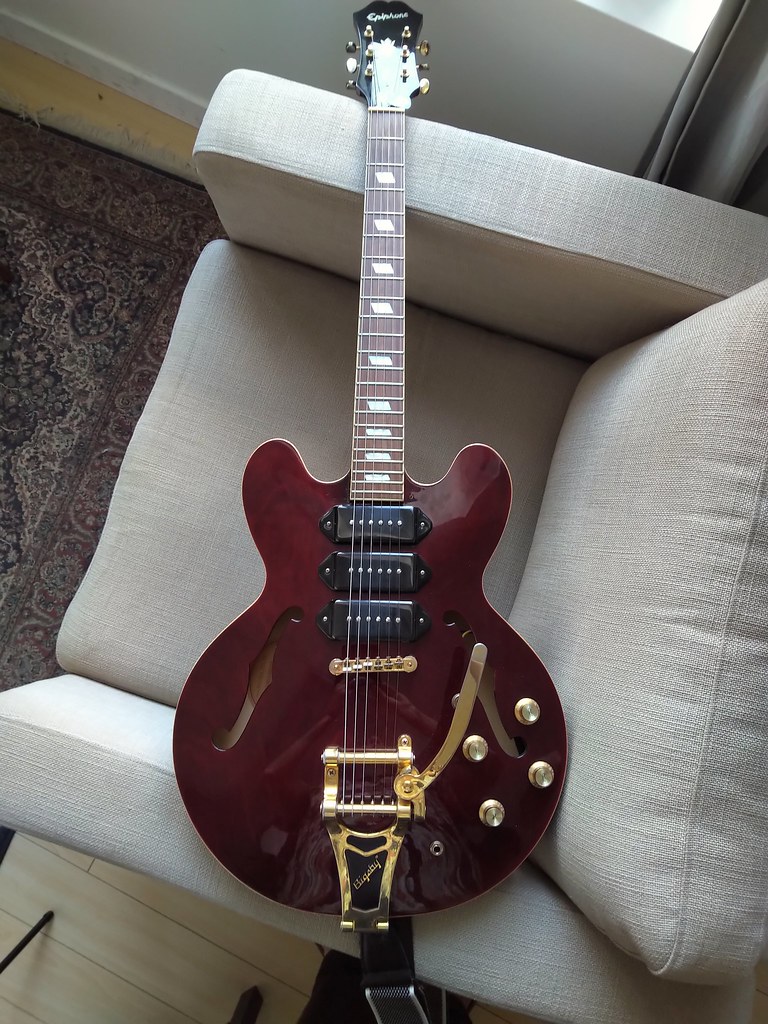
I play drums and can do adequate keyboards, but I’ve never (ever) wanted to learn to play guitar (just magically “play” it? Sure, but not actually learn the thing), despite the fact that some of the greatest influences on me are from guitar-driven music. Learning guitar is a strange yet rewarding process of teaching the increasingly calloused finger tips of my left hand to traverse the frets and coordinate themselves, touching the strings at first hesitantly, then, with practice, confidently. Oh, and then there are the pickups, the tuning, the tremolo bar. I’m not doing this because I want to start a band or play on stage, but rather because I’m drawn to this process, and a relationship that I am building with the instrument.
What am I learning? Mostly surf and rockabilly, for the time being.
Here’s more SRT:
Revival
As mentioned in this blog’s archives, not only was my uncle Mike the victim of a fatal interrupted burglary in April of 1979 (Austin TX), but I had the absurd experience of watching this played out on television in 2007 when the producers of America’s Most Wanted chose my uncle’s cold case to spotlight.
For a while there were people getting in touch with me, most whom had benevolent intentions: tips, recollections, perspectives on my uncle’s murder and the cultural scene of the time. I’ve also had a couple of troglodytes holding “vital” information over my head in the hope that somehow I would allow them the glory of solving this case.
Very recently, however, perhaps because the 40th anniversary came and went, I’ve been receiving a new stream of emails from people who have known Mike. And as much as I appreciate it, I have to admit that I don’t know what to do with it. I’m not talking about tips or any bits of info that would solve the case. I’m talking about personal memories of Mike the human being.
It’s draining.
I’m a psychotherapist. I stickhandle a lot of deeply personal information on a daily basis, but at the end of a session (barring a particularly resonant narrative) I’m not processing the information. It stays in the session. These days, when I receive an email recounting a lot of personal information about a relative I never had the chance to meet, who died tragically, and whose case will probably never be brought to justice, I find myself left…well, numb. I have a natural respect for those who wish to share their thoughts and feelings about my uncle, but I don’t know what to do with it. I can only imagine what it’s like for families whose tragedies are caught in the public eye who receive torrents of public well-wishing. It’s heart-warming and overwhelming, then after a while you begin to feel like a cipher for others’ projected feelings.
Anyhow, just giving y’all a little taste of the glory that is having a dead relative on TV.
Community
I’d almost given up on pick up soccer.
In Toronto, if you’re looking to play soccer on a semi-regular basis you’d have better luck finding an Ayahuasca ceremony than a game that starts before 9pm an hour away from you. I suppose credit is due to the fact that soccer is popular (this wasn’t always the case, and there was a humiliating period of time in the late 90s where more people were playing “Ultimate” frisbee than soccer). However, finding people to play with casually — the sort of pick up game I played when I first moved to the city — has gone by the wayside in lieu of organizations such as Toronto Sport and Social Club and apps such as OpenSports.
I ran a co-ed pick up game for several years. This was after several previous migratory years of word-of-mouth and occasionally stable runs with a group of friends and acquaintances at locations across the city (note: if you want to discover a city, this is a very good way). Back then there was no leader per se, however, as good as that sounds I feel that either this part, or someone electing themself as the certifiably wrong leader, led to the instability. The pick up game I ran was fairly stable: Sundays in Stanley Park. Sometimes we were hungover, sometimes we treated it with the reverence of Mass. I met some very interesting people over those years, from a variety of backgrounds, and I’m pretty sure that, beyond fresh air and exercise, it was these relationships that contributed to helping me find myself. A secure base, as we say in the therapy biz.
These things don’t last long. They just don’t. Whether it’s a writers’ group (which I co-ran for 9yrs) or pick up soccer, sometimes things just don’t work in the long-run. Democracy kinda sucks when it’s on the level of things like this: people don’t show without giving notice, or want to change the start time to suit their own needs. In a fictional country, as well as mandatory military service, there should also be the option of organizing a regular pick up sports game (as well as the option of working in a retail environment during the Christmas season, particularly in the Holt Renfrew concourse).
For the last 10 years, for better or worse, I’ve been involved with associations like TSSC in order to get my soccer fix — organizing things sucks, and why not pay for the privilege of walking onto a semi-pro pitch if you can, and not the community fields pockmarked with holes and strewn with tree branches and dog shit, using gym bags as goal posts. But I kinda lost my religion around these organized games over time. They were inconveniently scheduled (I can go into great detail about what it’s like to play soccer at 11pm on a Sunday) and if you weren’t able to put together a hand-selected team to register then you were individually thrown into a randomized team, which was basically admitting you weren’t going to win many games due to lack of familiarity with each other (that is, if you got along). I hated forgetting — because life — about each sign-up deadline only to discover that it was booked solid, then putting myself on a sub list.
One day, a bartender who is also a reader of mine, commented on my Ajax scarf (this was versus Juventus in the Champions League quarter finals, first round). We spoke a bit about playing pick up, and he mentioned that there was a bunch of people that met @ 3pm on Sundays at ________ Park. I didn’t know what to expect, and yet I secretly hoped it could work out. What with my partner on an extended trip across the Atlantic, I found myself available, and along came the first Sunday, and it was warm and sunny…so I went, secretly hoping magic would happen.
I had to stick my neck out. It looked like a bunch of older men at first, and I wondered if I’d intruded into a more private event, but as people showed up I could see this was a regular thing that had been going on for years, that travelled on word-of-mouth only. The range of ages went from 20-something to 50-something. Unlike a lot of pick up I played when I moved to Toronto there was no prima donna behaviour, although there were comically long periods where the older Latinx organizers argued over the size of the field-of-play and other distractions. On the sideline was a group of “fans,” friends of the older players, who brought beer and cheered any runs at goal. My Spanish has grown, let’s put it that way.
It was disorganized and basic, and I loved it. I instantly appreciated the casual nature of the group, their insistence that I bring people with me next time, the beer that one of the players handed me afterward. Everyone was there to have a good time, and there was to be a BBQ afterward (which I was unable to stay for). I can’t put it much more plainly, but this is the Toronto I adore. These are my people.
Pain, pt. 3
So, according to the chiropractor I was referred to, I have an irritated disc [“subacute grade III mechanical low back (irritation of the L5/S1 disc, affecting the L5 nerve root on the left”)]. It’s nice having an answer. It’s also nice to hear that, contrary to what my impatience tells me, I’m doing very well (though I’d leave out the “…for your age” part, ahem). Basically, she said to keep doing what I’m doing and give it time.
The pulled Achilles is slowly healing. Ironically, though it didn’t stop me from running that 8K race, it does prevent me from doing my baguazhang forms due to the crouching stance required.
In the meantime, the weather is warming up, my winter coat is spending most of its time unused.
Again: give it time.