How To Measure Progress When Not Much Is Really Changing

I’m a fiction writer.

This is what I tell people, which is often followed by digging my fingernails into my palms, hoping they don’t ask me if-

“Have you been published?”

No. The answer is no. And no, you can’t tell them that a poem you wrote in high school was published in the local paper – you’re over 30 and nearly twice the age of that (wonderfully talented) kid.

“Um…not yet.”

This is about as affirmative as it gets. It’s like telling someone you’re a bus driver, and when they ask a perfectly normal question like “Oh, where? For what company?”, you reply: “Actually, I’m not driving a bus right now…I’m hoping that someone will allow me to drive a bus soon.”.

I’m a bus driver without a bus, albeit with a route of sorts and sufficient credentials to do the work without injuring passengers (save for their sensibilities at times). I’ll let that analogy fizzle like a wet campfire. Needless to say, telling people you’re a fiction writer without having anything to show in terms of published work, one feels like an impostor after a while. Gladly, writers naturally feel like impostors so it’s not that bad.

The reality is not quite as depressing as it appears tm. I’ve only been at this seriously for a few years, having spent a few years before that working on a novel which I ultimately decided to shelve, lest I spend years more perfecting something I’d outgrown and was really tired of staring at. Since then, I’ve crafted several solid short stories and have started a new novel. The more I work on short stories, the more improvements I see in my writing overall which then reflects in the novel. It’s a nice arrangement, save for the fact that the time/energy I devote to the short stories are subtracted from what’s going toward the book.

My strategy is that the short stories – the good ones, not the ones I hand people and preface with “It’s an experiement!” – are “easier” to get published, if only because they require less time to write/revise than a novel. Thus, with some sort of publishing precedent, it would be easier to attract a publisher for the novel.

Of course, I’ve yet to have anything of note published. I’m trying to keep at least two submissions outbound at all times, but even that’s tricky because you want to gear the right type of story (stylistically, etc.) to a publisher who will be most receptive to what you’re offering. Add to this that waiting for acceptance or rejection (the latter being all the rage these days) can take anywhere from 3 weeks to 6 months with ethical penalties if you submit the same piece to more than one publisher at a time. So, let’s say you spend two months on a short story – from ink on the page (I still do my rough drafts by hand) to “rev. #12f” on my laptop. If the publisher you submit to (assuming, like what happened to me and the magazine Maisonneuve, the post office doesn’t return it claiming they can’t find the address) takes 3 months to get back to you, that’s almost half a year spent with no dividends to show (aside from the aforementioned improvements in your writing, which, when you receive a rejection letter, isn’t very compelling at all).

Fun.

Yet, if I didn’t think my work was good, I wouldn’t bother. If I didn’t see improvements in my skill, I wouldn’t bother. I have to remind myself that, although I don’t have anything to show for my efforts as regards to getting published, I do have the work itself, which is no small accomplishment by anyone’s measurement. In any case, it’s all I have at the moment – that and will.

And the moniker, “fiction writer”.

Share

Translation, Traducción, and перевод

I used to hang-out in cafés when I was in my early twenties. It was a means to get out of the house without going to bars. Chances were, the conversations were better in cafés, and – depending upon the type of café – the people were usually a little more sophisticated [why writing that word feels like an elitist thing, I’m not sure – is there something wrong with sophistication?]. Most of all, cafés are cheaper than bars, and when you’re in college and starving, it made sense to choose the former if you wanted to avoid the bottleneck of debt.

There was a place in Burlington (Ontario, sorry Vermont) which lasted perhaps only a year (as all good things die early in Burlington, including the dreams of its youth…but I digress). I can’t even remember the name – French, I think. The owner was a very interesting fellow, an accomplished academic who’d lived and studied in Paris previously. I’m not sure how he managed to afford a café in the middle of a very chi chi shopping square, but he made the best of it: poetry readings, live music, parties. It was all very fin de siècle; nothing like that can live for very long in a town as complacent and suburban as Burlington was at the time.

I remember one afternoon, sitting with him (his name escapes me…so much of the years from 1990 -> 1995 escape me), and chatting. The topic arose of translation. He revealed that he wrote about the aesthetics and potential controversies of translation. Can you imagine having a book published about translation? I couldn’t then – it was something I simply took for granted and sometimes still do. The more we talked, the more I realised how much blind trust we put in the hands of the person whose job it is to convert the prose of the world’s great non-English-speaking writers. It never crosses our minds that a translator could be culturally prejudiced, or simply unimaginative for that matter.

Let’s face it: when I recently read Crime and Punishment I didn’t hesitate to think that I was reading anything but the prose of Fyodor Dostoevsky. But, of course, it was a translation. I can only assume it was accurate, not that I would have any way to tell as I only have an elementary understanding of Cyrillic (let alone Russian). What is astounding to me, is to think of how effortless and transparent the best translations are – when I consider the acrobatics some of them must go through in order to preserve the magic of the original text (the rhythm, the flow, the style, the weight, the economy) I always conclude that it must be such a rewarding and paradoxically unheralded role to play. Who translated the copy of Crime and Punishment that I just finished reading? Couldn’t tell you. I didn’t look.

This was brought to my attention most recently, and most magically, with the appearance of the book The Master and Margarita in my life. I was speaking with a Russian composer one day, relating how much I enjoyed speculative fiction from former-Soviet countries (Stanislaw Lem, the Strugatsky brothers…) when he mentioned, “Have you read Master and Margarita, by Bulgakov?”. “Who??” was my response. Let’s face it, Bulgakov is not a name etched in the collective memory of popular literature. “You must read Master and Margarita.” was all he said, with that particularly curt Slavic insistence which intones the inherent universal importance of whatever it is that’s being recommended, without question. So, I went on my laptop and did some searching – what I found was that there were, at last count, five English translations of the book.

Five.

As it turned-out, one was based on the censored Soviet text, another was marked as simply not in-depth enough, with three more ranging in response from capable to great. So – aware of the inherent importance of translation and having my curiosity piqued by the book itself – I did more research and found that the most recent translation had been done in 2006 by a fellow Canadian, Michael Karpelson (highlighted in this article from an otherwise obscure right-wing news site). To make a long story short, this translation was self-published through LuLu.com and was off-line due to small revisions Karpelson wanted to make. I ended up getting his email address from LuLu and contacted him directly – he was very nice and offered to sell me a copy from the existing print run. By the time I received it, I had no less than five other people, without prompting, ask whether I’d read the book. Talk about destiny.

So, for the Michael Karpelson’s of the literary world, without whom authors as diverse as Camus, Marquez, Borges, and the Dalai Lama would have no means to speak to English-speaking readers, I raise a toast of appreciation.

[note: I will have a proper review of The Master and Margarita within the next week or so]

Share

Upgrading…


I’ve sorta hit the wall with what I can do with the present blog template, which means I’ve no choice but to upgrade to the new template design that Blogger offers. They make it nice and clear:

you will lose many of the changes you previously made to your template

So…in case you notice that things have changed, broken, or aesthetically don’t work. Fear not! I shall be busy doing triage if this happens.

Wish me luck (he says, pulling snorkel mask over face, fitting flippers on his feet).

Update: it was ugly at first, but I’ve straightened-out most of the bugs. If you have any design comments/feedback, please let me know.

Share

Article: Regarding A New Humanism

I came across an extremely well-written essay on the Edge site today. Written by Salvador Pániker, Regarding A New Humanism contains exactly the right sort of balance of passion and intellect that I find missing in so many essays concerning the path “we” (read: society) should take. It is neither heavy-handed nor exclusionary. I’d take the time to summarize it, but look, it’s a short essay. If you can’t spare the time to read it for yourself without a synopsis, even though the title is pretty darn self-explanatory, then…well, that’s just too bad. And it’s Friday.

An excerpt:

Indeed, those who pit science against sacred texts or science against art do so in error. Respective boundaries of autonomy aside, everything forms a part of the same prodigious struggle. The pursuit of the real which, in a sense, is the also the pursuit of the absolute. The absolute that is intuited, though it remains inaccessible. A fusion of fields as was seen in the Renaissance is certainly no longer possible; the mountain of specialization has grown too high. However, one might demand that the different fields of knowledge communicate with one another and without undermining each other.

Share

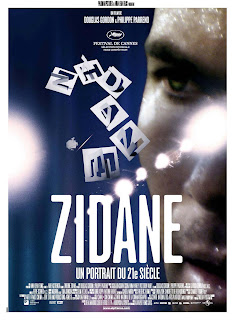
Film Review – Zidane: A 21st Century Portrait

[july 13 – I’ve updated the information on the game played in the film. Thanks “SM”!]

I don’t normally do film reviews – so many other places provide this (for better or worse) – but I thought the following would be of interest…

When I heard that the documentary Zidane: A 21st Century Portrait was playing a one-night show at the Bloor Cinema, I couldn’t resist getting tickets for myself, my wife, and my good friend – let’s call him “SM”.

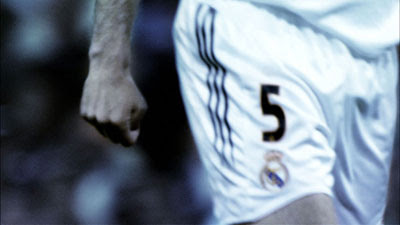
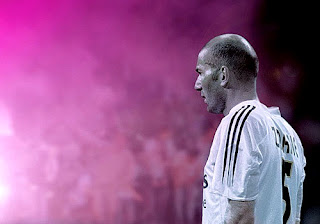
My friend and I both work in film/TV and both are big soccer fans, so there was potentially a lot here for us to appreciate (or at least make fun of afterwards). I’d separately heard the Mogwai soundtrack beforehand and thought it was interesting – very meditative. A short synopsis on the film: it recounts French soccer star Zenedine Zidane’s club game with Real Madrid, in a match with Spanish cup rival Villareal on April 23rd, 2005.

After the screening, we stood on the street, slowly coming to the conclusion that we all had problems with the film. Yet, rather than write it off as a “bad film” and drink with purposeful abandon, we found ourselves talking about it – trying to make sense of what it was that did or didn’t work.

What follows are a set of emails I exchanged with “SM”, which I feel demonstrates better than a formal film review our thoughts on the film. I am “MC” and my wife shall be known as “G”.

—-
From SM:

I now think that I really didn’t like the film beyond a technical
appreciation, especially for the sound design. I have slept on it and feel
fairly strongly about this.

It could be that I brought too much baggage to the film, or perhaps as
“G” suggested, it didn’t lend itself well to the theatre environment
(even if only on that day). But during the film I found myself missing the
wide screen coverage of the action at least for some sense of geography. Or perhaps more variance on the close up detail of ZZ – ie, exaggerated time stretching of actions to capture muscle tone/movement. Perhaps something to break the tedium. And that was perhaps the biggest frustration – the tedium. If the point was to study someone performing a Sisyphean task so closely that you really couldn’t tell what the task was at any given time, then that mission was accomplished. But for me it didn’t inform or entertain but left me detached, distracted and unmoved.
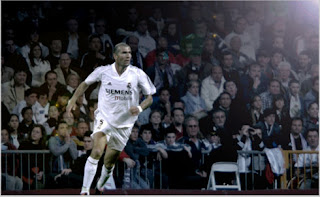
Also, it became a side issue to see what kind of possible image rights
issues they may have had to deal with. The animated sideboards were all in English – Kellogg’s “Frosties”, Gillette razors. In Madrid? Perhaps that is so. But it stuck in my mind. As did the peripheral existence of Michael Owen. I’m positive I saw him running on the fringes of the screen, but no image of him straight on lasted long enough for recognition, neither did his jersey name or number. But there was a lot of everyone else. And so I started to wonder, hmm, what if some players were not willing to lend their image to the film? But I don’t think I should have been thinking that. In fact I was frustrated that I was doing that. But the film left me little else to think or feel.

—-
From MC:

I do agree with your after-sleep assessment – in particular what you wrote about rights clearances. I must admit, the exact same thing was going through my head the entire time: did they need permission from Beckham? Did they need permission to show the Frosted Flakes ad? What about Zidane’s clothing sponsorship (Adidas)? However, two questions arise from this:

1) If we’re asking ourselves those questions in the first place, is that not indicative that the film has problems?
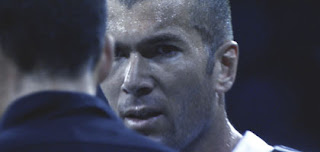
2) Again, to take the “naive media soul” approach, would the average person ask those questions? Are we being too savvy/media-aware? Mind you, considering our tastes and how potentially this film could have catered to them, if *we* were thinking about rights clearances what the hell was the Annex chick with the $200 haircut and the flip flops focusing on (that would be the “proverbial Annex chick…” not anyone in particular)?

I must say that I would like to see it again (not soon) on home video. I think that, aesthetically speaking, it would/could be a better experience seeing it in an intimate environment.

At least we’re talking about it! Maybe the director just wanted to make something people could chat about?? Eh?

—-
From SM:

Yeah, but the director of “The People Under The Stairs” had me talking after the film too. Just not anything I can repeat in mixed company.

The “naive media soul” might not drift to the kinds of thoughts we were (image rights) but perhaps instead might think “do I need to pick up some eggs?” or “hey I need to Lemon Pledge my tables this weekend” to help fill in the void left by watching this film

on imdb there’s two polar opposite reviews (see below)

POINT

“This is the most affecting, profound piece of documentary film I have seen in years. That said, it is a challenging work that doesn’t fully reveal it’s power until well into the viewing. As much a meditation as a film, the net effect is similar to that of watching “Winged Migration”. Watching the simple, relatively unaffected actions of Zidane over the course of a match begins to work on you. I pondered politics, commercialism, world conflict, fame, economics, the media and more over the course of my first viewing. There is no easy way to encapsulate the overall feeling, the ebbs and tides experienced while watching the film, but afterward you will view the world in as if with new eyes. It is also a masterpiece technically. I couldn’t help but admire the precise and exquisite sound design and music, how they blended to the action and psychological state being portrayed to the moment. The cameras seamlessly take the viewer from sprawling, epic points of view to the most intimate. The use of subtitle without voice over narration used to portray Zidane’s thoughts is nothing short of revolutionary. This film may disappoint a soccer fan simply seeking a piece of sports entertainment, but for a lover and student of film it is groundbreaking, important work that must be seen.”

COUNTERPOINT
“The guys who made this movie got it so wrong. They actually show Zidane as a tired static player and not the football god he is. Zidane is my idol for many years and what makes him a great player is: 1. his absolute vision of whats going on on the football field 2. His abilities to make the players around him better. Yes, he’s got amazing control of the ball and elegant movements that wont put to shame even a ballet dancer. But thats not it. For example, to show the amazing abilities of the conductor Zubin Mehta, you wont film him waving his hands for an hour of a silence movie. You must record his orchestra and show the connection between the conductor’s brilliance and its outcome on his “TEAM” of musicians. The same goes to Zidan. It is pretty obvious that the film makers here, do not understand football and what really made Zidane the amazing player he is. They showcase a too long, too static performance, mostly in close ups. Most of the time you don’t know where Zidane is located on the pitch, or how does he reacts to the opponents formation or plays. Sorry. Nice try but the results are poor and boring.”
BACK TO ME

The frustrating thing is, I agree and disagree with both of them. The first guy is a bit lofty with his praise, but I agree with his assessment of it being a technical masterpiece (well maybe not that high up, but you know). I don’t however think “it is groundbreaking, important work that must be seen.” I miss not really being able to see the attributes that the second reviewer describes. But I think too that it would then verge on “highlight reel” stuff.

I wondered if it would have been more engaging if this had been a vocal midfield general like Roy Keane or someone who saw more of the ball (maybe a Beckham). I really would like to hear an honest opinion of a professional footballer to this film. Not that they’re better players, but perhaps there’d be more range of emotion? And maybe that’s what I was missing. By the time Zidane’s emotions showed (smiling with Roberto Carlos, getting in the brawl), it was too late; I had stopped caring at half time.

—-
From MC:

I fall between the two points also.

I do think there is a mantric quality to the film which, combined with the half-time segment and the sound design, provides a larger (albeit arguably more “wispy”) palette for the viewer – it becomes less about soccer and more about…well, who the fuck knows. Spin the wheel. However, this last point starts getting more into the territory of Art and Art Appreciation – the lack of a fixed message isn’t the point. However, not to let the director off the hook, I’m not entirely sure his intent was clear or if it was, whether it was achieved.
On the other hand, yes, anything else probably would’ve become a sports-porn highlight reel. I wondered if, instead of Zidane it would’ve been more effective to choose someone else – either a name or another position – but that too poses just as many problems. Zidane isn’t a Chatty Cathy and his largely mute performance works because it’s all about his focus or lack thereof. You could say the same about most goaltenders, but then again if you thought the focus on Zidane was static, imagine someone standing within two goalposts for 90m would be? Keane…that would be interesting. Certainly more dynamic, but would it have the same quiet grace and reflectiveness?

Yes – I would like to have a pro footballer’s perspective on the film. I’m hoping the Guardian or someone else thinks of this. Better still would be a moderated discussion between the director, a professional footballer, and an interviewer. Unfortunately this would only ever be shown on television in France. Still…

—-
From SM:

Yes yes and yes.

The intention was unclear.

The quiet grace and reflectiveness works for a moment for me. But it became ironically grating over time. A shorter film would probably achieve more.
Or more accurately, if this approach were applied to a smaller scene in a film where the protagonist is followed like this in a climactic match or just an fairly important match this would be quite effective as a montage.

Reminds me, if memory serves correct, of the Raging Bull fight where LaMotta finally wins the title – the camera stays mostly on him/his face throughout the fight. But with Raging Bull, there had been a connection to the subject previous to this – mostly thanks to it being a narrative form and that the subject was an expressive actor – as well as throughout.

With the Zidane film one’s only connection was any expectations you brought to the film based on your knowledge of the subject from your reality (World Cups 98 thru 2006 etc etc). And the silent disconnect experienced here can only lead to a let down from that expectation.

Here’s the stick, you want one last go?

I decided not – I think we both had our turns at it. Yet, irregardless of whether Zidane was a success or failure, any film which can elicit these sorts of thoughts is worth a mention.

Share

The Vocabulary of Conflict: Afghanistan and Iraq

If there are two things I’ve avoided mentioning since the inception of this blog, it is Iraq and Afghanistan. For anyone who has casually surfed a blind selection of blogs in their spare time, I think you can understand why I’ve chosen not to get involved in the often mephitic atmosphere of this debate. It’s chaotic and reflects the lack of clarity in the wars themselves.

Six Canadian soldiers were killed yesterday by a roadside bomb. The media refers to these bombs as IED’s (improvised explosive devices), following the vocabulary of military spokespersons. In response to these latest deaths, here is an excerpt to more effectively demonstrate this vocabulary, from the Globe and Mail:

The Taliban’s increasing use of roadside bombs has also taken a toll on civilians, Brig.-Gen. Grant said. “They have managed to kill six great young Canadians today, which is an absolute tragedy,” he said. “The other part of this is that they’re killing lots of Afghans. They’re attacking the weak, they’re killing women, they’re killing children, they’re killing policemen. These are not the tactics of anything other than terrorists.”

[…]

Asked whether this represents an “Iraqization” of the conflict, Lieutenant-Colonel Jean Trudel, who serves as chief of staff for the Canadian headquarters in Kandahar, shook his head.

“Not particularly,” he said. “It indicates a loss of control by the insurgents.”

Canadian troops faced insurgents in the farmland southwest of Kandahar city last year in the largest battles Afghanistan has witnessed since the collapse of the Taliban regime. Those fights have taught the Taliban that it’s fruitless to openly confront the Canadians, Lt.-Col. Trudel said.

“The fact that we’ve lost a lot of soldiers from IED attacks indicates a success, in the sense that our conventional operations have succeeded against the Taliban,” the chief of staff said.

Where to start…

1) These roadside bombs – sorry, IED’s – are not, historically speaking, the “tactics of terrorists”. They are the tactics of guerrillas. Crashing planes into buildings and floating boats laden with explosives into aircraft carriers are tactics of terrorists. There is more than a semantic difference between the two classifications; when you paint civilian-based militias as terrorism you are admitting a loss of control and belying a critical problem with the military operation at-hand. See: Corsica.

2) If by “Iraqization”, the journalists mean “people who were under a tyrant who barely kept a fractious mix of misplaced ethnicities (largely due to Western colonial folly) under control and who now are now occupied by Western forces (yet again) whose motives increasingly speak more about global economics than humanitarianism” then there are some similarities. However, the way in which the term is implied in the article suggests that the “tactics of terrorism” are being imported from Iraq, which itself is an interesting bit of circular logic given that Afghanistan is the only one of the two countries that had anything to do with the destruction of the World Trade towers.

3) To suggest that the killing of six of our soldiers (along with civilians and police) represents a “loss of control” by the insurgents is perhaps one of the more grotesque distortions of military logic I’ve read (recently). Sounds to me as if the insurgents are in control if by their actions they are disrupting the lives of its citizenry and the work of the soldiers who have been put there to resurrect what is becoming the Romantic dream of a post-Taliban Afghanistan.

All things considered, no matter how passionate or well-reasoned your opinion, it simply isn’t enough to oppose either of these wars, at least not anymore. Three or four years ago, perhaps. However, there is a marked difference between the two conflicts. With Afghanistan there was, at the very least, a reason for NATO troops to get involved; it was, after all, the training ground for Al-Qaeda and, considering the devastation of 9/11/01, arguing for a military response was not an irrational (ie. purely emotional) action. Iraq, however, was and is a debacle of historic proportions. It would depress me to recount just how ill-conceived (and corrupted) the decision to invade Iraq was. There are many other sites out there which can do a better job of summing up the horrible negligence of the latter invasion.

One thing I will mention, and I do so on behalf of my countrymen who are stationed in Afghanistan, is that, failing “success” – itself a contentious ideal in any war – the blame for the lack thereof can be directly attributed to two factors:

1) Iraq. If the United States and Britain had not diverted (and thus fragmented) their troops so that they were intervening [or invading, whichever way you wish to see it – I’ll leave the Semantics of Conflict essay for another day] in not only one but two countries, NATO would’ve had the maximum available response in order to accomplish whatever goals there were in the Afghanistan mission. Instead, by pulling troops out of the latter and into the former, they hobbled the efforts of the only justifiable military action of the two and endangered both.

2) Although there are 37 countries involved in the NATO/ISAF deployment in Afghanistan, there is a disproportionate amount of Canadian troops on the frontline in the most tumultuous areas (read: Kandahar), despite repeated calls for other participating countries to commit troops for support. Say what you will about the Afghanistan mission (and again, a lot of contentious arguments are to be had), it angers me to see such reluctance on behalf of other participating countries: either you’re there and fight or you should rightfully leave. You simply can’t have it both ways on the battlefield.

Canada has a tragic history of its soldiers being used as gun-fodder in armed struggle, most notably in the trenches of WWI. This perhaps explains why we did not involve ourselves in Vietnam or Iraq; though we have our share of military controversies to deal with (much of it due to financial stagnation and federal meddling), we have generally learnt not to follow into armed conflict when the goals of the coordinating military power (usually the US and/or England) are suspicious. The difference this time is that our public is looking very critically at the war in Afghanistan, asking the right questions, and putting pressure on our politicians to ensure that this latest involvement does not devolve into the sort of pandemonium currently underway in Iraq.

I would be lying if I thought the current plan in Afghanistan was particularly clear or that our politicians (and some of the bureaucratic upper ranks of our Armed Forces) had the best interests of our soldiers, Afghanis, or the reputation of Canada in mind. The former Soviet Union went bankrupt as a result of their involvement in the 80’s, with the U.S. funding, arming, and training the civilian insurgency. The shoe is on the other foot, with Russia and China supplying the insurgency via Iran. Whether we call them terrorists or not, vocabulary alone is not enough to soften the blow of rising casualties in a conflict sorely in need of clarity.

Share

Book Review: Crime and Punishment, by Fyodor Dostoevsky

Rodion Raskolnikov, an impoverished ex-student living in St. Petersburg, methodically sets out to kill a money-lender. As if that isn’t bad enough, the cold-blooded murder goes terribly wrong, and – being a man of principle – he endures a multitude of agonies associated with his crime. Erstwhile, his mother and sister are moving to the city in preparation for his sister’s just-announced engagement to an ambitious cad.

All in all, it’s not a good time to be Rodya Raskolnikov, or for that matter, to live in St. Petersburg during the late 1800’s.

Crime and Punishment, completed in 1866, is a brooder of a book. It looks unsparingly at the lives of the desperate and destitute – comprising most of its central characters – and sends them in circles around a very lonely and philosophically distraught young man who makes a terrible decision: murder. It isn’t made in haste, but meticulously planned and carried out until the act itself is within his grasp, at which point it explodes in his face. Rather than empowerment, to be “a man and not a louse” in Raskolnikov’s words, he comes face to face with reality: his less-empowered and certainly more human inadequacies.

The problem, however, is that the police aren’t after him…or are they? He tries several times early in the novel to expose his crime, but barely arouses suspicion – if anything, people around him grow more and more concerned for his health. The irony is that it’s after Raskolnikov’s crime when everyone around him starts paying him visits and taking care of him – even though half the time he’s flirting with madness and fever. It is during this purgatorial reprieve from justice – with the police as close as his friends – that he is drawn into the lives of those around him and takes pains to emancipate the weak from their burdens.

Characters sad and corrupt walk into his life, often literally, and draw him into their own. Vacillating between pity, outrage, and spiritual agony, Raskolnikov takes great pains to make amends with those around him, sensing that the payment for his earlier crime is hanging inevitably in front of him, whatever turn he takes. After all, if the noose is in the mind, there are no lands you can escape to.

Crime and Punishment has many strengths, chief among them some of the best dialogue in literature. Surprisingly, there are great swaths of humour too, most notably Raskolnikov’s friend, Razumikhin – who becomes smitten with Rodya’s sister, the ravishing Avdotya. Dostoevsky, who spent four years as a political prisoner prior to writing C&P, writes honestly about the souls of those who are defeated by the circumstances of life. The city to which the book is seemingly dedicated – albeit in a poison pen fashion – St. Petersburg, comes across as a Gothic cesspool of poverty and corruption.

If there are drawbacks to Crime and Punishment it is the bleak hues in which the story is rendered. Although it is ultimately a book about the greatest aspect of humanity – fiery perseverance – there a number of parts that move at a snail’s pace. In particular, I found the fourth chapter (of six) to be burdensome. I say this in case anyone would take me for a masochist.

Still, I recommend Crime and Punishment to those wanting to pick up the classics, particularly written from Eastern Europe. In Rodion Raskolnikov, Dostoevsky has created a template of the tortured idealist that stands as tall now as it did in 1866.

Crime and Punishment, by Fyodor Dostoevsky (ISBN: 019 281549 0) is available at a friendly independent bookstore near you. Or online at any number of vendors

Share