

Book Review: A Supposedly Fun Thing I’ll Never Do Again, by David Foster Wallace

For those of you who didn’t know already, author David Foster Wallace took his life last September. It was an all-too-unfortunate excuse for me to delve into his work, particularly his non-fiction, having enjoyed it years ago when I was a Harper’s subscriber (see here for context).
A Supposedly Fun Thing I’ll Never Do Again is a collection of seven essays he wrote during the 90’s (there are other collections of more recent work available as well, fyi) for such periodicals as Harper’s, Esquire, and Harvard Book Review. On display is everything I recall from my earlier introduction: his wry sense of humour, an idiosyncratic writing style (in particular his prominent affection for footnotes), and his ability to turn the subject matter back onto his own life without self-indulgence.
This is where I make a (hopefully) short (and hopefully respectful, considering the circumstances) tangent: after DFW’s death, along with the dismay of those who were fans, I read just as many comments from people who – without hesitation – admitted to simply not liking the man’s style of writing. This sentiment (though still not what I would call “the prevailing opinion”) was even echoed in Harvard professor/New York Times book critic James Woods’ recent opus How Fiction Works; for him Wallace’s prose evidently did not. I figured this mood extended itself more to his fiction which – truth be told – I have not read. His most recognized piece, Infinite Jest, is over 1,100 post-modernist pages long. Not interested.
Because I had such little exposure to his work, reading ASFTINDA was an interesting experience: I could see what his detractors must have been referring to. While there is no doubt Wallace was an extremely intelligent and talented writer (which I shall get to), there are numerous examples in this volume where he comes across as rather pompous, which wouldn’t be so bad were it not for his habit of typing huge swaths of text which any good editor would have asked him (nay demanded) he remove because of either its redundancy or its convolution of said essay’s point. He also suffers an ailment similar to what I found with Carl Wilson (recently reviewed here) where, for no particular reason, he seems hell-bent on exhuming obscure words which stick out like antlers on a house cat.
Of the seven essays, three are distinctly underwhelming for reasons cited above. In particular, his essay E Unibus Pluram: Television and U.S. Fiction is a terribly long argument for post-modern fiction (ie. the type he writes) using academic media theory as a course of analogy (via reminiscences of 70’s and 80’s television shows). While the fact that his examples are quite dated is no fault of his (it was written in ’93 after all – hello, St. Elsewhere), it is problematic that after many excruciating paragraphs of explanation/theorizing he never actually gets around to completing his argument in a way that satisfies the effort of having read it.
That all said (he types, rolling his eyes) the remaining four essays are gold and worth the price of the book. In particular and unquestionably his essays Getting Away from Already Being Pretty Much Away from It All (an assignment from Harper’s to cover the Illinois State Fair) and the eponymous A Supposedly Fun Thing I’ll Never Do Again (another Harper’s assignment – do you see a trend? – this time to take a 7-day ocean liner cruise of the Caribbean). On display in both is the perceptive laugh-out-loud satire of society’s absurdities as well as well-crafted reportage. There is also enjoyment in reading the essays on David Lynch (hanging out on the set of Lost Highway while opining on Lynch’s place in the American cinematic landscape) as well as tennis player Michael Joyce (set at the Canadian Open in Montreal, one of many coincidental Canadian-content inclusions throughout the book).
These four essays provide an opportunity for us to assess Wallace, the writer and person, without the willing academicism or pro-post-modernist chip on his shoulder. There is, for example, a wonderfully personal (yet appropriately witty) gem in the tennis essay where he admits, having previously questioned Michael Joyce’s IQ only to discover that, rather than a lack of intelligence it was an overwhelming physical and mental commitment by the athlete to his sport, and realizes by comparison that he can be a snob and an asshole. I like to come by my revelations honestly and it is in these four essays where Wallace’s gift shines.
So, if you don’t mind wincing a little and skipping a couple of entries, A Supposedly Fun Thing I’ll Never Do Again is rewarding in the end. When he was on his A-game, Wallace had a unique voice and a wonderfully biting sense of humour; it makes the suddenness and nature of his passing all the more sad. I’m sure I will pick up more of his non-fiction in the months to come.
A Supposedly Fun Thing I’ll Never Do Again, by David Foster Wallace [ISBN: 978-0316925280] is available at a friendly independent bookseller near you, or online at numerous impersonal sources.
Cellphoto: Turn

The Happiness Project
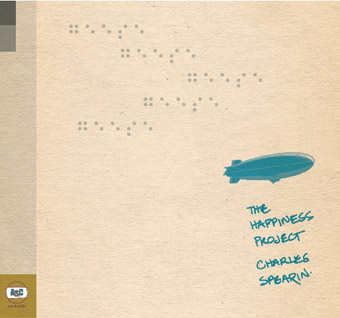
My friend, Charles Spearin, has released an innovative CD he calls “The Happiness Project“. The gist of it is that he began to interview his neighbours and recorded their conversations. Attuned to the tonality of how people expressed themselves he got the idea to replace the voices of his interviewee’s with musical instruments which mimicked each person’s voice pattern. The result is a unique (and very approachable) experiment which weaves voice, instrumentation, and environmental background sounds (birds, etc..). You may know Charles’ other projects, namely Broken Social Scene or Do Make Say Think. If you’re interested, please check out the site for “The Happiness Project” and see what he’s up to.
Perspectives on Percentages
“Life is ten percent what happens to you and ninety percent how you respond to it.”
– Lou Holtz, American football coach“Eighty percent of success is showing up.”
– Woody Allen“Ninety percent of everything is crap.”
– Theodore Sturgeon, fiction writer“Genius is one percent inspiration and ninety-nine percent perspiration.”
– Thomas Edison“Ninety-nine percent of who you are is invisible and untouchable.”
– Buckminster Fuller
Photo: Mist #6

Happy "Family Day"
Tomorrow (Monday) is a newly-created holiday (which, if you’ve been in Canada in February, is crucial for mental survival), called “Family Day”. This is its second year in existence and nobody really knows what to do with it. Okay, when I say “nobody” I mean me.
I’ve never been someone who makes elaborate plans in advance of long-weekends. For me, weekends are about plugging-out of work and relaxing, writing, photography, and the occasional neighbourhood brunch. I suppose if I had a cottage up north things would be different (not that February is necessarily when you want to be at a cottage up north).
Add to this the ree-coc-u-lous name “Family Day”. The premier of Ontario deemed it so, pinning its creation to his rationale; whether said rationale is window-dressing or solemn honesty is beside the point. I hate the name.  I’m not a militant sort, but what of those of us without children? Should I spend the day meditating on my biological error? Are all those people gearing-up to get drunk up and down Ossington Avenue tonight doing so as a testament to the strength of the Ontarian family? Doubtful.
Rather than spending it with our kids (who don’t exist, though we do have a lovely cat – her name is Selchie), I shall be mending clothing with holes, cleaning up some paperwork, filing things away, and reading. And yes, we’re going for drinks tonight.
So, from our family to yours, have a lovely Family Day tomorrow, gracious readers.
Book Review: Let’s Talk About Love: A Journey To The End of Taste, by Carl Wilson

Celine Dion.
There is something about the utterance of her name which induces an involuntary sneer on some faces. As a Canadian, there is a double-whammy to this in that – of all the internationally recognized names from our country – hers is the most prevalent.
We associate her name, subconsciously, intentionally, metaphorically with everything that is crassly commercial, saccharine, and paradoxically successful in spite of the fact that “people like us” (which is to mean, those of us with cultivated tastes) can’t stand her music.
Yet, despite these reactions, are we giving her a fair shake? Are we just a bunch of snobs? Is it possible to approach her music as we would approach our cherished performer x. This is the premise of the 52nd edition of the wonderful 33 1/3 series of books (appropriately CD-sized) by the publisher, Continuum. The purpose of the series has been for various people to write about albums which influenced their lives (without constraints on form, so rather than all of them being journalistic essays, some are fictional prose, some are non-linear ruminations inspired by said album).
Whereas others wrote from direct inspiration, Let’s Talk About Love: A Journey To The End of Taste is Carl Wilson’s unique attempt to explore the Celine Dion phenomena knowing in advance that he didn’t particularly care for her music.
What begins with curiosity (the fact that Celine shared the stage with Elliot Smith, a fave of Wilson’s, during the 1998 Academy Awards) and a faint appreciation for her success turns into a deep exploration – the kind you would see a fictional FBI agent do in a movie, you know, the guy who gets into the mind of the killer, etc. – of Celine’s life story (her disadvantaged roots in a small Quebec town), the power of her music internationally (from the Caribbean to the Middle East), as well as an astute aggregation of studies done on popular taste (which show that, yeah, sneering at Celine is kinda snobby and narrow-minded when you think about it).
Wilson’s summary of Dion’s youth and Quebec’s socio-political history, the distinction of kétaine (a sort of Quebecois kitsch), and how she is both a product and a paradox of the society in which she was raised is brilliant. It is rare to find someone (Quebecois or not) who can write about Quebec, who can encapsulate its frustrations with the rest of the country, its cultural tonality and political upheaval without either trivializing the causes and effects or isolating the province further from our understanding. The fact that Wilson can do all this in a relatively brief chapter of an already svelte-sized book is commendable.
Also of note is the book’s well researched and thought-provoking exploration of what we mean when we talk about taste and – intriguingly – whether there truly is any point in claiming that one form of art (or one artist) is intrinsically better than another. In particular the perspectives which support the (unfairly derided) trope of sentimentality, that hallmark of Celine Dion’s repertoire, are fascinating. Why, Wilson realizes, must everything be so f#cking bleak in order to be seriously respected? I found myself nodding in agreement with him and pondering the philosophical reach of the arguments.
In the end this is a personal rather than purely journalistic task for Wilson. Celine’s presence and music are weaved, sometimes touchingly, through various aspects and events within his life. However, if there is a fault it is Wilson’s penchant for using 5-dollar words; it lends an unnecessarily academic tone to the book which (thankfully infrequently) obscures an otherwise fun and fascinating read.
That quibble said, I cannot recommend this book enough.
Let’s Talk About Love: A Journey To The End of Taste, by Carl Wilson [ISBN: 978-0826427885] is available at a wonderful, friendly independent bookseller near you, or online via various impersonal vendors.
