Book Review: War and Peace, by Leo Tolstoy

“I took a speed-reading course and read War and Peace in twenty minutes. It involves Russia.” – Woody Allen

There is a time and place for everything. The trick is having a sense for timing; the place will take care of itself, which I believe is an as-yet undiscovered Newtonian law. When I heard/read that there was a new (somewhat bally-hoo’d) translation of Tolstoy’s 500lb (226.79kg) gorilla, War and Peace, I felt it was the right time to tackle it. Santa Claus delivered and I begun my task of reading all 1,224 pages with the aim of finishing by the end of 2008. Now, normally I am not a slow reader, but because this was an exquisite hardcover edition (384cm2 in size and weighing under 3lbs) it was not something I could take with me on the streetcar to work. It became my bedside book for the entire year.

War and Peace follows the lives of several members of Moscow nobility during the Napoleonic wars of 1805 and 1812. In particular, two families are focused upon: the Rostovs and the Bolkonskys. Skirting between the two, becoming the unlikely main protagonist of the book, is Pierre Bezukhov, an awkward intellectual who inherits his ailing father’s fortune at a young age without having any sense of purpose to guide him.

The Rostovs, represented by their patriarch, the well-meaning but indebted Count Ilya Andreevich, feature the principle protagonists Nikolai and Natasha (as well as siblings Petya and Sonya – the latter an orphan). The Bolkonskys, represented by the hard-nosed military man Prince Nikolai Andreevich, feature the siblings Andrei and Marya.

Before I go any further, I bet you’re asking yourself something: “Hey, that’s a little confusing. What with both patriarchs having the name Andreevich and one of them sharing the first name with the other’s son, Nikolai. Wow – how do you keep track?”. One of the nice things about this edition (and I can only speak of this edition as I haven’t perused another) is that it has a handy list of principle characters at the beginning…which you will need for the first, oh, 200 pages.

Right, where were we. Oh, yes, Russia. Introductions are made to the principle characters in a way which seems presciently tailored to a sweeping Hollywood adaptation: colourful fêtes with dancing and ball gowns, the young Count Bezukhov at his dying father’s side, the talk of war amongst the men. It is from this point that the eldest sons – Nikolai and Andrei – ready themselves to join the military: Nikolai as a member of the corps, Andrei as an adjutant. During the build-up to the first battles, Pierre, a reluctant member of the nobility perennially in search of meaning without any family or friends to guide him walks through the lives of both the Rostov and Bolkonsky families, acting as both an outsider and confidante.

If I may take this moment to say the following: it’s a really long book, and so I’m not going to draw a quaint plot summary. If anything, the book follows the travails of the Bolkonsky and Rostov siblings – through war, personal tragedy, love, and faith. Tolstoy renders the winding lifelines of Prince Andrei, Count Rostov, Pierre, and Natasha in a knowing way. He knows that, between idealistic teenhood and adult maturity, people’s lives do not often move in diagonally vertical lines; mistakes are made, passions are erupted, and past conflicts infect our clarity. In short, Tolstoy has formed unique characters who capture the spirit of their day (and class) while also imbuing them with strengths and weaknesses which seem tangible.

It is important to note several things about W&P and Tolstoy. First and foremost, that, as a book, it is not really easy to classify. In his own words (from the Appendix): “[…] it is not a novel, still less an epic poem, still less a historical chronicle.”. Secondly, that it was first published in serial form, which may explain its girth (assuming he was paid by the word). Third, that regardless of its size, its ornate complexity as regards relationships between characters, regardless of Tolstoy interrupting the story from time to time to philosophize about the nature of war or critique the narrow-minded assumptions of historians, you will probably not read (or find) a book like this again.

There are three predominant voices in the book: Tolstoy the storyteller/character-driver, Tolstoy the military historian, and (as noted above) Tolstoy the agit-prop polemicist. I didn’t expect that latter. I thought I was getting a thick slab of story wrapped in history, but what I didn’t realize is that the wrapping is heavily spiced. In several places Tolstoy makes asides to the reader, and whether it is describing the clock-like movement of troops or the erroneous presumption of Napoleon’s genius, I felt closer to Tolstoy the writer; although some will find these sections a bit out of place, his commentaries are poetic and philosophically powerful.

Excerpt:

“As in the mechanism of a clock, so also in the mechanism of military action, the movement once given is just as irrepressible until the final results, and just as indifferently motionless are the parts of the mechanism not yet involved in the action even a moment before movement is transmitted to them. Wheels whizz on their axles, cogs catch, fast-spinning pulleys whirr, yet the neighboring wheel is as calm and immobile as though it was ready to stand for a hundred years in that immobility; but a moment comes – the lever catches, and, obedient to its movement, the wheel creaks, turning, and merges into one movement with the whole, the result and purpose of which are incomprehensible to it.” (Volume I, Part Three, Chapter XI, p. 258)


It is at this point where I return (briefly) to the translators of this new edition, Richard Pevear and Larissa Volokhonsky. They have (thankfully) preserved the Russian-ness of the book, unlike previous translations. Character names are left as-is and not Westernized, nor are elements like religious ornaments (such as the ever-present ikons) given Westernized names. When French is spoken, it is left in French w/ English footnotes at the bottom of the page. While this may require a little more dexterity on the part of the reader, this edition also comes with a handy 20-page appendix of reference as well as historical notes.

Will one’s life be less if one doesn’t read War and Peace? Only you can answer that. I’m happy to have read it, yet by the time I’d reached the end I barely had room in my head for Tolstoy’s more essay-like commentaries on Napoleon, his so-called genius, and the philosophical symbiosis between freedom and necessity.

I will say that it is not light reading, in case this hasn’t been sufficiently communicated in this review. Truth be known, there is much (much) more I could write on this book, but this is a blog and not the NYT Book section. I do, however, recommend W&P to anyone catching up on classics, or who are curious about non-traditional styles of literature.

War and Peace, by Leo Tolstoy (translated by Richard Pevear and Larissa Volokhonsky)[ISBN-13: 978-0307266934], is available at a fine independent bookseller near you, or via any number of places on the Internet.

Share

Completion

A quick note: I’ve just finished Tolstoy’s War & Peace. I’ve been reading it for just over a year – the gi-normous, anti-public-transit hardcover version of the Pevear/Volokhonsky translation – and finally read the last of the last pages last night (if that sounds awkward, the thing has an Epilogue in two parts, each spanning several chapters, plus an Appendix by Tolstoy). I would’ve finished sooner had the second half of the Epilogue not consisted of an essay by the author on the philosophical/socio-historical implications of freedom vs. necessity in society.

So, yes, in the upcoming days, I will post a formal review. There shall be more book reviews in general in the coming months, seeing as those are the things which are responsible for 50% of this blog’s traffic. I’m assuming this percentage consists, in equal measure, of both curious readers-to-be and desperate students cramming for their essays/tests (Question 2a: “What are the themes in Hesse’s Siddhartha?”).

Share

And The Nominees Aren’t…

I will do what most major news outlets won’t do and say upfront that there are an enormous amount of more important things going on in the world (or, conversely, not going on) than this…

That said, I’m a film hound and thus can justify this mirage of mostly-useless information

The 834th Academy Award (ie. The Oscars) nominations were announced this morning. I don’t think there has ever been an Oscars year where I’ve been satisfied that the right films were (or weren’t) nominated for the right category (or at all). And yet…

  • WALL-E didn’t get nominated for Best Picture, but was instead victimized by the mostly-useless ghetto category of “Best Animated Film of the Year”, where it shares it’s chances with such a memorable classic as Bolt. I will admit, I loved WALL-E; it was one of the most subversively humane films made in years. The sooner the “Academy” can eliminate the Animated Film category the better.
  • The Reader…I haven’t seen it. I don’t know anyone who’s seen it. Yet while it seemed to get slightly trashed when it came out (one of the Nazi-themed Christmas 2008 releases) – and by “trashed”, I mean it was called a weak, manipulative Oscar-baiting film – it was nominated for “Best Motion Picture of the Year”. Again, I don’t want to criticize things I haven’t seen…but…
  • I haven’t seen any of the films nominated for “Best Motion Picture of the Year”. I do want to see Slumdog Millionaire (terribly), whereas Frost/Nixon and Milk – though I do not doubt their quality – will probably come into my life via DVD rentals. As for The Curious Case of Ben(*yawn*), I have no interest.
  • Editing, that category no one seems to understand seems a mirror image of the Best Picture nominees, with The Reader swapped for The Dark Knight. I’m okay with that, yet – while I liked Dark Knight, I would not necessarily nominate it for best editing; the big chase scene in the Chicago (sorry, Gotham) tunnel was terribly disorienting (as in, this is all cutty and fast and good and stuff, but why does it make no sense to me?). I don’t have a problem, on the surface, with a cutty style of editing (it was well-served in the Oscar-winning Bourne Ultimatum, perhaps one of the best action films of the decade), but it needs to make sense, which I felt was missing in parts of DK.
  • Happy that Waltz with Bashir and The Class were nominated for Best Foreign Language Film – I want to see both of them very much. Would have been nice if the Swedish film, Let The Right One In, had been nominated, but that’s me dreaming.

And now, on to more interesting things…

Share

An Unspoken Rule: It’s Never Simple

For the last few years, I’d get the odd inspiration to write something suitable for the Facts & Arguments section of the Globe and Mail. For those unacquainted, it is a daily feature of one of our national newspapers; a personal essay between 800 and 1,000 words, open to the public for submissions.

Easy, right?

Truth: no. Every time I’ve tried in the past, I can’t pull it off. Can’t even get past two paragraphs. It’s not a question of writing 800 words of personal essay, but rather pulling off 800 words of personal essay that actually is interesting to a wide array of people which isn’t intellectually disingenuous at the same time. I say this because it’s easy to make fun of the Facts & Arguments essay (or at least I find it easy). “In the end,” I’ve joked to my wife, “what I learnt from my cat is that it’s not the travails I endured, but the lessons contained therein which have enriched my life. Ha, ha“. They are all, clichés aside, about personal experiences which lead to larger realizations. You could compare this (somewhat) to the essay featured at the back of the New York Times Sunday magazine, only longer and not as consistently curated.

Again: easy, right? After all, it’s just 800 words of personal stuff. You’re a writer, eh Cahill?

Truth: no, not easy. No, not at all. One misty Sunday morning over the Christmas break, I got the inspiration and decided that I was going to finally hunker down and do it. Me, the fiction-writing blogging sorta guy was going to sit his ass down and write an honest to goodness Facts & Arguments-style essay if it killed me. And it had to be good. And it had to be honest. No bullshit. No cynical kiss-ass formula-copying. It would, after all, have my name on it, published or not.

I realized several things immediately:

  1. Even though I write for this blog, which could be construed as “personal non-fiction” (or whatever the latest strain of non-fiction terminology is), it’s still pretty free-form stuff. It’s not like I have an editor, aside from my own middling expectations. In other words, it was not a load of help.
  2. Unlike fiction, I couldn’t write it all down as a semi-coherent story and then revise-by-whim from there. I don’t write enough non-fiction to have those strengths. My first “draft” (and trust me, that word deserves those odious quotation-marks) was a stinky grab-bag of overly-literary ideas which made no sense to the world outside my head, which for the most part seemed up my ass at the time that I wrote it.
  3. Being honest in a blog and being honest in a personal essay intended for mass (as in nationwide) publication are two totally (totally) separate things. I had to pay attention to a lot more than I had bargained for. And no swearing.

It has been torture. I’ve spent more time on this than I care to mention (at last count, thirteen revisions in two weeks). And yet, I didn’t want to give up. The format was a challenge and as a writer/artist/whatever it’s important to be challenged, especially if one wants to be versatile. In the end (ha ha), I’ve finally got something worth submitting. Whether it actually gets published (and, God knows, I’ve done my best on this sucker) is no longer a chief concern. The goal was to submit my best effort and that is what I’ve done (though of course I’ve cursed my chances of this ever happening, having written about it beforehand and all).

Many lessons learnt, indeed.

Share

You

Inevitably, you will go somewhere, some informal gathering of friends, perhaps a party of some sort. You will discover that you are surrounded by people your age who all seem to be doing pretty well in life: active, successful, progressing in their art (whatever that word may be construed to mean), and content in a non-complacent way. And it will slowly make you feel like crap. Particularly the morning after.

You look squarely at your day ahead, at your day-job-slash-career (the thing you do for money), your achievements (or things you hope to achieve within a certain time period) and you have realizations of which many are negative, self-critical, sometimes despairing.

You know the colder months do not treat you well. You know that you suffer silently from something which begins with a “d” and rhymes with “repression”, and that there’s sweet-dick you can do about it short of spinning the midway crown-and-anchor wheel of pharmaceuticals. You also know that there is no cure, that winter has only begun, and that your public transit reading material is a collection of essays written by someone who suffered similarly and recently committed suicide.

It is one of those moments when the warmest of jazz songs on the radio does not warm you, that despite the windows in your apartment the January daylight is too cold. It is one of those moments where you look outward for signs of optimism, but in doing so you also make yourself susceptible, where both good and bad pass freely through your unarmed perimeter. That, given your disposition, you see more bad than good (or even worse, emptiness; after all, even “bad” is a symptom of humanity). You know the good is there, but for some reason it is not as visible or vibrant as “good” should be.

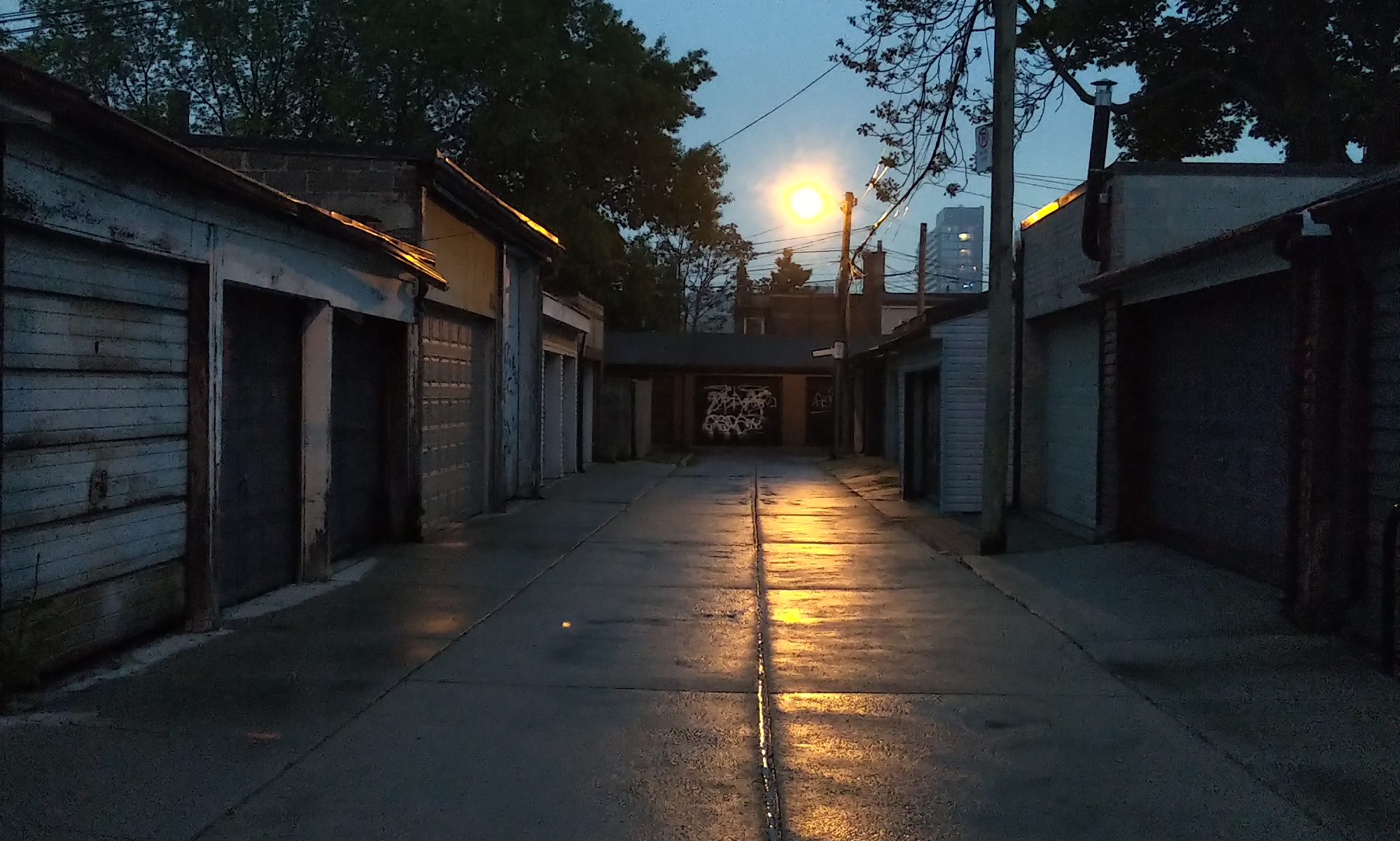
You find solace in writing about it in second-person (a format you’ve been wanting to try) and by an unfinished roll of film in your camera and the possibility that there are things outside that could be captured as means to portray these unanswered questions. And that a long walk will do you good.

Share