

What are you doing on Tuesday night?
So…I’m drumming again. In spades.
This Tuesday (April 17th) at The Cloak & Dagger (College & Bathurst) I’m appearing with a rag tag outfit of musicians for a jam night. My colleagues include Shannon Du Hasky (from the Z-Rays) on guitar, Graydon James on bass, and Nancy Brooks on French horn. If all goes well, it could spring into a regular fixture (!).
Context:
The last time I performed live (or even played on a drum kit for that matter) was over 12 years ago…in Thorold no less. It was the end of the band I’d been playing with for several years, a fin de siecle for that part of my life and it was a terrible (nay apocalyptic) gig. It was one of those nights where you grab your gear and run so that you don’t have to remember anything about it. We never played again for various good reasons, although it was nice while it lasted 1.
Fast forward: not only am I part of the jam outfit, but I’m also part of a new band called Behind The Garage (appearing April 28th @ Mitzi’s Sister).
Weird. But damned fun. Like life.
Come on out and enjoy the drink and songs – I couldn’t imagine playing in a better environment with a better group of people. 2
Update: Okay…I looked up the band I used to be in (we were called Spin Tree. We hailed from Burlington.) and found our demo album listed on someone’s Most Underrated Albums of All Time list. Wow. I sent him an email thanking him…it’s a little overwhelming to see yourself on someone’s list with such luminaries as Inspiral Carpets and Arcade Fire.
1. We were a goth band. I can say this now because at the time I hated when we were referred to as a goth band. Okay – we were a goth band with non-goth aspirations. We played with some well-known acts of the day, and got to play at such venues as The Opera House and The Drake (before it closed and became what it is now).
2. Until meeting and playing with Behind The Garage and the jam-band (if you have a band name, let me know – we’re dying for one), I’d always equated playing music with friction. This, of course, was an emotional artifact from my early days where there was a lot more artistic conflict – much of it needless. It’s 180 degrees different now – everyone I’m playing with is a *really nice person who also happens to be a really good musician*. Am I lucky or what?
So long, pal

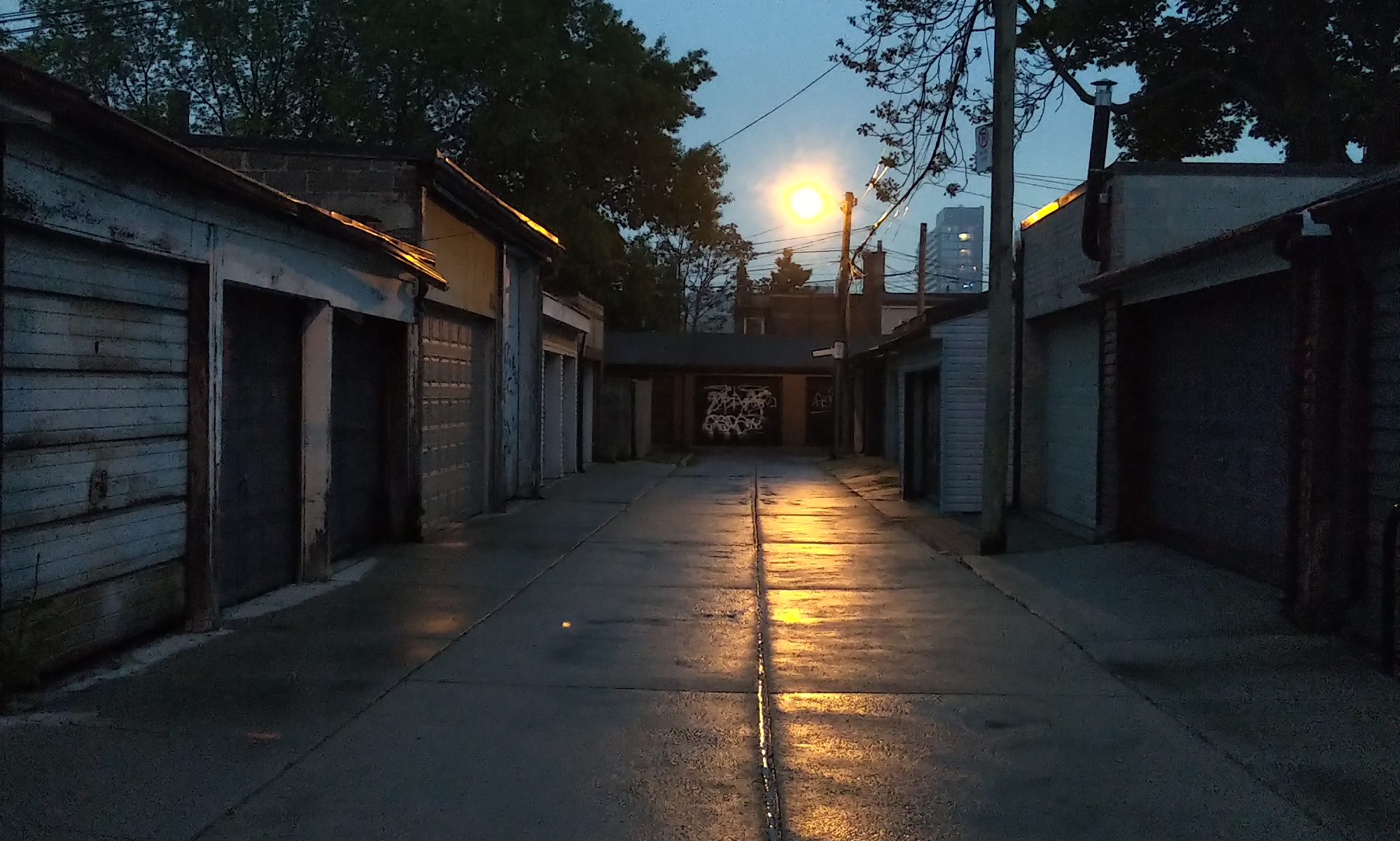
Photo: College & Palmerston #6

Note: The "Book of Days Murder" on America’s Most Wanted
############################################
Update: the story is up on the AMW site here.
############################################
For those who have kept an eye on this blog for the last year, you might remember an article I posted, called “Remembering Michael Cahill“. It was linking to a front page article in the Austin American Statesman written by Denise Gamino: “A Calendar Book, A Guitar, And A Very Cold Case“.
On April 13th, 1979, my uncle, Michael Cahill, had his acoustic guitar stolen from his apartment in Austin. In the midst of the foot chase, Michael was shot in the forehead and killed instantly. His guitar was never found, and – like all murders and killings – the event has permanently etched itself into the hearts and minds of those who knew and loved him.
My family’s history is rather odd – not in a depraved daytime talkshow sense – but odd enough. I’m not going to go into details, but I never got to meet or to know my uncle. I was 8 years old and 2,658 kilometres away on the Friday night he was shot. He was in Texas, I was in Ontario. I remember a few occasions being told by my father how much I reminded him of his little brother, especially when I got glasses for the first time.
In any case, the reason I’m mentioning this is that America’s Most Wanted is showcasing this story in their next broadcast (this Saturday @ 9pm on the Buffalo FoxTV affiliate, WUTV).
If you’d asked me this time last year whether I would ever be watching the story of a family member on America’s Most Wanted…well, like most of you, doubtful would be an understatement. You certainly wouldn’t take the thought seriously.
Aside from the abrupt tragedy itself, what makes the story interesting for the outsider are the strange circumstances that surrounded it, the centrepiece being a community art project called The Book of Days. It was a calendar showcasing the works of local black-and-white photographers, among them Berkeley Breathed – who would go on to create the Bloom County comic strip. It seems some of the photographers included in the 1978 edition of The Book of Days, some of whom were friends with my uncle, had also had some of their possessions stolen. Investigators believe my uncle’s murderer and the peculiar thief who preyed upon Leica cameras are one and the same person.
To be honest, I have a personal stake in this post: I hope they catch the bastard who did it.
#####
UPDATE (April 2020): http://imagitude.com/michael-cahill/michael-cahill-coda/
Photo: Mother-In-Law’s Tongue

The Steppenwolf Effect, pt.2: Books, Covers, and Judgement
####
Achtung: it seems Comments were disabled on this and another post recently. This was not intentional. I will try to be more diligent in making sure that visitors can respond (when Blogger will allow).
####
One thing I wanted to mention, way back when I was in Steppenwolf mode (see here), was that book covers have come a long way since I was a kid.
Let me put it this way, if you have a faint interest in reading, let’s say, Pride and Prejudice (figuring that you hadn’t seen any of the filmed adaptations, but simply heard good things), what would go through your head when you saw this:

Let me guess: the most boring book in the world? Tedium personified? 300 pages about drollness?
Of course that’s not true. Most people who’ve read P&P consider it a classic. People get into arguments about its film/TV adaptations, which is a good sign that the book rules over them all. But the cover! The cover stinks! Let’s face it, this is not a cover intended to sell a book, it’s a cover intended to put you to sleep (unless you are a Victorian fetishist).
Now, you say, look here chap – don’t you know you shouldn’t judge a book by its cover? Yes. I agree. But why bother having an illustration on the cover, or some semblance of design if it does nothing for what it represents? The only reason Jane Austen allows that cover on her book is that she’s dead and there’s nothing she can do about it.
Quite frankly, I prefer this as an alternative, if I had the choice:

Why?
Because it doesn’t fill me with preconceived notions about the subject matter.
If I wanted to read P&P, the above cover wouldn’t stop me from doing so. I’d be forced to read it in order to find out if I liked it or not, without the mediation of what is often for “classic literature” terrible book design.
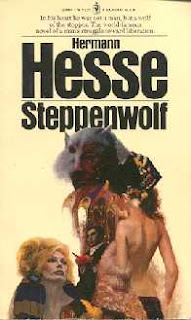
This is why Steppenwolf figures into this story. Check out the cover that I grew up looking at:

While yes, technically it incorporates many of the elements of the book, it’s such a literal and terribly dated approach, it’s always turned me off. It’s a James Bond poster by way of Aldous Huxley. *Blech* – no thank you.
Now, when I finally picked up a copy last year, this is what I saw on the shelf:

It’s a book! It’s a book! Not a movie, not an illustrated story, but a book, with an author! I like this approach because it’s direct yet cryptic at the same time – it’s telling me nothing about the novel, yet ties in the title of the book with a visual artifact. That’s it. Nothing more. Aside from the synopsis on the back cover, you’re on your own.
To me – and I should tread carefully here because my wife happens to design books – this is what book design is about. Forget about “don’t judge a book by its cover” – that’s a nice aphorism as it applies to people, but to books – considering there are so many vying for our attention, the covers should support the material they…um…cover.
If you’ve got a moment, check out this f-a-n-t-a-s-t-i-c site which shows all of the major cover designs of HG Wells’ The War of the Worlds. That is, from 1898 to the present, from different countries and featuring a vast array of designs and interpretations. It gives you a fascinating look at how book design has evolved over the decades.
A late Friday’s amusement…

Cheers to Charles Taylor
From the Globe & Mail:
NEW YORK — Charles Taylor, a Canadian philosopher who says the world’s problems can only be solved by considering both their secular and spiritual roots, was named Wednesday as the recipient of a religion award billed as the world’s richest annual prize.
Dr. Taylor, a professor of law and philosophy at Northwestern University, has won this year’s Templeton Prize for Progress Toward Research or Discoveries About Spiritual Realities. The award is worth more than $1.5-million (U.S.).
In a career spanning more than four decades, Dr. Taylor, 75, has investigated a wide range of issues, including how it is that the search for meaning and spiritual direction can end in violence. He contends that relying only on secular analyses of human behaviour leads to faulty conclusions.
(read the rest)
Not only am I happy that a nice Canadian boy won the prize, but that a well-measured and (dare I say, in this fractured age of ours) balanced look at the price society pays, being the lost children in the divorce between the strictly secular social sciences and the often inflexible tenets of religion.
I will definitely check out this man’s work – please read the full article.
Stress
It creeps up on you like nausea mixed with fire. Your stomach muscles tighten as if someone has just thrown cold water on the back of your neck. Beads of sweat form on your forehead; your skin feels both cool and feverish. You can’t hear clearly or focus on peripheral tasks.
A rollercoaster you never paid to ride, there is no visible end to the loops in the rails.
You take notice of everything around you that invokes hatred and irritation: crying children, inconsiderate drivers, the playlist on the radio. You try to ignore the rupturing stream in the hope that you can keep it from igniting a base fury rumbling in the darkness of some primal ancestry.
You cannot sleep. You cannot pay attention.
You are immobilized and nothing anyone can say will help.
…but it will pass…
You will survive.
There is no devil manipulating things behind the curtain of consciousness; no wheel of fortune spinning capriciously against you. The day will come when you will wake up and the sun will be shining and you will realise that your world, while unpredictable, isn’t likely to combust as you have feared.
You learn to breathe; you wash your face of worry and watch the dirt whirl down the drain into the blackness of limbo. You realise that the future is full of new days, both dark and light, and that those who succeed are the ones who see clearly, who manage to allow the darkness to pass around them and not through.