Thoughts on Truth & Medium

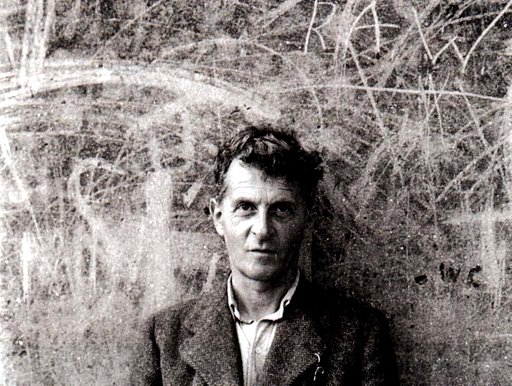
I’ve been reading Wittgenstein’s Tractatus Logico-Philosophicus. Intimidating little book. Seems to be written in its own language: cold fucking logic. Still, there are some fascinating ideas relating to how we choose to define the world around us. It’s easy to see how revolutionary this book may have been for some people, as concepts of truth and falsity take a back-seat to the greater question of a proper logical confine for the philosophy itself – in doing so, Wittgenstein is saying that the structure of a philosophy is greater than the veracity of its content.

Gleaning from this, I couldn’t help but be reminded of Marshall McLuhan’s 1 observation, “the medium is the message” (which was also the name of the resulting book he published 2), which seems resonant of Wittgenstein’s approach (if not somewhat parallel).

From Tractatus:

3.332 No proposition can say anything about itself, because the propositional sign cannot be contained in itself (that is the “whole theory of types”).

3.333 A function cannot be its own argument, because the functional sign already contains the prototype of its own argument and it cannot contain itself.

It would be rather trite to pit Wittgenstein against McLuhan based upon a couple of sentences (foundational though they may be). However, from this discourse I’m curious to take a closer look at what McLuhan was trying to say – I suppose I carry a vain hope of tripping over a Unified Theory.

You know you’re part-geek when things like this really interest you. However, I swear, I’m also part-superhero 3.

1. I always get this guy’s name mixed up with the guy who created the Sex Pistols (Malcolm McLaren)…if only they were the same person.

2. Although, technically speaking, due to a copy-edit error, the book was first published as The Medium is the Massage. I shit you not.

3. …as opposed to the Nietzschean concept of the Superman (*chortle*)

Share

Book Review: Moby Dick, by Herman Melville

You may be asking yourself: “Moby Dick, eh? Not exactly current fiction, Mr. Blogger.”

No, it’s not. But if it’s good, it should be read. This is a good book. It’s a classic 1.

Published in 1851 (happy 155th anniversary!), Moby Dick is an originally rendered tale told by Ishmael (whose last name we never know…in fact, we never learn the full names of any of the characters), a young veteran of the merchant marines who longs to find work (and a new life) on a whaling vessel. Naturally, his interests take him to Nantucket, Massachusetts, where he finds a ship waiting to sail – the Pequod. With the help of an exotic tattooed harpooner, Queequeg, he hops aboard willingly, despite the warnings of a street prophet regarding the Pequod’s captain – Ahab.

Once aboard and sailing, the narrative eventually inverts from the wide-eyed first-person accounts of the opening to third-person, peppered with Ishmael’s astute observations – it’s clear from this narrative transformation that Ishmael himself becomes subsumed by his experiences at sea aboard the Pequod, obsessed with the details of her crew and captain, and with the object of their profession: whaling.

The problem begins soon after setting sail; Ahab, a remarkably bleak and forceful figure, announces that – contrary to their practical purpose – they have an ultimate quest ahead: to find and kill the White Whale, Moby Dick. This single whale, we learn, is the burning flame which drives the Pequod’s captain to “monomaniacal” ends, Moby Dick having claimed Ahab’s leg (and perhaps a part of his soul) on a previous voyage.

As the novel proceeds, the reader is consumed by the everyday life of a whaler at sea: the sometimes savage danger, the simple yet sublime pleasures, and the technologies of the day. Everyone from the sail-mast lookout to the blacksmith, from the cook to the boatsmen who trawl for prey – whales, and most importantly, their precious oil – are drawn in colourful detail. Readers expecting a fast-moving plot line should note that Moby Dick takes great pains to paint the seafarer’s life, specifically the dying years of the whaling industry (at least as it existed in its heyday); as such the novel has its peaks and valleys as regards pacing. I refuse to take the “this is an old book so you have to disregard its old style” stance – though it’s a masterpiece, its strengths will only be rewarding to those with a little patience.

Moby Dick is probably one of the best-written novels I’ve read. Melville is a writer’s writer; he loves language and is very particular about how he describes the life of his characters without it becoming an academic exercise, nor are the allegorical elements cryptically depicted so as to make reading it in a non-allegorical frame of mind impossible. Take any of Ahab’s monologues and read it aloud: you will instantly notice the cadence and perfect shape of the sentences – it’s like hearing Shakespeare. The book is rife with symbolism: the ship is the world, the crew its people. Moby Dick itself becomes a symbol of the capricious result of the burgeoning 20th-century-man’s fateful need to conquer nature.

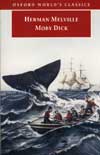
I would like to point out that I read the paperback edition, published by Oxford University Press (pictured above). I mention this in particular for two reasons: it’s cheap (500+ pages = $10!), and it comes with a handy reference guide at the back to clarify any directly symbolic (Biblical or simply antiquarian) references in the text. Also, there is an Introduction (written by Tony Tanner) which, after you’ve read the novel 2, will give you some insight into some of the mainstream analyses of the book. There is also a set of letters Melville wrote to Nathaniel Hawthorne (to whom the novel was dedicated) at the back of this edition – can’t say there’s anything relevatory there, other than the fact that Melville clearly idolised Hawthorne.

Moby Dick is available for sale at a fine independent bookstore near you and online at…Powell’s, Amazon, Chapters, and others. Published by Oxford University Press (ISBN: 0192833855)

1. I don’t mean “It’s a classic.” in the sense that, because everyone calls certain books “classics” that they must always be superior. Some “classics” do not age well. This is not one of those.

2. This is my guide to reading “classic” books: by all means avoid anything written by someone other than the original author until after you’ve read the book, whether it be an introduction, a foreword, a preface, what have you. Most introductions are academic in nature and worse, full of spoilers. Stanislaw Lem wrote a book, inspired by his distaste for these after-the-fact literary addons. It’s called Imaginary Magnitude.

Share

Oh, right – the world

If I’ve relented from espousing opinions on the world lately, it’s because of two things (primarily):

    1. The world is nuts.


  • Too many people are trying to make sense of #1


Let me qualify this…well, actually no. No, I don’t think it’s necessary to qualify either of these. This isn’t a formal academic essay.

Ludwig Wittgenstein, whose work I’ve found myself inexplicably drawn to lately, believed that the role of philosophy wasn’t to change the world, but rather to articulate it 1. I’ve played with this aphorism for quite a while, objectively and personally; while not conclusive, I suspect it applies to more than just philosophy.

Music, calculus, meditation…essentially, the Big Three 2 : Art, Science, and Religion.

I suppose what I’m getting at (as I type this on borrowed time, with little sleep, on an old laptop, knowing that at any minute someone’s going to drop the proverbial Anvil of Stress on my head) is that rather than having a Romantic notion that the world needs to be changed, perhaps we should focus primarily on expressing what exactly it is first, unwieldy though it may be. We can’t even start to explain what the world is (and thus, life) without starting from the beginning: how we individually see it, how we individually live our lives, and the extent to which our individual morals and ethics weigh our actions. Let’s face it, if we can’t articulate these foundational (and certainly more practical) questions then the world, try as we might to change it, will most likely turn and laugh in our face…or just walk by, carrying shopping bags, without looking (in Toronto, anyway).

Instead of trying to ram our passions down the throats of others 3 in the (rather selfish) hope that everyone’s life will change as a result of our unbottled wisdom, what if we changed our approach? What if, instead of proselytizing, we simply worked on articulating ourselves as well as possible (as if that wasn’t formidable enough)? I would argue that a well-conceived, original articulation of an individual point of view would have a much better chance of affecting our environment in the long term than all the thunder and plunder of what essentially boils down to a Crusade To Make The World Understand The Way [place name here] Sees It.

It’s funny that, when the emphasis of our philosophical passions are changed from “tell it like it is” to “tell your story well”, you wind up with less fire and brimstone (ie outrage) and a greater sense of awareness.


1. Michael Dummet, “Vagueness: A Reader”, Edited by Rosanna Keefe and Peter Smith, (essay: Wang’s paradox, pg.100), MIT Press 2002

2. (articulated previously here)

3. (boy, could this sentence be misconstrued)

Share

…and that was the summer

Summer ’06, we hardly knew thee.

Actually, I’m lying. I vividly recall it: hot, humid, and busy. Regarding the latter, you will probably note that I’ve not been posting much lately. This is due to ending my full-time position and going freelance; I have so much to wrap up by Friday, it makes my head spin thinking about it…and then I start another production next week.

However, blog content is coming. Just as air molecules oscillate between compression and rarefaction, it is during those periods where I’m not blogging that I’m able to source the features, take the photos, read the books, and live a life that will inevitably find itself reflected here.

I should make a t-shirt that reads:

I’m not prodigous, just quality-conscious. 

Doesn’t really have a zing to it though. *sigh* Another project to tinker with…
Share

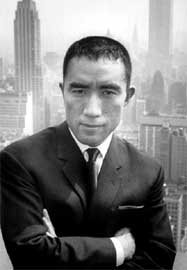
Profile: Yukio Mishima

It’s hard to discuss mercurial writer, playwright Yukio Mishima (January 14, 1925 -— November 25, 1970) without the spectre of his demise casting a pall on the dialogue.

From Wikipedia (edited for conciseness):

On November 25, 1970, Mishima and four cohorts visited the commandant of the Ichigaya Camp – the Tokyo headquarters of the Eastern Command of Japan’s Self-Defense Forces. Once inside, they proceeded to barricade the office and tied the commandant to his chair. With a prepared manifesto and banner listing their demands, Mishima stepped onto the balcony to address the gathered soldiers below. His speech was intended to inspire them to stage a coup d’etat and restore the Emperor to his rightful place. He succeeded only in irritating them and was mocked and jeered. As he was unable to make himself heard, he finished his planned speech after only a few minutes. He stepped back into the commandant’s office and committed seppuku (ritual suicide).

Now that’s an exit.

The full story on Mishima is complex and troubling: a sheltered child raised by a temperamental and artistocratic grandmother (who came from a samurai bloodline), only to return at the age of 12 to his parents. His father was a strict disciplinarian and it is suggested that his relationship with his mother bordered on incestuous.

Writing in secret (so that his father wouldn’t find out), Mishima’s stories focused on recurring themes of death, obsession, dishonour, and the consequences of unexamined emotions.

Mishima was gay, yet paradoxically (considering the society he inhabited) became obsessed with martial arts and militaristic self-discipline.

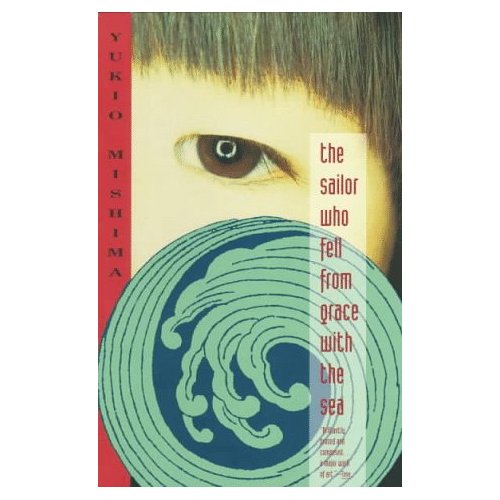
Of his more popular works is The Sailor Who Fell From Grace With The Sea.The novel takes place in post-WWII Japan and concerns the blooming love between a sailor on-leave and a wealthy industrialist whose son is part of a devilishly manipulative cabal of disaffected local children.

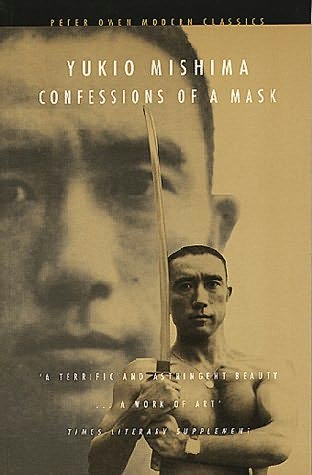
His critically-praised work includes the semi-autobiographical Confessions of a Mask and the fiction tetralogy Sea of Fertility. Mishima submitted the final draft of the fourth novel in the series, The Decay of the Angel, to his publisher on the same fateful day he and his colleagues would drive to the military school.

Having read a selection of his work (Confessions, Sailor, and the short story collection Acts of Wisdom), it’s clear that Mishima was an individual tortured by his own demons. One may argue he was born into a society which could never support his dynamic shape. His narrative style is poetic and sensual, though often critical of society and soaked with the tragedy of characters misdirected by love and self-discipline. Beautiful though they are, Mishima’s stories are often dark and painful. It’s for this reason I would be lying if I said I read his work regularly – though I wouldn’t hesitate to describe them as rewarding (if not seminal) works for the fiction reader.

If you’re curious about Yukio Mishima – and while I would not call it a definitive example – you may want to check out Mishima: A Life in Four Chapters, a film by Paul Schrader (who wrote Taxi Driver). It blends the story of his untimely death with lusciously visual renderings of some of his short stories.

Share

To want to be alive

You have to lose
You have to learn how to die
if you want to want to be alive
– Wilco, “War on War

I had this song going through my head all weekend, the last weekend of my vacation (and sorry for the lack of updates recently). It’s probably one of the best songs I’ve heard in such a very long time. Like Guided By Voices’ “Game of Pricks” and Roxy Music’s “Mother of Pearl“, it’s one of those tracks that I have to listen to again and again and again because somewhere in it is a phenomenal beauty that is as elusive as it is sublime.

It’s uplifting but with a hurt core – the capitulation that “you have to learn how to die if you […] want to be alive”. I’ve been coming to terms with this theme over the last while, admittedly transposing it onto something it probably was never intended to be 1.

After four-and-a-half years, I gave notice today that I was leaving my full-time job. Steady pay, benefits, desk – gone, so that I can work as a freelancer.

Without going into sordid detail, I felt the need/want/desire to leave, but for the longest time I was paralyzed with fear about going freelance. This in spite of the fact I often came home despondant…that it was harder to write/revise my fiction when the best chunk of the day was spent in a chaotic environment…that with every passing week I felt I was missing out on a different yet possible life.

I don’t believe there is any more effective way to conquer a fear than doing so knowing that failure is also a possibility. You have to float on a raft to get over your fear of water. The chance of failure must be present, otherwise all you can achieve is a virtual success – in which case you might as well play a video game simulation of it rather than tackle the real thing. Playing blackjack against a computer will allow you to learn about the rules of blackjack (and probability mathematics) – it will not prepare you at all for a table full of experienced players in Vegas staring at you like a idiot because you’ve never had to deal with intimidation.

In other words, you must be prepared for the chance that, no, things may not go well. That is, after all, the way life works: at the dawn of time mankind signed no such contract which promised we would die unbruised. So, if an amount failure is inevitable (whether it be due to chance or fault) the best you can do is inform yourself as much as possible before taking any big leaps. The rest is going to happen whether you intended it to happen or not.

I needed more flexibility in my life. More freedom to do what I want without collaborating with a single entity that could never realistically put my needs before its own. Now the responsibility is mine: I can’t blame anyone anymore if things don’t pan out. However, I can tell you, in facing the unknown there is something very, very liberating.

1. I think it’s wrong for there to be a finite explanation of what any song “means”, however I also feel protective of songs whose themes are misconstrued/manipulated by others.

Share

Hey – thanks.

Hello all,

I’ve passed the 50-post mark without much fanfare (I’m saving it for the 100th), and I don’t see Imaginary Magnitude hitting the 10,000 visitor-mark for another couple of months – however I thought I’d just say hello and thanks to all the people who pass-through, whether via BlogMad, StumbleUpon, or any of the myriad ways people find their way here.

This site gets visitors from across the globe – here’s the latest 100-visitor sample:

Sure, a little Ameri-centric, but every visitor counts.

What surprises/impresses me in particular is the number of people who spend more than an hour actually reading the articles I write (either that or staring at the pretty photos…or maybe they just fell asleep and didn’t log-off). From the same sampling, here’s the breakdown:

That’s 17.7% of people spending over an hour here.

On this note, if anyone has any suggestions, please let me know. More photos? More essays? More article/book reviews? Less? Go home? Your blog sucks? Let me know.

Share