

My "I Hate Award Shows" Article is up!

Brief Reviews: The Town vs. Animal Kingdom
When Ben Affleck’s The Town came out, many praised it as a powerful crime drama/action film. And yet, the shine seems to have come off of that project, probably as a result of people chasing the hype and actually watching it.
First, let’s discuss its poster. In recent years, I’ve become sensitive to bad marketing. A good example of this is the film Forgetting Sarah Marshall: the ad campaign (in Toronto at least) consisted of anonymous black and white bus and streetcar ads, with hand-scrawled “I HATE YOU SARAH MARSHALL!” (and the like) written on them*. In short, the campaign was cheap-looking, lame, and soured any potential expectation I had for the film – it wasn’t until much later, at my wife’s urging, that I caught it on DVD and found it to be one of the highlights of the year.

Similarly, the poster for The Town (displayed here) is a marketing mystery to me: it looks like a horror movie. It’s directed by and stars Ben Affleck, yet the poster is covered in evil nuns with automatic weapons. In short, I don’t get it: sure, it’s a “serious movie” but what were they thinking? Was it reverse psychology? Who knows. If it were me, it would be a close-up photo of John Hamm licking Ben Affleck’s unshaven face, with the caption: “Holy shit! It’s the guy from MadMen with Ben Affleck! And they shoot weapons!”
Then there’s the film itself. Technically, it’s very impressive. Affleck’s direction is solid. The performances are gritty and engaging. It’s free of stunt-casting. Camerawork, editing, sound: great. But when the credits rolled, I realized what was wrong. The story’s been done a hundred fucking times before – twice by Michael Mann. So, for me, there was nothing being risked as a viewer because, having watched more than one crime drama in my life, there were no surprises in the script. Believe me when I say that I wanted this film to be as good as it promised – and, in fact, it is good. Just not as good as it clearly could’ve been when you take into account all that it has going for it.
So what did I want The Town to be? I wasn’t sure…until I saw the Australian crime drama Animal Kingdom on DVD. It has all the grit, tension, and complexity of The Town, with less overt style and more substance, and no actors recognizable to most North American audiences (outside of Memento‘s Guy Pearce). Its poster? Have a look:
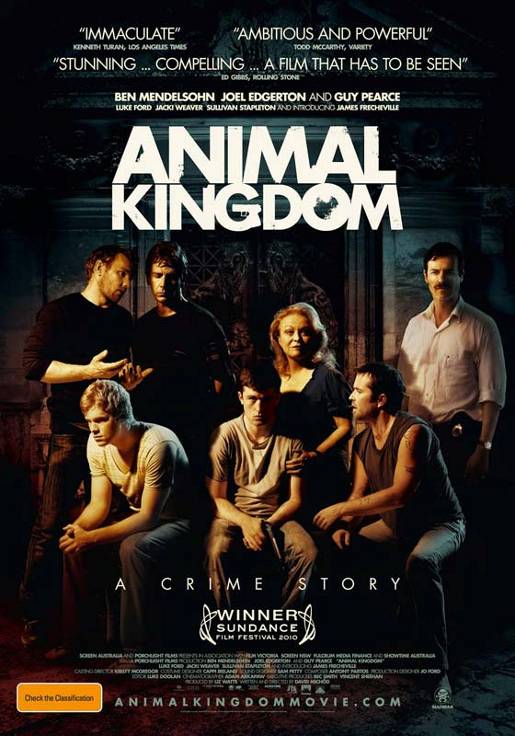
It reminds me of a Jeff Wall photograph. And in the middle of it all is the crafty look on the face of actor Jacki Weaver (nominated for Best Supporting Actress at the 2011 Oscars).
Animal Kingdom is a film fluent in the crime drama language – it even shares some of the tropes of The Town (the nervous druggie robber, the dutiful police detective) yet never once feels as if you are watching a re-treaded story. It is unpredictable and the performances are naturalistic and subtle.Its lack of artifice keeps us watching, whereas with The Town, each successive car chase weighed it down with Hollywood cliché. Where one carries broader tension, the other is quietly disturbing and takes a more nihilistic view of the cops and robbers game.
The good news is that both are available for your perusal on DVD, and both are extremely watchable. Neither, ultimately, will disappoint: it depends on where your expectations are set. I feel that Animal Kingdom is the film The Town wanted to be.
* I admit I’m particularly sensitive to ads which don’t make it clear that they are ads, especially if they look like actual public messages of hatred.
Movies & A Book: Some of The Best Things I’ve Witnessed in 2010
Here’s the best of what I’ve seen this year. I haven’t seen everything. You may disagree with what I have seen. This is life.
FILM:
Inception
Go ahead. Try. Try disagreeing that this is one of the most technically (and perhaps conceptually) elaborate mainstream Hollywood productions released in years which also happens to work as a “movie” that a wide variety of audiences would enjoy watching.
There has been a backlash against Inception. I don’t know how or why this is – perhaps it was over-sold as a deep “puzzle-solver” film, which it is not. And yes, the NYT’s A.O. Scott has a point in his comment that the film’s literal depiction of dreams are lacking psychological heft (outside of Marion Cotillard’s performance as DiCaprio’s wife). In any case, something has caused a revolt against this film and I say this revolt is missing the point.
Inception is, generally speaking, the most watchable, the most fascinating film of 2010. You are allowed to hate it.
A Prophet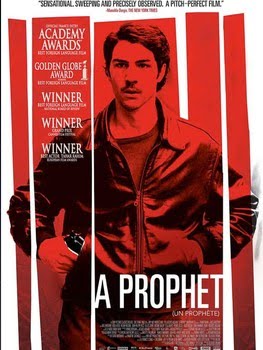
I am a huge fan of Jacques Audiard, a French director who has always rewarded the viewer with films (Read My Lips, The Beat My Heart Skipped) that balance passion with style. With A Prophet, Audiard expands his canvas, creating a gritty, novelistic masterpiece on-par with The Godfather (yes). The story concerns a young incarcerated Muslim who slowly rebuilds himself from within the treachery of prison life, rising from under the thumb of a vicious mob leader to become his own person and create his own empire. Epic, patient, and in places extremely violent. People will be referring to this film for years to come even if it has not really made a mark in North America. Again, a masterpiece.

The Eclipse
I realize this Irish film was released in 2009, but it didn’t get here until now. A compelling ghost story which eschews the two-dimensionality of ghost story films. It was around the twenty-minute mark that I realized it was a film which was going to confound my expectations (expectations based upon years and hundreds of similar plot lines): it wasn’t going to squander what it was and fall prey to hackneyed cliché. A gorgeous, touching, ultimately humanistic film with a stand-out performance by Ciarán Hinds as a grieving father of two children who must swallow his pride to escort a loud-mouthed Aidan Quinn through the motions of a book tour of the small coastal city of Cobh, in County Cork. A sublime achievement by director Conor McPherson.
Notable: Winter’s Bone – see it. It’s on DVD now. Like A Simple Plan, it’s a self-contained “rural thriller” (ugh) with a chilling undertone of barren hopelessness. Unlike A Simple Plan, it’s uncomplicated which is what gives it more of an honest strength. Exit Through The Gift Shop is the perhaps best film made about art and the art world that I have seen – like Inception, it’s not trying to be deep, just smart. Scott Pilgrim vs. The World blew me away because I expected it to be weak (perhaps because all the publicity photos inexplicably used a static image of Michael Cera standing against a fucking wall…imagine if you will, trying to sell Star Wars with a picture of Mark Hamill sitting cross-legged in the desert – sounds awesome, eh?). Not only was it not weak, it was the strangest case of “I don’t know why I love this movie but I really do”. Painstakingly, sublimely Toronto-centric (which, unlike the inexplicable promo photos of Michael Cera, shouldn’t be factored into explaining why it didn’t fare well at the box office) and wildly imaginative – those two things have never met before…oh but wait, I forgot the perfect companion piece: Kick Ass – also shot in TO, and also exceedingly expectation-defying (although the climax is kinda drawn-out). As far as performances go, Jesse Eisenberg (The Social Network) and Colin Firth (The King’s Speech) stand out, along with Winter’s Bone‘s Jennifer Lawrence, and Hailee Steinfeld for True Grit (who, at 14-years, shows huge promise as an actor).
BOOK:
I would have said “BOOKS”, but due to work and school I haven’t read anything published this year (that I can remember), with the exception of John Vaillant’s The Tiger. Lucky for me, since it is without doubt one of the best non-fiction titles I’ve read in years.
The Tiger is a meaty real-life tale of vengeance by the titular beast, in the winter hinterland of the Russian Far East (which the author calls, paradoxically, “the boreal forest”). Vaillant describes an environment historically, politically, and biologically unique, inhabited by hardened outcasts. The shadow of a predator male tiger, known never before to attack without cause, creates a wave of dread throughout the land, with only a small band of volunteers to figure out the mystery. Vaillant provides wave after wave of fascinating detail – examples of how man and beast have evolved throughout time, how human and animal behaviour have worked in similar paths – that by the end of the book you feel as if you should have a credit in Ethology. This is truly a page-turner and I cannot recommend it enough.
The Skinny on Stereoscopic Films, or, What’s Up With 3D?
This is one of those moments where I find myself on the inside of a phenomena which (increasingly) arouses strong opinions from members of the public. In this case, stereoscopic filmmaking – or 3D, for short (even though it’s not really 3D and tramples on a term which is used in animation for both stereoscopic and non-stereoscopic work).
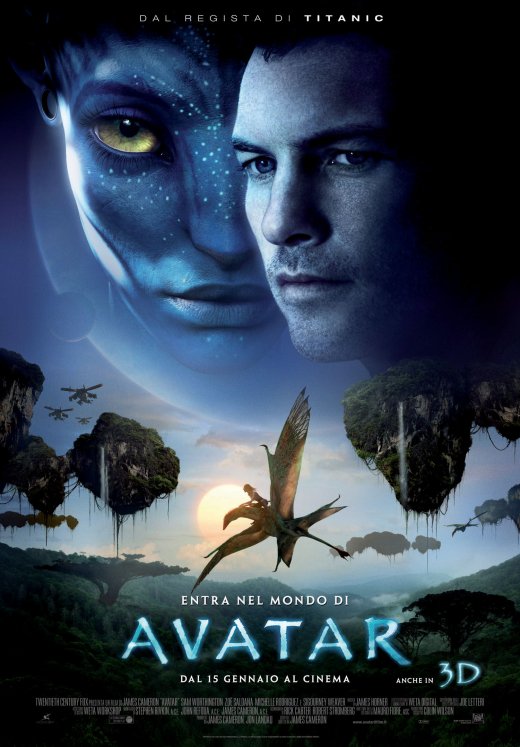
I’m currently working on a 3D film in an age (or, more precisely, over the course of a year, starting with James Cameron’s Avatar) where 3D technology is being pushed as the next in-thing. And yet there are many detractors, some of whom have some good ammunition for their opinions.
As someone who has been intimately involved with a 3D production, from beginning to end (well, almost – we’ll be in theatres in October) I find myself more and more a spokesperson for the technology, if not for the studios who currently are trying to cram every release into a 3D format, whether or not they were meant to be that way.
Let me begin by saying that I enjoy the notoriety of being the resident expert on 3D technology at parties and barbecues whenever the subject arises. Now that I have that out of the way, allow me to bitch…
Everyone keeps asking me: is 3D here to stay? The answer is a conditional “yes”. The condition being that film studios understand two things: First, that you can’t take a 2D movie and make it 3D using brain-dead rotoscoping software and expect it to be a success; second, that you can’t continue charging more for 3D films and not deliver a product that is both a good example of 3D and a relatively good film to boot.
To elaborate:
1) Since the release of Avatar, there seem to be just as many films released in theatres boasting 3D which were never shot in 3D, nor even envisioned in 3D prior to production. Some examples would be Tim Burton’s Alice in Wonderland and M. Night Shyamalan’s The Last Airbender. These films were taken by the studios after completion and put through a 2D-to-3D conversion process, using software to rotoscope the 3D effect, frame-by-frame, a process unsupervised by the director.
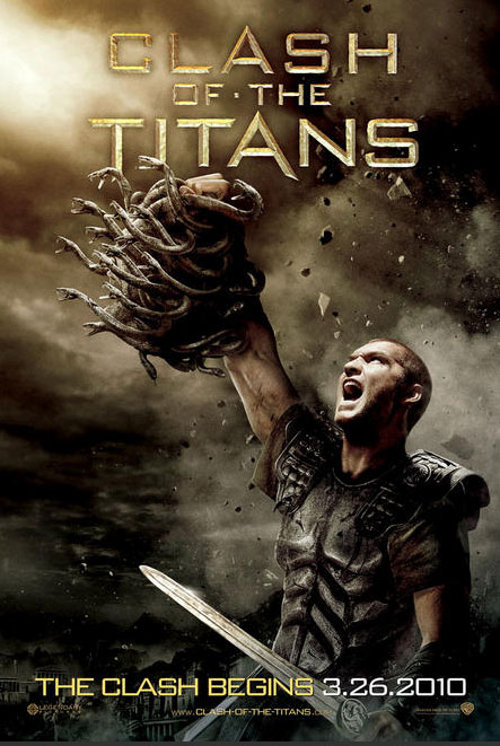
This process, while handy for converting short bits from 2D to 3D for films which originate in 3D, ignores a very large consideration for those producers and filmmakers who shoot in 3D from the outset: you have to plan to shoot in 3D from the start. You cannot take a script or a shot list for a 2D film and superimpose it onto a 3D film: your set design, your camera lenses, your blocking, your picture editing…so many things change as a result of switching from 2D to 3D. When you simply take a 2D show and auto-render it in faked-out 3D you get something which most viewers – critics and plebes alike – will say isn’t necessary. At worst, you get Clash Of The Titans – the current poster child for anyone with an axe to grind about 3D in general and post-converted 3D specifically. Not only was it a weak remake of the original (from what I hear), but the 3D post-conversion was done in two weeks. Two weeks. From what I hear, the subsequent “3D” is ridiculous to view.
2) Considering that theatres charge a premium for 3D films (about $3 more than usual depending upon where you go – sometimes more), when a poorly rendered post-converted 3D film is released it damages the viability of an already vulnerable new technology. It’s one thing if a film is bad, but when it’s bad in two dimensions, bad in a crappily-rendered pseudo-third dimension, followed by the sucker punch of having to pay MORE to see it…you get my point. I hope. Movie audiences can be forgiving, but there comes a point of revolt which I can see happening if there aren’t enough 3D films released which originate on 3D. Furthermore, the studios do no service to themselves if they don’t make a point of clarifying this to audiences: why can’t they say when a film is originally shot in 3D? Isn’t that a selling point? Likewise, why not be honest and say when a film has been post-converted? If it’s a case that no one wants it to be known that their film was post-converted…then why post-convert to 3D in the first place? There’s certainly no audience I know that is clamouring for blocky cut-out shapes which look like they were poorly separated from the background using Photoshop. To summarize this point, content is king: the quality of content, not the volume of illegitimate content.
Up until Avatar (and god knows how I long for the day when another film takes its place as the “gold standard”), the greatest accomplishment in 3D technology was the few seconds of the guy in House of Wax, standing outside a theatre with a ping-pong mallet, knocking the ball directly toward the camera. You could imagine people ducking for cover at the time. That was 1953. From that point onward, 3D technology didn’t change, largely due to the format never winning over audiences: the films were oft-times gimmicky and there were never enough 3D films at any given time to make it feel as if the aesthetic was going anywhere. With the recent advent of digital cinematography, 3D is much easier (logistically and technically) to achieve. And while I would love someone to make “art” (are you reading this, Wong Kar Wai?), I’m happy if, for the time being, the format stakes its territory in the ghetto where its strengths have always been: action/sci-fi/fantasy – hey, if it works, why not? I don’t hear anyone clamouring for a 3D Terms of Endearment…
Technicians and filmmakers are doing their part: they are taking a risk and trying to push forward innovatively with something daunting and new. Is 3D here to stay? Again, a conditional “yes”. What we need are studios and theatre chains to be honest with the audience and not do irreparable damage to the very thing they are hoping to profit from.
Why You Should See "SUCK" (And Why It Shouldn’t Have To Be On DVD)
In 2008/9, I worked on the indie feature, SUCK. It’s a rock-and-roll vampire road-movie comedy directed by Toronto’s Rob Stefaniuk and produced by Capri Films’ Robin Crumley. For a low-budget feature (and I realize that’s not the best way to preface a compliment) SUCK is well-written, well-cast, funny, and in places very funny.
However, despite being well received at both the Toronto International and South-By-Southwest Film Festivals, it was denied any interest in a theatrical release by Canadian distributors. The longer I waited for someone to pick it up, the more I wondered what the problem was. Sure, you could argue that vampire films have saturated the market lately, but that’s seeing things from the late-summer of 2010 (SUCK was completed over a year ago). It was a no-brainer, even for a limited release: who wouldn’t like a rock vampire comedy w/ cameos by Iggy Pop, Alice Cooper, and Alex Lifeson (among others)? It’s the sort of smart-but-not-overly-self-conscious effort which seems perfectly balanced for a theatrical audience.
Nothing happened. Well, actually, less-than-nothing happened: a lot of crap was released in Canadian theatres instead. Crap like the widely-released and quickly forgotten Gunless, which begged the question: if nobody is interested in seeing Westerns in theatres, what could possibly have been the selling point of a comedy-romance-Western with (as you might have guessed) no gunfighting? The answer is that it doesn’t matter: this is Canada, and film distributors prefer to release crap like Gunless and GravyTrain than anything which could hold an audience’s sustained interest. Evidently, the point of film distribution in Canada is to go through the motions.
Well, it’s too late for Canada. While SUCK secured a limited theatrical distribution in the U.S., it’s out on DVD here (the US DVD release is September 28th). This means it will only be screened here through niche film festivals. While that’s not a bad thing, it pisses me off that a funny, well-produced film (rare creature that is) should be all but abandoned after a successful festival run. This situation is certainly not helped by SUCK‘s (pardon the pun) anemic website: it makes no mention of any upcoming film screenings, DVD release dates, or even contact information. Who the hell is the site for? This is what happens when you don’t have a distributor to help with publicity. Not even the local indie journals can help: NOW Magazine completely omits any mention of it, as a film or DVD release. How’s that for hometown support? Thankfully, The Toronto Star’s Peter Howell is the only mainstream film critic to put the DVD release of SUCK on public record (in glowing terms no less…and slagging Gunless ).
I want people to see this film. Not because I worked on it, not because I want to punish producers who keep banking on dead-brained populist Paul Gross vehicles, but because this is a worthy film. It’s not Sophie’s Choice, it’s not going to change your life. But you’ll laugh. I just wish it had been allowed the opportunity of a theatrical run, which it so clearly deserved. It works better in a theatre than on DVD: with a pumped-up audience rather than in the controlled confines of your livingroom. That said, I will be pleased if, by my writing about it, one more person will see this movie than if I hadn’t.
Ryeberg Article is Up!
Hello all,
As previously mentioned, my first “curated video” essay for Ryeberg is now online. Enjoy.

Impetus
Since the beginning of 2010 (I still can’t adjust to typing that without staring out the window to see if there are flying cars in the sky) I’ve felt change is imminent for me. Whereas last year seemed to be a boat load of life coming straight at me, the inverse seems to be conjuring its way into this year – I feel more connected to surroundings, and better able to manipulate (if I may use the word manipulate in the best possible way) the outside world, the not I (to quote Krishnamurti).
This is not to say that I’ve got all of the problems with life, the world, or myself sorted out (ha!), but rather I feel a greater impetus to direct energy outward to affect change; to raise my own hurdles rather than wait for life to throw me hers.
I just don’t know the details of how this energy will manifest yet – I’m listening intently. Perhaps small steps: publishing my short fiction to this here blog, and/or showcasing others’? Alternately, putting a cap in this blog entirely and moving on to something different. Shifting to work more with my own media rather than with others’. Sparks. You see: the light of change. Inarticulate still, but pulsing with activity, from the inside out.
quote
“Celebrities are not superlatives in our field of expertise. If celebrities that are schnoring in on our field started out trying to do what we do and were held to the standards we started out upholding, a great many of them would’ve never made it.”
– Billy West, voice actor (“Futurama”) on the use
of celebrity voice work in animated films.
For *’s Sake
It’s been one of those battle-cries of mine the last while. Everything in the world, culturally-speaking (and I don’t necessarily mean high culture) seems to be evaporating into mindless bullshit.
The AV Club – a site I admittedly have a love/hate relationship with already – just posted an interview with actor Paul Giamatti. In the opening summary, the interviewer describes the plot of his latest film, which reads like a counterscript of 1999’s Being John Malkovich and yet there is no mention of this parallel anywhere in the article, something even Entertainment Tonight would do. The interviewer talks about this upcoming film with Giamatti as if it and his role – the John Malkovich role, if it were Being John Malkovich – were just soulless objects to be discussed out of necessity. In other words, it’s just like any other media-junket interview, like something you would read in InStyle or Chatelaine. Not that those examples are b-a-d, but when you pride yourself as better, especially savvy, tongue-in-cheek better, you shouldn’t even be in the same postal code as InStyle or Chatelaine if you want to retain your reputation.
The Motley Fool – again, a site previously known for being savvy, even though they deal with the stock market – now reads like Ain’t It Cool News, complete with arguments which, under rational analysis, seem completely idiotic and antithetical to what one would assume is their mission statement (ie. being different than the rest of those brain-dead-and-short-sighted Money sites).
Oh, and CNN. Not that they’ve ever been more relevant than a Reuters news ticker, but they’ve gone from mediocre to stupid by allowing one of their show hosts, Lou Dobbs, to continuously question the origin of Barack Obama’s citizenship, a paranoid suspicion virulent in the libertarian/right-wing fringe of the U.S. that has been repeatedly disproved (read: he doesn’t want Johnny Foreigner running and ruining the most-possibly-greatest-country-ever-in-the-world).
Now, one of the arguments I can imagine hearing is: well, Matt, in a 24-hour newsday (whether on TV or the Internet) when people expect constant information there inevitably has to be weaker material. To which I say: I understand, but I’d settle for less information over less hours (if need be), if it means the information will be consistent and better. After all, you are what you eat, and in this day and age we feed on media in an astonishingly unconscious and voracious manner.